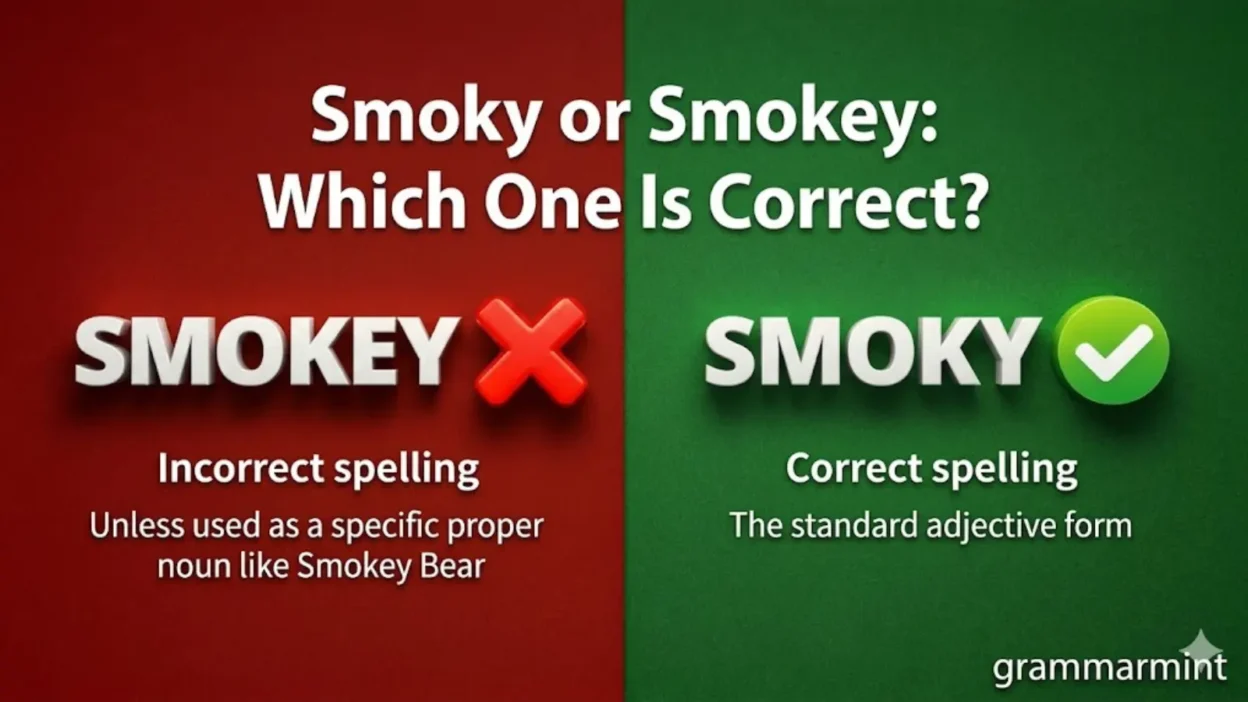
Smoky is the standard choice when you mean filled with smoke, smelling like smoke, tasting like smoke, or looking like smoke.
Smokey is usually a name or a special spelling, as in Smokey Bear. It can also appear as a less common spelling of the adjective and as a rare American slang noun, but it is not the best choice for normal descriptive writing.
So, for most sentences, write smoky.
Quick Answer
Use smoky when describing air, food, color, makeup, a voice, or anything related to smoke.
Use Smokey when it is part of a name, nickname, title, or brand-style spelling.
Correct: Smokey Bear reminds campers to prevent wildfires.
Correct: Smokey Robinson is a famous singer.
In everyday US writing, smokey flavor, smokey room, and smokey smell may be understood, but smoky looks cleaner and more standard.
Why People Confuse Them
People confuse Smoky and Smokey because the base word smoke has an e. It feels natural to keep that e when adding y, but the usual standard spelling is smoky.
Another reason is name recognition. Many Americans know Smokey Bear, and that famous name makes Smokey look familiar. Familiar does not always mean best for ordinary description.
The confusion also shows up in food writing and makeup writing. People write smokey BBQ, smokey eye, or smokey scent because the spelling looks stylish. Still, standard edited English prefers smoky BBQ, smoky eye, and smoky scent.
Key Differences At A Glance
| Context | Best Choice | Why |
|---|---|---|
| Describing smoke in the air | smoky | It is the standard adjective. |
| Describing food flavor | smoky | It means smoke-like in taste or smell. |
| Describing makeup | smoky | “Smoky eye” is the standard descriptive form. |
| Describing a low, husky voice | smoky | It can describe a deep, throaty quality. |
| Referring to Smokey Bear | Smokey | It is part of the official name. |
| Referring to a person’s name or nickname | Smokey | Proper names keep their chosen spelling. |
| Using old or rare slang for a state trooper | Smokey or smokey | It can work as a slang noun, though it is informal. |
| Formal, school, work, or news writing | smoky | It is the safer standard spelling. |
Meaning and Usage Difference
Smoky is an adjective. It describes something connected to smoke.
A smoky room has smoke in the air. Foods with a smoky flavor taste or smell like smoke. Smoky gray describes a soft, dark, or hazy color that resembles smoke. A smoky voice often sounds low, husky, or throaty.
Smokey is different in normal use. It is most often a proper name, nickname, title spelling, or brand-style spelling. When people see Smokey with a capital S, they usually expect a name, not a description.
There is one important nuance: smokey is recorded as a less common adjective variant. That means it is not nonsense. But in modern US writing, using smokey as a regular adjective can still look like a spelling mistake to many readers.
Tone, Context, and Formality
Smoky sounds standard, polished, and natural. It fits formal and casual writing.
Use it in school assignments, work emails, recipes, menus, product descriptions, travel writing, fire reports, and everyday messages.
Smokey sounds name-like or stylized. It fits when the spelling is fixed by a person, character, brand, title, or nickname.
| Feature | Smoky | Smokey |
| Main role | Standard adjective | Name, special spelling, or rare slang noun |
| Best for | Descriptions | Proper names and fixed titles |
| Formality | Neutral and polished | Informal or name-specific |
| Reader reaction | Looks correct | May look mistaken as an adjective |
| Example | smoky air | Smokey Bear |
Pronunciation does not usually help you choose. In everyday speech, smoky and smokey sound the same: SMOH-kee. The difference is mainly spelling and usage.
Which One Should You Use?
Use smoky for nearly every ordinary description.
Write smoky when you mean:
• smoky air
• smoky skies
• smoky flavor
• smoky ribs
• smoky scent
• smoky gray
• smoky eye
• smoky voice
• smoky bar
• smoky haze
Use Smokey when the spelling belongs to a name or title.
Write Smokey in:
• Smokey Bear
• Smokey Robinson
• Smokey and the Bandit
• a person’s nickname spelled Smokey
• a brand or product name that officially uses Smokey
When in doubt, ask one question: “Am I describing smoke, or am I naming something?”
If you are describing smoke, use smoky. If you are naming something, keep the official spelling.
When One Choice Sounds Wrong
Smokey sounds wrong when it is used as a regular adjective in careful writing.
Awkward: The apartment smelled smokey after dinner.
Better: The apartment smelled smoky after dinner.
Awkward: The chef added a smokey sauce.
Better: The chef added a smoky sauce.
Awkward: She blended a smokey eye.
Better: She blended a smoky eye.
But smoky sounds wrong when you change a proper name.
Wrong: Smoky Bear
Correct: Smokey Bear
Wrong: Smoky Robinson
Correct: Smokey Robinson
Proper names do not have to follow the spelling you would use for the common adjective.
Common Mistakes (and Quick Fixes)
Mistake: Writing smokey for taste.
Fix: Use smoky.
Better: The salsa had a smoky chipotle flavor.
Mistake: Writing smokey for air or weather.
Fix: Use smoky.
Better: The sky looked smoky after the wildfire smoke moved in.
Mistake: Writing smokey eye in polished beauty writing.
Fix: Use smoky eye.
Better: She used brown shadow for a soft smoky eye.
Mistake: Changing a name to match the adjective.
Fix: Keep the official spelling.
Better: Smokey Bear is spelled with ey.
Mistake: Treating Smokey and smoky as fully interchangeable.
Fix: Use smoky for descriptions and Smokey for names or fixed spellings.
Everyday Examples
The grill gave the vegetables a smoky flavor.
My jacket still smells smoky from the bonfire.
The old cabin had a smoky fireplace.
The sunset turned the sky a smoky orange.
She chose a smoky eye for the wedding.
His smoky voice worked well for late-night radio.
Smokey Bear is one reason people remember the ey spelling.
My uncle’s old dog was named Smokey.
The restaurant’s sign says “Smokey Joe’s,” so keep the spelling used in the name.
A character named Smokey should stay Smokey, even if the scene around him is smoky.
Dictionary-Style Word Details
Verb
• Smoky: Not commonly used as a verb in standard US English. Use smoke as the verb: The fire will smoke if the wood is wet.
• Smokey: Not commonly used as a verb in standard US English. It should not replace the verb smoke.
Noun
• Smoky: Not commonly used as a regular noun. It appears in proper names and place names, such as the Smoky Mountains, but it is mainly an adjective.
• Smokey: Common as a proper name or nickname. It can also be an informal American slang noun for a state highway patrol officer or a state police car, but that use is casual and limited.
Synonyms
• Smoky: Closest plain alternatives depend on meaning.
• Smokey: No true synonym fits when it is a proper name. For the slang noun, closest plain alternatives are state trooper, highway patrol officer, or patrol car.
Antonyms work only for some uses of smoky. For smoky air, possible opposites include clear, clean, or fresh. For Smokey as a name, there is no real antonym.
Example Sentences
Smokey:Smokey Bear is a famous wildfire-prevention character.
Smokey: Because of his gray fur, the puppy was named Smokey.
Smokey: In old highway slang, a patrol car might be called a smokey by drivers.
Word History
• Smoky: The word is built from smoke and is the long-established standard adjective. Its spelling without the e is the form readers expect in regular US English.
• Smokey: The ey spelling is well known in names, especially Smokey Bear. It also appears as a less common adjective variant and as informal American slang. That does not make it the best spelling for normal descriptions.
The safest history note is simple: smoky became the standard descriptive spelling, while Smokey stayed visible because of names, titles, and informal uses.
Phrases Containing
• Smoky: smoky flavor, smoky air, smoky room, smoky haze, smoky sky, smoky eye, smoky voice, smoky gray, smoky quartz, Smoky Mountains.
• Smokey: Smokey Bear, Smokey Robinson, Smokey and the Bandit, Smokey Joe, a dog named Smokey, a nickname spelled Smokey.
FAQs
1. Is “smokey” ever correct?
Yes, Smokey is correct only as a proper name, brand, or title (like Smokey Bear or Smokey Robinson). It can also appear as a rare American slang noun, but it is not standard for regular descriptions.
2. When should I use “smoky” instead of “smokey”?
Use smoky for anything describing smoke: air, flavor, smell, color, makeup, or voice. Example: The barbecue gave the sauce a smoky flavor.
3. Do “smoky” and “smokey” sound different when spoken?
No. Both are pronounced the same: SMOH-kee. The difference is purely in spelling and context.
4. Can I write “smokey eye” in a beauty article?
The standard spelling is smoky eye. Writing smokey eye may be understood, but it looks less polished in professional or formal writing.
5. Why do so many people write “smokey” when they mean smoky?
Many confuse it because the base word is smoke, and because Smokey Bear is well known. Familiarity with the name makes “smokey” look correct even when describing something ordinary.
6. Are there any antonyms for “smoky”?
Yes, depending on context: clear, fresh, or clean can be opposites of smoky air, haze, or room. No antonyms exist for Smokey as a proper name.
7. Can “smokey” be used as a noun?
Yes, but very rarely. It is informal American slang for a state trooper or patrol car. This usage is uncommon and casual.
Conclusion
Choose smoky when you are describing something related to smoke. It is the standard adjective for air, food, smell, color, makeup, and voice.
Choose Smokey when it is part of a name, nickname, title, or fixed brand spelling. It can also appear as a rare slang noun, but that is not the everyday use most writers need.