If you write for school, work, reviews, or everyday business copy, Premise or Premises can trip you up fast. The two words look almost the same, yet they point to different meanings: an assumption, an argument, a story setup, a property, a building, or a site. So, the right choice matters in emails, signs, leases, film blurbs, class papers, and office writing. This guide breaks down the difference in plain American English, explains the legal twist behind premises, shows where conclusion and contract language fit, and gives you practical examples you can copy with confidence.
Quick Answer
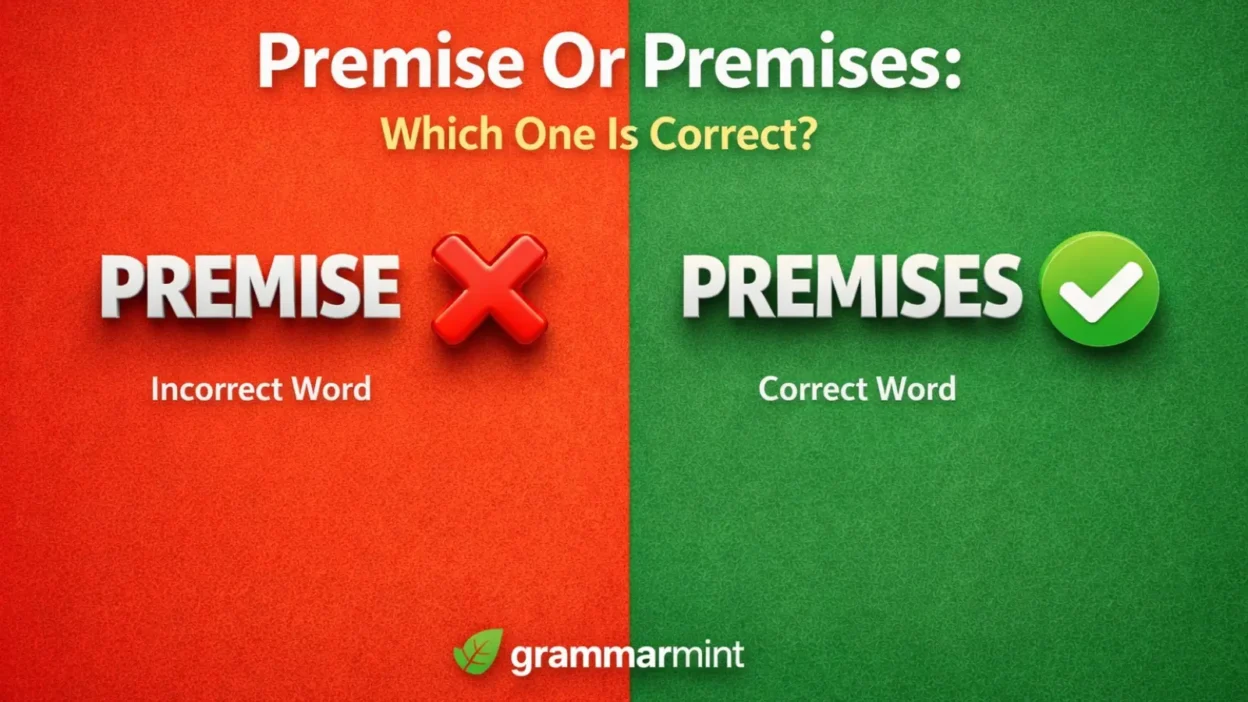
Premise or premises depends on meaning. Use premise for an idea, assumption, argument, or story setup. Use premises for land, a building, a business location, or multiple logical statements.
TL;DR
- Premise usually means an idea or setup.
- Premises usually means property or location.
- Two logical statements can be premises.
- One building may still be premises.
- “On the premises” is the standard phrase.
The Difference At A Glance
Start with meaning, not spelling. Once you know whether the sentence is about an idea or a place, the right choice becomes much easier.
- Context decides the right choice.
- Meaning changes with one final s.
- Word choice matters more than spelling here.
- premise points to an idea.
- premises points to a place.
- one assumption can be a premise.
- several assumptions become premises.
- a store can still be premises.
- a show can have a strong premise.
- a lease usually names the premises.
- logic and property use different senses.
- check the sentence before choosing.
What Premise Means
In everyday English, premise usually means a starting idea. However, the word also has a more technical logic sense.
- Assumption is a common near-match.
- Presupposition fits careful formal writing.
- Idea works in plain English.
- premise supports later reasoning.
- premise can start an argument.
- premise can guide a theory.
- premise can frame a discussion.
- premise can shape a claim.
- premise may later prove false.
- premise often follows based on.
- premise is singular in form.
- premise rarely means location.
What Premises Means
In property writing, premises means a place. So, you’ll often see it in rules, leases, notices, and security language.
- Property is the clearest plain substitute.
- Building works in many everyday cases.
- Site fits business and workplace writing.
- premises often means land plus structures.
- premises appears in notices and leases.
- premises often sounds formal.
- premises usually refers to a location.
- premises can mean one business address.
- premises often follows leave or enter.
- premises suits legal or security wording.
- premises does not mean story idea.
- premises is common on signs.
When Premises Is The Plural Of Premise
Here is the trap: premises can also be the plural of premise. Because of that, the same spelling can point either to ideas or to property.
- Plural form can cause the confusion.
- Propositions become plural as premises.
- Argument steps may include several premises.
- one premise, two premises.
- three supporting statements are premises.
- context shows which meaning applies.
- logic books use premises often.
- ordinary readers may misread the word.
- not every premises means property.
- count the statements in view.
- if ideas multiply, premise becomes premises.
- surrounding nouns solve the puzzle.
Premise In Logic And Argument
In logic, a premise supports a conclusion. So, this is the most technical and oldest classroom use many students meet.
- Conclusion depends on the supporting statements.
- Reasoning starts with accepted statements.
- Syllogism is the classic textbook example.
- premise supplies support for a claim.
- major and minor premises can appear.
- false premises weaken an argument.
- clear premises improve analysis.
- hidden premises can confuse readers.
- arguments may have one premise.
- arguments may have many premises.
- premise is technical in philosophy.
- conclusion is not the premise.
Premise In Stories, Books, And Film
Outside logic, premise is also common in entertainment writing. In other words, it can mean the basic setup behind a story.
- Storyline use is now very common.
- Plot setup is a helpful plain gloss.
- Hook captures the entertainment sense.
- premise can describe a movie concept.
- premise can summarize a novel fast.
- premise is not the full plot.
- premise gives the starting setup.
- premise may sound original or tired.
- reviews often judge the premise.
- pitches often open with premise.
- strong premise still needs execution.
- weak premise can limit interest.
Premises In Law
The property meaning of premises has a legal past. That history explains why the word still sounds formal and why it often appears in contracts.
- Deed language helps explain the history.
- Conveyance appears in older legal discussion.
- Property description links the legal sense.
- premises can mean the named real estate.
- lawyers use premises for the parcel.
- leases may define the premises precisely.
- contracts often describe the premises first.
- legal writing favors exact boundaries.
- this sense helped create the modern noun.
- law kept the plural form alive.
- property records often sound formal.
- everyday speech borrowed the legal sense.
Can One Building Still Be Premises?
Yes, and that surprises many writers. Even one shop, office, or house can still be called premises in the property sense.
- Single property is still called premises.
- Business location does not need many buildings.
- Usage tradition beats surface logic here.
- one office can be the premises.
- one shop can be the premises.
- one apartment complex can be premises.
- the word names the property unit.
- it does not count structures literally.
- that is why premise sounds wrong here.
- legal history explains the mismatch.
- signs keep this older pattern.
- many writers still find it surprising.
Is Premises Singular Or Plural?
This point is messy because the word looks plural. Even so, real usage sometimes treats it as one property and sometimes as a plural-form noun.
- Plural form and meaning do not always match.
- Verb agreement varies by style and sentence.
- Notional number matters more than shape.
- premises often takes a plural verb.
- some writers use a singular verb.
- legal and business copy prefer consistency.
- the premises are closed sounds natural.
- the premises is secure also appears.
- pick one pattern and stay consistent.
- many readers expect are.
- sentence rhythm often decides.
- clarity matters more than dogma.
On The Premises Meaning
This fixed phrase is very common in American writing. Usually, it means inside that building or on that property.
- Fixed phrase makes this usage easy to spot.
- Location phrase points to the site itself.
- Business wording often uses it on notices.
- on the premises means at that location.
- off the premises means away from it.
- made on the premises means made there.
- smoking on the premises means smoking there.
- staff on the premises are physically present.
- the article the is common here.
- the phrase sounds formal but familiar.
- property rules often use it.
- hotels and stores use it often.
On Premises Vs On-Premises
Now the phrasing gets more specific. As a result, grammar and style both affect what looks most natural.
- Compound modifier often takes a hyphen.
- Adjective form usually appears before a noun.
- Style choice depends on house rules.
- on-premises software is standard business wording.
- on premises can work after verbs.
- on premise is widely frowned on.
- keep hyphenation consistent in one piece.
- technical writing likes on-premises systems.
- labels often shorten the phrase.
- formal copy should avoid on premise.
- readers expect premises for place meaning.
- phrasing changes with grammar role.
Premise Vs Premiss
This side issue shows up less often, but it still matters. In general American writing, premise is the normal spelling.
- Premiss is the rarer spelling.
- British spelling shows up more often.
- Logic texts may still use it.
- American readers mostly see premise.
- modern general writing prefers premise.
- premiss does not mean property.
- premises is not the same as premiss.
- avoid mixing both spellings casually.
- choose one spelling per document.
- style guides often favor premise.
- casual readers may think premiss is a typo.
- use premiss only with purpose.
Common Mistakes To Avoid
Most errors happen because writers blend the idea sense with the property sense. So, a quick meaning check fixes almost everything.
- Wrong sense creates the biggest problem.
- Mixed meanings can derail a clear sentence.
- Context clues usually reveal the fix.
- wrong: the premise was searched.
- right: the premises were searched.
- wrong: the movie premises is weak.
- right: the movie premise is weak.
- wrong: one argument had two premise.
- right: one argument had two premises.
- wrong: on premise parking.
- better: parking on the premises.
- better: on-premises parking staff.
Example Sentences With Premise
These examples use the idea, argument, or story sense. Notice how none of them refers to a building or location.
- Idea sense is the target here.
- Argument sense appears in school writing.
- Story sense appears in reviews.
- The article starts from a risky premise.
- Her premise sounded simple but strong.
- The debate rests on a false premise.
- I reject the premise behind that policy.
- The novel has a clever premise.
- Its premise feels fresh and funny.
- The professor questioned my main premise.
- Their campaign premise never convinced voters.
- We began with the same premise.
Example Sentences With Premises
These examples use the property sense or the plural-of-ideas sense. In most everyday writing, readers will understand the property meaning first.
- Property sense is the focus here.
- Location sense fits notices and leases.
- Formal tone is common with this noun.
- Visitors must leave the premises now.
- No pets are allowed on the premises.
- Security checked the premises at dawn.
- The company moved to larger premises.
- Food is prepared on the premises.
- Police searched the premises carefully.
- Staff remained on the premises overnight.
- Cameras cover the full premises.
- The lease covers the premises and grounds.
Which One Should You Use?
When you’re deciding fast, reduce the sentence to its core meaning. Then the choice usually becomes obvious in seconds.
- Audience and purpose should guide you.
- Sentence meaning settles the choice fast.
- Final check prevents last-minute errors.
- use premise for ideas.
- use premises for places.
- use premises for multiple argument statements.
- use premise in movie summaries.
- use premises in signs and leases.
- avoid premise for a property.
- avoid on premise in careful prose.
- swap in place if unsure.
- swap in idea if unsure.
FAQs
What is the difference between premise and premises?
Premise usually means an idea, assumption, or story setup. Premises usually means property or a location, though it can also be the plural of premise in logic.
Is premises singular or plural?
It is plural in form, but usage can feel mixed because it often refers to one property. In careful writing, many people still prefer plural agreement, especially in formal or legal contexts.
What is the plural of premise?
The plural of premise is premises. That’s why the word can be confusing: premises may mean either multiple supporting statements or one property, depending on context.
Can premise mean property?
In careful modern usage, premise is not the standard word for property. When you mean land, a building, or a business location, premises is the safer choice.
What does premise mean in logic?
In logic, a premise is a statement that supports a conclusion. An argument can have one premise or several premises, depending on how the reasoning is built.
What does premise mean in a story?
In stories, films, and reviews, premise means the core setup or central idea. It tells readers what the story is built on, not every plot detail.
Conclusion
When you’re choosing Premise or Premises, let the sentence meaning do the work.
Idea, argument, or story setup points to premise; property, site, or building points to premises.
Run one quick meaning check, and the right form usually appears right away.