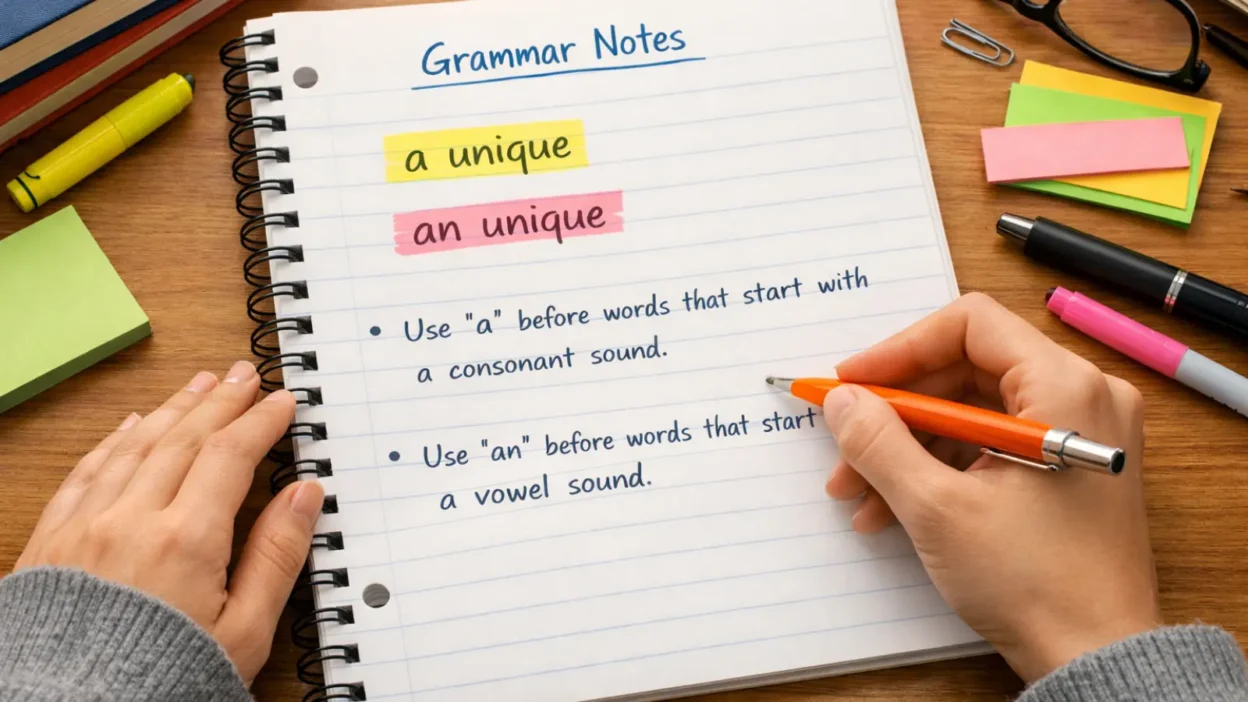
Many English learners pause when they reach the phrase “a unique.” Since unique begins with the vowel letter u, it may seem natural to write “an unique.” However, that choice is not correct in standard modern English.
The confusion comes from a common misunderstanding about the articles a and an. English does not choose between them simply by looking at the first letter of the next word. Instead, the choice depends on the first sound you hear when that word is pronounced.
The word unique begins with a /j/ sound, which is the same initial sound heard in you, yes, and yellow. Therefore, we say a unique, not an unique.
Getting this rule right helps your writing sound more natural and accurate. In addition, it can prevent common mistakes in school assignments, professional emails, tests, and everyday communication.
This guide explains which article to use, why pronunciation matters, how the rule works in American English, and how to avoid similar mistakes.
Quick Answer
The correct form is “a unique.”
Unique is pronounced approximately “yoo-NEEK” and begins with the consonant sound /j/, similar to the beginning of you. Because a is used before consonant sounds, a unique is correct.
By contrast, “an unique” is not standard in modern US English.
Correct:
It was a unique experience.
Incorrect:
It was an unique experience.
Key Differences at a Glance
| Feature | A Unique | An Unique |
|---|---|---|
| Based on pronunciation | Correct | Incorrect |
| Beginning sound | /j/ as in “you” | Incorrectly treats the “u” as a vowel sound |
| Standard US English | Yes | No |
| Formal writing | Correct | Generally incorrect |
| Everyday conversation | Natural | Unnatural |
| Recommended for learners | Yes | No |
Overall, the easiest way to remember the difference is to focus on sound rather than spelling.
Why “A Unique” Is Correct
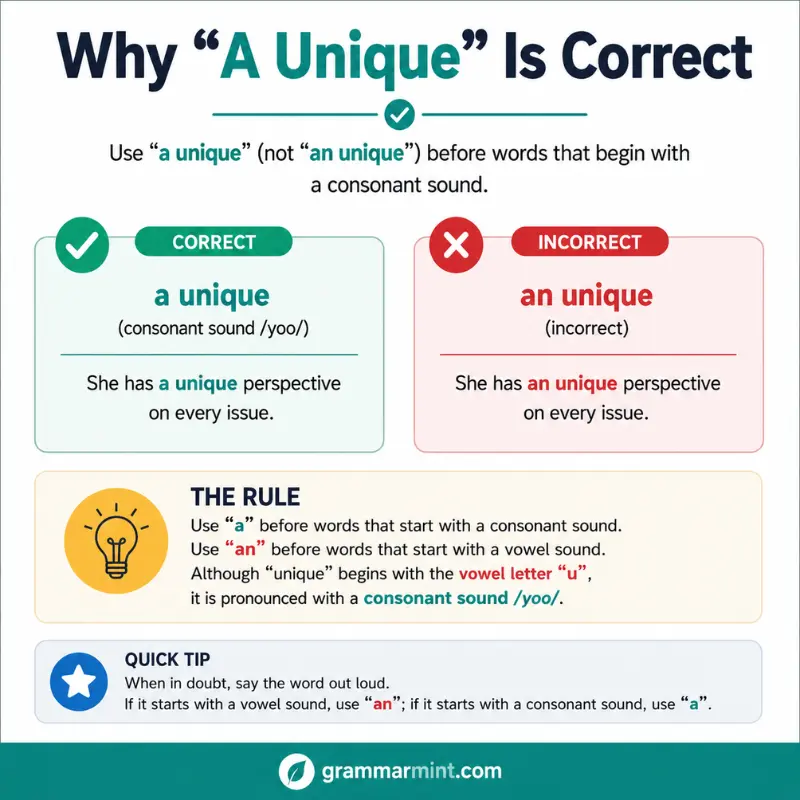
The articles a and an are called indefinite articles. They usually appear before singular countable nouns or before adjectives that describe those nouns.
For example:
- a book
- an apple
- a beautiful house
- an interesting story
Most importantly, the choice between a and an depends on the sound immediately following the article.
Use a before a consonant sound:
- a car
- a dog
- a teacher
- a useful tool
- a university
- a unique opportunity
On the other hand, use an before a vowel sound:
- an apple
- an orange
- an idea
- an hour
- an unusual situation
Although unique begins with the vowel letter u, its first sound is /j/. Since that is a consonant sound, a unique is the correct form.
Therefore:
a unique idea ✅
an unique idea ❌
How Is “Unique” Pronounced?
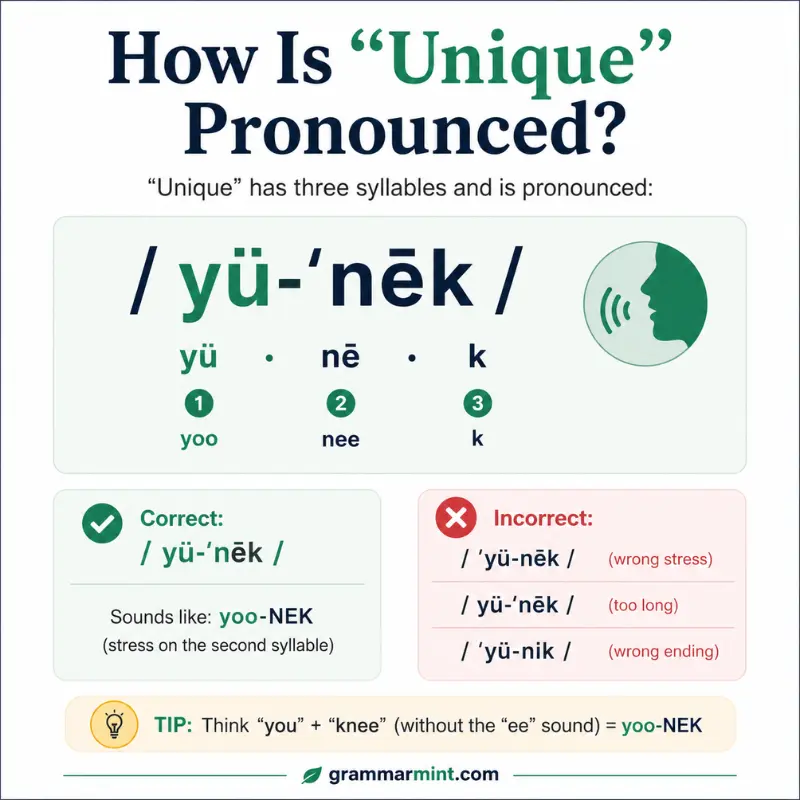
Unique is commonly pronounced:
/juːˈniːk/
A simple pronunciation guide is:
yoo-NEEK
Notice the “y” sound at the beginning. That initial /j/ sound is what determines the article.
For comparison, think about the word you. We would never say “an you.” Similarly, unique begins with the same type of sound.
As a result, the natural phrase is:
a unique
This pronunciation rule also explains why looking only at the letter u can be misleading.
Article Choice Depends on Sound, Not Spelling
One of the most important rules about a and an is that English follows pronunciation rather than the written letter.
Students are sometimes taught a simplified rule:
“Use a before consonants and an before vowels.”
However, that explanation can cause mistakes because it focuses too much on letters.
A more accurate rule is:
Use “a” before a consonant sound and “an” before a vowel sound.
For example, compare these words.
Words Beginning With U but Taking “A”
- a unique idea
- a university student
- a useful website
- a uniform
- a user
- a unit
- a unicorn
Each of these words begins with a sound similar to “yoo.” Therefore, they take a.
Words Beginning With Vowels and Taking “An”
- an apple
- an elephant
- an interesting book
- an orange
- an umbrella
In these examples, the words begin with true vowel sounds. Consequently, an is the correct article.
So, spelling alone does not decide which article is correct.
Why Do People Write “An Unique”?
The most common reason is the letter u.
Many learners remember that a, e, i, o, and u are vowels. As a result, they may automatically place an before every word beginning with one of those letters.
That approach works in many cases:
- an apple
- an egg
- an idea
- an orange
- an umbrella
Nevertheless, it does not work every time.
English includes words where a vowel letter begins with a consonant sound. Likewise, some words beginning with consonant letters actually start with vowel sounds when spoken.
Unique is a good example of the first situation. Its spelling begins with u, but its pronunciation begins with /j/.
Therefore:
a unique experience is correct.
“A Unique” in Everyday English
The phrase appears naturally in many types of communication.
In Conversation
“She has a unique sense of humor.”
“That restaurant has a unique atmosphere.”
“His way of explaining things is unique.”
In Text Messages
“That’s a unique idea!”
“I found a unique gift for her.”
“Your style is really unique.”
On Social Media
“Sharing a unique moment from our trip.”
“This place offers a unique view of the city.”
“What a unique design!”
At School
“The author uses a unique writing style.”
“Each student presented a unique solution.”
“The experiment produced a unique result.”
At Work
“We have a unique opportunity to expand.”
“She brings a unique perspective to the team.”
“Our company offers a unique service.”
In all of these situations, a unique is the natural standard form.
Formal Writing Examples
The same rule applies in academic, professional, and formal writing.
For instance:
The study provides a unique perspective on the issue.
Our company developed a unique approach to customer service.
Each participant faced a unique set of circumstances.
Researchers identified a unique pattern in the data.
This project presents a unique opportunity for collaboration.
In contrast, using an unique in these sentences would normally be considered an article error in modern edited English.
Common Mistakes and Quick Fixes
Mistake 1: Using “An” Because Unique Starts With U
Incorrect:
She has an unique skill.
Correct:
She has a unique skill.
Remember that the opening sound matters more than the first written letter.
Mistake 2: Saying “An Unique Opportunity”
Incorrect:
This is an unique opportunity.
Correct:
This is a unique opportunity.
Since the first sound in unique is /j/, a is required.
Mistake 3: Applying the Same Rule to Every U-Word
Not all words beginning with u use the same article.
For example:
a university
a uniform
a unique idea
However:
an umbrella
an uncle
an unusual idea
The difference comes from pronunciation. University, uniform, and unique begin with the /j/ sound, whereas umbrella, uncle, and unusual begin with vowel sounds.
Unique vs. Unusual: Why the Articles Are Different
This comparison is especially useful because both words start with the letter u.
We say:
a unique experience
but:
an unusual experience
Why?
Unique begins with:
/j/ — “yoo”
Meanwhile, unusual begins with a vowel sound.
Therefore, the correct phrases are:
- a unique idea
- an unusual idea
- a unique solution
- an unusual solution
- a unique situation
- an unusual situation
This comparison clearly shows why pronunciation matters more than spelling.
Similar Words That Use “A”
Several other words follow the same pattern as unique.
A University
Correct:
She attends a university in California.
Because university begins with a “yoo” sound, it takes a.
A Useful Tool
Correct:
This is a useful tool for students.
Once again, useful begins with the consonant sound /j/.
A User
Correct:
A user can change the settings.
Here, the first sound is also /j/, so a is correct.
A Uniform
Correct:
The student wore a uniform.
Similarly, uniform begins with a “y” sound.
A European Country
Correct:
France is a European country.
Although European begins with the vowel letter e, its pronunciation starts with a /j/ sound. Therefore, a European country is correct.
Together, these examples reinforce the main rule: listen to the sound.
Why “An Hour” Is Correct but “A Unique” Is Correct
The word hour demonstrates the opposite situation.
It begins with the consonant letter h. However, the h is silent.
As a result, hour sounds like:
our
Because the first pronounced sound is a vowel sound, we say:
an hour
Compare:
a unique opportunity
with:
an hour-long meeting
Clearly, the written first letter does not control the article. Instead, pronunciation determines whether a or an is required.
“A Unique” vs. “An Unique” in US and UK English
Modern American and British English generally follow the same pronunciation-based rule for unique.
The standard form is:
a unique
You may occasionally encounter an unique in older texts, historical material, or nonstandard writing. However, it is not the normal choice in present-day English.
Therefore, for schoolwork, professional communication, website content, academic writing, and everyday conversation, a unique is the safer and standard choice.
Does “Unique” Always Use “A”?
When the article appears directly before unique, use a.
For example:
a unique ideasomeone with a unique personalityan opportunity that is unique
However, the article can change when another word appears between the article and unique.
Consider this example:
an unusually unique design
Here, the article comes directly before unusually, not unique. Since unusually begins with a vowel sound, an is correct.
Compare:
a unique design
and:
an unusually unique design
This detail is important because the article is determined by the sound of the next word, not by a later word in the phrase.
Can You Say “Very Unique”?
You may sometimes hear phrases such as:
- very unique
- really unique
- extremely unique
Traditionally, unique can mean one of a kind. For that reason, some writers argue that something cannot logically be “more unique” or “very unique.”
In everyday English, however, people often use unique more broadly to mean highly unusual, distinctive, or remarkable.
For precise formal writing, you can instead choose expressions such as:
- truly unique
- distinctive
- highly unusual
- one of a kind
- unlike anything else
Nevertheless, this issue does not change the article rule. Whether unique means literally one of a kind or simply distinctive, a unique remains the correct form.
More Example Sentences With “A Unique”
Here are additional examples:
- She has a unique talent for solving difficult problems.
- This city has a unique history.
- We found a unique solution to the problem.
- Every child has a unique personality.
- He gave us a unique perspective on the topic.
- The building has a unique architectural style.
- They created a unique marketing campaign.
- It was a unique experience for the entire family.
- The artist developed a unique technique.
- Our team faces a unique challenge this year.
- She bought a unique piece of jewelry.
- This program provides a unique opportunity for students.
- Each fingerprint has a unique pattern.
- The restaurant offers a unique dining experience.
- His background gives him a unique advantage.
As these examples show, a unique works naturally across many different contexts.
A Simple Trick to Remember the Rule
Whenever you are unsure whether to use a or an, say the next word aloud.
Then ask yourself:
What sound do I hear first?
If you hear a consonant sound, use a. On the other hand, if you hear a vowel sound, use an.
For example:
Unique → “yoo-neek” → consonant /j/ → a unique
University → “yoo-ni-ver-si-ty” → consonant /j/ → a university
Hour → “our” → vowel sound → an hour
Umbrella → vowel sound → an umbrella
In most cases, this simple sound test makes the correct choice clear.
Quick Comparison Table
| Phrase | Correct? | Reason |
| a unique idea | ✅ | Begins with /j/ |
| an unique idea | ❌ | Does not match pronunciation |
| a university | ✅ | Begins with “yoo” |
| an university | ❌ | Begins with consonant /j/ |
| a useful tool | ✅ | Begins with “yoo” |
| an useful tool | ❌ | Wrong article for the sound |
| an unusual event | ✅ | Begins with a vowel sound |
| a unusual event | ❌ | Requires “an” |
| an hour | ✅ | H is silent |
| a hour | ❌ | Begins with a vowel sound |
When to Use Which
In everyday conversation, use a unique:
“That’s a unique idea.”
For school essays, the same form applies:
“The character has a unique role in the story.”
Likewise, professional emails should use a unique:
“We have a unique opportunity to collaborate.”
Academic writing follows the same rule:
“The findings reveal a unique pattern.”
Finally, social media captions naturally use a unique as well:
“What a unique experience!”
Therefore, whenever the article directly precedes unique, avoid an unique in standard modern English.
Frequently Asked Questions
Which Is Correct, “A Unique” or “An Unique”?
A unique is correct in standard modern English. Since unique begins with the consonant sound /j/, similar to the first sound in you, it takes a, not an.
Is It “A Unique Opportunity” or “An Unique Opportunity”?
The correct phrase is a unique opportunity.
For example:
This job offers a unique opportunity to develop new skills.
Why Do We Use “A” Before Unique?
We use a because unique begins with the consonant sound /j/. In other words, article choice depends on pronunciation rather than the first written letter.
Do We Choose “A” or “An” Based on Spelling?
No. Instead, choose the article according to the sound that follows it. That is why we say a university but an umbrella.
Can “An Unique” Ever Be Correct?
You may encounter an unique in historical or nonstandard writing. However, it is not the normal form in contemporary US English. For modern writing, use a unique.
What Are Other Words Like “Unique”?
Words such as university, useful, user, uniform, unit, unicorn, and European also begin with a /j/ sound. Therefore, they normally take a.
Is It “A Unique Experience” or “An Unique Experience”?
Use a unique experience.
For example:
Visiting the historic site was a unique experience.
Mini Quiz
Choose the correct article:
1. ___ unique advantage
Answer: a unique advantage
2. ___ hour of practice
Answer: an hour of practice
3. ___ university event
Answer: a university event
4. ___ unusual situation
Answer: an unusual situation
5. ___ useful guide
Answer: a useful guide
6. ___ unique opportunity
Answer: a unique opportunity
Overall, if you selected the answers by listening to the opening sound rather than looking only at the spelling, you applied the rule correctly.
Conclusion
In modern US English, a unique is the correct form when the article comes directly before unique.
Although the word begins with the vowel letter u, it is pronounced approximately “yoo-NEEK.” Therefore, its first sound is the consonant /j/, which requires a rather than an.
The most useful rule to remember is simple: choose a or an according to the sound of the next word, not merely its first letter.
For this reason, we say a unique idea, a university, and a useful tool. By contrast, we say an umbrella, an unusual event, and an hour.
Finally, if you are ever unsure, pronounce the phrase aloud. Listening to the first sound will usually help you choose the correct article quickly and confidently.