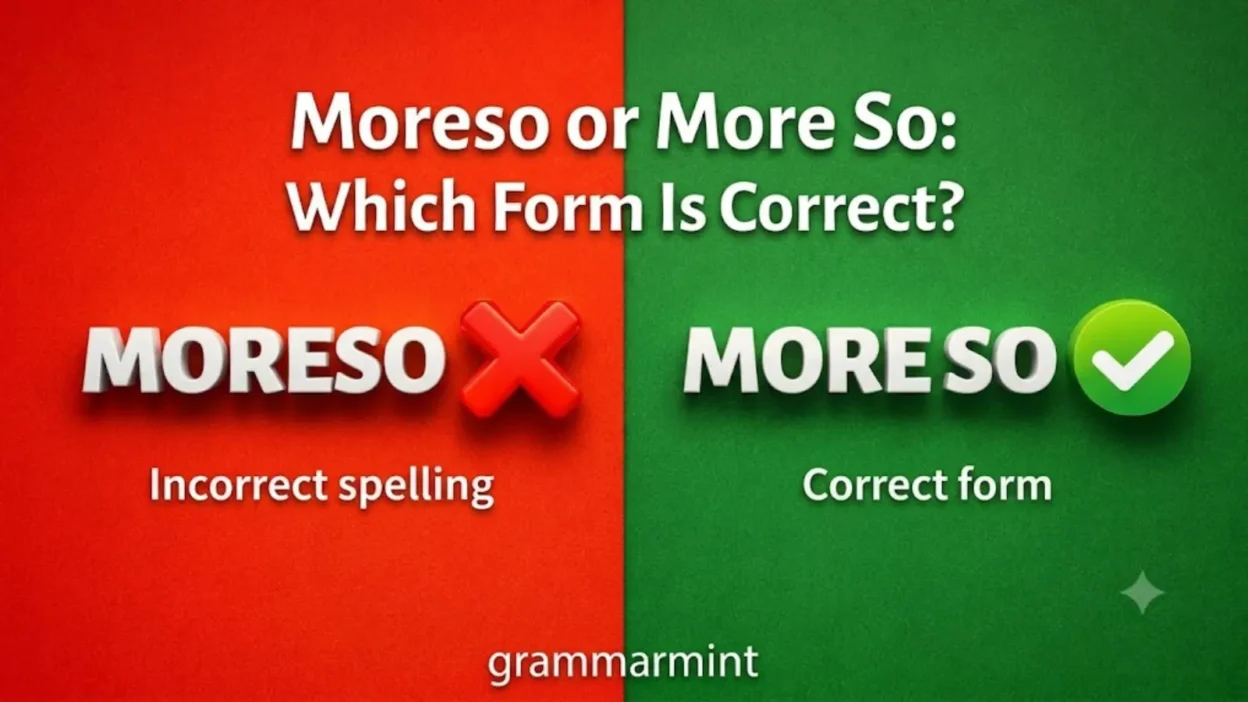
Moreso or more so is a common writing question because both forms appear online. The safer and more accepted choice in standard US English is more so, written as two words.
Use more so when you mean to a greater degree, especially when so points back to something already mentioned.
Example:
The second plan is risky, more so than the first.
The one-word form moreso appears in casual writing, but many editors, teachers, and careful readers still see it as nonstandard. In school papers, business writing, journalism, and formal content, more so is the better choice.
Quick Answer
Use more so, not moreso, in polished US English.
More so is the standard phrase. It means something is true to a greater degree or even more in that way.
Moreso is a one-word spelling that many people use informally, but it is not the best choice for careful writing.
Correct:
The issue matters today, more so than it did last year.
Less accepted:
The issue matters today, moreso than it did last year.
A simple rule works well: when writing for school, work, publishing, or a general audience, choose more so.
Why People Confuse Them
People confuse moreso and more so because the phrase sounds like one smooth word in speech. When people say it quickly, there is no clear pause between more and so.
The confusion also comes from similar closed-up words, such as anymore or nevertheless. English sometimes turns common phrases into single words over time. That makes moreso look possible.
Still, more so remains the standard form. The word so has a job: it points back to a previous idea, quality, or condition.
Example:
The first chapter is helpful. The second is more so.
Here, so means “helpful.” The sentence means the second chapter is more helpful.
Key Differences At A Glance
| Context | Best Choice | Why |
|---|---|---|
| Formal writing | more so | It is the standard two-word form. |
| School essays | more so | Teachers are more likely to accept it. |
| Business emails | more so | It sounds polished and clear. |
| Casual texting | more so | Still the safer choice, even casually. |
| Informal online comments | moreso may appear | Some writers use it, but it is less accepted. |
| When “so” refers back to an idea | more so | This is the phrase’s main use. |
| When “so” adds nothing | usually more | The shorter word may be cleaner. |
Meaning and Usage Difference
More so means to a greater degree in the way just described.
Example:
The new policy is confusing, more so for first-time applicants.
This means the policy is especially confusing for first-time applicants.
The phrase works best when so clearly refers to an earlier word or idea.
Example:
The movie was emotional, and the ending was even more so.
Here, so means “emotional.”
Moreso is usually an informal spelling of more so. It does not create a new meaning. The main difference is acceptance, not meaning. In careful US English, the two-word form is preferred.
Tone, Context, and Formality
More so sounds standard, neutral, and appropriate in almost every setting. You can use it in emails, essays, reports, articles, and everyday messages.
Moreso sounds informal. Some readers may not notice it, but others may see it as a mistake. That makes it risky when your writing needs to look clean and professional.
Use more so in:
- college essays
- workplace messages
- client emails
- published articles
- resumes and cover letters
- formal explanations
Avoid moreso when accuracy and credibility matter. Even if the reader understands it, the spelling may distract from your point.
Which One Should You Use?
Use more so almost every time.
Choose more so when the phrase means even more in that same way.
Correct:
The budget is tight this quarter, more so than last quarter.
Correct:
The rule is helpful for beginners, and even more so for non-native speakers.
Also check whether you need so at all. Sometimes more alone is stronger.
Wordy:
I was more so interested in the price.
Better:
I was more interested in the price.
Use more so when it points back to a clear idea. Use more when you are simply comparing degree.
When One Choice Sounds Wrong
Moreso can sound wrong in polished writing because it looks like a closed-up spelling that has not fully become standard.
Example:
The delay hurt small businesses, moreso restaurants.
Better:
The delay hurt small businesses, more so restaurants.
Even better:
The delay hurt small businesses, especially restaurants.
Sometimes more so also sounds wrong when so does not refer to anything clear.
Awkward:
I more so wanted to ask about the deadline.
Better:
I mainly wanted to ask about the deadline.
Better:
I was more interested in the deadline.
The best fix depends on the meaning. Do not use more so as a fancy replacement for mostly, mainly, or especially in every sentence.
Common Mistakes (and Quick Fixes)
Mistake 1: Writing moreso in formal work
Incorrect:
This matters moreso in legal writing.
Correct:
This matters more so in legal writing.
Mistake 2: Using more so when more is enough
Weak:
She was more so nervous than excited.
Better:
She was more nervous than excited.
Mistake 3: Using more so with no clear reference
Unclear:
The update is more so for managers.
Clearer:
The update is mainly for managers.
Mistake 4: Forgetting what so means
Correct:
The first example is clear. The second is more so.
Here, so means “clear.” That is why the phrase works.
Everyday Examples
Here are natural examples of more so in US English:
The commute is stressful, more so during winter.
The new app is useful, and even more so for small teams.
Her first speech was strong. Her second was more so.
The rule applies to all drivers, more so to new drivers.
The problem is serious now, more so than it was in 2020.
This advice helps beginners, but more so students writing their first essay.
Now compare sentences where more is cleaner:
Weak:
I more so wanted a refund.
Better:
I mainly wanted a refund.
Weak:
He was more so tired than angry.
Better:
He was more tired than angry.
Dictionary-Style Word Details
Verb
Moreso: Not commonly used as a verb in standard US English. It should not be used as an action word.
More So: Not used as a verb. It is a phrase built from more and so, usually working adverbially in a sentence.
Noun
Moreso: Not commonly used as a noun in standard US English.
More So: Not used as a noun. It is a phrase, not a person, place, thing, or idea by itself.
Synonyms
Moreso: Because moreso is not the preferred standard form, use alternatives for the intended meaning rather than treating it as the best form.
Closest plain alternatives: more, even more, to a greater degree, especially, all the more.
More So: Closest plain alternatives include even more, to a greater degree, all the more, and sometimes especially.
Exact antonyms do not always fit because the phrase depends on context. In some sentences, the opposite idea may be less so.
Example:
The first version is confusing. The second is less so.
Example Sentences
Moreso:
Moreso appears in informal writing, but it is better to revise it to more so in polished work.
More So:
The offer is appealing, more so because it includes free shipping.
Moreso:
Instead of writing moreso than before, write more so than before.
More So:
The change helped everyone, but more so the employees who work remotely.
Word History
Moreso: The one-word form appears to come from writers closing up the phrase more so. It is seen in informal use, but its history as a fully accepted standard word is not firmly established.
More So: The standard form comes from the ordinary words more and so. In this phrase, more shows a greater degree, and so points back to a quality or idea already mentioned.
Phrases Containing
Moreso: No widely accepted standard phrases require the one-word form moreso.
More So: Common phrases include:
- more so than
- even more so
- all the more so
- more so because
- more so for
Examples:
The warning matters even more so for young drivers.
The story is moving, all the more so because it is true.
FAQs
Is it moreso or more so?
The correct standard form is more so, written as two words. Moreso appears in informal writing, but it is not the best choice for polished US English.
Is moreso one word?
Moreso is sometimes written as one word online, but careful writers and editors usually prefer more so. Use the two-word form in essays, articles, emails, and business writing.
What does more so mean?
More so means to a greater degree or even more in that same way.
Example: The rule is helpful for beginners, more so for students learning English.
Can I use moreso in formal writing?
It is better not to use moreso in formal writing. Choose more so because it looks cleaner, more standard, and more professional.
Is more so the same as more?
Not always. More simply compares degree. More so points back to an idea already mentioned.
Example: The first answer was clear. The second was more so.
When should I use more instead of more so?
Use more when you are directly comparing something.
Correct: She was more nervous than excited.
Do not write: She was more so nervous than excited.
Is even more so correct?
Yes. Even more so is correct when you want to add emphasis.
Example: The advice matters for new writers, even more so for students.
What is a simple trick to remember more so?
Ask whether so means a word or idea from the previous sentence. If it does, use more so. If it does not, more, mainly, or especially may sound better.
Which is better for US English: moreso or more so?
For standard US English, more so is better. Moreso may be understood, but it can look informal or incorrect to careful readers.
What is the main difference between moreso and more so?
The meaning is usually the same, but the acceptance is different. More so is the standard form. Moreso is an informal spelling that many writers avoid.
Conclusion
For moreso or more so, the best answer is simple: use more so in standard US English.
More so is the accepted two-word phrase meaning to a greater degree or even more in that way. Moreso appears in casual writing, but it can look nonstandard and may distract careful readers.
When in doubt, write more so. Then check whether so points back to a clear idea. If it does, the phrase works. If not, a simpler word like more, mainly, or especially may be better.