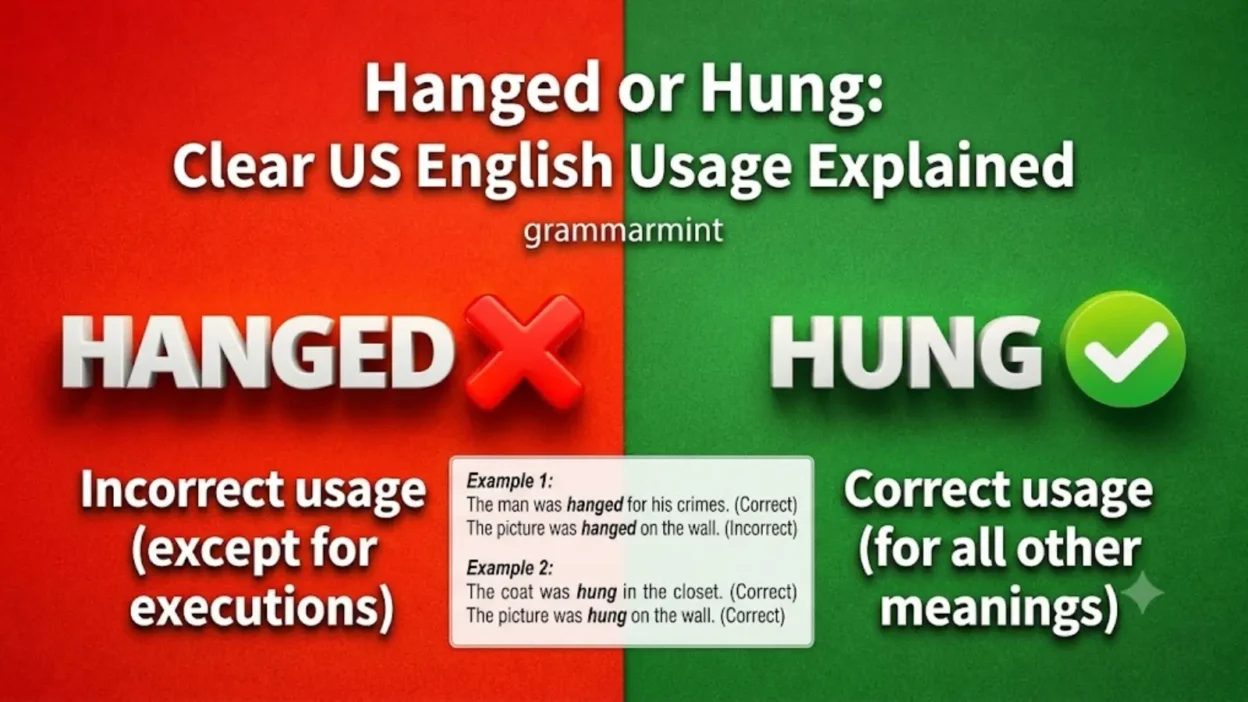
Hanged or hung confuses many writers because both words come from the verb hang. However, careful American English gives each word a different job.
Most of the time, choose hung. People hung pictures, clothes, curtains, signs, and holiday lights. Friends hung out after school. A trial can also end with a hung jury.
In contrast, choose hanged when the sentence refers to execution by hanging. That use sounds serious, formal, legal, or historical.
Therefore, the right choice depends on meaning. You do not choose between hanged and hung by grammar alone. Instead, ask what kind of “hanging” the sentence describes.
Quick Answer
Choose hung for almost every normal use of hang.
Choose hanged when your sentence means execution by hanging.
Examples:
Correct: We hung the mirror in the hallway.
A natural legal phrase: The jury could not agree, so it became a hung jury.
Everyday use: They hung out after class.
Execution context: Officials hanged the prisoner at dawn.
For everyday writing, hung will usually fit. However, hanged becomes the clearer choice in legal, historical, or serious writing about execution.
Why People Confuse Them
People confuse hanged and hung because both words come from the same base verb: hang.
The present tense looks simple:
I hang the picture.
She hangs her coat.
They hang out after work.
The problem starts in the past tense.
For ordinary meanings, writers use hung:
I hung the picture.
She hung her coat.
They hung out after work.
However, when hang means to execute someone by suspending that person by the neck, careful writers usually choose hanged:
The court ordered that officials hanged the convicted man.
As a result, one verb has two past forms. Each form points to a different meaning.
Key Differences At A Glance
| Context | Best Choice | Why |
|---|---|---|
| A picture on a wall | Hung | Ordinary meaning: placed or suspended |
| Clothes on a line | Hung | Ordinary meaning: attached from above |
| A sign outside a store | Hung | Ordinary physical placement |
| Spending time with friends | Hung | Correct form in “hung out” |
| A jury that cannot agree | Hung | Fixed phrase: “hung jury” |
| Execution by hanging | Hanged | Formal and traditional choice |
| Historical execution | Hanged | Clearer and more expected |
| Casual speech about death by hanging | Usually hanged in edited writing | Some people say “hung,” but “hanged” sounds more precise |
Meaning and Usage Difference
Hung tells readers that someone suspended, placed, displayed, delayed, or left something in a certain state.
Examples:
The jacket hung by the door.
We hung the lights before dinner.
His head hung low after the loss.
The call hung for a second before it dropped.
In addition, hung appears in many common phrases:
We hung out downtown.
The trial ended with a hung jury.
The screen hung during the update.
Hanged, on the other hand, has a narrow meaning. Writers use it when they describe execution by hanging.
Examples:
Officials hanged the prisoner.
In the old case file, the court sentenced the defendant to be hanged.
The pronunciation also helps. Hung sounds like “huhng,” while hanged rhymes with “banged.” Because the words sound different and serve different uses, readers should not treat them as simple spelling variants.
Tone, Context, and Formality
Hung sounds natural in casual, professional, and formal writing when the sentence describes ordinary suspension, placement, or delay.
Examples:
The gallery hung the artwork near the entrance.
She hung the calendar above her desk.
We hung around after the meeting.
Meanwhile, hanged carries a heavier tone because it refers to death by hanging. You will often see it in history, law, crime writing, and formal discussion of executions.
Example:
Officials hanged the man after the trial.
In casual speech, some people use hung even when they mean death by hanging. Still, careful American writing usually favors hanged for execution because it sounds clearer and more exact.
Which One Should You Use?
Start with hung unless the sentence discusses execution by hanging.
For objects:
I hung the photo above the couch.
They hung the banner outside the gym.
For body posture:
He hung his head in shame.
For social time:
We hung out at Maya’s apartment.
For a jury:
The trial ended with a hung jury.
For execution:
The authorities hanged the prisoner at dawn.
Here is a simple test: if the idea means put up, displayed, suspended, or spent time, choose hung. If the idea means executed by hanging, choose hanged.
When One Choice Sounds Wrong
Hanged sounds wrong when the sentence talks about ordinary objects.
Wrong: I hanged the painting in the living room.
Right: I hung the painting in the living room.
Wrong: She hanged her coat on the hook.
Right: She hung her coat on the hook.
Wrong: We hanged out after school.
Right: We hung out after school.
In contrast, hung can sound careless in formal writing about execution.
Less careful: The prisoner was hung.
Better: Officials hanged the prisoner.
Real speech sometimes uses hung for death by hanging. Even so, hanged remains the safer choice when you want formal, careful, and precise wording.
Common Mistakes (and Quick Fixes)
Mistake 1: Using hanged for pictures or objects
Wrong: We hanged the new curtains.
Correct: We hung the new curtains.
Mistake 2: Using hanged in “hang out”
Wrong: I hanged out with my cousins.
Correct: I hung out with my cousins.
Mistake 3: Using hanged for a jury
Wrong: It was a hanged jury.
Correct: It was a hung jury.
Mistake 4: Using hung in formal execution writing
Less careful: The murderer was hung.
Better: The state hanged the murderer.
Mistake 5: Treating hanged and hung as fully interchangeable
These words overlap because both come from hang. However, modern careful use gives them separate roles.
Everyday Examples
The following examples show the difference in natural American English.
Hung:
I hung my keys by the door.
The team hung streamers before the party.
A large clock hung over the front desk.
She hung the shirt in the closet.
We hung out at the coffee shop after work.
The app hung for a few seconds.
The trial ended with a hung jury.
He hung his head and apologized.
Hanged:
The state hanged the prisoner after the court’s sentence.
The old report says officials hanged the man for treason.
In the historical novel, the guards hanged the accused spy in the final chapter.
Small comparison block:
- Hung: normal past form for ordinary meanings of hang.
- Hanged: special past form for execution by hanging.
- Hung: common in daily speech and writing.
- Hanged: serious, formal, legal, or historical.
- Hung out: correct.
- Hanged out: incorrect.
Dictionary-Style Word Details
Verb
Hanged: Writers use hanged as a past-tense and past-participle form of hang when the meaning involves execution by hanging. It does not fit ordinary placement or suspension.
Example: The authorities hanged the prisoner.
Hung: Writers use hung as the usual past-tense and past-participle form of hang for most meanings, including placing, suspending, displaying, drooping, delaying, and spending time casually.
Example: We hung the painting above the sofa.
Noun
Hanged: Standard American English does not commonly use hanged as a noun.
Hung: Standard American English does not commonly use hung as a noun when it serves as the past form of hang. However, hang itself can work as a noun in phrases like get the hang of it. That noun use belongs to hang, not hung.
Synonyms
Hanged: Exact synonyms rarely fit because hanged names a specific kind of execution. Closest plain alternatives include executed by hanging and put to death by hanging.
Hung: Synonyms depend on context. Closest plain alternatives include suspended, placed, displayed, attached, and dangled.
Antonyms do not help much with hanged. For hung, possible opposites depend on the sentence, such as removed, took down, or detached.
Example Sentences
Hanged:
The court ordered that officials hanged the prisoner.
The history book says soldiers hanged the rebel leader.
The judge sentenced the condemned man to be hanged.
Hung:
I hung the photo beside the window.
The towels hung over the balcony rail.
We hung out after the game.
The jury hung, so the judge declared a mistrial.
Word History
Hanged and hung both come from the verb hang. Over time, English kept two past forms, and modern usage gave them different jobs.
The older development has more detail than most readers need. For practical writing today, remember this: hung handles the broad everyday meanings, while hanged mainly handles execution by hanging.
Phrases Containing
Hanged:
- be hanged
- sentenced to be hanged
- hanged by the neck
- hanged for murder
- hanged for treason
Hung:
- hung out
- hung up
- hung over
- hung around
- hung back
- hung jury
- hung on every word
- hung his head
- hung by a thread
Also, watch hung up. It can mean ended a phone call, delayed by a problem, or emotionally stuck on something. It never changes to hanged up.
Conclusion
The choice between hanged or hung depends on meaning.
Choose hung for almost every everyday use of hang: pictures, clothes, signs, curtains, calls, juries, posture, and time with friends.
Choose hanged when the sentence means execution by hanging.
Once you remember that difference, your sentences will sound clearer, more natural, and more correct in American English.