
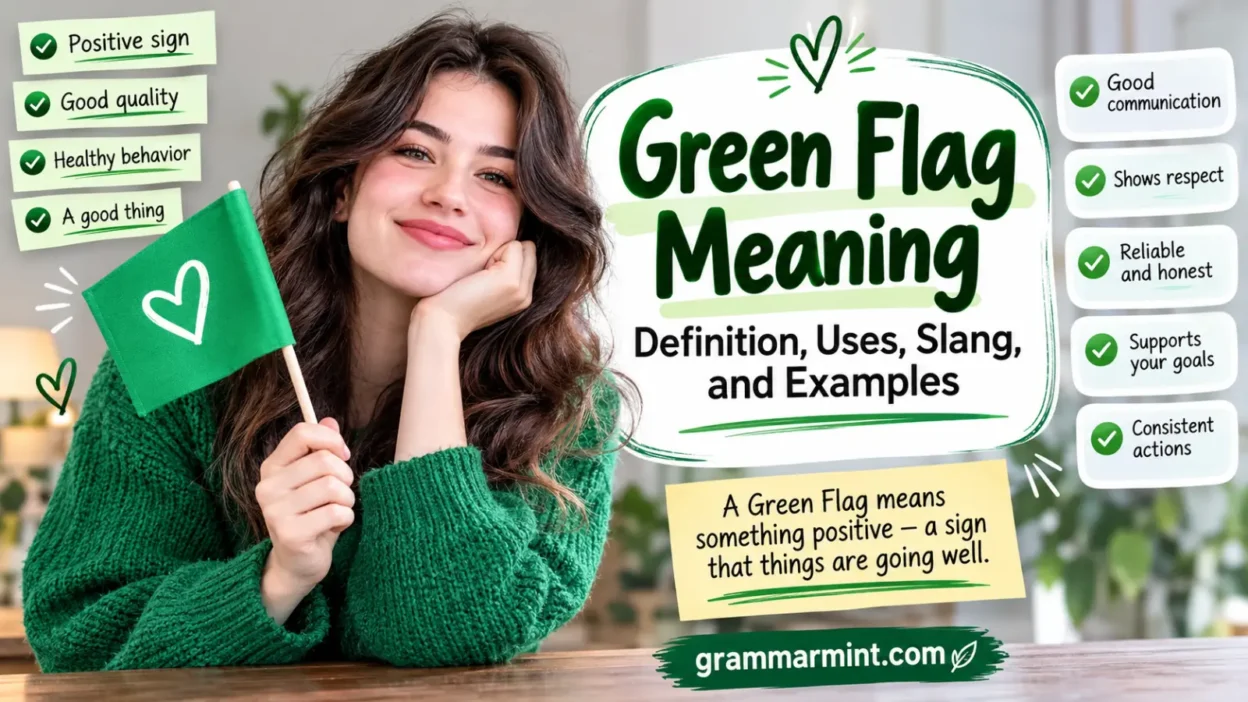
You may hear someone say, “That’s a green flag,” after noticing a positive behavior. The phrase often appears in dating conversations, texts, videos, and social media posts.
A green flag points to something encouraging or desirable. It may describe honesty, kindness, reliability, respect, or another promising quality.
However, the phrase is not limited to romance. People can notice green flags in friendships, workplaces, businesses, products, and everyday situations.
Understanding the phrase helps you follow modern conversations more easily. It also helps you use the expression naturally and correctly.
This guide explains its definition, slang use, grammar, pronunciation, and common contexts. You will also see clear examples and related expressions.
Quick Answer
Green flag meaning: a green flag is a positive or encouraging sign. It suggests that a person, behavior, choice, or situation has desirable qualities.
In relationships, it often describes behavior that supports trust, respect, safety, or healthy communication.
TL;DR
• A green flag is a positive sign.
• It often describes desirable behavior or qualities.
• The phrase is common in dating conversations.
• It also works outside romantic relationships.
• A green flag does not guarantee perfection.
What Green Flag Means in Plain English
A green flag is something that gives you a good reason to feel positive. It suggests that something may be healthy, suitable, reliable, or worth continuing.
Think of it as a sign that says, “This looks promising.”
For example:
• “She listens without interrupting. That’s a green flag.”
• “The company answered every question clearly, which was a green flag.”
• “His kindness toward strangers was a major green flag.”
The exact quality depends on the situation. Honesty may be important in one context, while reliability matters more in another.
A green flag is evidence in a positive direction. However, one good sign does not prove that everything is perfect.
Green Flag Meaning in Slang and Texting
In casual language, green flag usually means a desirable trait, action, or sign. People commonly use it when judging behavior positively.
You may see the phrase in texts, comments, captions, dating discussions, and online videos.
For example:
“Her communication is such a green flag.”
This means the speaker views her communication style positively.
Another person might text:
“He remembered my coffee order. Green flag.”
Here, the short phrase expresses approval. It suggests that the thoughtful action made a good impression.
People also use the phrase jokingly.
“Loves dogs and makes great tacos? Two green flags.”
The meaning stays positive, even when the tone is playful.
Calling someone “a green flag” is also common informally. It means the person seems to show several desirable qualities.
Green Flag in Relationships and Dating
The phrase is especially common when people discuss dating or romantic partners.
A relationship green flag is a behavior that suggests a healthy or promising connection. It can show how someone communicates, handles conflict, or respects another person.
Common examples include:
• respecting personal boundaries
• communicating openly
• listening carefully
• being honest
• keeping reasonable promises
• accepting responsibility for mistakes
• supporting personal independence
• treating other people respectfully
For example:
“My date respected my decision without arguing. That felt like a green flag.”
Another example is:
“We disagreed, but she stayed respectful and listened.”
That behavior may be considered a green flag because disagreement did not become disrespect.
However, green flags are not a perfect checklist. Different people value different qualities.
A positive sign should also be viewed as part of a larger pattern. Consistent behavior usually matters more than one impressive moment.
Other Contexts Where Green Flag Appears
Although dating is common, the expression works in many situations.
Friendships
A friend who respects your limits may show a green flag.
“Jake never pressures me to share private things. That’s a green flag.”
Workplaces
Employees may use the phrase for positive signs about an employer.
“The manager explained the salary and expectations clearly. That was a green flag.”
Businesses and Services
Customers can notice green flags before making a decision.
“Clear pricing and an easy return policy were green flags for me.”
Everyday Decisions
The phrase can describe almost any encouraging clue.
“The apartment was clean, quiet, and well maintained. All green flags.”
The basic meaning remains the same. Something creates a positive impression or suggests a good outcome.
How to Use Green Flag Correctly
The most common pattern is:
Something + is + a green flag.
Examples:
“Honest communication is a green flag.”
“Being respectful to servers is a green flag.”
You can also describe several positive signs:
“Those are all green flags.”
The plural form is green flags.
Another natural pattern is:
“That’s a green flag for me.”
Adding for me shows that the judgment is personal.
For example:
“Having close lifelong friends is a green flag for me.”
People also informally describe someone as a green flag:
“He is a total green flag.”
This does not literally mean the person is a sign. It means the speaker sees many positive qualities in that person.
Avoid writing greenflag as one word. The standard form is green flag.
Green Flag vs Red Flag and Beige Flag
These expressions use colors to label different impressions.
| Context | Best Choice | Why |
|---|---|---|
| Positive or encouraging sign | Green flag | Suggests something desirable |
| Warning or concerning sign | Red flag | Suggests caution or possible trouble |
| Neutral or harmless quirk | Beige flag | Usually neither strongly good nor bad |
A red flag warns that something may be wrong.
Example:
“He constantly ignores your boundaries. That’s a red flag.”
A green flag expresses the opposite direction.
“She respects your boundaries without complaining. That’s a green flag.”
A beige flag usually describes a harmless or unusual trait. It is often used playfully in dating discussions.
For example:
“His beige flag is organizing snacks by package color.”
Beige flags are more subjective and humorous. Green and red flags usually carry clearer positive or negative judgments.
Pronunciation, Grammar, and Part of Speech
Green flag is pronounced simply as green flag.
“Green” sounds like the color. “Flag” rhymes with bag.
The main stress naturally falls on flag when the phrase is spoken carefully.
Grammatically, green flag functions as a noun phrase.
Singular:
“That is a green flag.”
Plural:
“Those are green flags.”
It can name a literal flag or a figurative positive sign. Context usually makes the intended meaning clear.
In modern informal speech, the phrase can also label a person.
“She’s a green flag.”
This is still based on the noun meaning. The speaker is saying that the person shows promising qualities.
Origin and Literal Meanings
The exact beginning of the figurative expression is unclear.
Its meaning makes sense because green has long been used as a signal to proceed. This creates a natural contrast with red warning signals.
A literal green flag can also carry specific meanings.
At some beaches, a green flag can indicate safer swimming conditions.
In motor racing, a green flag can signal the start or restart of racing.
These literal uses share a common idea. Green often communicates permission, safety, or movement forward.
The figurative meaning follows a similar pattern.
A red flag suggests, “Stop and pay attention.”
A green flag suggests, “This looks positive. Continuing may be reasonable.”
Modern relationship language expanded this idea to personality traits and behavior.
Related Terms, Synonyms, Antonyms, and Common Mistakes
Several expressions can communicate a similar idea.
Close Synonyms
• positive sign — the closest general alternative
• good sign — simple and conversational
• encouraging sign — suggests hope or progress
• favorable indicator — more formal wording
• promising sign — suggests possible future success
These are close alternatives, not perfect replacements in every sentence.
Antonyms and Opposites
The clearest opposite is red flag.
Other related opposites include:
• warning sign
• bad sign
• cause for concern
• negative indicator
A beige flag is not a true opposite. It usually describes something neutral or mildly unusual.
Common Mistake: Thinking It Means Perfection
Wrong idea:
“He showed one green flag, so he must be perfect.”
Better understanding:
A green flag is only a favorable sign. People should still consider the larger pattern.
Common Mistake: Using It Only for Dating
Green flag is common in dating, but its use is broader.
Correct:
“Transparent pricing is a green flag when choosing a service.”
Common Mistake: Writing It as One Word
Incorrect:
“greenflag”
Correct:
“green flag”
The normal plural is green flags.
Mini Quiz
1. What does “green flag” usually mean?
A. A warning
B. A positive sign
C. A serious mistake
D. A secret message
2. Which sentence uses the phrase correctly?
A. “She respects my boundaries. That’s a green flag.”
B. “The storm caused a green flag of damage.”
C. “I green flag to school every day.”
D. “The food tasted green flag.”
3. Which term is closest to the opposite?
A. Good sign
B. Positive signal
C. Red flag
D. Compliment
4. Can “green flag” describe something outside dating?
A. Yes
B. No
Answer Key
- B
- A
- C
- A
FAQs
What does green flag mean in slang?
In slang, a green flag is a positive trait, behavior, or sign. It suggests that someone or something makes a good impression.
The phrase is especially common when discussing dating, friendships, and personal qualities.
What does it mean when someone calls you a green flag?
It usually means they see positive qualities in you. They may view you as respectful, trustworthy, thoughtful, reliable, or emotionally mature.
The exact reason depends on what that person values.
Is a green flag good or bad?
A green flag is positive.
It points to something encouraging, desirable, or promising. However, one green flag does not guarantee that everything else is good.
What is a green flag in a relationship?
A green flag is a positive behavior that suggests a healthy or promising relationship.
Examples can include respect, honest communication, trust, accountability, and respect for boundaries.
What does green flag mean in texting?
In texting, it keeps the same basic meaning: a positive sign.
Someone may text “green flag” after noticing behavior they like. The phrase may be serious or playful.
Can green flag be used outside dating?
Yes. People use it for friendships, jobs, businesses, products, and many everyday situations.
For example, clear prices and honest policies may be green flags when choosing a company.
Conclusion
The green flag meaning is simple: it describes a positive or encouraging sign.
Use it for behaviors, qualities, people, or situations that seem promising. Always consider the full context, not just one sign.