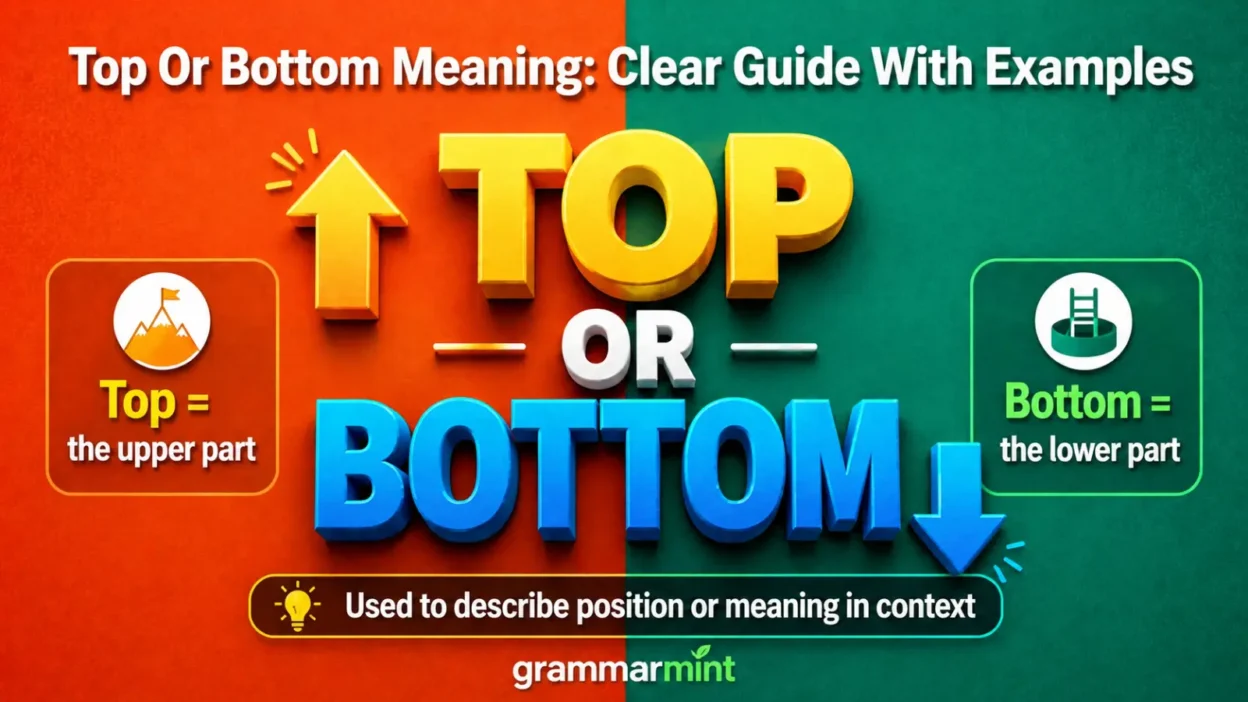
When people search this phrase, they usually want a clear answer without awkward wording or confusing assumptions. Top or bottom most often refers to a role or preference label, especially in relationship or dating conversations, but it can also appear in everyday English as a simple contrast between upper and lower position. This guide explains the common meaning, modern slang, context, relationship use, profile shorthand, and related labels like vers and side in plain language.
Quick Answer
Top or bottom usually means a preferred role label, especially in dating or relationship conversations. In simple terms, a top is usually the more giving or leading partner in that context, while a bottom is usually the more receiving partner. The exact meaning depends on context, and not everyone uses these labels.
TL;DR
• The phrase can be literal or slang
• Context decides the right meaning
• “Vers” usually means both fit
• Labels are optional, not mandatory
• Role is not always power
• Clear talk matters more than labels
What Top Or Bottom Usually Means
Most people asking this want the modern meaning first. In common use, role labels like these usually describe what part someone prefers to play in an intimate context.
At the same time, the terms can be broad. So, they may signal a general meaning, a loose label, or just quick shorthand.
• Top usually means the giving role
• Bottom usually means the receiving role
• The words describe preference, not worth
• Many people use them casually online
• Some use them very seriously
• Others avoid labels completely
• Context always changes the meaning
• The same word can feel broad
• Some people use soft preferences
• Some people use firm preferences
• These labels are often flexible
• Not every relationship uses them
The Simple Meaning In Everyday English
Outside dating or relationship talk, the phrase can be completely literal. In plain literal English, top means higher, and bottom means lower.
That’s why slang and everyday context matter so much. The same words can point to location, order, rank, clothing, or a modern label.
• Top shelf means the higher shelf
• Bottom drawer means the lower drawer
• A top floor is higher
• A bottom step is lower
• Bikini top names the upper piece
• Bikini bottoms name the lower piece
• Top of the page means higher
• Bottom of the page means lower
• From top to bottom means completely
• Top choice can mean favorite
• Bottom line can mean main point
• The setting decides the meaning
What “Vers” Adds To The Conversation
A lot of readers also see “vers” in chats or profiles. Versatile usually means someone is comfortable in more than one role.
That idea often feels more flexible than a fixed category. In many cases, it simply signals range, openness, or changing preference.
• Vers is short for versatile
• It usually means both can fit
• Some people switch by mood
• Some switch by partner
• Some switch by comfort
• Some switch over time
• Vers does not mean confused
• Vers can still include preferences
• A vers person may lean one way
• The label can be temporary
• The label can be long-term
• It often reduces pressure
How People Figure Out What Fits
Many people want a label before they have experience. Usually, though, people learn through comfort, honest boundaries, and open communication.
There is no race here. In fact, some people know quickly, while others need time and real-life experience.
• Start with what feels comfortable
• Notice what sounds appealing
• Pay attention to your boundaries
• Let curiosity guide you slowly
• You do not need certainty
• You can change your mind
• Attraction and preference can differ
• Fantasy and real life differ
• Comfort matters more than pressure
• Honest communication helps a lot
• Experience may change your answer
• No label is also valid
Can You Be Both? Yes
Yes, you absolutely can. Some people feel both roles fit, and some feel more fluid than fixed.
Also, a person can switch over time, by partner, or by mood. That does not make them inconsistent. It just means their preference is wider.
• Both can be true
• Fluid labels are common
• Preferences can change gradually
• Preferences can change quickly
• Mood can shape your answer
• Trust can shape your answer
• Chemistry can shape your answer
• Experience can reshape comfort
• A past label needn’t stay forever
• A current label can stay
• Flexibility is not indecision
• You choose what fits now
Why The Terms Show Up In Slang
These words are short, memorable, and easy to type. So, they appear often on dating apps, in profiles, and in quick online shorthand.
Because of that, they can feel more common than they really are in daily speech. Online spaces often compress complex feelings into fast labels.
• Profiles often use brief labels
• Apps reward fast shorthand
• Slang spreads through repetition
• Friends may use the terms jokingly
• Memes made the labels familiar
• Short labels feel easier online
• Some people use them loosely
• Others use them precisely
• Meanings can vary by community
• Tone can change the message
• Humor can hide real preference
• Asking kindly clears confusion
How The Labels Work In Relationships
In real relationships, labels matter less than compatibility. What matters more is shared expectations, emotional ease, and physical chemistry.
Sometimes two people use labels that match neatly. Other times, they need a longer conversation to understand what those words really mean to each person.
• Matching labels can help quickly
• Clear expectations prevent frustration
• Chemistry matters more than buzzwords
• Compatibility is rarely one-word simple
• Preferences should be discussed early
• Pressure makes conversations harder
• Curiosity keeps conversations open
• Honest timing helps both people
• Shared language reduces confusion
• Boundaries deserve direct respect
• Mutual comfort matters most
• Labels should support connection
Top Does Not Always Mean Dominant
This is one of the biggest mix-ups. Dominant does not always equal top, because control and role are not the same dynamic.
A person can take a top role and still be gentle, passive, playful, or partner-led. The label alone does not explain the whole interaction.
• Top is not automatic dominance
• Role and power can differ
• Control can shift naturally
• Some tops are very soft
• Some tops follow partner cues
• Some tops prefer shared control
• Some tops dislike rigid roles
• A label cannot show personality
• Confidence is not the same
• Gentleness can still lead
• Dynamics depend on both people
• Assumptions create avoidable confusion
Bottom Does Not Always Mean Submissive
The same myth works in reverse. Submissive does not always equal bottom, and that stereotype misses real dynamic variety.
Some bottoms are highly confident, very expressive, and fully in charge of pacing, tone, or boundaries. So, the label should never be treated as a personality summary.
• Bottom is not automatic submission
• Stereotypes oversimplify real people
• Some bottoms lead the pace
• Some bottoms set strong boundaries
• Some bottoms prefer clear direction
• Some bottoms prefer shared control
• Confidence and bottoming can coexist
• Quiet does not mean passive
• Bold does not mean top
• Personality is bigger than labels
• One word cannot define someone
• Respect beats stereotype every time
How The Terms Are Used Across Different Relationships
These labels are often linked with queer communities, but people may use them in straight or lesbian contexts too. Usage depends on relationship style, community language, and comfort.
That said, not every group uses the terms equally. Some people love them, while others prefer completely different wording.
• Usage often starts in queer spaces
• Some straight couples use them
• Some lesbian couples use them
• Some people avoid them entirely
• Community language shapes interpretation
• Age can affect familiarity
• Apps spread terms across groups
• Friends may reuse them casually
• Meanings can widen over time
• Personal comfort still comes first
• No group uses labels identically
• Ask, don’t assume, the meaning
What “Side” Means
Another term readers often see is side. In simple terms, side usually describes someone whose preference leans toward non-penetrative intimacy.
This label matters because it reminds people there are more options than one narrow binary. It gives people language for what they actually want.
• Side is another modern label
• It usually means non-penetrative preference
• It broadens the conversation helpfully
• Not everyone wants the main binary
• Some people feel more seen
• Some use side permanently
• Some use side situationally
• The label can reduce pressure
• It supports clearer expectations
• It helps profile accuracy
• It is valid and useful
• It reminds people of variety
What “Power Bottom” Usually Means
This phrase gets attention because it flips assumptions. A power bottom usually suggests a bottom with strong confidence and noticeable control in the interaction.
The phrase is often playful, but it can be meaningful too. Usually, it points to energy, intention, and an active role in shaping what happens.
• It challenges old assumptions
• Confidence is central to it
• Control may stay with them
• The term is often playful
• It can still be serious
• It does not erase bottoming
• It often signals assertiveness
• Energy can define the vibe
• Communication still matters most
• Consent stays the foundation
• The phrase is community shorthand
• Meaning can vary slightly
What “Service Top” Usually Means
A service top is often described as a more partner-focused or giving top. The emphasis is usually on what helps the other person feel good.
That doesn’t make the label weak or passive. Instead, it often highlights attentiveness, responsiveness, and care within the moment.
• Service top stresses partner focus
• Giving energy often defines it
• Attention matters more than ego
• It can feel very caring
• It can still feel confident
• It does not erase desire
• The label suggests responsiveness
• Many people like its clarity
• It can pair with softness
• It can pair with intensity
• The phrase is still flexible
• Each person may define it differently
What Vers Top And Vers Bottom Mean
These mixed labels help people show a lean. Vers top and vers bottom usually mean a person is versatile but has a clear lean.
So, they are useful when “vers” feels too broad. They keep the idea of flexibility while still signaling a likely starting point.
• Vers top leans more top
• Vers bottom leans more bottom
• Both still allow flexibility
• Lean does not mean rule
• Mood may still shift
• Partner fit still matters
• Context may change outcomes
• The label adds useful detail
• It helps reduce guesswork
• It is common on apps
• It can simplify first chats
• It still leaves room
Common Phrases And Easy Examples
This topic gets easier with simple examples. A few short phrases can show how real usage changes by setting.
Below, the wording stays broad and beginner-friendly. So, you can understand the phrase without overthinking it.
• “Top shelf” means highest shelf
• “Bottom drawer” means lowest drawer
• “From top to bottom” means completely
• “I’m vers” means both can fit
• “He’s top-leaning” shows a preference
• “She prefers no labels” is clear
• “Ask first” keeps chats respectful
• “That was slang” explains the tone
• “Context matters here” avoids mistakes
• “Role isn’t personality” corrects myths
• “We talked openly” shows maturity
• “Labels helped us communicate” fits well
Common Myths To Ignore
A lot of confusion comes from fast assumptions. These myths can make people feel boxed in, and those labels are already broad enough without extra assumptions.
So, the smartest move is simple: listen, ask clearly, and let people define their own words.
• A top is not always dominant
• A bottom is not always submissive
• Vers is not indecisive
• Labels are not personality tests
• Labels are not permanent rules
• You do not need one
• Experience is not a requirement
• Gender does not decide role
• Appearance does not decide role
• Confidence does not decide role
• Jokes can still mislead people
• Clear conversation beats guessing
FAQs
What does top or bottom mean?
Most often, it refers to a preferred role label in dating or relationship conversations. In a broader sense, the words can also keep their plain literal meaning of upper and lower position.
How do you know if you’re a top or bottom?
Usually, people figure it out through comfort, curiosity, boundaries, and experience. You do not need to force a label early, and you can change your answer later.
Can you be both a top and a bottom?
Yes. Many people use “vers” or “versatile” to show that both roles can fit. Some also use “vers top” or “vers bottom” to show a lean.
Does top mean dominant?
Not always. A top role and a dominant dynamic can overlap, but they are not automatically the same thing.
Does bottom mean submissive?
No. A bottom can be confident, directive, playful, or highly in control. The label does not automatically describe personality or power.
Do these terms apply only to gay men?
No. They are strongly associated with queer communities, but some people use them more broadly across different relationship contexts. Usage depends on the people involved.
Conclusion
Top or bottom is usually a context-based label, not a full description of a person. Once you understand the basic meaning, the rest gets easier: listen, ask clearly, and use the words the way the people involved actually use them.