If you’ve ever paused while writing time flies or time flys, you’re not alone. This phrase confuses students, writers, and English learners because it mixes correct spelling, verb form, idiom meaning, present tense, common mistake, and sentence usage in one short expression. The good news is that the answer is simple once you see the pattern. In everyday American English, the correct form is time flies. After that, the real job is learning why it works, what it means, and how to use it naturally in speech and writing.
Quick Answer
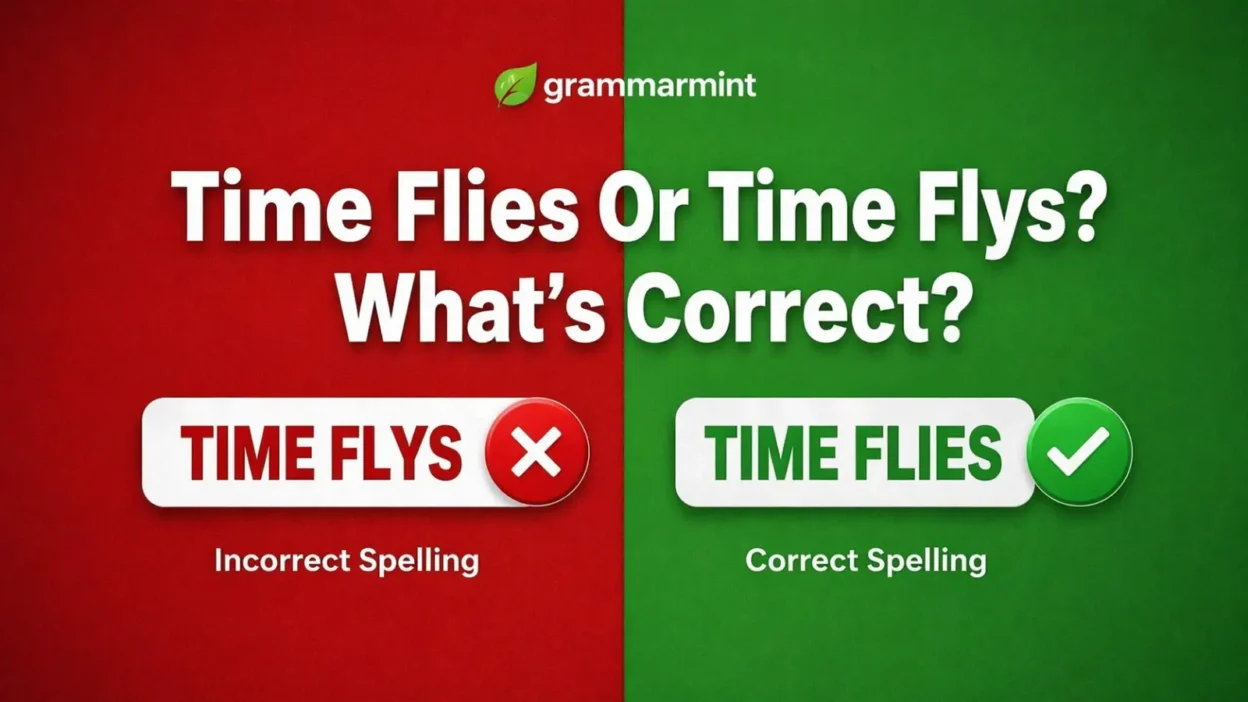
Time flies is correct. Time flys is wrong because the verb fly changes to flies in the third-person singular present tense.
TL;DR
• Time flies is the correct form.
• Time flys is a spelling mistake.
• The phrase means time passes quickly.
• It’s a common idiom in English.
• Use time flew for past-tense meaning.
• The grammar rule is simple and common.
The Correct Form
The right phrase is easy to remember once you see it in a full sentence. Here, time is the subject, and flies is the verb.
• Time flies during busy weeks.
• Time flies when life feels full.
• Time flies in good company.
• Time flies on long vacations.
• Time flies around the holidays.
• Time flies during senior year.
• Time flies in a new job.
• Time flies after graduation.
• Time flies with little kids.
• Time flies during wedding planning.
• Time flies in summer.
• Time flies before deadlines.
Time Flys or Time Flies?
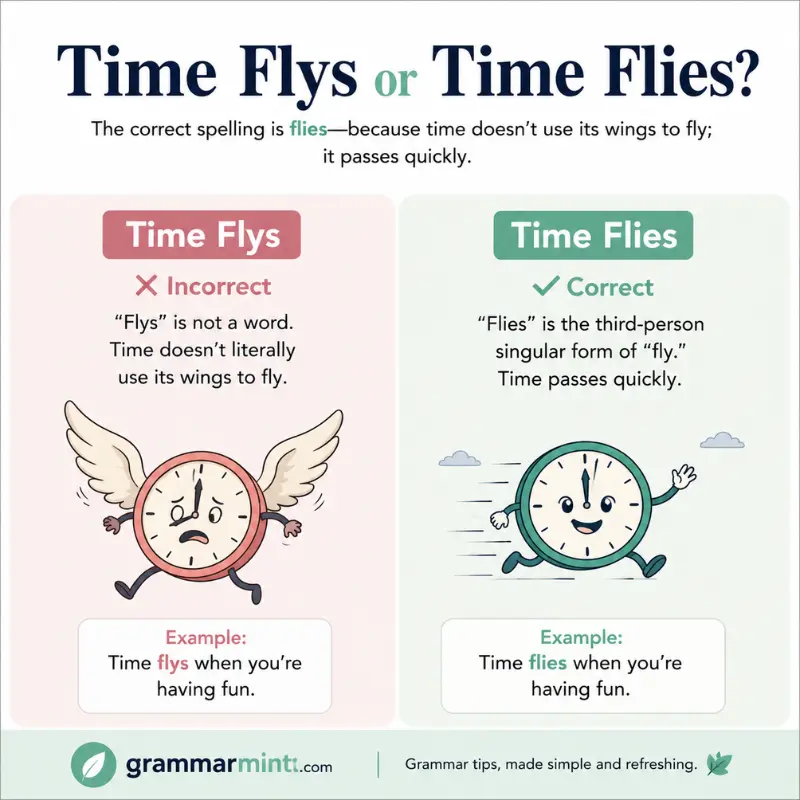
If you are deciding between time flys or time flies, the second version is correct:
Time flies
The word time is grammatically similar to he, she, and it because it is a singular third-person subject.
Compare these sentences:
- He flies frequently.
- She flies for work.
- It flies through the air.
- Time flies quickly.
Each sentence requires flies, not flys.
Time Flies or Flys?
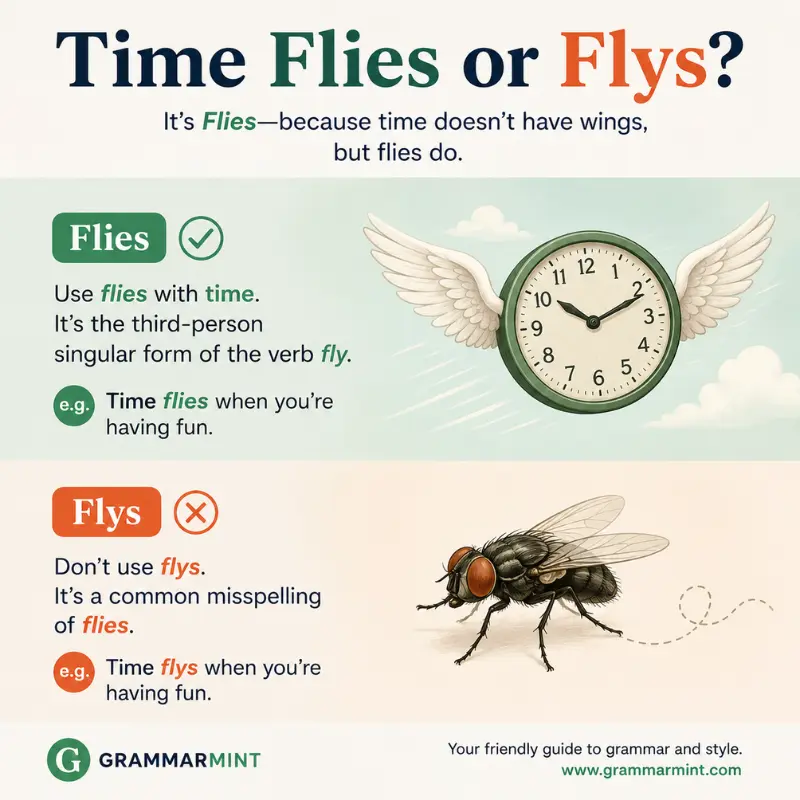
The correct answer to time flies or flys is also time flies.
Although many verbs simply take an s in the present tense, verbs ending in consonant + y follow a different spelling rule.
For example:
- play becomes plays because a vowel comes before the y
- enjoy becomes enjoys because a vowel comes before the y
- fly becomes flies because a consonant comes before the y
- try becomes tries because a consonant comes before the y
Therefore:
- Correct: Time flies quickly.
- Incorrect: Time flys quickly.
Why Flies Is Correct
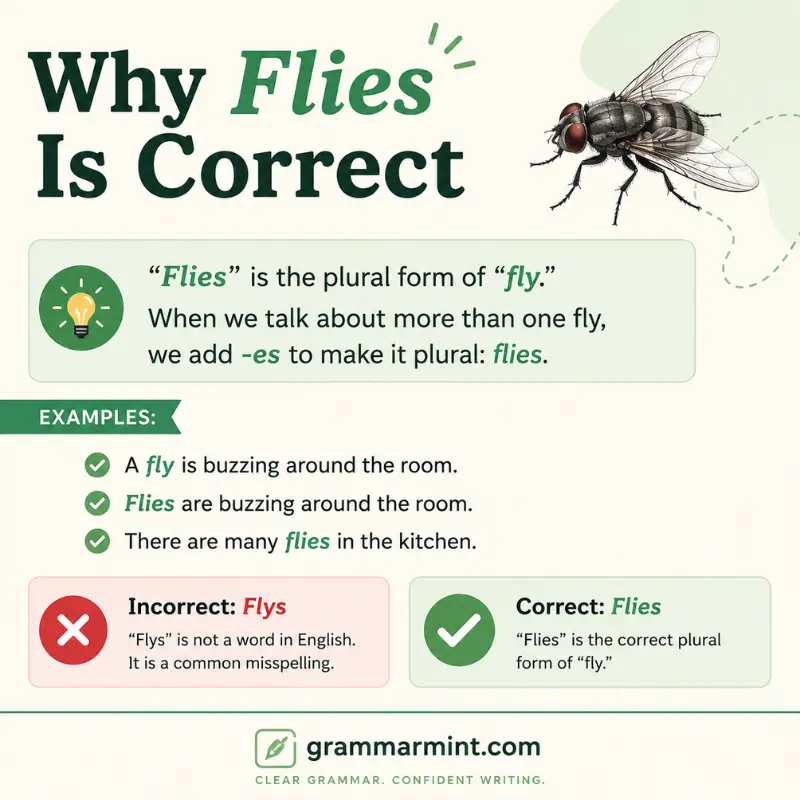
This is a basic verb form rule in English. When a verb ends in y after a consonant, it often changes to ies in the third-person singular.
• cry becomes cries
• try becomes tries
• carry becomes carries
• hurry becomes hurries
• reply becomes replies
• apply becomes applies
• qualify becomes qualifies
• multiply becomes multiplies
• deny becomes denies
• notify becomes notifies
• vary becomes varies
• fly becomes flies
Why Flys Is Wrong
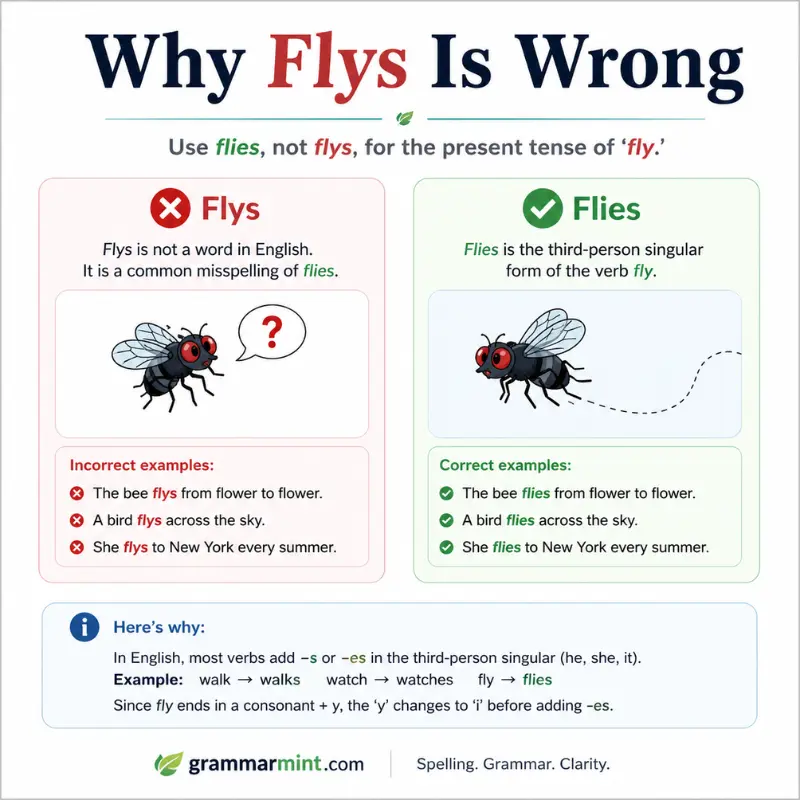
Flys looks possible at first glance, but standard English does not use it as the present-tense form here. So, if you’re writing the phrase, skip that spelling.
• Wrong: Time flys in summer.
• Right: Time flies in summer.
• Wrong: Time flys at school.
• Right: Time flies at school.
• Wrong: Time flys when you’re busy.
• Right: Time flies when you’re busy.
• Wrong: How time flys.
• Right: How time flies.
• Wrong: Time flys too fast.
• Right: Time flies too fast.
• Wrong: Doesn’t time flys fast?
• Right: Doesn’t time fly fast?
What Time Flies Means
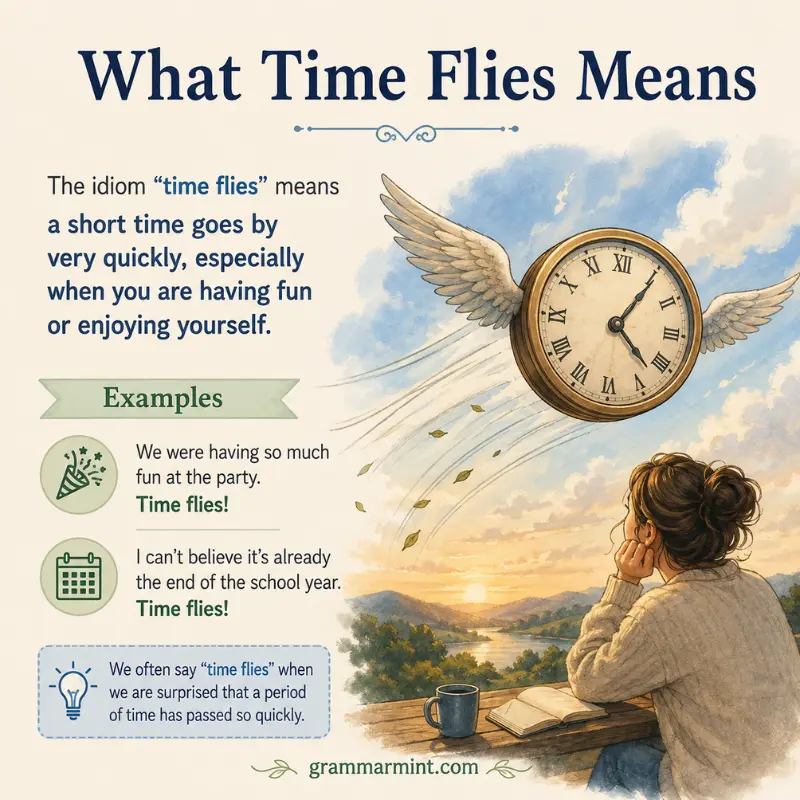
As an idiom, this phrase does not mean literal flying. Instead, it means time passes quickly, especially when you’re focused, happy, or surprised by how much time has passed.
• It means time passes quickly.
• It often expresses surprise.
• It usually feels emotional.
• It sounds natural in speech.
• It fits casual writing well.
• It can fit formal writing too.
• It often follows reflection.
• It suggests life feels fast.
• It is figurative, not literal.
• It works across age groups.
• It appears in everyday English.
• It often marks a memory.
Time Flys or Flies?
The correct choice between time flys or flies is flies.
Many English verbs ending in a consonant followed by y change the y to i before adding -es.
| Base Verb | Third-Person Singular |
|---|---|
| cry | cries |
| try | tries |
| carry | carries |
| hurry | hurries |
| reply | replies |
| apply | applies |
| deny | denies |
| fly | flies |
Because fly follows this pattern, we write:
- The bird flies over the trees.
- She flies to New York every month.
- The plane flies every morning.
- Time flies when you are having fun.
We do not write flys in these sentences.
Is Time Flies An Idiom
Yes, it works as a fixed expression people use to describe a feeling about time. Because of that, you usually see it in familiar patterns.
• Time flies when you’re busy.
• Time flies when you’re happy.
• My, how time flies.
• Wow, time flies.
• Funny how time flies.
• I can’t believe time flies so fast.
• Time flies these days.
• Time really flies here.
• Somehow, time flies together.
• Around family, time flies.
• At camp, time flies.
• During breaks, time flies.
The Grammar Rule Behind Flies
This section helps if you want the pattern, not just the answer. The grammar is short, clear, and useful far beyond this one phrase.
• Singular subject takes singular verb form.
• Time is a singular noun.
• Therefore, flies matches time.
• He flies home tomorrow.
• She flies often for work.
• It flies over the field.
• The bird flies low.
• That plane flies daily.
• Time flies every weekend.
• Each hour flies by.
• The month flies past.
• The season flies away.
How Time Flies Works In Context
The phrase sounds most natural when you’re reacting to life moving faster than expected. So, it often appears after memories, milestones, or quick check-ins.
• We just met, and time flies.
• Suddenly, ten years were gone.
• The kids grew up fast.
• One semester disappeared quickly.
• The weekend ended too soon.
• Summer break felt short.
• The visit was over already.
• The movie ended fast.
• Lunch break vanished quickly.
• Our trip felt too short.
• The month ended early.
• The year moved fast.
The Full Saying Explained
You’ll often hear the longer version, “Time flies when you’re having fun.” It keeps the same meaning, but it adds a reason.
• It links speed with enjoyment.
• It sounds warm and familiar.
• It is common in conversation.
• It fits family moments well.
• It works after a party.
• It suits vacation talk.
• It fits happy reunions.
• It sounds natural in captions.
• It often closes a memory.
• It can open a reflection.
• It feels casual, not stiff.
• It is widely understood.
Everyday Sentence Examples
The best way to remember the phrase is to see it in normal life. These examples keep the wording natural and easy to copy.
• Time flies when school is fun.
• Time flies at the beach.
• Time flies during football season.
• Time flies around good friends.
• Time flies in college.
• Time flies during road trips.
• Time flies at family dinners.
• Time flies in a new city.
• Time flies with a great teacher.
• Time flies in dance class.
• Time flies during wedding season.
• Time flies on movie nights.
Formal And Casual Examples
This phrase leans casual, but it can still work in polished writing when the tone allows it. Still, formal work often prefers slightly plainer wording.
• Casual: Time flies with old friends.
• Casual: Wow, time flies.
• Casual: Funny how time flies.
• Casual: Time flies here.
• Neutral: The months passed quickly.
• Neutral: The year moved fast.
• Neutral: The semester went by quickly.
• Formal: Time passed more quickly than expected.
• Formal: The project period ended rapidly.
• Formal: The final quarter passed quickly.
• Formal: The weeks seemed short.
• Formal: The schedule moved faster than expected.
Time Flies, Time Flew, And Time Has Flown
The phrase changes with tense just like other verbs. So, present, past, and perfect forms all matter.
• Present: Time flies in summer.
• Past: Time flew during break.
• Perfect: Time has flown lately.
• Present: The week flies by.
• Past: The week flew by.
• Perfect: The week has flown by.
• Present: The years fly past.
• Past: The years flew past.
• Perfect: The years have flown past.
• Present: Vacation time flies.
• Past: Vacation time flew.
• Perfect: Vacation time has flown.
Questions, Negatives, And Variations
When you turn the phrase into a question or negative, the verb shape changes. That’s where many learners make a second mistake.
• Does time fly when you’re busy?
• Doesn’t time fly on vacation?
• Why does time fly here?
• How does time fly so fast?
• Time doesn’t fly at the dentist.
• Time didn’t fly during finals.
• Did time fly for you too?
• Does the evening fly by?
• The afternoon doesn’t fly by.
• Why didn’t time fly today?
• Does summer always fly by?
• That hour didn’t fly by.
Common Mistakes To Avoid
Most errors happen because writers mix spelling and grammar at the same time. A few quick checks fix nearly all of them.
• Don’t write time flys.
• Don’t add extra apostrophes.
• Don’t capitalize it mid-sentence.
• Don’t use flies after does.
• Don’t write does time flies.
• Don’t confuse noun and verb uses.
• Don’t force it into stiff writing.
• Don’t overuse it every paragraph.
• Don’t treat it literally.
• Don’t say time flys by.
• Don’t forget tense changes.
• Don’t copy awkward textbook examples.
Similar Expressions
English has several nearby expressions that carry a similar idea. Some feel warmer, while others sound more neutral.
• Time passes quickly.
• The day flew by.
• The week went fast.
• The months slipped away.
• The year rushed past.
• Before I knew it, evening came.
• The hours went by quickly.
• The season passed in a blur.
• It was over too soon.
• Where did the time go?
• Tempus fugit.
• The years flew past.
Origin And Background

You do not need the origin to use the phrase well, but it helps some readers remember it. The Latin expression tempus fugit is often linked with the same idea.
• Tempus fugit means time flies.
• It comes from Latin.
• It sounds more literary.
• English uses the plain version.
• The modern phrase is common.
• The Latin phrase feels formal.
• Both stress passing time.
• Both are figurative expressions.
• Both appear in reflective writing.
• English is better for daily use.
• Latin is better for style.
• The core idea stays the same.
Punctuation And Capitalization
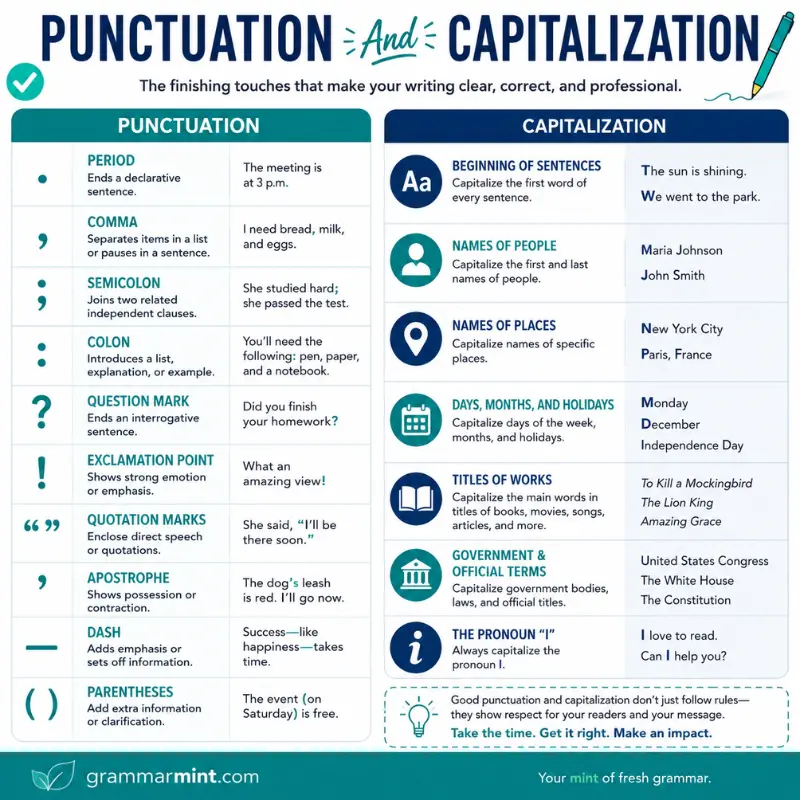
This phrase is simple, but punctuation still matters. Use standard sentence rules, and don’t make it look more complicated than it is.
• Start with capitals only if needed.
• Use a period in statements.
• Use an exclamation mark sparingly.
• Use commas for natural pauses.
• Write: My, how time flies.
• Write: Time flies when you’re busy.
• Write: Wow, time flies.
• Avoid random quotation marks.
• Avoid full caps for emphasis.
• Keep contractions natural here.
• Don’t overpunctuate short lines.
• Let the phrase stay clean.
Memory Tricks That Help
A memory trick makes this easier to keep forever. Once you link fly → flies, the phrase becomes automatic.
• Think cry becomes cries.
• Think try becomes tries.
• Match fly with flies.
• Match singular subject with flies.
• Remember: time is singular.
• Say the phrase out loud.
• Copy three correct examples.
• Compare right and wrong forms.
• Practice question forms too.
• Notice the y-to-ies shift.
• Use it in one diary line.
• Review it with other verbs.
FAQs
Is it time flies or time flys?
Time flies is correct. Time flys is a misspelling in standard English, so you should avoid it in both school writing and everyday use.
What does time flies mean?
It means time seems to pass quickly. People usually say it when they feel surprised by how fast a moment, day, or season went by.
Is time flies an idiom?
Yes, it is an idiomatic expression. The idea is figurative because time does not literally fly, but it can feel as if it moves very fast.
How do you use time flies in a sentence?
You can use it in simple lines like “Time flies during summer break” or “Time flies when you’re having fun.” It works best when you’re reacting to time passing faster than expected.
Why is flies correct instead of flys?
Because fly changes to flies in the third-person singular present tense. The same pattern appears in verbs like try → tries and cry → cries.
What is the past form if I want the same idea?
Use time flew or time has flown, depending on the sentence. For example, “Time flew during the trip” and “Time has flown since graduation” are both correct.
Conclusion
If you’ve been stuck on time flies or time flys, the answer is clear: time flies is the correct form. Keep the rule simple, use the examples above, and the right version will start to feel natural fast.