Me Either or Me Neither can confuse students, writers, and everyday speakers who want a quick, natural reply. You’ll hear negative agreement, spoken English, standard English, casual speech, formal writing, and everyday conversation pull in different directions here. In real life, people also compare these phrases with me too, neither do I, and I don’t either. So this guide clears it up in plain American English, with easy examples and safer choices for school, work, and texting.
Quick Answer
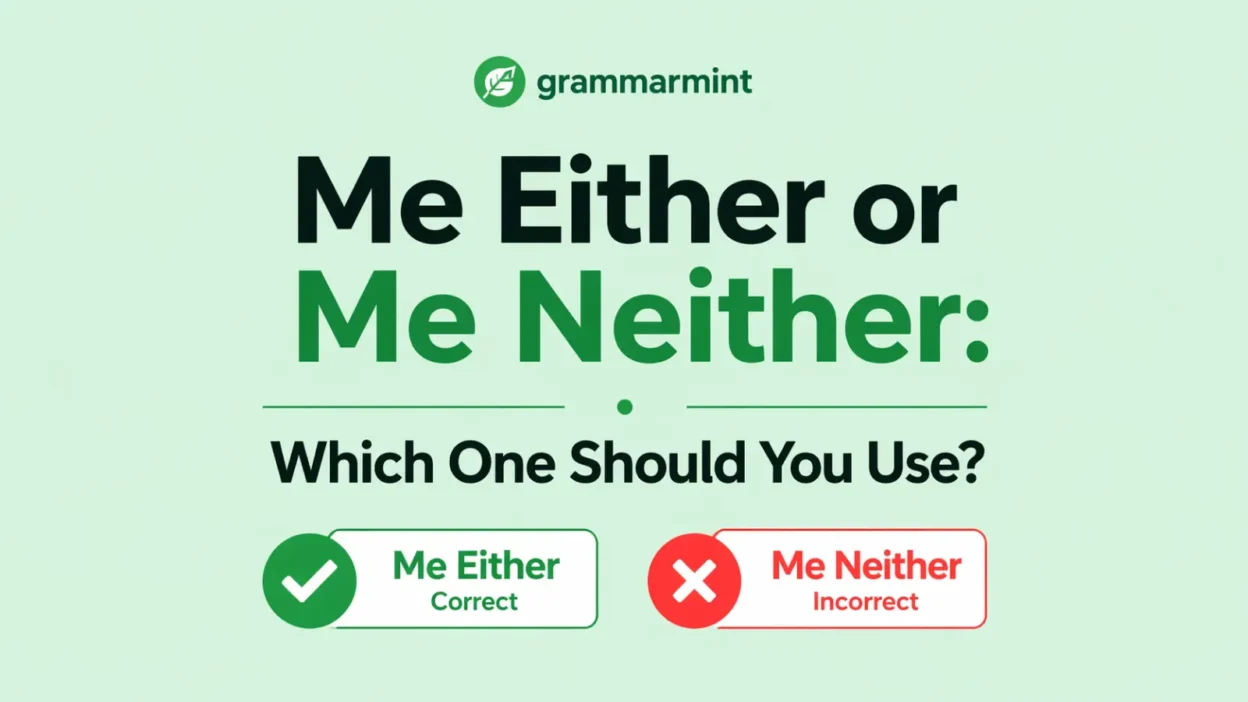
Me either or Me Neither: the safer and more widely accepted choice is me neither when you agree with a negative statement. In casual U.S. speech, many people also say me either, but some readers and teachers still see it as less standard. For careful writing, use me neither, neither do I, or a full reply like I don’t either.
TL;DR
• Use me neither after negative statements
• Me either is casual and debated
• Don’t use either one after positives
• For formal writing, choose neither do I
• I don’t either sounds natural too
• Match your reply to the original sentence
Quick Answer And Core Rule
This topic feels tricky because both forms appear in real life. Still, one is clearly safer when you want broad acceptance.
• Negative statement gets a negative-agreement reply
• Me neither is the safer default
• Me either appears in casual speech
• Careful writing favors me neither
• Formal writing favors Neither do I
• Full replies also work well
• Don’t use either after positives
• Tone matters as much as grammar
• School settings need safer choices
• Texting allows more variation
• Work writing needs cleaner phrasing
• Audience should guide your pick
What Me Neither Means
Me neither means you agree with someone’s negative statement. It works as a short, natural reply in conversation.
• “I don’t like olives.” “Me neither.”
• “I can’t swim.” “Me neither.”
• “I wasn’t ready.” “Me neither.”
• “I haven’t seen it.” “Me neither.”
• “I won’t go.” “Me neither.”
• It signals shared negative feeling
• It sounds quick and clear
• It fits most casual conversations
• Many teachers accept it more readily
• It feels standard to many readers
• It works best after negatives
• It is not for positive statements
What Me Either Means
Me either is also used to agree with a negative statement. However, it sounds more casual, and some people still judge it as less standard.
• “I don’t want coffee.” “Me either.”
• “I can’t stay late.” “Me either.”
• “I haven’t gone yet.” “Me either.”
• “I wasn’t invited.” “Me either.”
• It shows shared negative agreement
• It appears often in U.S. speech
• It sounds casual and conversational
• Some listeners barely notice it
• Some teachers still mark it wrong
• It’s weaker for formal contexts
• It’s common in dialogue and texts
• It should be used with care
Why The Two Forms Feel Different
The difference starts with how either and neither normally work in English. As a result, me neither feels more clearly negative to many people.
• Neither already carries negative force
• Either often needs a negative nearby
• That shapes people’s grammar instincts
• Neither feels cleaner in short replies
• Either feels looser in fragments
• Some speakers hear both as natural
• Others prefer one strongly
• The gap is about acceptance
• It is not just about meaning
• It is also about form
• Short replies often break strict rules
• Spoken English allows more shortcuts
How Negative Agreement Works
Negative agreement means you share a negative opinion, fact, or feeling. So your reply should match the negative shape of the original sentence.
• “I don’t drive.” “Me neither.”
• “I can’t come.” “Neither can I.”
• “I haven’t eaten.” “I haven’t either.”
• “I’m not ready.” “Me neither.”
• “I won’t complain.” “Me neither.”
• Match negative with negative
• Don’t flip the sentence type
• Keep the meaning parallel
• Short replies sound more natural
• Full replies sound more precise
• Agreement must fit the tense
• Agreement must fit the tone
Me Too Vs Me Neither
People mix these up all the time. The fix is simple: use me too for positives and me neither for negatives.
• “I love pizza.” “Me too.”
• “I don’t love pizza.” “Me neither.”
• “I’m excited.” “Me too.”
• “I’m not excited.” “Me neither.”
• “I can help.” “Me too” is wrong
• “I can’t help.” “Me too” is wrong
• Positive needs positive agreement
• Negative needs negative agreement
• Don’t answer a negative with me too
• Don’t answer a positive with me neither
• This is the most common mix-up
• A quick polarity check solves it
Better Formal Alternatives
When you need a polished reply, longer forms are better. They sound more careful, more complete, and more widely accepted.
• Neither do I
• Neither can I
• Neither have I
• Nor do I
• Nor can I
• Nor have I
• These suit formal settings
• They work well in essays
• They fit careful dialogue
• They sound clean in meetings
• They avoid the me either debate
• They show strong sentence control
Full-Sentence Alternatives
Sometimes the best choice is a full sentence. That way, you avoid doubt and still sound natural.
• I don’t either
• I can’t either
• I wasn’t either
• I haven’t either
• I wouldn’t either
• I’m not either
• Full replies feel very clear
• They keep normal word order
• They work well in speech
• They work well in writing
• They reduce grammar arguments
• They help learners build confidence
When Me Neither Is Safer
If you want one easy default, choose me neither. It is the better pick when you are unsure how formal or careful you need to be.
• Use it in schoolwork dialogue
• Use it in edited content
• Use it in workplace chats
• Use it with teachers
• Use it with new readers
• Use it when tone matters
• Use it when being graded
• Use it in shared documents
• Use it in customer messages
• Use it in learning materials
• Use it when you want fewer objections
• Use it when you need a safer reply
When Me Either Sounds Natural
Even though it is debated, me either can sound completely normal in casual American conversation. It shows up most in relaxed speech, not careful prose.
• Use it in quick texts
• Use it in casual dialogue
• Use it with close friends
• Use it in comic voice
• Use it in social captions
• Use it in informal scripts
• Use it in relaxed banter
• Avoid it in polished copy
• Avoid it in formal email
• Avoid it in school essays
• Avoid it when tone is strict
• Avoid it when correctness is central
U.S. Usage Note
In the United States, many people do say me either in real conversation. Still, that does not make it the best choice for every audience.
• U.S. speech often allows shortcuts
• Informal usage spreads through habit
• Real speech is less strict
• Writing gets judged more closely
• Teachers may prefer safer forms
• Editors may change me either
• Friends may not notice a difference
• Some regions sound more relaxed
• Some households prefer one form
• American speech is not one style
• Casual talk differs from formal prose
• Usage and acceptance are not identical
Common Mistakes To Avoid
Most errors happen because the reply does not match the original sentence. So check the sentence type before you answer.
• “I don’t agree.” “Me too.”
• “I like it.” “Me neither.”
• “I can’t go.” “Me too.”
• “I was happy.” “Me either.”
• Using me either in formal essays
• Using me too after negatives
• Ignoring tense in longer replies
• Mixing positive and negative logic
• Forgetting audience expectations
• Choosing slang in business writing
• Overthinking tiny speech differences
• Skipping clearer full-sentence options
Everyday Examples
These examples show how the choice changes by context. In daily life, clarity and tone matter more than showing off grammar terms.
• Text: “I’m not hungry.” “Me neither.”
• Text: “I can’t today.” “Me either.”
• Friend: “I don’t watch that.” “Me neither.”
• Friend: “I wasn’t impressed.” “Me either.”
• Work chat: “I haven’t finished.” “I haven’t either.”
• Meeting: “I don’t think so.” “Neither do I.”
• Class: “I didn’t get it.” “Me neither.”
• Family: “I’m not going out.” “Me neither.”
• Caption: “Not my vibe.” “Me either.”
• Group chat: “I can’t make Friday.” “Me neither.”
• School dialogue: “I don’t eat fish.” “Me neither.”
• Email note: “I don’t recommend it either.”
School And Test Writing
For tests, homework, and essays, play it safe. Teachers usually reward the clearer, more standard form.
• Prefer neither do I in essays
• Prefer me neither in dialogue
• Avoid me either on tests
• Use full sentences when possible
• Match the original tense
• Match the original auxiliary
• Keep punctuation simple
• Avoid slang in formal tasks
• Show consistent sentence logic
• Choose clarity over trendiness
• Rewrite fragments when unsure
• Read the sentence aloud once
Pronunciation And Rhythm
Speech adds another layer because both phrases are short and fast. That is why casual forms often spread easily.
• Neither has two common pronunciations
• Either also has two
• U.S. speakers may vary freely
• Rhythm often shapes what sounds natural
• Fast speech shortens grammar edges
• Short replies get reduced quickly
• Stress usually falls on the key word
• Tone can sound warm or flat
• Rising tone can sound surprised
• Flat tone can sound calm
• Clear pauses improve spoken replies
• Natural rhythm matters in dialogue
Which Should You Use
The final choice depends on context. However, if you want one answer that works most often, use me neither or a fuller alternative.
• Use me neither for a safe default
• Use Neither do I for formality
• Use I don’t either for clarity
• Use me either only casually
• Use me too only for positives
• Match audience before style
• Match setting before habit
• Match sentence type first
• Choose clarity over cleverness
• Choose standard forms when unsure
• Choose casual forms with friends
• Choose confidence, not guesswork
FAQs
Is it correct to say me either?
In casual American speech, many people do say me either after a negative statement. Still, many teachers, editors, and grammar references treat it as less standard than me neither, so it is not the safest choice for careful writing.
Is me neither grammatically correct?
Me neither is widely accepted as a short informal reply to a negative statement. In very formal settings, a fuller version like Neither do I may be better, but me neither is usually the safer short choice.
What is the difference between me either and me neither?
They are both used to agree with a negative statement in real conversation. The main difference is acceptance: me neither is more broadly accepted, while me either sounds more casual and more debated.
Can I use me either after a positive statement?
No. After a positive statement, use me too, not me either. Negative replies should follow negative statements.
Should I say neither do I instead?
Yes, especially in formal writing, schoolwork, or polished speech. Neither do I is a strong, standard choice that avoids the whole me either question.
Is I don’t either a good alternative?
Yes. I don’t either is a clear full-sentence reply that sounds natural in everyday English. It is often easier for learners because it keeps normal word order.
Conclusion
For most readers, Me Either or Me Neither becomes simple once you match the reply to the sentence type.
Use me neither as your safer short choice, and switch to neither do I or I don’t either when you want a cleaner tone.