If you’re writing about school, college life, or student years, it’s easy to pause at freshman or freshmen. The two words look almost the same, yet they do different jobs in a sentence. You might also wonder about phrases like freshman year, freshman student, first-year student, college, campus, high school, or orientation.
The good news is that the rule is simple. Once you see the difference between one student and more than one student, the choice becomes much easier.
Quick Answer
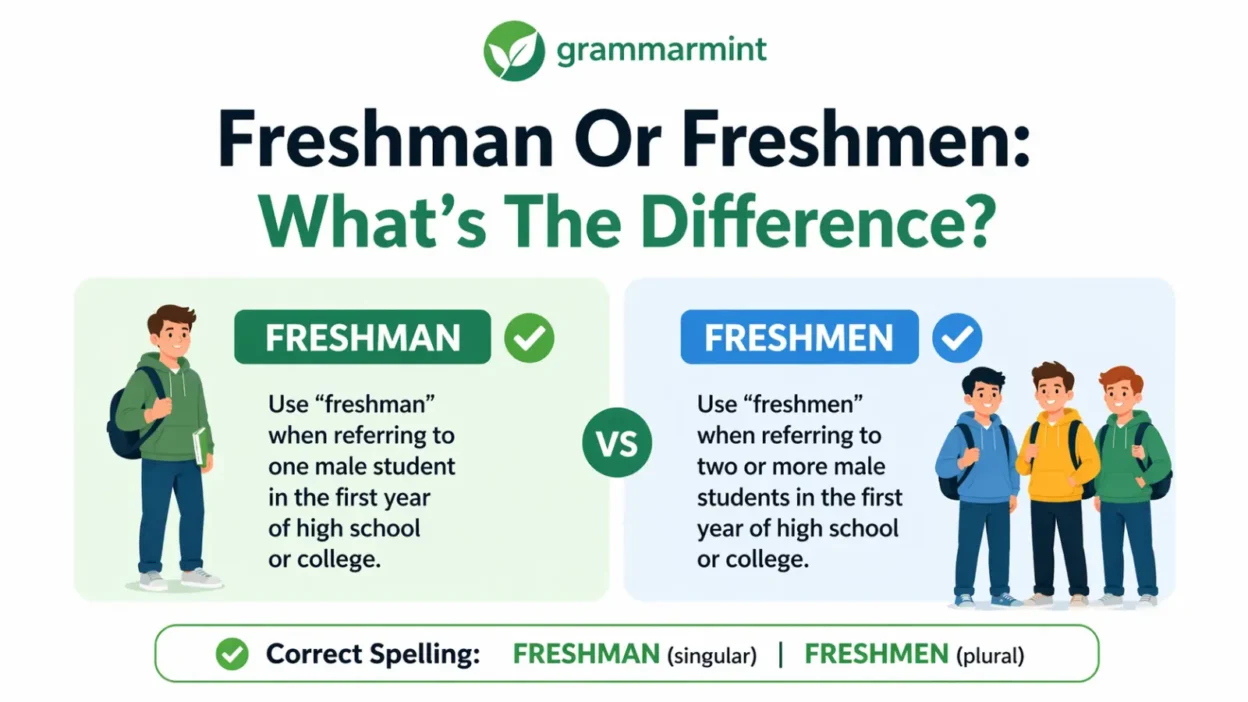
Freshman means one first-year student. Freshmen means two or more first-year students. Dictionaries also show that freshman year is the normal phrase, because freshman can work as a modifier before another noun.
TL;DR
• Use freshman for one student
• Use freshmen for many students
• Write freshman year, not freshmen year
• Freshman can describe another noun
• First-year student is a common alternative
• Check whether you mean one or many
Freshman Or Freshmen: Quick Rule
The main rule is short and reliable. Use one form for one person, and the other for a group. Standard dictionary and grammar sources agree on that.
• One student = freshman
• Two students = freshmen
• A new college student = freshman
• New college students = freshmen
• One first-year learner = freshman
• Several first-year learners = freshmen
• A freshman joined the club
• Three freshmen joined the club
• One athlete was a freshman
• Ten athletes were freshmen
• Ask: one or many?
• Then choose the matching form
What Freshman Means
In American English, freshman usually means one student in the first year of high school or college. Merriam-Webster also notes a broader meaning: a beginner or newcomer in other settings.
• One student in year one
• One new person on campus
• One beginner in a program
• One first-year class member
• One rookie lawmaker, sometimes
• One newcomer to a team
• A freshman at college
• A freshman in high school
• A freshman on the debate team
• A freshman in biology
• A freshman from Texas
• A freshman with big goals
What Freshmen Means
Freshmen is simply the plural form of freshman. Cambridge and other dictionary sources show this clearly, so you use it when you mean more than one first-year student.
• More than one first-year student
• A group of new students
• New students on campus
• Incoming students as a group
• First-year classmates together
• Several beginners in one class
• The freshmen arrived early
• Many freshmen attended orientation
• Freshmen filled the auditorium
• The freshmen asked questions
• Freshmen wore school colors
• All freshmen got schedules
Freshman Vs. Freshmen
This comparison is where most confusion happens. The meaning changes with the number, not with the school type or the sentence topic.
• One person = freshman
• More than one = freshmen
• She is a freshman
• They are freshmen
• He was a freshman then
• We met several freshmen
• One roommate was a freshman
• Four roommates were freshmen
• A freshman asked for help
• Freshmen asked for help
• Use singular after “a”
• Use plural after numbers
What The Plural Of Freshman Is
The plural of freshman is freshmen, not freshmans. This follows the same spelling pattern seen in older English word pairs like man and men.
• Correct plural: freshmen
• Wrong plural: freshmans
• The vowel changes in plural
• The ending stays compact
• It’s an irregular plural
• Learn it as one set
• One freshman, two freshmen
• One classmate, many freshmen
• One athlete, several freshmen
• Never add a simple -s
• Check spelling before posting
• Use the dictionary form
Freshman Year Or Freshmen Year
The standard phrase is freshman year. That is because freshman works like an adjective here, describing the word year. College advice pages and dictionaries support this pattern.
• Correct: freshman year
• Wrong: freshmen year
• Freshman describes the year
• It modifies the noun
• Keep the singular form
• This phrase is very common
• My freshman year was busy
• Her freshman year felt exciting
• During freshman year, he worked
• Freshman year can feel overwhelming
• We remember freshman year clearly
• Use this phrase in essays
Freshman Student Or Freshmen Student
You can say freshman student, although many writers shorten it to just freshman. By contrast, freshmen student sounds off in standard usage because freshmen is plural while student is singular. Usage discussions consistently treat that mix as incorrect or awkward.
• Correct: a freshman student
• Better: a freshman
• Wrong: a freshmen student
• Correct: freshman students
• Also correct: freshmen
• Match number with the noun
• One freshman student waited
• Two freshman students waited
• Two freshmen waited outside
• Avoid mixed singular-plural forms
• Keep the phrase simple
• Drop extra words when possible
When Freshman Acts Like An Adjective
Dictionaries show that freshman can work before another noun, not only as a standalone noun. That is why phrases like freshman class and freshman orientation sound normal.
• It can modify another noun
• It can describe year
• It can describe class
• It can describe orientation
• It often stays singular
• This is common in English
• freshman class
• freshman seminar
• freshman orientation
• freshman housing
• freshman handbook
• freshman adviser meeting
Freshman In High School
American dictionaries include high school in the meaning of freshman. In U.S. usage, it often refers to a ninth-grade student.
• A ninth-grade student
• A first-year high schooler
• Common in American schools
• Often used in school schedules
• Seen in clubs and sports
• Used in yearbook language
• She’s a high school freshman
• The freshmen toured the building
• Freshman lockers opened today
• Freshman classes start Monday
• Freshmen joined the choir
• A freshman tried out today
Freshman In College
The word is also widely used for college and university students in their first year. This is one of its most common modern uses in American English.
• A first-year college student
• A new university student
• Common in campus writing
• Used in orientation materials
• Seen in admissions talk
• Heard in dorm conversations
• He is a college freshman
• New freshmen moved in early
• The freshmen found their dorms
• A freshman joined the lab
• Freshmen met their advisers
• One freshman felt nervous
Sports Use Of True Freshman
In sports coverage, true freshman is a common phrase for an athlete in the first year of school who is playing without a redshirt year. Current dictionary examples and collocation evidence show this usage clearly.
• Common in college sports
• Refers to first-year athletes
• Often contrasts with redshirts
• Usually appears in coverage
• Also seen in rosters
• Popular in recruiting talk
• The true freshman started today
• Two freshmen earned minutes
• A freshman guard impressed coaches
• Freshmen added team depth
• One true freshman scored early
• Several freshmen made the trip
First-Year Student Vs. Freshman
Some schools and writers now prefer first-year student because it feels more neutral and formal. Merriam-Webster notes that alternatives such as first-year are rising in use, even though freshman remains widely understood.
• First-year student sounds neutral
• Freshman still remains common
• School style may vary
• Formal writing may differ
• Campus offices may prefer alternatives
• Choose the house style
• A first-year student registered
• First-year students moved in
• The freshman class arrived
• Both may be understood
• Use what fits context
• Stay consistent in one piece
Common Mistakes With Freshman And Freshmen
Most errors come from mixing singular and plural patterns. The easiest fix is to look for clue words like a, one, two, many, or several.
• “A freshmen” is wrong
• “One freshmen” is wrong
• “Many freshman” is usually wrong
• “Freshmans” is wrong
• “Freshmen year” is usually wrong
• “A freshman” is correct
• “One freshman” is correct
• “Many freshmen” is correct
• “Two freshmen” is correct
• “Freshman year” is correct
• Check nearby number words
• Read the sentence aloud
Possessives And Articles
Possessives follow the base form you need first. Then you add the apostrophe pattern: freshman’s for one, freshmen’s for more than one.
• One student’s = freshman’s
• Many students’ = freshmen’s
• Use “a” with freshman
• Don’t use “a” with freshmen
• Use “the” with either form
• Match the article carefully
• A freshman’s notebook
• The freshman’s schedule
• The freshmen’s lounge
• The freshmen’s adviser
• One freshman’s opinion
• Several freshmen’s projects
Sentence Examples You Can Copy
Real examples help the rule stick. These model sentences keep the forms clean and easy to reuse in school, email, or casual writing.
• She is a freshman at UCLA
• My brother became a freshman
• The freshmen filled the stadium
• Several freshmen joined the club
• His freshman year felt intense
• Their freshman orientation starts Friday
• A freshman asked for directions
• Two freshmen shared the dorm
• The freshman class looked excited
• New freshmen checked in early
• One freshman won the prize
• The freshmen made fast friends
Easy Memory Tricks
A tiny memory trick can save you time. Think of man = one and men = many, then match that same change in freshman and freshmen.
• man points to one
• men points to many
• freshman ends in man
• freshmen ends in men
• One = freshman
• Many = freshmen
• Say the sentence once
• Find the number clue
• Check for “a” first
• Check for plural verbs
• Keep the year phrase singular
• Use first-year if unsure
FAQs
Is freshman singular or plural?
Freshman is singular. Freshmen is plural. Major dictionaries and grammar references present that rule consistently.
What is the plural of freshman?
The plural of freshman is freshmen. It is an irregular plural, so you do not add a simple -s.
Is it freshman year or freshmen year?
The normal phrase is freshman year. In that pattern, freshman works as a modifier before year.
Can I say a freshmen student?
No. Say a freshman student or, more naturally, just a freshman. Use freshmen only when you mean more than one student.
Is freshman only used for college?
No. Standard dictionary definitions include both high school and college in American English.
Is freshman gender-neutral?
Many people still use freshman as a general label, but some schools prefer first-year student or first-year as a more neutral alternative.
Conclusion
The difference between freshman or freshmen comes down to number. Use freshman for one student and freshmen for more than one, and keep freshman year in the singular form.