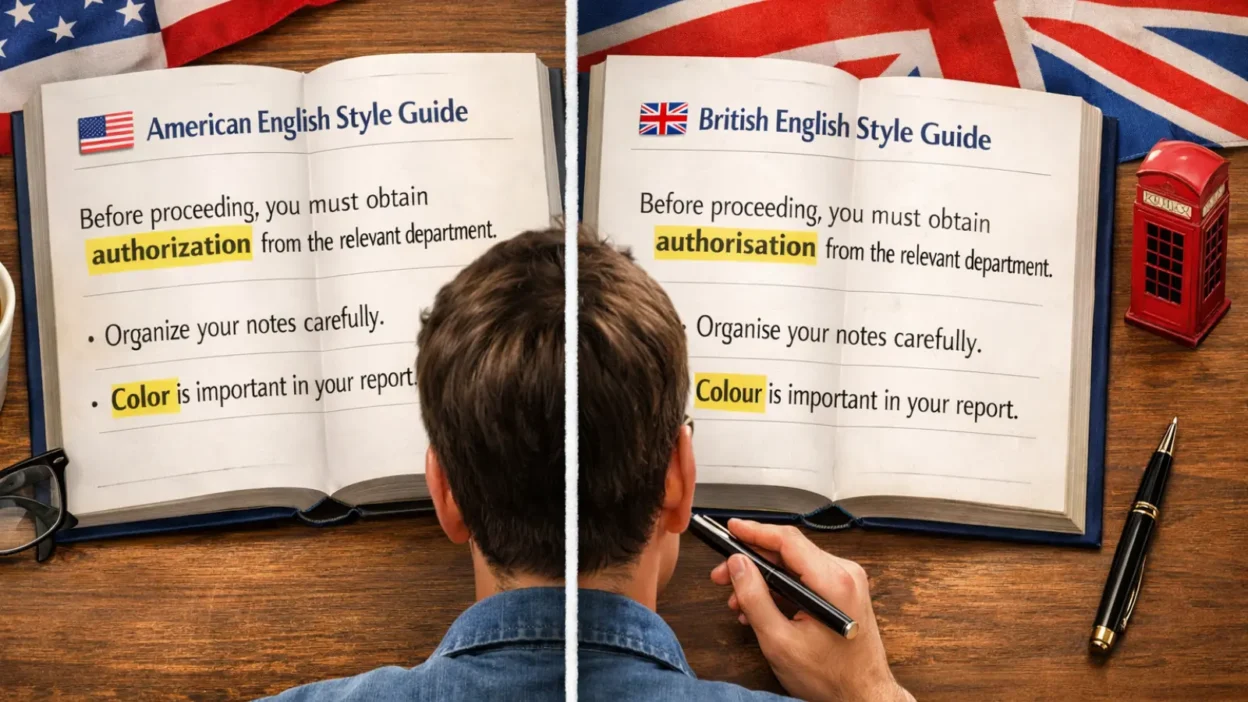
Many English writers pause at authorization vs. authorisation, especially when preparing business documents, emails, academic papers, legal forms, or website content.
The difference is not related to meaning. Instead, it reflects regional spelling conventions. Authorization is the standard spelling in American English, while authorisation is commonly associated with British English.
However, the distinction is slightly more nuanced than simply saying one spelling belongs to the United States and the other belongs everywhere else. Some British publishers and institutions also use the -ize spelling, while Canadian English frequently accepts authorization.
This guide explains which spelling to use, why both forms exist, how they appear in real sentences, and how to maintain consistency in professional writing.
Quick Answer
In American English, authorization is the correct and preferred spelling. Authorisation has the same meaning, but it follows a British-style -ise spelling convention and may look out of place in writing intended for a U.S. audience.
Both words mean official permission, approval, or the act of allowing someone to do something.
Authorization vs. Authorisation at a Glance
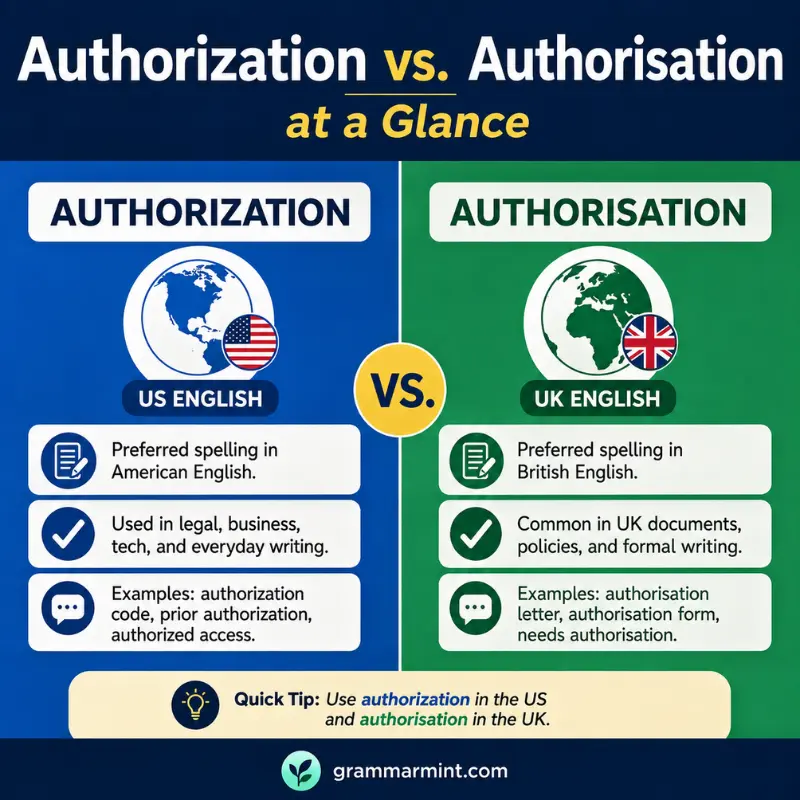
- Authorization is the standard American English spelling.
- Authorisation is a common British English spelling.
- Both words have the same definition.
- Their pronunciation is generally the same.
- The correct choice depends on your audience and chosen style.
- A document should not switch randomly between the two forms.
For American readers, use authorization unless an organization, quotation, product name, or official document requires a different spelling.
What Does Authorization Mean?
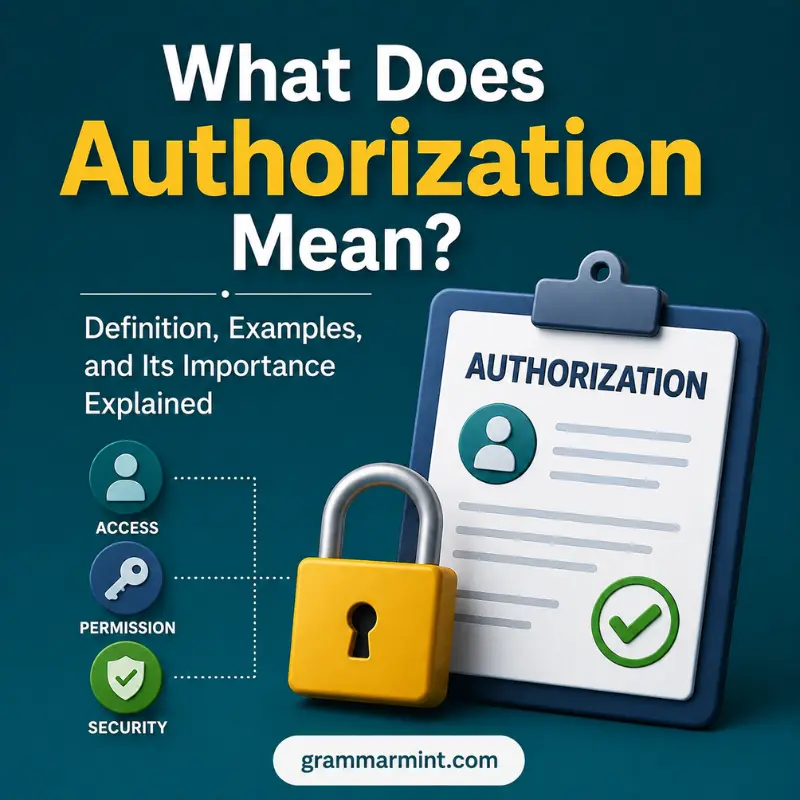
Authorization is a noun referring to official permission or approval.
It can describe either the permission itself or the process of granting that permission.
For example:
- You need written authorization to access the files.
- The manager gave authorization for the purchase.
- Payment authorization may take several seconds.
- The employee acted without proper authorization.
In each sentence, authorization refers to permission granted by a person, company, authority, or system.
The word is commonly used in business, technology, banking, healthcare, government, education, and legal communication.
Is Authorization or Authorisation Correct in American English?
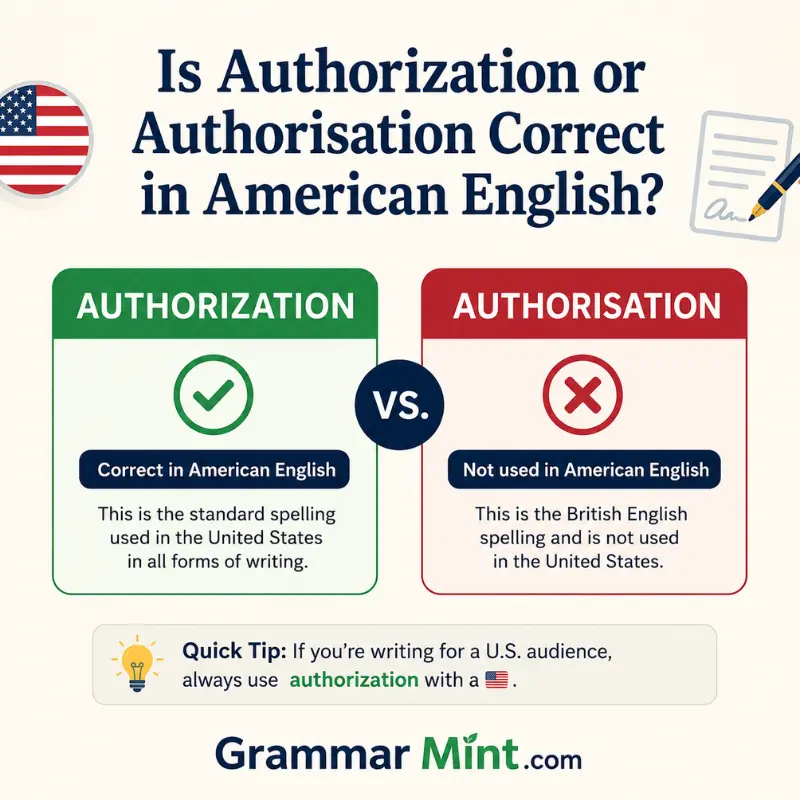
Authorization is correct in American English.
American dictionaries, publications, government agencies, universities, businesses, and legal institutions normally use spellings built from authorize, including:
- authorize
- authorizes
- authorized
- authorizing
- authorization
For example:
The account owner must provide authorization before the company can release the information.
Using authorisation in an American document would not usually make the sentence difficult to understand. However, many American readers, editors, and spell-checking programs would identify it as a British spelling.
Therefore, writers targeting the United States should use authorization.
Is Authorisation Incorrect?
Authorisation is not an incorrect word.
It is a legitimate spelling used in British English and in countries or organizations that follow British spelling conventions.
For example:
Written authorisation is required before the equipment can be removed.
This sentence is grammatically correct. It simply follows a style in which authorise and authorisation are written with -ise rather than -ize.
The choice becomes inappropriate only when it conflicts with the expected regional style. In a U.S. business proposal, for instance, authorisation may appear inconsistent or incorrectly localized.
Why Do Two Spellings Exist?
The variation comes from the different ways English-speaking regions standardized words ending in -ize and -ise.
American English generally favors -ize in words such as:
- authorize
- organize
- recognize
- specialize
- standardize
Many British writers use -ise instead:
- authorise
- organise
- recognise
- specialise
- standardise
The -ize ending has historical roots in Greek and Latin word formation. It is not simply a modern American invention. For that reason, some British publishers, including those following Oxford spelling conventions, also prefer -ize forms.
This means authorization may appear in both American and British writing, depending on the chosen style guide. However, authorisation remains uncommon in standard American English.
American and British Usage
The main difference can be summarized as follows:
American English
Use:
- authorize
- authorized
- authorizing
- authorization
Example:
The director authorized the department to hire two additional employees.
British English Using -ise
Use:
- authorise
- authorised
- authorising
- authorisation
Example:
The director authorised the department to hire two additional employees.
The meaning does not change. Only the spelling changes.
A Note About Canadian English
It is inaccurate to assume that every Commonwealth country automatically prefers authorisation.
Canadian English combines American and British spelling patterns. Canadian writers often use British forms such as colour, but many Canadian dictionaries and publications favor -ize endings in words such as authorize and organize.
As a result, authorization is common and widely accepted in Canada.
Organizations in Canada may still establish their own spelling rules, so writers should follow the relevant house style when one is available.
Which Spelling Should You Use?
Your audience should determine your choice.
For a U.S. Audience
Use authorization.
This includes:
- American business documents
- U.S. academic assignments
- workplace emails
- government forms
- legal writing
- software interfaces
- banking instructions
- website content for American readers
For a British Audience
Follow the publication or organization’s style guide.
Many British organizations use authorisation, but some follow Oxford spelling and use authorization.
For an International Audience
Select one recognized variety of English and apply it consistently.
For example, a global company may choose American English for all documentation. In that case, it should use authorization, even when some employees are based in countries that normally use British spelling.
Consistency is usually more important than trying to change spelling for every individual reader.
Authorization in Business Writing
In American business communication, authorization is the expected form.
Common phrases include:
- prior authorization
- written authorization
- payment authorization
- manager authorization
- purchase authorization
- account authorization
- security authorization
- authorization request
- authorization form
- authorization code
Examples:
- Written authorization is required before the contract can be changed.
- Please submit the purchase authorization form by Thursday.
- The accounting team is waiting for payment authorization.
- Only employees with security authorization may enter the facility.
- We received authorization to proceed with the project.
Because the word often appears in policies and formal procedures, spelling consistency is especially important.
Authorization in Legal and Official Writing
In U.S. legal and official contexts, authorization is the standard spelling.
It may refer to permission granted through:
- a law
- a contract
- a signed form
- a court order
- a company policy
- a government agency
- an authorized representative
Examples:
- The agent acted with the client’s authorization.
- No payment may be issued without written authorization.
- The authorization remains valid for 12 months.
- The applicant must sign the authorization section.
- Federal authorization may be required before construction begins.
Legal writers should preserve the exact spelling used in quoted statutes, contracts, and official titles. Outside direct quotations, the document’s chosen style should remain consistent.
Authorization in Technology and Cybersecurity
The word authorization has a specific role in technology.
It describes the process of determining what an authenticated user is permitted to access or do.
Authentication and authorization are related, but they are not identical:
- Authentication confirms who a user is.
- Authorization determines what that user is allowed to access.
For example, a person may successfully sign in to a company system through authentication. The system then uses authorization rules to decide whether that person can view financial records, edit customer accounts, or change administrative settings.
Examples:
- The server denied the authorization request.
- Users need administrator authorization to install the software.
- The application uses role-based authorization.
- Your card issuer declined the payment authorization.
- The authorization token has expired.
American software documentation normally uses authorization.
Authorization in Healthcare
In American healthcare communication, authorization commonly appears in phrases such as:
- prior authorization
- medical authorization
- treatment authorization
- insurance authorization
- release authorization
Examples:
- The procedure requires prior authorization from the insurance company.
- A parent must provide authorization for the child’s treatment.
- The clinic is waiting for insurance authorization.
- Please complete the medical-record authorization form.
- The patient withdrew authorization to release the information.
Writers should not change an official form’s wording, even when editing surrounding content. If a healthcare provider calls a document an “Authorization for Release of Information,” preserve that exact title.
Pronunciation
Authorization and authorisation are normally pronounced the same way.
A common American pronunciation is approximately:
aw-thuh-ruh-ZAY-shun
The spelling difference affects written language rather than everyday pronunciation.
That is why listeners usually cannot tell which spelling a speaker prefers. The regional distinction becomes visible only in writing.
Grammar and Word Family
Both spellings function as nouns.
American English Word Family
- authorize — verb
- authorized — past-tense verb or adjective
- authorizing — present participle
- authorization — noun
- unauthorized — adjective
Examples:
- The manager will authorize the payment.
- The bank authorized the transaction.
- She is responsible for authorizing refunds.
- We are waiting for final authorization.
- The system blocked an unauthorized login attempt.
British -ise Word Family
- authorise
- authorised
- authorising
- authorisation
- unauthorised
Do not mix the two families within the same document.
Incorrectly mixed:
The director authorised the purchase after receiving written authorization.
Consistent American English:
The director authorized the purchase after receiving written authorization.
Consistent British -ise style:
The director authorised the purchase after receiving written authorisation.
Common Mistakes and How to Fix Them
Using Authorisation in U.S. Content
Incorrect for standard American style:
Please provide authorisation before accessing the account.
Better:
Please provide authorization before accessing the account.
The original sentence is understandable, but the revised spelling fits an American audience.
Mixing Regional Spellings
Inconsistent:
The manager authorized the request, but written authorisation was still required.
Consistent American English:
The manager authorized the request, but written authorization was still required.
Assuming the Spellings Have Different Meanings
Some writers believe authorization and authorisation refer to different types of permission. They do not.
Both can describe:
- granting permission
- receiving permission
- official approval
- technical access rights
- a document proving permission
Depending Entirely on Spell-Check
A spelling program may accept or reject a word based on the document’s language settings.
For example, a document set to British English may flag authorization, while a document set to American English may flag authorisation.
Before editing, check whether the software is using:
- English (United States)
- English (United Kingdom)
- English (Canada)
- English (Australia)
Changing Words Inside Official Names
Do not automatically alter the spelling in an official title, quoted passage, organization name, or document label.
For example, a British organization may officially call a document an “Authorisation Form.” Preserve that wording when referring to the official document, even in otherwise American prose.
Real-Life Examples in American English
Text Message
Do you have authorization to enter the building?
Workplace Email
Please send the signed authorization form before Friday afternoon.
Business Report
The department received authorization to increase the project budget.
Banking Notice
Your payment authorization was declined by the card issuer.
Medical Message
The insurance provider has not yet approved the prior authorization request.
Academic Administration
Students need written authorization to access the restricted archive.
Technology Policy
Administrator authorization is required to change these settings.
Legal Document
The representative may act only with the client’s written authorization.
Casual Conversation
We finally got authorization to start renovating the office.
Although the word often sounds formal, it can appear naturally in everyday situations involving official permission.
Formal and Informal Alternatives
Authorization is useful when permission is official, documented, or connected to an authority.
In less formal communication, simpler alternatives may sound more natural.
Instead of:
I need your authorization to share the photo.
You could write:
I need your permission to share the photo.
Other possible alternatives include:
- permission
- approval
- consent
- clearance
- access
- confirmation
These words are not always interchangeable.
For example, consent often emphasizes voluntary agreement, while clearance may refer to security or administrative approval. Authorization is especially suitable when a person or system has the formal power to permit an action.
Comparison Table
| Context | Recommended Spelling | Reason |
|---|---|---|
| U.S. business document | authorization | Standard American spelling |
| American academic paper | authorization | Matches U.S. English conventions |
| U.S. legal document | authorization | Expected spelling in American legal writing |
| American website | authorization | Appropriate for U.S. readers |
| British document using -ise style | authorisation | Matches the chosen British convention |
| British document using Oxford style | authorization | Oxford style commonly permits or prefers -ize |
| Canadian document | Usually authorization | -ize forms are widely accepted in Canadian English |
| International company document | Follow the house style | Consistency across the organization is essential |
| Direct quotation | Preserve the original spelling | Quoted wording should not be silently altered |
| Official form or title | Use the official version | Formal names should remain unchanged |
How to Keep Your Spelling Consistent
Use these practical steps when preparing a document:
- Identify your primary audience.
- Select American, British, Canadian, or another recognized English style.
- Set the correct language in your writing software.
- Search the document for both “authoriz” and “authoris.”
- Check related words such as authorized, authorizing, and unauthorized.
- Preserve spellings inside quotations and official titles.
- Follow the organization’s house style when one exists.
A final search is particularly helpful in documents written by multiple contributors. One writer may use American spelling while another uses British spelling.
FAQs
Is Authorisation Wrong in the United States?
It is not meaningless or universally incorrect, but it is not the standard American spelling. In most U.S. documents, editors would change authorisation to authorization.
Do Authorization and Authorisation Mean the Same Thing?
Yes. Both words mean official permission, approval, or the process of giving someone permission to do something.
Can I Use Authorization in British English?
Yes. Some British publications and institutions use -ize spellings, especially when following Oxford style. British writers should follow the style guide required by their organization or publisher.
Is Authorisation Used in Canada?
It may appear, but authorization is also common and widely accepted in Canadian English. Canadian usage does not always follow British spelling rules consistently.
Which Verb Goes With Authorization?
Use authorize with authorization in American English.
Example:
The supervisor authorized the request after reviewing the authorization form.
Can I Mix Authorization and Authorisation?
Avoid mixing them in original prose. Choose one spelling system and apply it throughout the document. Preserve the original spelling only in direct quotations, official titles, and proper names.
Is Authorization a Formal Word?
It is more formal than permission, but it is common in professional and administrative communication. It is particularly appropriate in legal, financial, medical, technological, and workplace contexts.
Mini Quiz
1. Which spelling should appear in a U.S. job application?
Answer: Authorization
2. Which sentence follows American English?
A. The manager provided written authorisation.
B. The manager provided written authorization.
Answer: B
3. Do the two spellings have different meanings?
Answer: No. Their meanings are identical.
4. Should you use authorize in one paragraph and authorise in another?
Answer: No. Choose one regional style and remain consistent.
5. Can authorization appear in British English?
Answer: Yes. Some British style systems use -ize spellings.
6. Which spelling is normally used in American software documentation?
Answer: Authorization
Conclusion
For American English, authorization is the correct and preferred spelling. It is the standard choice in U.S. business documents, academic writing, legal communication, healthcare forms, banking instructions, and technology content.
Authorisation carries the same meaning, but it follows a British-style -ise convention. It is not inherently wrong, although it may appear inconsistent in writing created for American readers.
The most reliable rule is simple: use authorization for a U.S. audience, follow the required style guide for other regions, and keep the spelling consistent throughout your document.