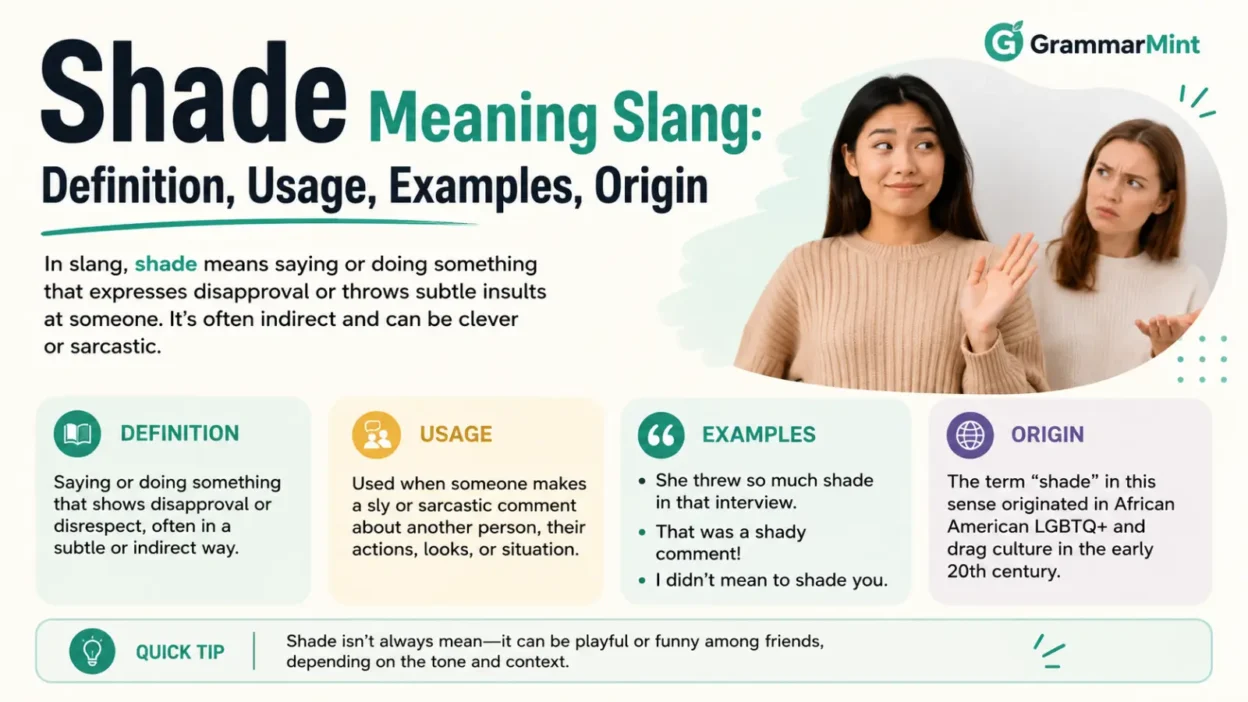
You may see shade in texts, comments, group chats, reality shows, memes, interviews, and everyday talk. In slang, the word does not mean darkness from the sun. It means a subtle insult, a sharp comment, or indirect disrespect.
This matters because shade can sound playful in one setting and rude in another. A friend may laugh at it, but a coworker may feel attacked. This guide explains the meaning, definition, pronunciation, part of speech, origin, examples, related terms, and common mistakes.
You will also learn when to use it, when to avoid it, and how to understand phrases like “throw shade” and “no shade.”
Quick Answer
Shade meaning slang: shade is an indirect insult or subtle sign of disrespect. It can be spoken, written, or shown through a look, pause, or reaction.
TL;DR
• Shade means indirect disrespect.
• It is usually informal slang.
• “Throw shade” means criticize subtly.
• Shade can be playful or mean.
• Context decides the tone.
• Avoid it in formal writing.
What Shade Means in Slang
In slang, shade means a comment or action that insults someone indirectly. It is not always loud or obvious. The sting often comes from what is implied.
A person can throw shade with a sentence, facial expression, or pointed silence. The meaning depends on tone, timing, and relationship.
Example: “Nice outfit. Very brave choice.”
That may sound polite, but it can carry shade.
Shade Definition in Plain English
Shade is subtle disrespect. It often sounds calm on the surface, but it carries a negative message underneath.
A simple definition is this: shade is an indirect insult that suggests criticism without saying it plainly.
For example, “She finally arrived on time” may be shade. It suggests the person is usually late.
Shade is different from plain criticism. Criticism is direct. Shade is more hidden, clever, or sarcastic.
Part of Speech and Pronunciation
Shade is pronounced “shayd.” It rhymes with made, paid, and stayed.
In slang, shade can work in several ways.
• Noun: “That comment was shade.”
• Verb: “He shaded her outfit.”
• Phrase: “She threw shade at him.”
The phrase “throw shade” is very common. You can also see “cast shade,” but “throw shade” sounds more natural in casual English.
How Shade Works in Conversation
Shade often works through suggestion. The speaker does not say the full insult. The listener understands it from context.
Tone is important. A flat voice, raised eyebrow, or fake compliment can change the meaning.
Example: “Wow, you actually finished the project.”
This can suggest surprise that the person completed anything.
Shade can also be nonverbal. An eye roll, smirk, or slow pause may send the message.
How to Use Shade Correctly
Use shade only in informal settings. It fits casual talk, social posts, entertainment writing, and friendly joking.
The most common pattern is “throw shade at someone.”
| Context | Best Choice | Why |
|---|---|---|
| Casual chat | “She threw shade at him.” | Natural slang use |
| Formal report | “She criticized him indirectly.” | Clear and professional |
| Friendly joke | “No shade, but that was messy.” | Softens the comment |
Be careful with “no shade.” It means “no disrespect,” but it can still introduce criticism.
Example: “No shade, but that presentation felt rushed.”
Common Contexts and Examples
Shade appears often in social talk. You may see it in entertainment news, comments, captions, or group chats.
Everyday examples:
• “That was a lot of shade for one sentence.”
• “He threw shade at his old team.”
• “No shade, but I liked your first design better.”
• “Her smile said everything. Pure shade.”
• “They shaded the restaurant without naming it.”
In texting, shade can be harder to read. Without voice or facial expression, a joke may feel mean.
Origin and Cultural Context
Modern slang use of shade is often linked to Black and Latino gay ballroom and drag culture. It became widely known through drag performance, pop culture, and social media.
The idea behind shade is not just random rudeness. It often involves wit, timing, and indirect expression.
Still, the word has cultural roots. Use it with respect, not as a way to mock the people or communities that shaped it.
Today, many people use shade in general casual English. It remains informal and context-sensitive.
Synonyms, Antonyms, and Related Terms
Shade has close synonyms, but none match it perfectly.
Close synonyms:
• subtle insult — clear and simple
• indirect criticism — more formal
• diss — casual and more direct
• jab — quick critical remark
• sarcasm — related, but not always shade
Useful antonyms depend on context.
• praise
• compliment
• respect
• support
Related terms:
• shady: suspicious, dishonest, or questionable
• throw shade: criticize indirectly
• no shade: no disrespect
• read: a sharper, more direct insult in related slang use
• roast: a direct joke or insult, often public
Common Mistakes and Mini Quiz
A common mistake is using shade for every insult. Shade is usually indirect. A direct insult is not always shade.
Wrong: “You are terrible.”
Better: That is a direct insult.
Shade: “Well, at least you tried.”
Another mistake is confusing shade with shadow. In slang, shade does not mean a cool place away from sunlight.
Mini quiz:
- Does shade mean direct praise?
- Is “throw shade” formal?
- What does “no shade” try to mean?
- Can shade be nonverbal?
- Is “You are awful” subtle shade?
Answer key:
- No.
- No.
- No disrespect.
- Yes.
- No, it is direct.
FAQs
What does shade mean in slang?
Shade means indirect disrespect or a subtle insult. It is often clever, sarcastic, or implied. The person may not say the criticism directly.
What does it mean to throw shade?
To throw shade means to criticize or disrespect someone indirectly. The phrase is informal. It often appears in casual speech, social posts, and entertainment writing.
Is shade always rude?
Not always. Shade can be playful between close friends. Still, it can feel rude if the person feels targeted or embarrassed.
Can shade be a compliment?
Shade can look like a compliment, but it usually has a hidden insult. For example, “That dress is unforgettable” could be kind or shady. Tone decides the meaning.
What does no shade mean?
No shade means “no disrespect” or “I am not trying to insult you.” People often say it before giving honest criticism. It does not always remove the sting.
Is shade the same as gossip?
No. Gossip is talk about someone’s private life or behavior. Shade is indirect disrespect. A comment can be both, but they are not the same thing.
Can I use shade at work?
Use it carefully. It may sound unprofessional in serious workplace writing. In formal settings, use “indirect criticism” or “disrespectful comment” instead.
Conclusion
Shade meaning slang is simple: it means indirect disrespect or a subtle insult.
Use it in casual contexts, but watch the tone. When the setting is serious, choose clearer and kinder wording.