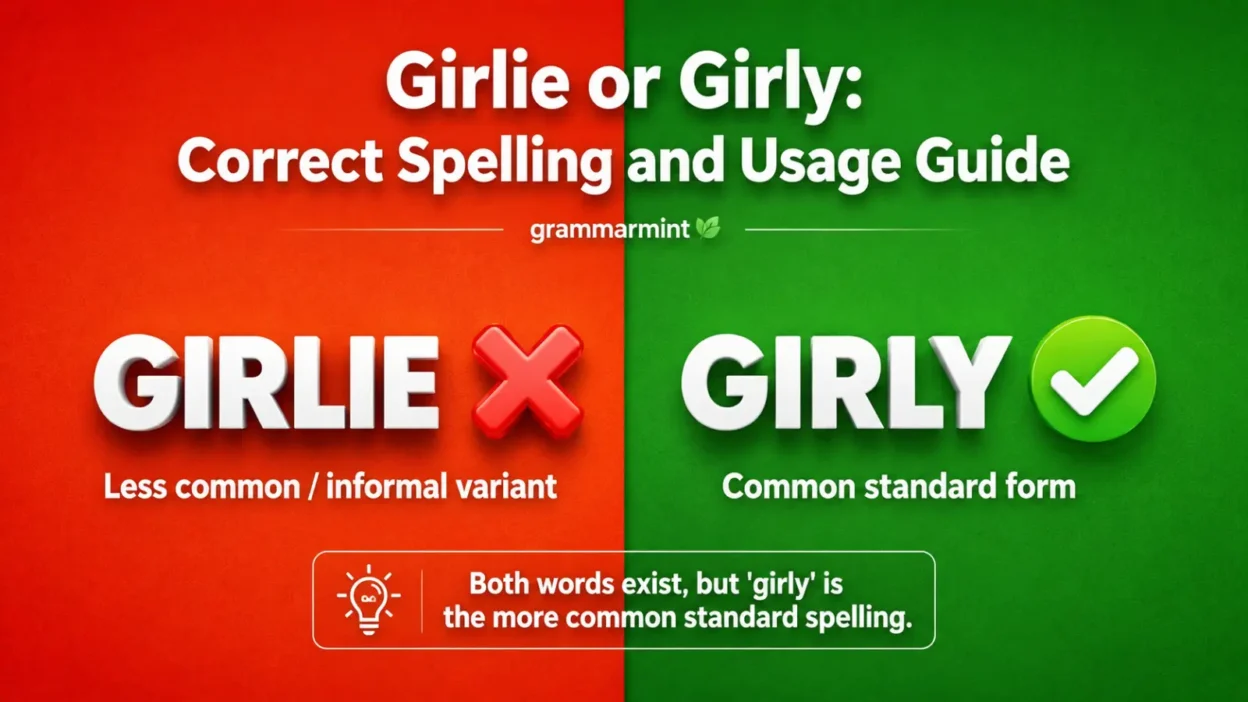
If you’re choosing between Girlie or Girly, you probably want your sentence to sound natural, clear, and current. The words look alike, but they do not always carry the same feeling. In most U.S. writing, “girly” is the better everyday choice. It fits fashion, décor, captions, texting, personality, and style descriptions without sounding unusual. However, “girlie” is still a real word, and it can work in playful, retro, or phrase-based contexts. This guide explains the difference in plain English, so you can pick the right spelling with confidence.
Quick Answer
Girlie or Girly comes down to tone: use “girly” for most modern U.S. writing, and use “girlie” only when you want a playful, old-fashioned, or special phrase-based feel.
TL;DR
• “Girly” is the safer modern spelling.
• “Girlie” is real but less common.
• Use “girly” for U.S. writing.
• Use “girlie” for playful style.
• Avoid both when tone feels dismissive.
Girlie Or Girly Quick Answer
The correct spelling for most everyday writing is “girly.” It is the standard spelling in modern U.S. English. Meanwhile, “girlie” works as an informal variant when the tone is playful or intentionally retro.
• Use “girly” for everyday descriptions.
• Choose “girly” in school assignments.
• Pick “girly” for blog writing.
• Use “girly” in product descriptions.
• Try “girly” for fashion captions.
• Save “girlie” for playful wording.
• Use “girlie” in casual nicknames.
• Avoid “girlie” in formal emails.
• Keep one spelling per piece.
• Match the spelling to tone.
• Consider your reader’s age.
• When unsure, choose “girly.”
Girly Or Girlie Meaning
Both spellings point toward a feminine style, a cute tone, or something girl-like. Still, they do not feel identical. “Girly” sounds more current, while “girlie” sounds more playful or older.
• “Girly” describes a soft style.
• “Girly” can describe clothing.
• “Girly” can describe room décor.
• “Girly” often fits beauty topics.
• “Girly” may describe personality.
• “Girlie” can sound affectionate.
• “Girlie” may sound old-school.
• “Girlie” can feel extra cute.
• Context changes the meaning fast.
• Tone matters more than spelling.
• Reader reaction matters too.
• Choose warmth over stereotypes.
Girly Definition
“Girly” is usually an adjective. It describes something linked with a feminine look, mood, habit, or style. In modern English, it is the more natural spelling for most American readers.
• A girly dress has feminine details.
• A girly room may use pastels.
• A girly logo may feel soft.
• A girly hobby can sound playful.
• A girly voice describes sound.
• A girly theme suggests style.
• A girly gift feels cute.
• A girly design may use florals.
• A girly outfit can be bold.
• A girly caption feels light.
• A girly brand needs balance.
• A girly sentence needs context.
Girlie Definition
“Girlie” can mean girlish, but it often carries a playful spelling or dated tone. Because of that, it needs more care. It can sound sweet in one sentence and awkward in another.
• “Girlie” may work in jokes.
• “Girlie” can fit retro branding.
• “Girlie” appears in older phrases.
• “Girlie” may sound less neutral.
• “Girlie” can feel extra casual.
• “Girlie” suits close friendships sometimes.
• “Girlie” rarely fits formal reports.
• “Girlie” may confuse young readers.
• “Girlie” can sound intentionally cute.
• “Girlie” may feel British sometimes.
• “Girlie” should match the voice.
• “Girlie” needs clear context.
Girly Vs Girlie
The main tone difference is simple. “Girly” feels clean, flexible, and modern. The usage difference is that “girlie” is a spelling variant with stronger style attached.
• “Girly” sounds more neutral.
• “Girlie” sounds more marked.
• “Girly” works in more places.
• “Girlie” needs a reason.
• “Girly” fits American readers better.
• “Girlie” can feel nostalgic.
• “Girly” describes things smoothly.
• “Girlie” may act like slang.
• “Girly” feels less distracting.
• “Girlie” draws attention quickly.
• “Girly” is easier to defend.
• “Girlie” works best sparingly.
Is Girlie A Word
Yes, “girlie” is a real word. It appears as a dictionary entry, so it is not simply a typo. However, being an accepted variant does not make it the best choice everywhere.
• “Girlie” is not fake.
• “Girlie” is not always wrong.
• “Girlie” is less common today.
• “Girlie” can still be useful.
• “Girlie” should feel intentional.
• “Girlie” may seem informal.
• “Girlie” can fit brand names.
• “Girlie” may fit captions.
• “Girlie” needs tone awareness.
• “Girlie” should not replace “girly” automatically.
• “Girlie” can carry baggage.
• “Girlie” works with caution.
Girly In American English
In U.S. English, “girly” is the safer choice for everyday writing. It looks more natural to American readers. Also, it works across casual, creative, and semi-professional settings.
• Use “girly” in the United States.
• Prefer “girly” for schoolwork.
• Choose “girly” for workplace notes.
• Use “girly” for online articles.
• Try “girly” in captions.
• Pick “girly” for shopping pages.
• Use “girly” for style guides.
• Avoid “girlie” in serious contexts.
• Keep “girlie” for playful moods.
• Let audience guide the choice.
• American readers expect “girly.”
• Consistency makes writing smoother.
Girly And Girlie Examples
Good example sentences show natural usage and clear context. Therefore, the best way to learn the difference is to compare real sentence patterns. Notice how “girly” blends in more easily.
• Her room has a girly vibe.
• That bow looks very girly.
• I love this girly phone case.
• The invitation feels sweetly girly.
• This palette looks soft and girly.
• The brand uses girly details.
• She wanted a girly birthday theme.
• That caption sounds casually girlie.
• Hey girlie, are you free?
• This has a retro girlie feel.
• The flyer looks too girlie.
• Choose girly for clearer wording.
Girly Girl Meaning
A girly girl is someone who enjoys a feminine identity or personal style linked with traditionally feminine things. However, the phrase should be used with care. It is best when someone uses it for themselves.
• She calls herself a girly girl.
• The phrase can feel affectionate.
• It often suggests feminine interests.
• It may include makeup.
• It may include dresses.
• It may include soft colors.
• It can describe personal taste.
• It should not box anyone in.
• Avoid using it as criticism.
• Let people define themselves.
• Use it warmly, not sharply.
• Context keeps it respectful.
Girlie Girl Meaning
“Girlie girl” means nearly the same thing as “girly girl.” Yet the retro feel makes it a stronger stylistic choice. Because of that, it suits playful writing better than neutral explanation.
• “Girlie girl” feels more decorative.
• It may look intentionally cute.
• It can suit nostalgic branding.
• It feels less standard today.
• It may work in captions.
• It can sound like a nickname.
• It may seem overly sweet.
• It needs the right audience.
• It should not sound mocking.
• It works better in casual spaces.
• It is not the default phrase.
• “Girly girl” is usually safer.
Girlies Meaning
“The girlies” is friendly slang often used on social media. It usually refers to girls, women, friends, fans, or people sharing a vibe. Still, it is casual, so it does not fit every setting.
• “The girlies” sounds friendly online.
• It often means close friends.
• It can mean a fan group.
• It may include shared interests.
• It works in captions.
• It appears in comments.
• It sounds informal by nature.
• It should match the audience.
• It can feel warm.
• It can also feel cliquey.
• Avoid it in formal writing.
• Use it only casually.
Girly Aesthetic
The girly aesthetic often includes pastel style, bows, florals, gloss, soft textures, and soft fashion. Still, the look can be simple or bold. In captions, “girly” usually fits better than “girlie.”
• Girly aesthetic often uses pinks.
• Pastels can create softness.
• Bows add a sweet detail.
• Florals create a romantic mood.
• Pearls can feel polished.
• Lace adds delicate texture.
• Glossy makeup feels playful.
• Ballet-inspired pieces fit well.
• Coquette details may appear.
• Soft lighting supports the vibe.
• Minimal looks can stay girly.
• Bold looks can too.
Girly In Text
In texting slang, “girly” usually describes a caption style, outfit, plan, or casual message. It can feel friendly and light. However, “girlie” is more common as a greeting or playful address.
• “So girly” praises the vibe.
• “Hey girlie” sounds casual.
• “Feeling girly” fits captions.
• “Girly day” suggests fun plans.
• “Girly pop” sounds trendy.
• “Girlies night” feels social.
• “Too girly” can sound negative.
• “Girlie” works with close friends.
• “Girly” works in descriptions.
• Tone depends on the relationship.
• Emojis can soften meaning.
• Respect beats trendiness.
Girly Vs Girlish
“Girlish” often points to a youthful tone or childlike quality. “Girly” usually points to a feminine quality, style, or taste. So, the two words overlap, but they are not perfect twins.
• “Girly” often describes style.
• “Girlish” often describes youthfulness.
• “Girly” can suit adult fashion.
• “Girlish” may sound younger.
• “Girly” feels more casual.
• “Girlish” feels more literary.
• “Girly” works in captions.
• “Girlish” works in descriptions.
• “Girlish laugh” sounds natural.
• “Girly dress” sounds natural.
• Choose based on meaning.
• Avoid childish implications.
Girlie Magazine Meaning
“Girlie magazine” is a fixed phrase with an adult context and an old-fashioned use. Because the phrase has a specific history, do not swap it casually into modern style writing. It is not the same as a girly magazine layout.
• “Girlie magazine” is phrase-specific.
• It can refer to adult material.
• It sounds dated today.
• It should be used carefully.
• It is not a style compliment.
• It differs from “girly magazine.”
• Context prevents confusion.
• Avoid it in brand copy.
• Do not use it casually.
• Use neutral wording when possible.
• “Girly layout” means something different.
• Meaning changes by phrase.
Is Girly Offensive
“Girly” is not automatically offensive, but it can become a stereotype. A dismissive tone can make the word sound insulting. For respectful wording, describe the style without judging the person.
• “Girly” can be positive.
• “Girly” can be dismissive.
• Tone changes everything.
• Avoid mocking someone’s taste.
• Do not use it to belittle.
• Be careful with boys.
• Be careful with adults.
• Use “feminine” when needed.
• Use “soft” for design.
• Use “playful” for mood.
• Let people self-label.
• Respect makes wording safer.
FAQs
Is Girly Or Girlie The Correct Spelling?
Both spellings exist, but “girly” is the better choice for most modern U.S. writing. Use “girlie” only when you want a playful, retro, or casual feel.
Is “Girlie” Wrong?
No, “girlie” is not wrong by itself. However, it can look less standard, so it may not fit schoolwork, professional notes, or clear informational writing.
Which Is More Modern: Girlie Or Girly?
“Girly” is more modern in everyday use. “Girlie” often feels older, cuter, or more stylized.
Can I Use “Girly” In Formal Writing?
You can, but use it carefully. In very formal writing, “feminine,” “soft,” “delicate,” or “playful” may sound more precise.
Why Do Some People Still Use “Girlie”?
Some people use “girlie” for affection, nostalgia, branding, or online personality. It can also appear in fixed phrases and playful greetings.
What’s The Plural Form?
For the slang noun, the plural is “girlies.” For the phrase, write “girly girls” or “girlie girls,” depending on the spelling you choose.
Is “Girly” Positive Or Negative?
It depends on tone. It can be sweet and positive, but it can also sound dismissive when used to judge someone’s style, interests, or behavior.
Conclusion
Girlie or Girly is easy once you focus on tone. Use “girly” for most clear, modern U.S. writing, and save “girlie” for playful or special contexts. When in doubt, choose the spelling that sounds kind, natural, and respectful.