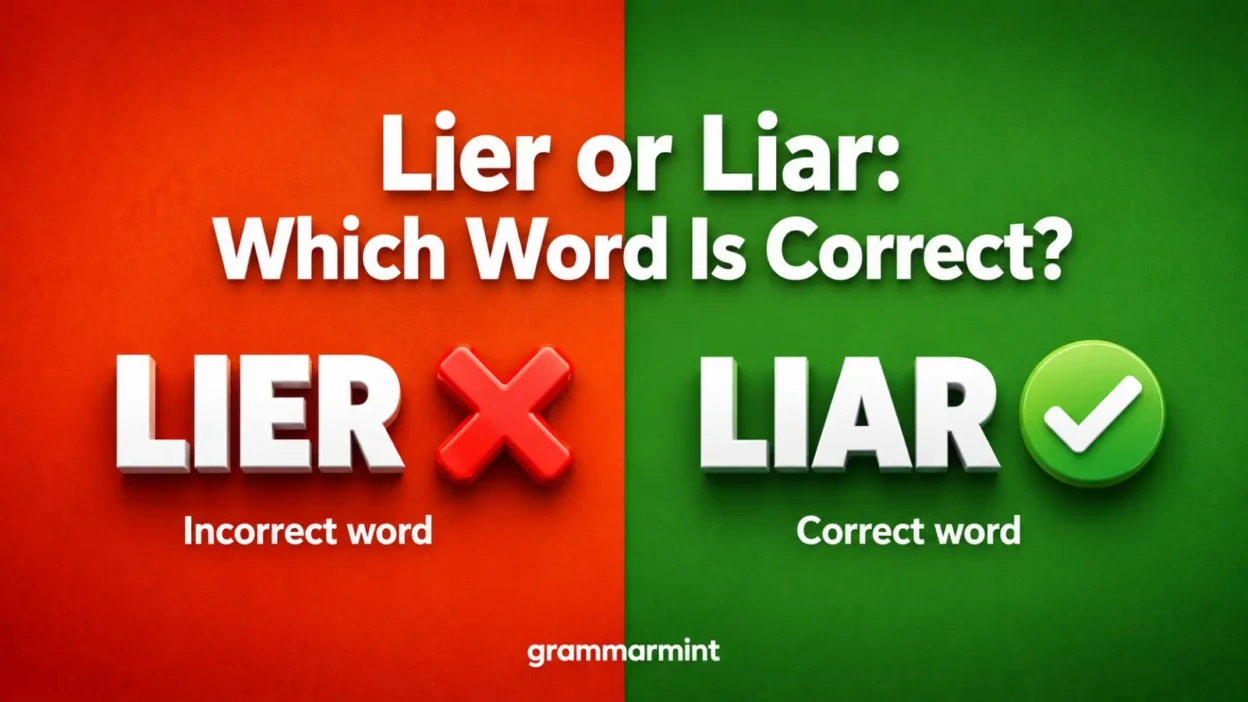
Lier or liar is a common word-choice mix-up because the words look almost the same and sound the same in normal speech. The right choice depends on what you mean.
Most of the time, the correct word is liar.
Use liar when you mean a person who tells lies or says things that are not true.
Use lier only in the rare sense of a person or thing that lies down, lies in a place, or lies in wait. In everyday US English, most readers do not expect to see lier, so it can look like a mistake even when a dictionary allows it.
That is the key point: liar is the normal word. Lier is real, but rare.
Quick Answer
Choose liar when you are talking about dishonesty.
Correct:
He is a liar.
This means he tells lies.
Usually wrong in modern writing:
He is a lier.
This looks like a misspelling if you mean he is dishonest.
Use lier only when the meaning comes from lie as in “to lie down” or “to lie in wait.” Even then, a clearer phrase is usually better.
Possible but uncommon:
The dog is a lier by the sunny window.
More natural:
The dog likes lying by the sunny window.
So for most emails, essays, captions, comments, messages, and school writing, the safe answer is simple: write liar, not lier, when you mean someone who does not tell the truth.
Why People Confuse Them
People confuse lier and liar for three main reasons.
First, both words sound like LYE-er in American English. When two words sound alike, spelling becomes harder. You cannot hear the difference in conversation.
Second, both words connect to the verb lie, but not to the same meaning of that verb. English uses lie in more than one way. One meaning is “to say something false.” Another meaning is “to rest in a flat position” or “to be located.”
Third, lier looks logical. Many English words name a person by adding -er to a verb: worker, driver, reader, runner. So a person may guess that someone who lies is a lier. But for dishonesty, standard English uses liar.
That small vowel change matters. Liar means a dishonest person. Lier does not normally mean that in current US usage.
Key Differences At A Glance
| Context | Best Choice | Why |
|---|---|---|
| A person tells false stories | liar | This is the standard noun for someone who lies. |
| Someone gives a false excuse | liar | The meaning is dishonesty. |
| A text message says “your a lier” | liar | The intended meaning is almost certainly “a person who tells lies.” |
| A person or animal is lying down | not usually lier | Use “is lying down,” “is resting,” or “is reclining” for natural wording. |
| A person waits secretly to attack or trap someone | lier, but rare | This older sense connects to “lying in wait,” though a clearer phrase is usually better. |
| Formal work, school writing, or business writing | liar for dishonesty | Readers expect the standard spelling. |
| Creative or old-fashioned wording | lier may appear | It still may feel unusual to modern readers. |
Compact comparison:
- Liar = a person who tells lies.
- Lier = a rare noun for one that lies down, lies in a place, or lies in wait.
- Liar is common and clear.
- Lier is uncommon and often mistaken for an error.
- If the sentence is about dishonesty, use liar.
Meaning and Usage Difference
Liar is a noun. It means a person who tells lies. A lie is something said as false or untrue, often with the purpose of misleading someone.
Examples:
Maya called him a liar after he changed his story twice.
Do not call someone a liar unless you are ready to back it up.
The report made him look like a liar.
Lier is also a noun, but it comes from a different meaning of lie. It can refer to someone or something that lies down, lies in a place, or lies in wait. This word is not common in everyday American English.
Example:
A hunter hidden in the brush could be called a lier in wait.
Even that sentence sounds old-fashioned. Most modern writers would say:
A hunter was lying in wait in the brush.
That is why the difference is not just spelling. The two words point to different meanings.
They are pronounced alike in ordinary US speech: LYE-er. Because they sound the same, the difference only shows in writing.
Tone, Context, and Formality
Liar is a strong word. It can sound direct, angry, serious, or accusing. Calling someone a liar is not a soft comment. It says the person tells lies, and it often suggests blame.
In casual speech, people use it quickly:
You told everyone I quit? You’re a liar.
In formal writing, it can still be correct, but it should be used carefully:
The witness was described as a liar by the defense.
Lier has a different tone problem. It does not usually sound rude; it sounds unfamiliar. Many readers may think it is a typo. If you write lier when you mean liar, your sentence will look less polished.
Even when lier is technically possible, it may feel stiff, dated, or strange. For modern US readers, direct wording is usually better:
Better: The cat is lying on the couch.
Awkward: The cat is a lier on the couch.
So the tone difference is clear. Liar is strong but normal. Lier is rare and usually distracting.
Which One Should You Use?
Use liar if your sentence is about truth, falsehood, honesty, deception, or someone making things up.
Use liar in sentences like these:
She is not a liar; she just misunderstood the question.
He looked like a liar when the video proved him wrong.
Nobody wants to be called a liar in front of the whole team.
Avoid lier in those sentences. It does not mean “dishonest person” in standard modern use.
Use a phrase instead of lier when your sentence is about position or rest:
Instead of: My dog is a lier near the heater.
Write: My dog is lying near the heater.
Instead of: He is a lier on the sofa.
Write: He is lying on the sofa.
Use lier only if you have a special reason, such as old-fashioned wording, a dictionary-style discussion, or a phrase tied to “lying in wait.” For normal writing, it is rarely the best choice.
When One Choice Sounds Wrong
Lier sounds wrong when the sentence is about dishonesty.
Wrong: She lied about the money, so she is a lier.
Correct: She lied about the money, so she is a liar.
Wrong: The post called him a lier.
Correct: The post called him a liar.
Wrong: I know you are not a lier.
Correct: I know you are not a liar.
Liar sounds wrong when the sentence is about someone lying down without any dishonesty.
Wrong: The baby is a quiet liar in the crib.
Better: The baby is lying quietly in the crib.
Wrong: The cat is a lazy liar in the sun.
Better: The cat is lying lazily in the sun.
In real life, though, the best fix for the second group is usually not lier. The best fix is to rewrite the sentence with lying, resting, or reclining.
Common Mistakes (and Quick Fixes)
Mistake 1: Using lier for a dishonest person.
Fix: Use liar.
Wrong: He is a lier who keeps making excuses.
Correct: He is a liar who keeps making excuses.
Mistake 2: Thinking lier is always fake.
Fix: Know that lier exists, but it is rare and not the normal word for dishonesty.
Better understanding: Lier is real, but it usually is not the word you need.
Mistake 3: Using liar for someone lying down.
Fix: Use lying down or another clear phrase.
Wrong: The patient is a liar in the hospital bed.
Correct: The patient is lying in the hospital bed.
Mistake 4: Letting sound guide the spelling.
Fix: Ask what the sentence means. If it means “someone who tells lies,” write liar.
Mistake 5: Overusing liar in serious writing.
Fix: Use it only when the accusation is clear. In softer contexts, try untruthful, misleading, or not honest.
Everyday Examples
Here are natural US-English examples with liar:
I felt like a liar when I pretended everything was fine.
She is not a liar; she got the date wrong.
The customer called the manager a liar during the argument.
If you keep changing your story, people will think you are a liar.
He lied about finishing the project, and now everyone sees him as a liar.
Calling someone a liar online can make a bad argument worse.
Now compare examples where lier would not be natural:
Awkward: The dog is a lier on the rug.
Natural: The dog is lying on the rug.
Awkward: She is a lier in bed after a long shift.
Natural: She is lying in bed after a long shift.
Rare: The lier in wait stayed hidden.
Natural: The person lying in wait stayed hidden.
These examples show the real rule in action. Liar belongs in honesty-related sentences. Lier is so rare that a phrase is usually clearer.
Dictionary-Style Word Details
Verb
Lier: Not commonly used as a verb in standard US English. Lier is a noun, not the action word. The related verb is lie, as in lie down or lie in wait.
Example: The cat likes to lie in the sun.
Liar: Not used as a verb in standard US English. Liar is a noun. The related verb is lie, as in to tell a lie.
Example: He might lie about where he was.
The tricky part is that lie has more than one meaning. That is why liar and lier do not mean the same thing.
Noun
Lier: A rare noun for a person or thing that lies down, lies in a place, or lies in wait. It is not the normal modern word for a dishonest person.
Example: The phrase “lier in wait” may appear in older or formal wording.
Liar: A common noun for a person who tells lies.
Example: A liar can lose people’s trust quickly.
This is the main difference readers need to remember.
Synonyms
Lier: Exact everyday synonyms are not very useful because the word itself is rare. Closest plain alternatives are one lying down, one resting, one reclining, or one lying in wait, depending on the sentence.
Liar: Meaning-matched synonyms include fibber, fabricator, deceiver, and prevaricator. These words are not always equal in tone. Fibber can sound lighter. Deceiver is serious. Prevaricator is formal.
Helpful antonyms for liar include truth-teller and honest person. There is no strong everyday antonym for lier because it describes position or waiting, not character.
Example Sentences
Lier:
The old story described a lier in wait near the road.
In modern writing, “person lying in wait” usually sounds clearer than “lier.”
For someone resting on a couch, “lying on the couch” is more natural than “lier.”
Liar:
She called him a liar after finding the fake receipt.
I do not want to sound like a liar, so I will correct the mistake now.
He was labeled a liar because his story kept changing.
Word History
Lier: The word is formed from lie in the sense of lying down, being placed, or waiting in hiding, plus a noun-forming ending. Its history is tied to that physical or positional meaning of lie.
Liar: The word is tied to lie in the sense of saying something false. It is the standard noun for a person who tells lies.
The important history point is safe and simple: these words come from different senses of lie. That is why they look similar but do not carry the same meaning.
Phrases Containing
Lier: There are no common everyday US phrases with lier. The phrase lier in wait may appear, but person lying in wait is clearer for most modern readers.
Liar: Common phrases include a known liar, a compulsive liar, a pathological liar, a bald-faced liar, and liar, liar. These phrases all connect to dishonesty.
Use those phrases carefully. They can sound harsh because they judge a person’s honesty.
FAQs
Is it lier or liar?
Use liar when you mean a person who tells lies. Liar is the standard word for someone who says things that are not true. Major dictionaries define liar this way.
Is lier a real word?
Yes, lier can appear as a real word, but it is rare. It can mean someone or something that lies in wait, lies in ambush, or lies down. In everyday writing, readers usually expect liar, not lier, when the meaning is “dishonest person.”
Which spelling is correct for someone who lies?
The correct spelling is liar.
Correct: He is a liar.
Incorrect: He is a lier.
Use liar for dishonesty.
Why is liar spelled with -ar, not -er?
English spelling does not always follow the pattern readers expect. Even though many person nouns end in -er, the accepted spelling for someone who tells lies is liar. The -er spelling creates a different, much rarer word.
Can I say “lier” when talking about a dishonest person?
No. In modern US English, lier sounds wrong if you mean someone who tells lies. Most readers will see it as a misspelling of liar.
What is the difference between lier and liar?
Liar means a person who tells lies.
Lier is a rare noun connected to lying down, lying in wait, or being in ambush.
So the difference is not tone or formality. The words point to different meanings.
Is lier commonly used in American English?
No. Lier is not common in everyday American English. Even when it is technically possible, most people would choose clearer wording, such as someone lying down or someone lying in wait.
What is an example of liar in a sentence?
She called him a liar after he changed his story three times.
Here, liar is correct because the sentence is about someone not telling the truth.
What is an example of lier in a sentence?
The old text described a lier in wait near the road.
This use is rare and sounds old-fashioned or unusual. In normal writing, avoid lier unless you have a very specific reason to use it.
Is liar rude?
Yes, liar is a strong and direct word. It accuses someone of dishonesty. In polite or careful writing, you may use softer wording, such as not being honest, misleading, or untruthful, depending on the situation.
What is another word for liar?
Closest plain alternatives include deceiver, fibber, fabricator, and dishonest person. Fibber sounds lighter or more informal. Deceiver and fabricator sound more serious.
What is the simple rule for lier or liar?
Use liar for a person who tells lies. Avoid lier unless you specifically mean someone or something lying down, lying in wait, or lying in ambush.
Conclusion
The choice between lier or liar is easy once you know the meaning.
Use liar for a person who tells lies. This is the standard, common, expected word in US English.
Use lier only for the rare meaning of someone or something that lies down, lies in a place, or lies in wait. Even then, a clearer phrase is usually better