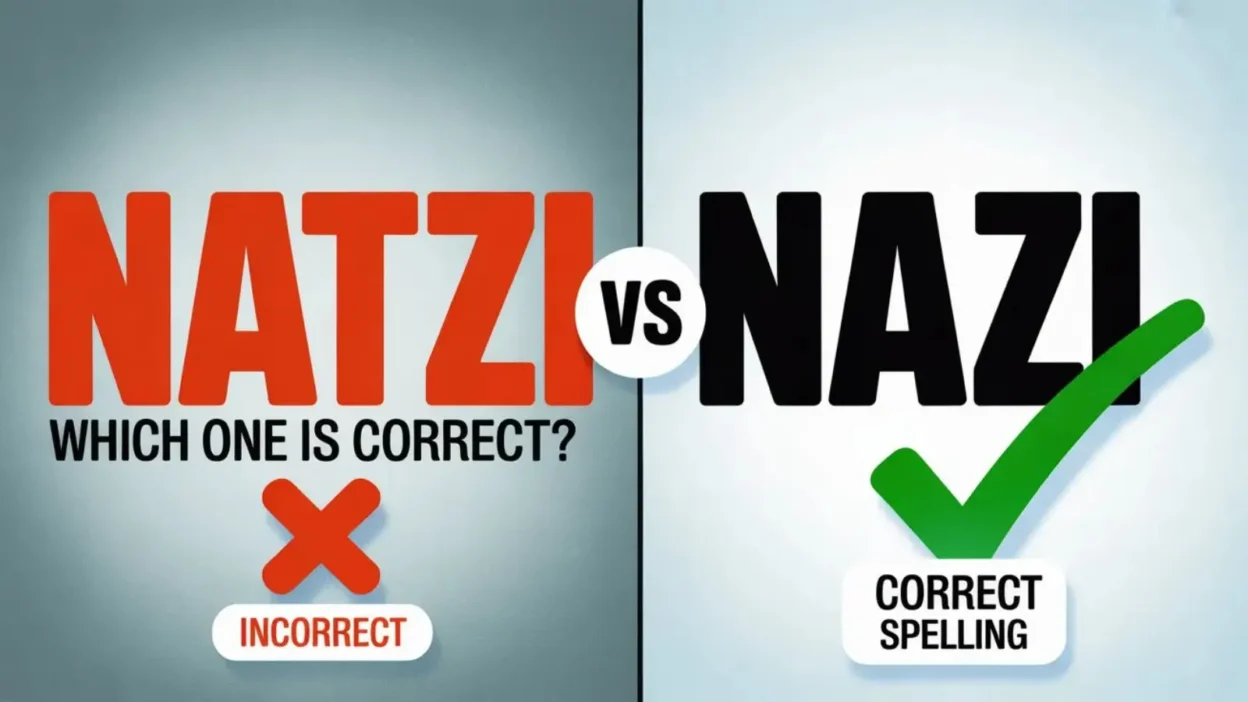
If you’re choosing between Natzi or Nazi, you’re likely checking a spelling before writing something important. The correct form is “Nazi,” while “Natzi” is a misspelling, not a separate word. This guide explains the correct spelling, meaning, pronunciation, capitalization, and usage in plain English.
Because the word connects to Nazi Germany, the Nazi Party, Adolf Hitler, World War II, and the Holocaust, accuracy matters. So, instead of treating it like an ordinary typo, it’s better to learn the right form, use it carefully, and avoid casual wording that can sound insensitive.
Quick Answer
Natzi or Nazi has one correct answer: “Nazi” is correct, and “Natzi” is wrong. Use “Nazi” for the historical term, and avoid the misspelled form in all writing.
TL;DR
• Nazi is the correct spelling.
• Natzi is not accepted English.
• Use a capital N historically.
• The word carries serious history.
• Avoid casual jokes with it.
• Check examples before publishing.
Natzi or Nazi: The Correct Spelling
The answer is simple, but the context is serious. The correct spelling is Nazi, and Natzi is a misspelling. In standard English, the extra “t” does not belong.
• Correct form: Nazi.
• Incorrect form: Natzi.
• Use Nazi in history essays.
• Use Nazi in formal articles.
• Avoid Natzi in school work.
• Avoid Natzi in social captions.
• Spell-check may flag Natzi.
• Dictionaries list Nazi, not Natzi.
• The word has four letters.
• The extra t changes nothing.
• Accuracy shows basic care.
• Historical terms need precision.
Natzi vs Nazi
Natzi vs Nazi is not a true word pair. The difference is that Nazi is the accepted form, while Natzi is the wrong spelling. So, they should not be used as alternatives.
• Nazi is the real word.
• Natzi is only an error.
• Nazi has historical meaning.
• Natzi has no accepted meaning.
• Nazi appears in dictionaries.
• Natzi usually appears by mistake.
• Nazi works as noun.
• Nazi also works as adjective.
• Natzi weakens your writing.
• Nazi keeps meaning clear.
• One letter creates confusion.
• Choose Nazi every time.
What Nazi Means
Nazi is a definition tied to a specific historical term. It refers to the German political party connected with Adolf Hitler and Nazi Germany. Therefore, it should be used with care.
• Nazi can name a party member.
• It can describe party-related things.
• Nazi Germany means that regime.
• Nazi policies were extremist.
• Nazi rule was authoritarian.
• The word is historically loaded.
• It is not casual slang.
• It belongs in serious contexts.
• It may appear in textbooks.
• It often appears in documentaries.
• It needs careful sentence placement.
• Meaning depends on context.
Is Natzi a Word?
Natzi is not a standard English word. It does not work as a dictionary entry for the historical term. Instead, it is a typo or nonstandard spelling.
• Natzi is not recommended.
• Natzi is not formal.
• Natzi is not historical.
• Natzi is not academic.
• Natzi is not a variant.
• Natzi is usually accidental.
• Teachers may mark it wrong.
• Editors will likely correct it.
• Readers may distrust it.
• Search tools may autocorrect it.
• Use Nazi for clarity.
• Delete the extra letter.
Why People Write Natzi
People often write Natzi because of sound. The word can feel like it has a hidden “t,” especially through phonetic spelling. However, that extra t comes from pronunciation, not spelling.
• The middle sound feels sharp.
• Some accents stress the “ts” sound.
• German-looking words can confuse writers.
• Fast typing adds stray letters.
• Autocorrect may not help.
• Students may copy online mistakes.
• Casual posts spread bad spelling.
• Unfamiliar history terms feel tricky.
• Similar-looking words can mislead.
• The ear guesses incorrectly.
• The eye accepts the error.
• A quick check fixes it.
How To Pronounce Nazi
Nazi is commonly pronounced with a clear first syllable. You may hear NAH-tsee in careful speech, though English pronunciation can vary. The German sound helps explain the spelling confusion.
• Say it as NAH-tsee.
• Keep the first syllable strong.
• Do not pronounce Nat-zee.
• The written form stays Nazi.
• Sound does not add letters.
• Pronunciation may vary slightly.
• American speakers often say NAHT-see.
• British speakers may sound broader.
• Audio dictionaries can help.
• Listen before presenting aloud.
• Avoid joking pronunciation games.
• Keep the tone respectful.
Nazi Spelling Rule
The spelling rule is easy to remember. There is no t in Nazi, and the word has four letters. This spelling rule works in every normal English context.
• Write N-A-Z-I.
• Never write N-A-T-Z-I.
• Do not add hidden letters.
• Keep the word short.
• Use one z only.
• Use one i at end.
• Capitalize in historical use.
• Check before submitting assignments.
• Check before publishing articles.
• Check before making slides.
• Correct typos during editing.
• Remember: no t.
Should Nazi Be Capitalized?
In historical writing, use a capital N. Nazi is usually treated like a proper noun or proper adjective. The capital letter also fits formal writing about the party, regime, or ideology.
• Write Nazi Party.
• Write Nazi Germany.
• Write Nazi officer.
• Write Nazi regime.
• Write Nazi ideology.
• Avoid lowercase in school papers.
• Capitalization signals historical reference.
• Headlines should keep Nazi capitalized.
• Captions should stay consistent.
• Notes can follow the same rule.
• Lowercase slang can look careless.
• When unsure, capitalize it.
Nazi Germany
Nazi Germany refers to Germany under Nazi rule. This is a historical phrase, not a casual label. The terms Germany, 1933–1945, and Third Reich often appear in the same context.
• Nazi Germany is correct.
• Natzi Germany is wrong.
• Use the phrase for history.
• Do not use it loosely.
• It refers to a regime.
• It connects to dictatorship.
• It connects to wartime Europe.
• It carries grave meaning.
• Students should spell it carefully.
• Writers should avoid exaggeration.
• Context helps prevent misuse.
• Precision protects the message.
Nazi Party
The Nazi Party was a real historical organization. Its German abbreviation was NSDAP, and it was led by Adolf Hitler. The party name should always be spelled with Nazi, not Natzi.
• Nazi Party is correct.
• Natzi Party is incorrect.
• Use capitals for the name.
• Keep the spelling exact.
• The party had extremist aims.
• The term belongs to history.
• Do not shorten carelessly.
• Avoid vague comparisons.
• Use full context when needed.
• Students should define it clearly.
• Writers should avoid slangy tone.
• Accuracy matters here.
Nazi Ideology
Nazi ideology refers to extremist beliefs tied to that movement. It involved antisemitism, racism, and authoritarian rule. Because of that, the word should never be treated lightly.
• Use the phrase carefully.
• Avoid playful comparisons.
• Avoid exaggerating minor problems.
• Explain context when teaching.
• Do not soften the meaning.
• Do not use Natzi here.
• Keep descriptions factual.
• Avoid shock-value wording.
• Respect affected communities.
• Use plain, direct language.
• Separate spelling from endorsement.
• Accuracy supports understanding.
Nazi History
Nazi history is a serious subject. It connects to World War II, the Holocaust, and wider historical accuracy. So, even a small spelling mistake can look careless.
• History writing needs exact terms.
• Nazi is the accepted spelling.
• Natzi distracts from meaning.
• Teachers expect accuracy.
• Editors expect consistency.
• Readers notice obvious errors.
• Dates should be handled carefully.
• Names should be checked twice.
• Sources should be reliable.
• Tone should remain respectful.
• Simple wording often works best.
• Facts matter more than flair.
Word Origin
Nazi comes from German political language. It is linked to Nationalsozialist, an abbreviation, and wider German origin history. Still, English spelling settled on Nazi, not Natzi.
• The word comes from German.
• It shortened a longer term.
• English kept the Nazi spelling.
• Natzi did not become standard.
• Origin explains the sound.
• Origin does not change spelling.
• The z carries the sharp sound.
• The t is unnecessary.
• Etymology helps memory.
• Short forms can feel confusing.
• Check roots, then usage.
• Modern English uses Nazi.
Grammar Nazi Phrase
“Grammar Nazi” is an informal phrase for someone strict about language. However, it is slang and can be an offensive phrase. In most settings, better alternatives sound kinder.
• Use “grammar stickler” instead.
• Try “strict editor” instead.
• Say “language perfectionist” carefully.
• Avoid the phrase at work.
• Avoid it in classrooms.
• Avoid it in polished articles.
• Casual jokes can offend.
• The history is too serious.
• Tone matters as much as spelling.
• Friends may still dislike it.
• Safer wording feels more professional.
• Choose kindness over edge.
Plural and Possessive Forms
The forms are simple once the spelling is clear. The plural is Nazis, the singular possessive is Nazi’s, and the plural possessive is Nazis’. Natzi does not fit any form.
• One person: Nazi.
• More than one: Nazis.
• One owner: Nazi’s.
• Multiple owners: Nazis’.
• Adjective form stays Nazi.
• Write Nazi policies.
• Write Nazi leaders.
• Write Nazis only for people.
• Avoid Nazi’s for simple plural.
• Avoid Nazis’s entirely.
• Keep apostrophes purposeful.
• Read the sentence aloud.
Correct Examples
Examples make the choice easier. These sentence examples work for school writing, articles, and notes with a respectful tone. Notice that every correct form uses Nazi.
• Correct: Nazi is the spelling.
• Incorrect: Natzi is the spelling.
• Correct: Nazi Germany appears in textbooks.
• Incorrect: Natzi Germany looks wrong.
• Correct: She studied Nazi history.
• Incorrect: She studied Natzi history.
• Correct: The Nazi Party gained power.
• Incorrect: The Natzi Party gained power.
• Correct: Historians discuss Nazi ideology.
• Incorrect: Historians discuss Natzi ideology.
• Correct: The plural is Nazis.
• Incorrect: The plural is Natzis.
FAQs
What is the correct spelling for natzi?
The correct spelling is Nazi. Natzi is a misspelling and should not be used in standard English.
Is “Natzi” a correct spelling of Nazi?
No, Natzi is not correct. It usually appears because people spell the word by sound instead of checking the accepted form.
What does the word Nazi actually mean?
Nazi refers to the German political movement and party connected with Adolf Hitler and Nazi Germany. In writing, it can be a noun or an adjective.
Why do people write “Natzi” instead of “Nazi”?
People often hear a sharp “ts” sound and assume a “t” belongs there. However, the spelling stays Nazi.
Is “Natzi” used in any dictionary?
Natzi is not the accepted dictionary form for the historical term. Major English references use Nazi.
Should “Nazi” be capitalized?
Yes, capitalize Nazi when referring to the historical party, regime, ideology, or related adjective. This is the safest choice in formal writing.
Can I use “Grammar Nazi” casually?
It is better to avoid it. Phrases like “grammar stickler,” “strict editor,” or “language perfectionist” are clearer and less hurtful.
Conclusion
Natzi or Nazi is easy once you remember the rule: Nazi is correct, and Natzi is not. Because the word carries serious history, spell it carefully and use it with respect.