You may see headcanon in fan posts, videos, comments, and discussions about fictional characters. The word appears often in communities built around books, movies, television, comics, anime, and games.
At first, it can sound like a technical term. Its meaning is actually simple. A headcanon is a personal idea that a fan accepts about a story.
That idea does not come directly from the official work. It may fill a gap, explain behavior, or imagine an unseen event. Some headcanons are serious, while others are playful.
Understanding the term helps you follow modern fandom conversations. It also prevents confusion with canon, fanon, fan theories, and alternate universes.
This guide explains the meaning, pronunciation, grammar, usage, examples, origin, and related terms.
Quick Answer and TL;DR
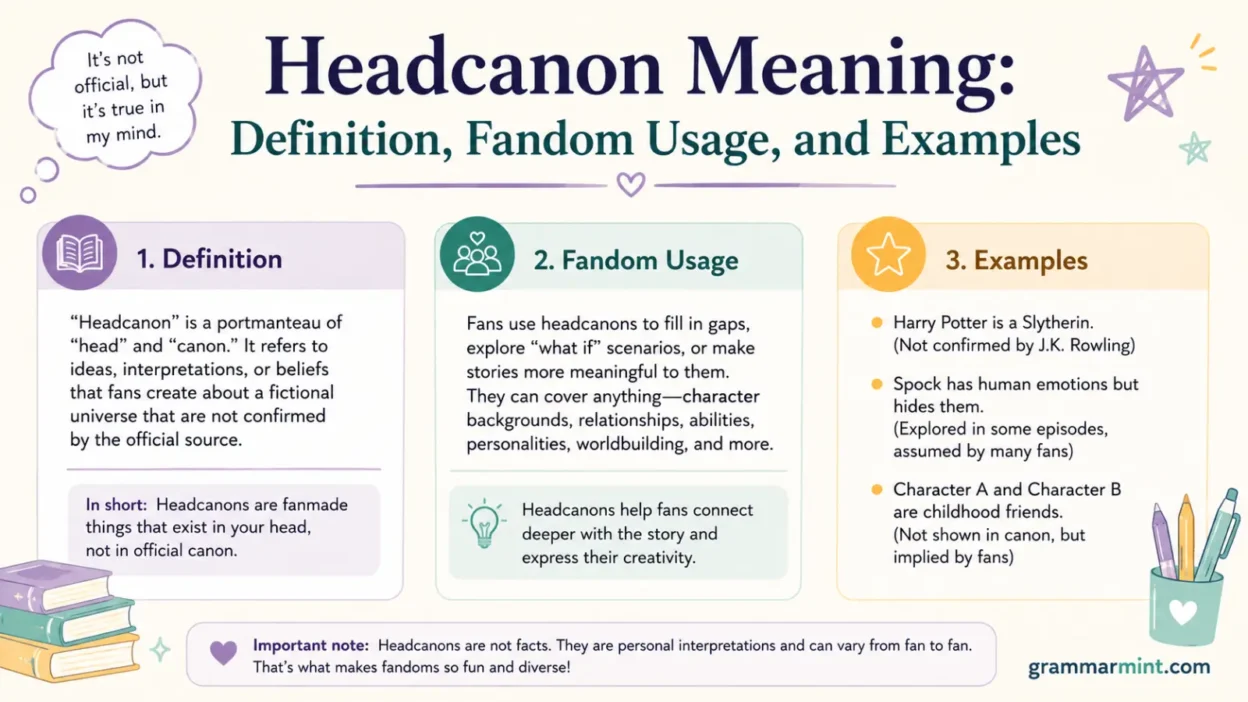
The headcanon meaning is a fan’s personal belief about a fictional story. The official source neither clearly confirms nor establishes that belief.
TL;DR
• Headcanon is mainly informal fandom language.
• It describes a personal, unofficial story belief.
• Canon contains officially established story details.
• Fanon is an idea widely accepted by fans.
• A headcanon can later become official canon.
• The usual pronunciation is “HED-kan-uhn.”
What Headcanon Means in Plain English
A headcanon is something you personally imagine as true within a fictional world. The original story does not directly establish it.
For example, a movie may never show a hero’s favorite food. You might believe the hero loves blueberry pancakes. That belief is your headcanon.
A headcanon can concern many story details:
• a character’s childhood
• an unseen friendship
• a private habit
• a character’s future
• an unexplained decision
• a possible relationship
• a missing event
The idea can be reasonable, emotional, funny, or unusual. However, it remains unofficial unless the story confirms it.
Headcanon is not usually a lie or factual error. Fans normally use the label to show that their idea is personal.
How Headcanon Works in Fandom
Fans create headcanons when stories leave open spaces. These spaces invite readers and viewers to imagine additional details.
A headcanon often begins with a small clue. A character may avoid celebrations, for example. A fan might imagine a sad birthday memory.
Other headcanons have little supporting evidence. A fan may simply enjoy an idea because it feels right.
People share headcanons through posts, videos, artwork, roleplay, and fan fiction. Other fans may accept, reject, or modify them.
You may see phrases such as:
• “My headcanon is that she writes poetry.”
• “I accept this headcanon.”
• “That detail became part of my headcanon.”
• “What are your headcanons for this character?”
A shared idea does not automatically become official. Popularity within a fan community cannot replace confirmation from the source.
Why Fans Create Them
Headcanons let fans stay connected with stories after the official material ends. They can also make unclear characters feel more understandable.
Some fans use headcanons to explore identity, family, culture, disability, or personal experience. Others imagine ordinary moments that the story skipped.
Writers and roleplayers may use headcanons for consistency. An invented habit can guide how a character speaks or reacts.
Artists may turn a headcanon into illustrations, short comics, or costume designs. Fans can then discuss how well the idea fits.
Headcanons also help people repair an ending they disliked. A fan may imagine a kinder future without changing every official event.
Still, no fan must accept another person’s idea. Headcanon is personal by nature, and respectful disagreement is normal.
Evidence and Story Clues
A headcanon may have strong clues, weak clues, or no clues. Evidence can make the idea convincing, but it remains unofficial.
Suppose a character always carries an old key. A fan might imagine that it opens a childhood home.
The object supports discussion, but it proves nothing alone. When evidence becomes central, the idea may also function as a fan theory.
The labels can overlap in casual conversation. The speaker’s purpose often determines which term sounds more natural.
Pronunciation, Spelling, and Part of Speech
Pronounce headcanon as HED-kan-uhn. The first part sounds like head, while the second sounds like canon.
The standard spelling is headcanon, written as one word. You may also see head canon or head-canon online.
Do not write headcannon. A cannon is a large weapon, while canon means officially accepted material.
As a Noun
Headcanon most often functions as a noun. Its regular plural is headcanons.
• “That is my favorite headcanon.”
• “The fans shared several headcanons.”
As a Verb
Some speakers also use headcanon as a verb. It means to accept an unofficial belief about a fictional work.
• “I headcanon the character as an excellent cook.”
• “She headcanoned them as childhood friends.”
The verb forms are headcanons, headcanoned, and headcanoning. Noun use remains more familiar to many readers.
How to Use Headcanon in Sentences and Posts
Use headcanon when you clearly present a personal interpretation. This label helps separate imagination from official story facts.
The most natural patterns include these forms:
• “My headcanon is that…”
• “In my headcanon…”
• “I have a headcanon about…”
• “I headcanon this character as…”
• “This is only a headcanon.”
Here are natural examples:
• “In my headcanon, Maya opens a bakery after the series ends.”
• “My headcanon is that the brothers exchange letters every week.”
• “I headcanon the captain as someone who secretly fears storms.”
• “That scene supports my headcanon, but it does not prove it.”
• “Her headcanons make the character feel more complete.”
The word usually sounds casual and community-specific. In formal school writing, use personal interpretation unless fandom language fits the assignment.
Headcanon vs Canon, Fanon, Fan Theory, and AU
Several fandom terms describe different relationships with a story. Their meanings overlap, but they are not identical.
| Term | Meaning | Simple Example |
| Canon | Officially established story material | The story states that Leo has a sister. |
| Headcanon | One fan’s personal belief | You imagine that Leo calls her weekly. |
| Fanon | An unofficial idea widely accepted by fans | Many fans use the same invented surname. |
| Fan theory | A claim supported by clues and reasoning | Fans predict that Leo is the masked stranger. |
| Alternate universe | A changed version of the story’s world | Leo lives in a modern college setting. |
A fan theory usually tries to explain or predict official events. A headcanon does not always require evidence.
Fanon develops when many fans repeatedly accept the same unofficial idea. A headcanon can contribute to fanon.
An alternate universe changes major facts, settings, or rules. A headcanon usually adds details without rebuilding the whole story.
Common Types and Examples of Headcanon
Headcanons can cover almost any unanswered story question. Several common types appear across fan communities.
Character Headcanons
These ideas add habits, talents, fears, preferences, or personal traits.
• “He keeps every birthday card he receives.”
• “She learned guitar from her older cousin.”
Backstory Headcanons
These ideas imagine events that happened before the official story.
• “The detective once wanted to become a teacher.”
• “The rivals met briefly as children.”
Relationship Headcanons
These ideas explore friendships, family bonds, or romantic possibilities.
• “The teammates celebrate holidays together.”
• “The two characters stay close after graduation.”
Future Headcanons
These ideas imagine what happens after the ending.
• “The hero returns home and opens a community center.”
• “The group continues meeting every summer.”
Humorous Headcanons
These ideas are mainly jokes or playful explanations.
• “The villain practices dramatic entrances in a mirror.”
• “The spaceship breaks because nobody reads the manual.”
When to Use It and When Not to Use It
Use headcanon in fandom discussions, casual reviews, fan fiction notes, and creative conversations. It works best when readers understand the source material.
The label is useful when your idea remains unofficial. It shows that you are sharing an interpretation, not reporting a confirmed fact.
Avoid presenting headcanon as canon. Readers may challenge the statement when the official work says something different.
Also avoid the term in unrelated real-life claims. Headcanon usually concerns fictional works, characters, and imagined worlds.
For serious literary analysis, explain the evidence behind your reading. Calling an argument a headcanon may make it sound unsupported.
A respectful phrase can prevent conflict:
“That is my headcanon, although I know the story never confirms it.”
Origin and Development of the Term
The word combines head and canon. The first part points to an idea existing in someone’s mind.
In fandom, canon means officially accepted story material. Therefore, headcanon suggests a private version of canon inside a fan’s head.
The term is commonly linked to online fan communities during the late 2000s. Fan blogs and discussion spaces helped spread it.
Its exact first use remains uncertain. However, documented online examples date back to at least 2007.
The word later became common across social platforms and many fandoms. Today, people use it for books, shows, movies, games, comics, and anime.
Common Mistakes and Related Terms
One common mistake is spelling the word headcannon. Remember that the middle word is canon, not cannon.
Another mistake is treating every theory as a headcanon. A theory usually depends on clues, while a headcanon may reflect preference alone.
Do not assume a popular headcanon is official. Wide acceptance may turn it into fanon, but not canon.
Close Alternatives
No single word matches headcanon in every context. These phrases can express similar ideas:
• personal interpretation
• fan interpretation
• imagined backstory
• unofficial belief
• private version of events
Contrasting Terms
Canon is the clearest contrast because it describes official material. Still, it is a contrasting term rather than an exact antonym.
Related fandom words include fanon, shipping, fan fiction, subtext, and alternate universe. Each describes a different kind of fan engagement.
Mini Quiz
Choose the best answer for each question.
1. What is a headcanon?
A. An official story fact
B. A fan’s personal, unofficial belief
C. A publishing mistake
2. Which spelling is standard?
A. headcannon
B. head-cannon
C. headcanon
3. Which term describes official story material?
A. canon
B. fanon
C. headcanon
4. Which sentence uses the word correctly?
A. “My headcanon is that she becomes a doctor.”
B. “The history textbook is my headcanon.”
C. “He fired the headcanon during battle.”
5. Can a headcanon become canon?
A. Never
B. Yes, if the official story later confirms it
C. Only when one fan repeats it
Answer Key
- B
- C
- A
- A
- B
FAQs
What is an example of a headcanon?
A fan might imagine that a quiet character secretly sings at home. The story never confirms it, so the idea remains headcanon.
Is headcanon the same as canon?
No. Canon includes officially established story details. Headcanon exists in a fan’s personal interpretation.
What is the difference between headcanon and fanon?
A headcanon may belong to one fan or a small group. Fanon is an unofficial idea accepted widely across a fandom.
Can a headcanon become canon?
Yes. A later episode, book, interview, or official release may confirm the same detail. The idea then becomes canon.
Is headcanon one word?
Yes, headcanon is the standard modern spelling. Some people write head canon, but the single word is clearer.
Can a headcanon contradict canon?
People sometimes use the term for conflicting ideas. Strictly speaking, a major contradiction is closer to an alternate version or universe.
Conclusion
The headcanon meaning centers on a fan’s personal, unofficial story belief. Use the term when sharing imaginative ideas without claiming official confirmation.
Label your interpretation clearly, then enjoy discussing it with other fans.