You may see ghosting in dating posts, text conversations, friendship advice, and workplace discussions. The word describes a sudden communication cutoff without a clear explanation.
People often use it after a promising conversation suddenly stops. They may feel unsure whether the other person is busy or intentionally gone.
Understanding the term helps you describe a specific social behavior. It also prevents confusion with delayed replies, mutual distance, or an announced boundary.
The label covers more than dating. It can also describe silence between friends, relatives, applicants, employers, clients, or online contacts.
This guide explains the ghosting meaning in plain English. You will learn its pronunciation, grammar, common contexts, and natural sentence patterns. You will also see related behaviors, common mistakes, a mini quiz, and clear answers to frequent questions.
Quick Answer and TL;DR
Quick Answer
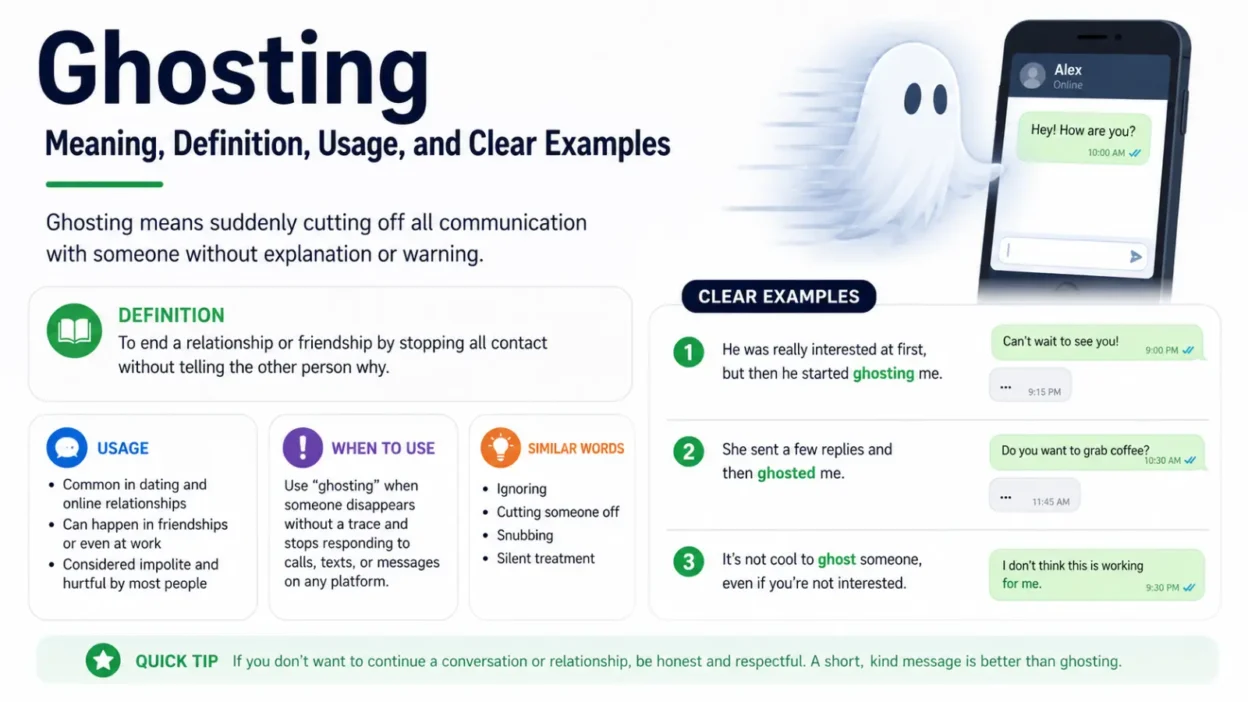
The ghosting meaning is suddenly ending contact with someone without explaining why. The person stops replying to messages, calls, or other attempts to communicate.
TL;DR
• Ghosting means disappearing from communication without an explanation.
• It commonly occurs in dating, friendships, texting, and work.
• Ghosting usually works as an informal noun.
• Ghost can also work as a verb.
• One late reply does not prove ghosting.
• Safety can justify ending contact without further discussion.
Meaning, Pronunciation, and Part of Speech
In everyday slang, ghosting means cutting off communication without warning or explanation. The person becomes unreachable, almost as if they disappeared.
The usual pronunciation is GOH-sting. The first part sounds like ghost, followed by ing.
In the relationship sense, ghosting is mainly an informal noun. It often names the behavior as a general practice.
Noun example: Ghosting can leave the other person confused.
The word also comes from the verb ghost. The verb means to stop communicating with someone without explaining the decision.
Verb example: Jordan ghosted Alex after their second date.
Present participle example: She is ghosting the group after agreeing to help.
The receiver often uses the passive form was ghosted.
Passive example: I was ghosted after three weeks of daily messages.
The word also has a technical meaning. Screen ghosting is a faint trail or duplicate image on a display. That meaning is separate from relationship slang.
Common Contexts for Ghosting
Ghosting first became strongly linked with dating and electronic communication. Today, people use it in several social settings.
Dating and Relationships
Someone may stop answering after dates, regular calls, or romantic messages. The silence ends the connection without a direct breakup.
Example: We made weekend plans, but he ghosted me afterward.
Texting and Social Media
A person may stop replying while remaining active online. They may also block, unmatch, or remove the other person.
Example: Maya thought she was being ghosted after every message went unanswered.
Friendships
Friends can also disappear without discussing a problem or ending the friendship. This can happen after years of regular contact.
Example: Losing the friendship hurt because the ghosting came without warning.
Work and Hiring
A job candidate may stop replying to a recruiter. An employer may also disappear after interviews or promised updates.
Example: The company ghosted several applicants after the final interview.
Family and Other Connections
The term can describe sudden silence among relatives, clients, classmates, or collaborators. However, context still matters.
How to Use Ghosting in Sentences
Use ghosting when the missing communication seems intentional and open-ended. The term usually suggests that a response was reasonably expected.
Common sentence patterns include:
• Ghosting someone: He admitted ghosting people when conversations became uncomfortable.
• Being ghosted: She felt confused after being ghosted by a close friend.
• Ghosted me: My date ghosted me after saying we should meet again.
• Ghosting at work: Candidate ghosting delayed the hiring process.
• Screen ghosting: Fast movement caused ghosting on the older monitor.
Tone also matters. The relationship sense is informal and common in conversation, lifestyle writing, and social posts. In formal writing, define the term before using it.
A neutral formal sentence could say: “The participant ended communication without explanation, a behavior commonly called ghosting.”
Ghosting Compared With Similar Behaviors
Several modern terms describe unclear or indirect communication. They are related, but they do not mean the same thing.
| Context | Best Choice | Why |
|---|---|---|
| All direct contact suddenly stops | Ghosting | Communication ends without explanation |
| Replies slowly become rare and empty | Soft ghosting | Contact fades instead of stopping at once |
| Direct replies stop, but social viewing continues | Orbiting | The person remains visible online |
| Small messages keep someone interested | Breadcrumbing | Limited contact continues |
| A boundary is clearly announced | No-contact | The reason or boundary is stated |
Ignoring someone can be temporary. Ghosting usually suggests a broader and less defined ending.
A slow fade happens over time. Traditional ghosting often feels more sudden, although real situations can fall between both patterns.
Why People Ghost
People ghost for different reasons. No single explanation fits every case.
Some people avoid difficult conversations. They may fear conflict, guilt, anger, or an emotional response.
Others lose interest and choose silence because it feels easier. Some believe disappearing will cause less pain than direct rejection.
Overwhelm can also affect communication. A person may withdraw during stress, illness, grief, or a personal crisis.
Safety creates an important exception. Someone may end contact quickly after threats, pressure, harassment, or controlling behavior. Personal safety matters more than social etiquette.
Ghosting should not automatically prove cruelty or a certain personality type. The behavior shows what happened, but it does not reveal every motive.
Why Being Ghosted Hurts
Ghosting creates an ending without a clear ending. The missing explanation can make the receiver question what happened.
People may replay messages and search for a mistake. They may wonder whether the connection was genuine.
Direct rejection can hurt, but it gives a clear answer. Ghosting often leaves uncertainty, which can delay emotional closure.
A helpful response is to focus on the available facts. Repeated silence may be the only answer the other person provides.
One calm follow-up message can be reasonable. Repeated calls or messages rarely create healthy closure.
Support from trusted friends can help. Strong emotions may also deserve support from a qualified mental health professional.
When Ghosting Is Not the Right Label
Not every unanswered message counts as ghosting. People can miss texts, lose access, become busy, or need time.
One delayed reply does not establish a pattern. Consider the relationship, normal response time, and previous communication.
Mutual drifting is also different. When both people stop reaching out, neither person clearly disappears from an active exchange.
An announced boundary is not usually ghosting. “I need space and will not respond” provides information, even when the message feels painful.
Temporary silence after an argument may be ignoring or cooling off. It becomes closer to ghosting when contact ends without explanation.
Technical screen ghosting is another separate meaning. It describes a visual trail, not a social action.
Origin and Modern Usage
The behavior existed long before smartphones and dating apps. However, the modern relationship term developed alongside electronic communication.
Written evidence for this sense appears by the mid-2000s. The exact first use remains difficult to prove.
The term became much more familiar during the 2010s. Dating apps, texting, and social media made sudden disappearance easier to notice.
Its meaning later expanded beyond dating. People now discuss friend ghosting, workplace ghosting, recruiter ghosting, and customer ghosting.
The central idea remains stable. Someone ends expected communication without giving a clear explanation.
Synonyms, Antonyms, and Common Mistakes
No single synonym matches ghosting in every situation. Several phrases express a close idea.
Close alternatives include:
• cutting off contact
• disappearing without explanation
• going silent
• stopping communication
• vanishing from a relationship
These phrases may sound clearer in formal writing. They also avoid slang when readers may not know the term.
There is no perfect one-word antonym. Opposite behaviors include direct communication, clear rejection, honest closure, and a respectful goodbye.
Common mistakes include using ghosting for every slow reply. The term needs a stronger pattern of unexplained silence.
Another mistake involves the active and passive forms.
Incorrect meaning: “I ghosted” when you mean someone disappeared on you.
Correct: “I was ghosted.”
Writers may also confuse ghosting with mutual distance. Ghosting usually involves one person ending expected contact.
Mini Quiz
Choose the best answer.
1. What does ghosting usually mean?
A. Sending many messages
B. Ending contact without explanation
C. Taking a short break
D. Changing a phone number
2. Which sentence uses the passive form correctly?
A. After my date stopped replying, I ghosted.
B. My date was ghosting by me.
C. After the second date, I was ghosted.
D. Ghosting me happened after the second date.
3. Which situation is closest to orbiting?
A. Every account gets blocked by the person.
B. The person clearly explains why contact must end.
C. Your messages go unanswered, but the person still watches your stories.
D. Daily replies continue as usual.
D. Someone replies normally every day.
4. Is one late reply always ghosting?
A. Yes
B. No
Answer Key: 1-B, 2-C, 3-C, 4-B.
Frequently Asked Questions
What does ghosting mean in texting?
Ghosting in texting means someone stops replying without explaining why. The silence continues even when a response would normally be expected.
What does it mean to ghost someone?
To ghost someone means to cut off contact without a clear goodbye. This may include ignoring calls, texts, emails, or direct messages.
How do you know someone is ghosting you?
Look for a clear change from active communication to repeated silence. One unanswered message alone does not confirm ghosting.
Can friends ghost each other?
Yes. A friend may suddenly stop responding and avoid further contact. Friendship ghosting can feel confusing because no reason is given.
Is ghosting the same as ignoring someone?
Not exactly. Ignoring can be temporary or limited to one message. Ghosting usually suggests a larger, unexplained end to communication.
What is soft ghosting?
Soft ghosting is a gradual withdrawal rather than a sudden disappearance. Replies may become shorter, slower, or limited to reactions.
Conclusion
The ghosting meaning centers on ending expected contact without an explanation. Use the term when silence replaces a clear goodbye.
Check the full context before applying the label. A pattern matters more than one missed message.