In everyday American English, few word pairs cause as much quiet frustration as “fourth” and “forth.” These two terms sound identical when spoken but carry completely different meanings on the page. Whether you’re drafting an important business email, writing a school report, posting on social media, or preparing a presentation, picking the wrong word can subtly undermine your credibility.
This confusion stems from their status as homophones — words that are pronounced the same (/fôrth/) but spelled differently and used in entirely separate contexts. American writers encounter this pair frequently because both words appear in common phrases across professional, academic, and casual settings. The mix-up happens so often that it has become one of the most reported spelling and usage issues in editing tools and grammar checkers.
This comprehensive guide resolves the fourth vs forth dilemma once and for all. You’ll discover exactly when to use each term, see realistic modern examples from American life, learn why the confusion exists, and pick up practical strategies to avoid mistakes. By the end, you’ll feel confident making the right choice every time.
Quick Answer
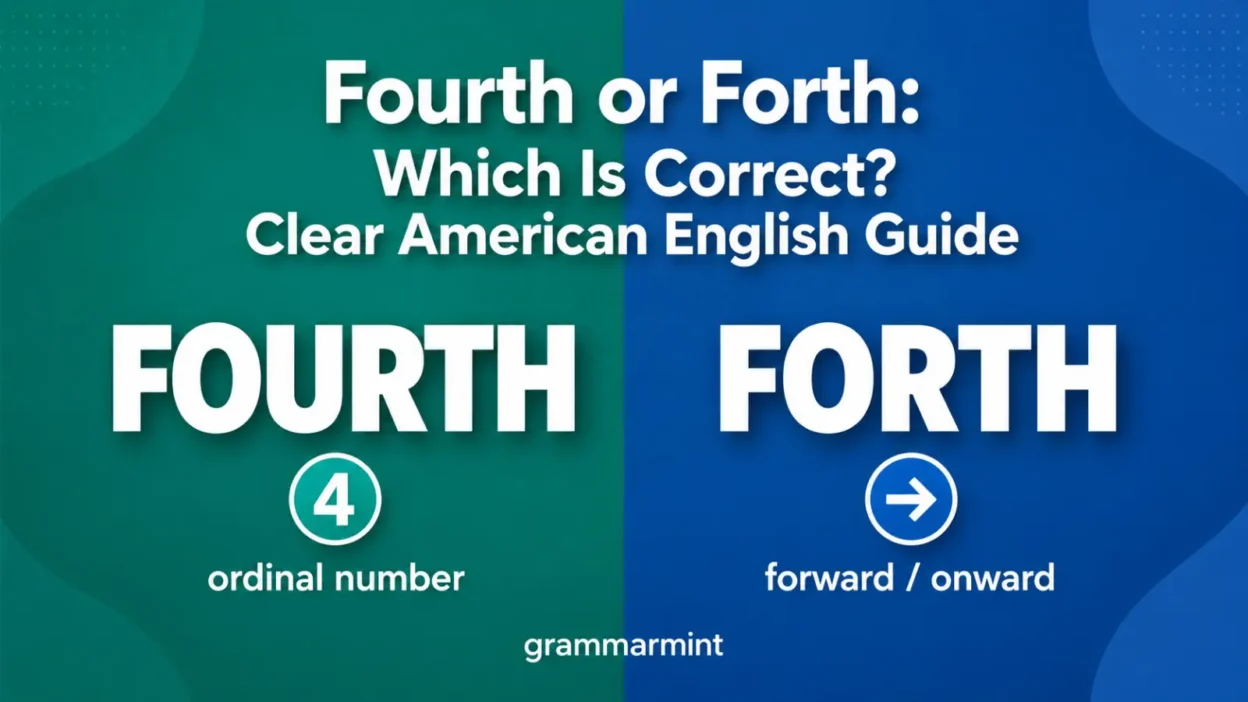
Use “fourth” when referring to anything connected to the number four in a sequence or as a fraction. It is the ordinal version of “four.”
Use “forth” when describing movement forward, bringing something into view, or continuing onward. It functions mainly as an adverb indicating direction or progression.
These words are not interchangeable. Substituting one for the other creates an incorrect and often awkward sentence in standard American English.
Why People Confuse Them
The primary reason for confusion is pronunciation. Both “fourth” and “forth” are pronounced exactly the same in American English: /fôrth/ (rhyming with “north” or “forthcoming”). This makes them easy to mix up when speaking quickly or typing fast.
Another factor is visual similarity. The spellings differ by just one letter — “fourth” includes the “u” from “four,” while “forth” drops it. In rapid writing or when relying on autocorrect, people often default to the more familiar-looking “fourth” even when “forth” is needed.
Context also plays a role. Many common expressions contain these words, such as “back and forth” (movement) or “fourth quarter” (time period). When people are thinking about one phrase, muscle memory can lead them to use the wrong spelling in another.
Additionally, non-native speakers and even experienced American writers sometimes overthink the choice because English contains many number-related words that shift form (three → third, five → fifth). This leads to hesitation and errors.
Key Differences At A Glance
| Context | Best Choice | Why It Fits |
|---|---|---|
| Ranking or position | fourth | Describes order after third |
| Time periods | fourth | Fourth quarter, fourth week |
| Fractions | fourth | One fourth of something |
| Forward movement | forth | Indicates direction or progress |
| Presenting ideas | forth | Bring forth, set forth |
| Continuation phrases | forth | And so forth, from that day forth |
| Sequential events | fourth | Fourth meeting, fourth attempt |
| Physical pacing | forth | Back and forth |
Compact Feature Comparison:
- Fourth: Centers on numerical order and quantity.
- Forth: Focuses on direction, emergence, or advancement.
This table helps you decide quickly based on the situation.
Meaning and Usage Difference
Fourth serves primarily as an adjective or noun. As an adjective, it shows position in a series: the fourth item on the list. As a noun, it can refer to a person or thing in that position (“She was the fourth to arrive”) or represent one quarter portion (“He owns a fourth of the company”).
Forth operates almost exclusively as an adverb. It indicates movement away from a starting point, either literally (step forth) or figuratively (bring forth new ideas). It suggests progression, openness, or continuation.
In American English, “fourth” connects directly to the concept of four. You can substitute the number 4 to test: “the 4th place” makes sense, but “the 4th and forth” does not. “Forth” connects to ideas of forward motion — think “forward” without the “war.”
These distinctions remain consistent across contexts. No major American style guides treat them as flexible or overlapping in meaning.
Tone, Context, and Formality
Both words work well across different levels of formality, but their tone feels slightly different in practice.
Fourth carries a factual, precise tone. It appears comfortably in highly formal documents like financial reports (“fourth quarter earnings”), legal papers, academic writing, and everyday conversation. It feels neutral and objective.
Forth can sound slightly more formal or literary in some constructions (“The committee set forth its recommendations”). However, it also fits naturally in casual speech (“We went back and forth on the decision”). In very informal texting, people sometimes avoid complex “forth” phrases altogether.
Pronunciation remains identical in all American regions, so spoken context usually resolves any potential ambiguity. In professional settings like meetings in Washington D.C., New York, or tech hubs in Austin, using the correct term signals attention to detail.
Neither word feels outdated, though some “forth” phrases like “hold forth” appear more often in written than spoken American English today.
Which One Should You Use?
Follow this simple decision process:
- Does the sentence involve counting, ranking, or dividing into four parts? Choose fourth.
- Does it involve moving ahead, presenting something, or continuing? Choose forth.
- Still unsure? Replace with “4th” or “forward.” Whichever fits best usually points to the correct original word.
In American business writing, precision matters. A manager saying “We discussed this back and fourth” loses credibility compared to the correct “back and forth.”
When One Choice Sounds Wrong
Certain errors stand out immediately to American readers:
- “She placed forth in the competition.” (Sounds incorrect because placement uses ranking.)
- “Please put your ideas fourth.” (Wrong — ideas are presented, not ranked here.)
- “The fourth of July celebration was great.” (Correct, but “forth of July” would sound completely wrong.)
- “He argued back and fourth for hours.” (Common mistake that disrupts flow.)
These examples demonstrate how the wrong choice breaks the natural rhythm of American English sentences.
Common Mistakes (and Quick Fixes)
Here are the most frequent errors seen in American writing:
- “Back and fourth” → Correct: “back and forth.” This describes physical or verbal movement.
- “And so fourth” → Correct: “and so forth.” Used when listing examples and wanting to say “etc.”
- “Bring fourth” → Correct: “bring forth.” Means to introduce or produce.
- “Set fourth” → Correct: “set forth.” Common in formal proposals.
- Using “fourth” for any forward action → Remember: numbers use “fourth,” direction uses “forth.”
Memory tricks that work:
- “Fourth” always contains the letter “u” — just like “four” and “quarter.”
- “Forth” has no “u” and matches “forward” in direction and spirit.
Practice by reading sentences aloud. Context usually makes the right choice obvious once you train your ear.
Everyday Examples
Using “fourth” in real American contexts:
In a sports report: “The Dallas Cowboys finished in fourth place in their division last season, missing the playoffs by a narrow margin.”
At work: “This marks the fourth consecutive quarter of growth for our company based in Chicago.”
The distinction between “fourth” and “forth” adds precision to everyday English. People often mix them up without realizing the impact on clarity.
In daily life, families enjoy fireworks and barbecues every Fourth of July.
Education settings require students to complete their fourth assignment soon.
Different food scenarios show someone eating just one fourth of their plate.
Forth appears naturally too. Business leaders set forth innovative strategies in meetings.
Conversations encourage people to step forth when opportunities arise.
Storytellers describe how events unfold from that moment forth.
Debates benefit when participants put forth evidence-based points.
Movement descriptions capture someone pacing back and forth anxiously.
Mixing these terms keeps writing fresh while avoiding repetitive patterns. Varying starters prevents monotony across multiple lines.
Readers appreciate the flow that results from careful attention to such details.
These examples show how both words integrate naturally into modern American life — from boardrooms in New York to family dinners in Texas.
Expanded scenarios for deeper understanding:
Imagine writing a project update email. Correct version: “This is the fourth iteration of the design, and we now bring forth the following recommendations.” Incorrect mixing would confuse readers and appear unprofessional.
In creative writing, an author might write: “On the fourth day of the journey, the explorer stepped forth into unknown territory.” Both words appear in one sentence but serve completely different purposes.
Dictionary-Style Word Details
Verb
- Fourth: Not used as a verb in standard modern American English. It does not describe an action.
- Forth: Also not a verb. It functions strictly as an adverb and cannot take verb forms like -ed or -ing.
Noun
- Fourth: Commonly used. It refers to the fourth position (“She finished as the fourth”) or a fractional part (“one fourth equals 25 percent”).
- Forth: Rarely functions as a noun in contemporary American English. Older literary uses exist but are uncommon today.
Synonyms
- Fourth: Closest alternatives include 4th (numerical abbreviation) and “quaternary” in technical contexts. No perfect everyday synonym exists.
- Forth: Closest plain alternatives are “forward,” “onward,” “ahead,” or “out.” Antonyms: Fourth has no strong direct antonym; Forth contrasts with “back” or “inward” in directional contexts.
Example Sentences
- The committee reviewed the fourth proposal before making a decision.
- She called forth all her courage to deliver the presentation.
- This is my fourth visit to Washington D.C. this year.
- The lawyer set forth the terms clearly in the contract.
- They discussed the issue back and forth during the meeting.
- One fourth of the team members joined the virtual call from California.
Word History
Both words developed from Old English roots connected to the concepts of four and forward movement. Their modern distinction has been stable in American English for a long time, though exact historical paths show some overlap in ancient forms. Current usage focuses on clear differentiation rather than shared origins.
Phrases Containing
- Fourth: fourth quarter, Fourth of July, fourth estate (the press), fourth dimension, fourth amendment.
- Forth: and so forth, back and forth, bring forth, come forth, set forth, put forth, hold forth, go forth, sally forth (somewhat archaic).
FAQs
Q1: Are fourth and forth ever acceptable as the same word? A: No. They have distinct meanings and using the wrong one is considered an error in American English.
Q2: Which is more common in everyday writing? A: “Fourth” appears more frequently due to dates, rankings, and fractions. “Forth” is common in specific idiomatic expressions.
Q3: Does autocorrect usually catch this mistake? A: Not always. Both words are valid, so context-based errors often slip through.
Q4: How do I explain the difference to someone learning English? A: Use the number test for “fourth” and the forward test for “forth.”
Q5: Is there any American regional variation? A: Usage remains consistent across the United States.
Conclusion
Understanding the difference between “fourth” and “forth” strengthens your American English communication. “Fourth” handles everything numerical and sequential, while “forth” manages direction and presentation. With the decision process, memory tricks, and examples provided here, you can eliminate this common confusion from your writing.
Practice by reviewing your recent emails and documents for these words. Over time, choosing correctly will become second nature. Clear, precise language helps you communicate more effectively whether you’re writing for work, school, or personal expression in today’s fast-paced world.