Americans eat billions of these sweet, fried treats every year. Whether you call them donuts or doughnuts, the love for this classic snack runs deep in US culture. Yet when it comes time to write about them, many people pause. Should you use the shorter “donut” or the longer “doughnut”?
This guide cuts through the confusion with straightforward advice tailored for American writers, businesses, students, and everyday people in 2026. You will see exactly when each spelling works best, why the difference exists, and how to choose confidently every time.
Quick Answer
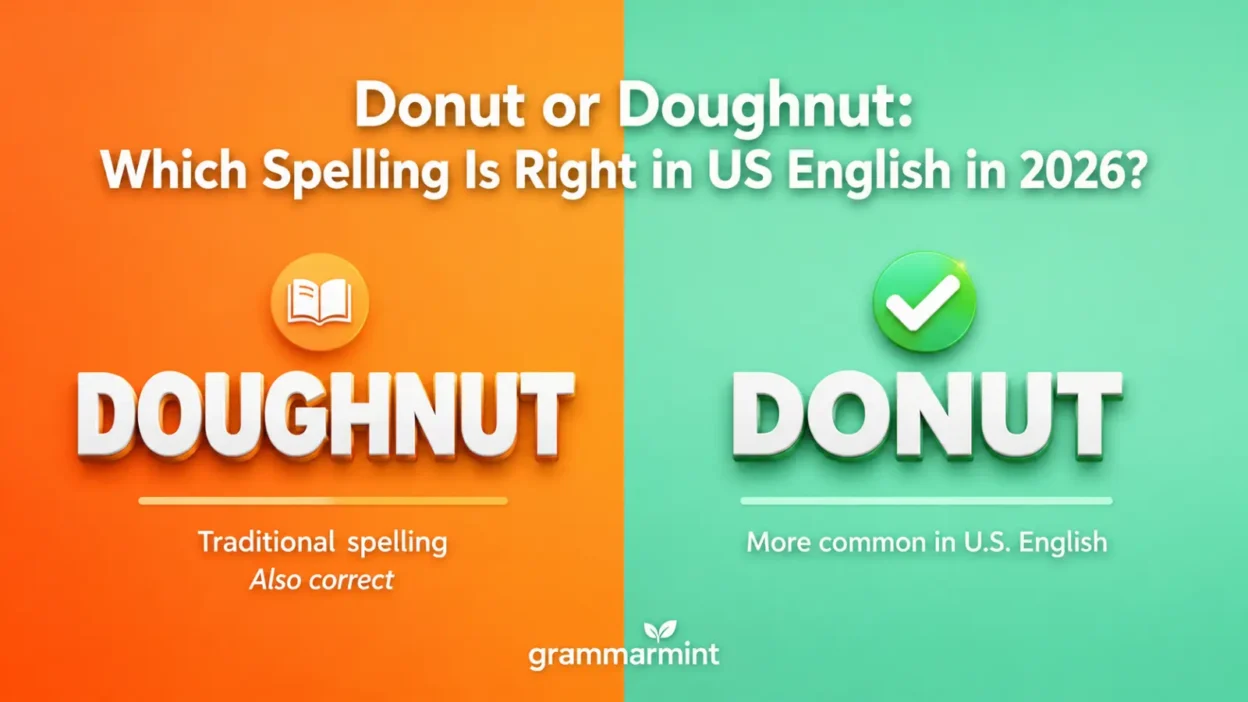
Doughnut is the traditional and preferred spelling in most formal American English writing. Donut is a fully accepted, simpler variant that dominates casual use, branding, and digital content across the United States.
Both spellings are correct in US English. Neither is wrong. The choice depends on your audience, purpose, and tone. Use doughnut when you want to sound polished or traditional. Choose donut for friendly, modern, or commercial situations. Consistency within a single piece of writing matters most.
Why People Confuse Them
The mix-up happens because both words describe the exact same food item with no difference in meaning. You see “Dunkin’ Donuts” signs everywhere, yet many newspapers and books still print “doughnut.” School lessons often teach the longer spelling, while social media and food delivery apps lean toward the shorter one.
This back-and-forth creates uncertainty. People wonder if one spelling is more “correct,” more American, or more professional. The confusion grows stronger when writing for different platforms — a formal report versus an Instagram caption, a school essay versus a restaurant menu.
Key Differences At A Glance
| Context | Best Choice | Why |
|---|---|---|
| News articles & formal reports | Doughnut | Traditional spelling preferred by major style guides |
| Social media & texting | Donut | Shorter, friendlier, modern feel |
| Restaurant menus & branding | Donut | Matches major chains and feels approachable |
| Academic or business writing | Doughnut | Looks more polished and professional |
| Technical descriptions | Donut | Common in phrases like “donut-shaped” |
| International readers | Doughnut | More widely recognized outside the US |
Feature Comparison
- Spelling Length: Donut (5 letters) is noticeably shorter and easier to type.
- Visual Appeal: Doughnut looks more traditional and complete to some readers.
- Everyday Recognition: Both spellings are instantly understood by Americans of all ages.
- Brand Influence: Donut appears far more often in company names and advertising.
Meaning and Usage Difference
Donut and doughnut share identical meanings. Both refer to a small, ring-shaped (or sometimes filled) piece of sweetened dough that is deep-fried or baked until golden. You can enjoy them plain, glazed, powdered, or filled with jelly, cream, or custard.
The words also extend beyond food. People use them for anything with a similar round shape that has a hole in the middle — for example, a “donut” graph in data visualization or a “donut” cushion designed for comfort. In casual American speech, “doing donuts” means spinning a car in tight circles in a parking lot, leaving circular tire marks.
There is no difference in actual meaning or grammar between the two spellings. The distinction is purely one of preferred form in different situations. “Donut” has become especially common in the United States since the mid-20th century, boosted by popular food chains and the general American preference for simpler spellings in daily life.
Tone, Context, and Formality
Doughnut carries a slightly more formal and traditional tone. It feels appropriate in serious publications, history articles, or when addressing a broad, mixed audience. Many editors and teachers still consider it the standard choice.
Donut sounds casual, contemporary, and approachable. It fits the fast, friendly style of American snack culture in 2026. You will see it everywhere on food truck signs, delivery app descriptions, and family group chats.
Pronunciation stays exactly the same for both: /ˈdoʊ-nʌt/ — “DOH-nut.” Most Americans say it the same way regardless of spelling, so sound does not help you choose.
In professional emails, company reports, or school assignments, doughnut usually feels safer. On TikTok, restaurant Instagram pages, or local event flyers, donut feels more natural and inviting. Context always guides the best decision.
Which One Should You Use?
Here is a practical decision guide for American writers in 2026:
- Writing a news story, research paper, or formal business document? Choose doughnut.
- Creating social media content, blog posts for a general audience, or advertising copy? Donut works best.
- Naming your own bakery or food business? Donut often feels warmer and more marketable.
- Unsure about the situation? Default to doughnut — it rarely looks wrong in professional US settings.
Always stay consistent. Switching between “donut” and “doughnut” in the same article or post can distract readers and make the writing look careless. Pick your spelling at the beginning and stick with it.
When One Choice Sounds Wrong
Using “donut” in a very formal academic journal or legal document can sometimes feel too casual to strict editors. It might pull attention away from your main message.
On the other hand, writing “doughnut” on a bright, colorful food truck menu or a fun birthday party invitation can feel overly stiff and old-fashioned. Guests might even find it slightly funny or out of place.
In technical fields — engineering, data science, or architecture — writers often prefer the shorter “donut” when describing shapes (“donut topology” or “donut magnet”). Using the longer version there can sound unnecessarily formal.
Common Mistakes (and Quick Fixes)
Many people run into the same issues with these spellings. Here are the most frequent problems and easy solutions:
- Mixing both spellings in one document. Fix: Decide early and use search-and-replace to make everything consistent.
- Thinking “donut” is incorrect or only slang. Fix: Remember it is a standard accepted variant in all major US dictionaries.
- Using “doughnut” when referring to specific brands. Fix: Always match the official brand spelling (Dunkin’ Donuts, not Doughnuts).
- Overthinking casual messages. Fix: In texts or quick emails, either spelling works fine — readers focus on the message, not the spelling.
- Forgetting regional preferences. Fix: In the US, both are fine, but doughnut remains safer for national or international formal audiences.
Everyday Examples
Here are realistic examples showing how Americans actually use these words in daily life:
- “I stopped at the corner store and picked up a coffee and a chocolate donut before work.” (Casual morning text to a friend)
- “The local bakery offers fresh doughnuts every morning at 5:30 a.m., including yeast-raised and cake varieties.” (Small-town newspaper feature)
- “Krispy Kreme Donuts just launched a new summer flavor lineup — perfect for hot days.” (Instagram post by a food influencer)
- “The data visualization uses a donut chart to show budget distribution across departments.” (Business presentation slide)
- “The kids were doing donuts in the empty parking lot after the football game.” (Parent describing teen activities in a group chat)
- “Powdered doughnuts are my guilty pleasure during long road trips across the Midwest.” (Travel blog post)
- “Make sure to bring two dozen donuts to the team meeting tomorrow.” (Office email from a manager)
These examples show how naturally both spellings fit into real American conversations and writing.
Dictionary-Style Word Details
Verb
- Donut: Not used as a verb in standard US English.
- Doughnut: Not commonly used as a verb. The related action appears in the phrase “do donuts” or “do doughnuts,” which describes spinning a vehicle in circles.
Noun
- Donut: A small, usually ring-shaped fried or baked sweet dough product. Also refers to objects with a similar shape, such as cushions, charts, or tire marks.
- Doughnut: The traditional spelling with the exact same noun meanings. Most major dictionaries list this as the primary headword.
Synonyms
Closest plain alternatives for both: pastry, fried dough, sweet bread. Specific types include: glazed donut/doughnut, jelly-filled donut/doughnut, cake donut/doughnut. No strong antonyms exist because these are specific food items rather than general concepts.
Example Sentences
- “She prefers cake donuts because they have a denser texture than yeast doughnuts.”
- “The mechanic noticed donut marks on the pavement from the accident.”
- “National Donut Day falls on the first Friday in June every year.”
- “Traditional doughnuts get their airy quality from yeast in the recipe.”
- “We ordered three boxes of assorted donuts for the office celebration.”
Word History
“Doughnut” is the older spelling. The shorter “donut” developed later as a simplified American variant. Both forms have coexisted for many decades. Dictionaries recognize “donut” as a valid alternative, especially common in the United States due to branding and preference for easier spellings in casual contexts.
Phrases Containing
- Donut hole (the small center piece or a popular coffee flavor)
- Do donuts / do doughnuts (performing car spins)
- Donut shop / doughnut shop
- Powdered donut / doughnut
- Jelly donut / doughnut
- Donut chart (in data visualization)
- Donut cushion (for sitting comfort)
- Grab a donut / doughnut (common casual expression)
FAQs
1. Is “donut” considered correct English? Yes. It is a standard accepted variant in US English according to major dictionaries.
2. Which spelling do most American newspapers use? Many prefer the traditional “doughnut,” though some modern outlets accept “donut” in casual sections.
3. Should I use “donut” for my business name? “Donut” often feels more approachable and modern for US food businesses.
4. Do the two spellings have different pronunciations? No. Both are pronounced the same way: “DOH-nut.”
5. What about National Donut Day vs Doughnut Day? The official celebration uses “Donut” in its common US marketing.
6. Can I mix the spellings? It is better not to. Pick one and stay consistent in each document.
Conclusion
In American English in 2026, both donut and doughnut are correct spellings for the same beloved treat. Doughnut remains the traditional choice that works well in formal, academic, and news writing. Donut has earned its place as the go-to option for casual, commercial, and digital communication.
The best approach is to consider your readers and purpose. Choose the spelling that matches the tone you want to create, then use it consistently. Whether you write donut or doughnut, focus on enjoying and sharing these classic American snacks. The spelling matters far less than the joy they bring to everyday life.