“Axe” and “ax” are two spellings of the same word in American English. Most people think they might mean different things, but in everyday usage, they usually do not. Both refer to a cutting tool and both can also mean removing something completely, like a job, project, or expense.
The confusion happens because English spelling has changed over time, and different regions prefer different versions. In the United States, both forms appear in real writing, which makes the choice feel unclear. Some readers see “axe” in books and “ax” in headlines and assume there is a meaning difference.
The truth is simpler: the difference is mainly spelling style and tone, not meaning. Understanding when each form feels natural helps you write more confidently in real-world situations.
Quick Answer
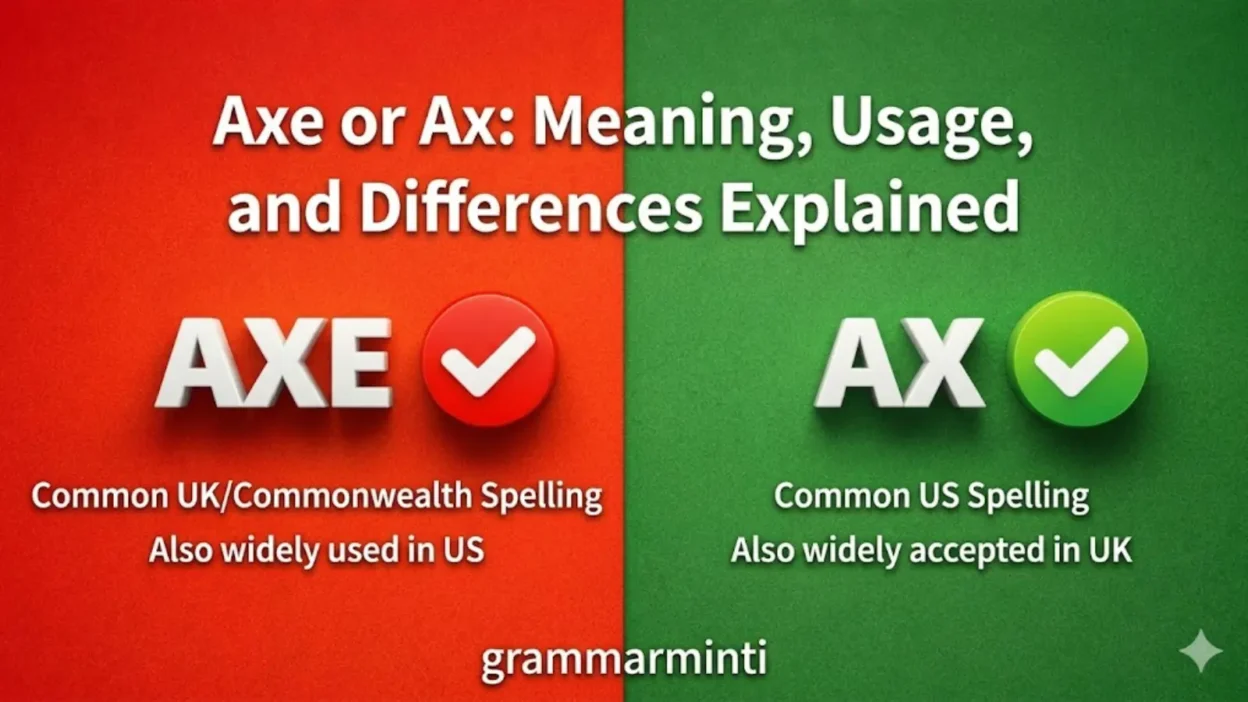
Both “axe” and “ax” are correct in American English. They mean the same thing.
• “Axe” is the more traditional spelling
• “Ax” is the shorter, simplified form often used in modern US writing
You can use either one, but consistency matters more than the choice itself.
Why People Confuse Them
The confusion comes from three main reasons.
First, English has many words with multiple accepted spellings. Over time, American English simplified several of them by removing letters that were not strongly pronounced. “Ax” is one of those simplified forms.
Second, readers encounter both spellings in different places. Books, educational content, and formal writing often prefer “axe,” while headlines, casual writing, and modern usage often prefer “ax.” This creates the impression that they must be different words.
Third, the word has both noun and verb uses, which adds another layer of confusion. People sometimes assume different spellings signal different meanings, but that is not the case here.
Key Differences At A Glance
| Feature | Axe | Ax |
|---|---|---|
| Spelling style | Traditional English spelling | Simplified American spelling |
| Common appearance | Books, formal writing, instruction | Headlines, casual writing, modern US usage |
| Meaning | Cutting tool / remove something | Cutting tool / remove something |
Meaning and Usage Difference
Both “axe” and “ax” refer to the same core ideas. The word can be used in two main ways.
First, it refers to a physical tool used for chopping wood or splitting material. This is the most direct and literal meaning.
Second, it is used as a verb meaning to remove, cancel, or eliminate something. This is often used in business or news writing when something is cut from a plan or budget.
There is no separate meaning hidden in each spelling. Instead, they share the same meaning and function. The only real difference is which spelling feels more appropriate in a given context.
In modern US English, “ax” is often chosen for shorter, sharper writing, while “axe” is still widely accepted and frequently used in more detailed or traditional writing.
Tone, Context, and Formality
Even though both spellings are correct, they can create slightly different impressions.
“Axe” often feels:
• More traditional
• Slightly more formal
• Common in instructional or descriptive writing
“Ax” often feels:
• More modern
• More direct
• Common in headlines and casual communication
For example, in a detailed article about woodworking, “axe” might feel more natural. In a short news headline about budget cuts, “ax” might feel more fitting.
This difference is not a rule but a style tendency. Writers often choose based on tone rather than correctness.
Which One Should You Use?
| Context | Best Choice | Why |
|---|---|---|
| Formal writing or educational content | Axe | More traditional and widely accepted in structured text |
| News headlines or short updates | Ax | Shorter and more direct for quick reading |
| General everyday writing | Either | Both are correct in US English |
The most important rule is consistency. If you choose one spelling, stick with it throughout the same piece of writing.
When One Choice Sounds Wrong
Neither spelling is grammatically wrong in American English, but tone mismatch can make writing feel awkward.
Using “ax” in a formal instructional guide may feel too casual for some readers. It can slightly reduce the seriousness of the tone.
Using “axe” in a very short headline may feel slightly heavy or outdated depending on the publication style.
However, these are stylistic impressions, not strict grammar rules. In most everyday writing, readers will not be confused either way.
The real problem only appears when both spellings are mixed randomly in the same text. That can make writing look inconsistent.
Common Mistakes (and Quick Fixes)
• Thinking they are different words → They are not; they are spelling variants
• Switching between spellings in one article → Pick one and stay consistent
• Assuming “ax” is incorrect → It is a valid American English spelling
• Overthinking meaning differences → Meaning stays the same in both forms
• Treating style choice as grammar rule → It is a writing preference, not a rule
A simple fix is to decide your tone early. If the writing is formal, stick with “axe.” If it is modern or short-form, “ax” works well.
Everyday Examples
Here are real-world examples showing both forms in use.
• The firefighter used an axe to break the door.
• The company decided to ax several low-performing projects.
• He sharpened his camping ax before the trip.
• The department was axed after budget changes.
• She carried a small axe while hiking in the woods.
• They will ax outdated policies next quarter.
These examples show that meaning does not change based on spelling. Only tone and style shift slightly.
Dictionary-Style Word Details
Verb
• Axe: to remove, eliminate, or cancel something
• Ax: same verb form in American English usage
Both forms are used in statements like cutting jobs, budgets, or plans.
Noun
• Axe: a handheld tool used for chopping wood or splitting materials
• Ax: simplified spelling of the same noun in US usage
The noun form is the most literal and physical meaning of the word.
Synonyms
• Axe: cut, remove, eliminate, cancel (context-based)
• Ax: cut, remove, eliminate, cancel (closest plain alternatives)
There are no perfect single-word synonyms that fully replace it in all contexts. Meaning depends on sentence use.
Example Sentences
• Axe: The team decided to axe the outdated system.
• Ax: The company axed the entire project last month.
• Axe: He swung the axe carefully at the log.
• Ax: She used a small ax during the camping trip.
• Axe: The manager may axe the proposal after review.
• Ax: Several roles were axed during restructuring.
Word History
The word comes from Old English roots referring to a chopping tool used for woodwork and construction. Over time, spelling variations developed.
American English gradually simplified some spellings for efficiency and modern usage, leading to “ax” as a shortened form. Both versions continued to exist in different writing styles, and neither replaced the other completely.
Today, both forms remain standard depending on context and preference.
Phrases Containing
• “to get the axe” — to be removed or fired
• “axe to grind” — a personal motive or hidden agenda
• “to axe a job” — to eliminate a position or role
• “face the axe” — to face removal or cancellation
These phrases are still commonly used in modern English writing and speech.
FAQs
1. Is “ax” or “axe” correct in American English?
Both are correct. “Axe” is the traditional spelling, while “ax” is the simplified American English form. They mean the same thing and can be used interchangeably depending on style.
2. Is there any difference in meaning between axe and ax?
No real difference in meaning. Both refer to a cutting tool and can also mean removing or eliminating something, like a job or project.
3. Why does “ax” exist if “axe” is already correct?
“Ax” developed as a shorter American English spelling. It simplifies “axe” by removing the extra “e,” but it did not change the meaning.
4. Which spelling is more common in the United States?
Both are used in the US. “Ax” is more common in modern, casual, and headline writing, while “axe” often appears in more traditional or formal text.
5. Is “ax” considered informal or incorrect?
No, it is not incorrect. It is an accepted American English spelling. However, some writers prefer “axe” in formal writing because it looks more traditional.
6. Can “axe” and “ax” be used as verbs?
Yes. Both can be used as verbs meaning to remove or cut something, such as axing a budget or axing a project.
7. Which spelling should I use in school writing?
Either is usually acceptable in US English, but it’s best to follow your teacher’s preference or your style guide. Consistency is more important than the choice itself.
8. Do “axe” and “ax” have different pronunciations?
No. Both are pronounced the same way: /æks/ (“aks”). The difference is only in spelling, not sound.
Conclusion
“Axe” and “ax” are not different words with different meanings. They are simply two accepted spellings in American English.
The choice between them depends on style, tone, and writing context rather than grammar rules. “Axe” feels more traditional, while “ax” feels more modern and streamlined.
As long as you stay consistent, both forms are correct and widely understood.