Few English mistakes show up as often in everyday writing as the confusion between “bear with me” and “bare with me.”
You’ll see it in emails, chats, work messages, and even professional posts. At first glance, both look correct because they sound identical when spoken. That similarity is exactly what causes the problem.
But only one is correct when you are asking someone to wait or be patient. The other word has a completely different meaning that does not fit this context at all.
This guide breaks everything down in a simple, practical way so you can always choose the right phrase without hesitation.
Quick Answer
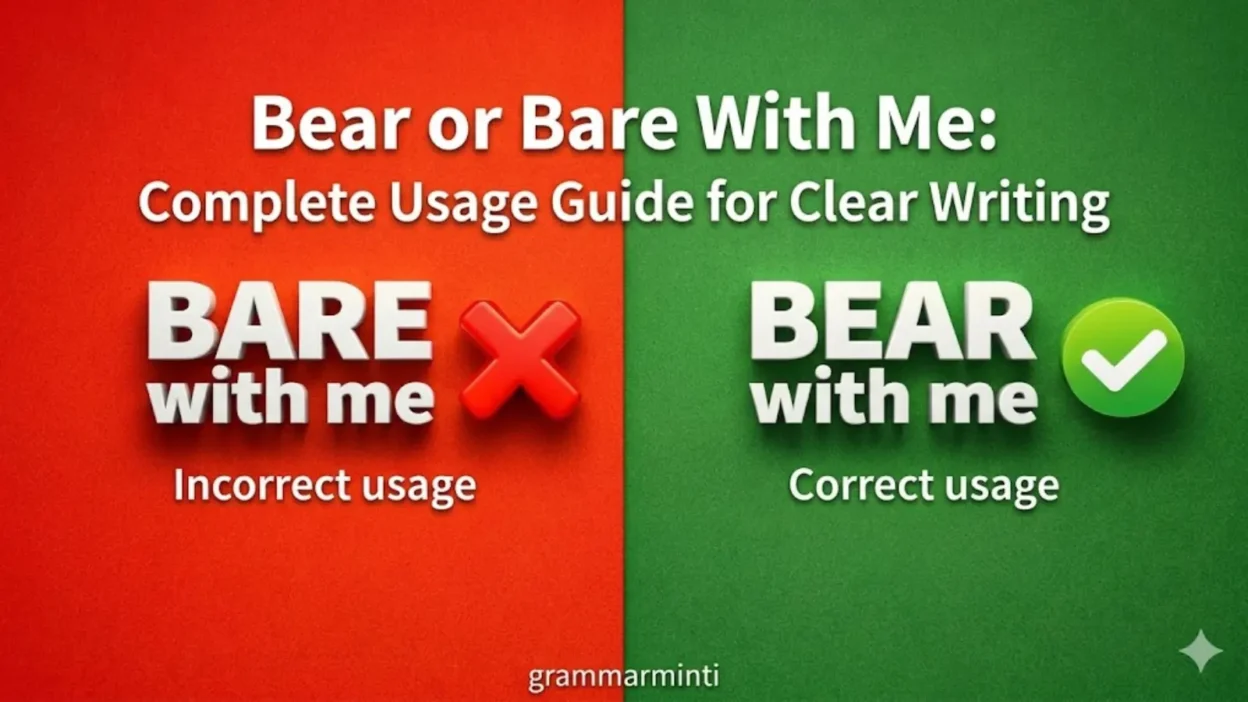
The correct phrase is “bear with me.”
It means: please be patient with me while I explain, fix, or complete something.
“Bare with me” is incorrect in this context and is almost always a spelling mistake.
Why People Confuse Them
The confusion is not about grammar complexity. It comes down to sound.
“Bear” and “bare” are homophones—words that sound the same but have different meanings and spellings.
That creates three main problems:
- People rely on how it sounds, not meaning
- Both words are common in English
- Autocorrect sometimes fails to correct it
Another reason is that “bare” is a very common word in English, so it feels familiar and “looks right” in a sentence, even when it is wrong.
But meaning—not sound—is what matters here.
Key Differences At A Glance
| Feature | Bear | Bare |
|---|---|---|
| Meaning | To tolerate, endure, or be patient | Uncovered, exposed, or minimal |
| Part of speech | Verb (in this phrase) | Adjective |
| Usage in phrase | Correct: “bear with me” | Incorrect for this phrase |
| Context | Patience or waiting | Physical state (empty or uncovered) |
The key takeaway is simple:
Only bear works with patience. Bare does not.
Meaning and Usage Difference
To understand this fully, it helps to break each word down clearly.
Bear (in “bear with me”)
In this phrase, “bear” is a verb. It means:
- to tolerate
- to endure
- to remain patient through something
So when someone says “bear with me,” they are literally saying:
“Please tolerate this delay or wait patiently while I continue.”
This usage is very old in English and still widely used in modern communication.
Bare (why it does not fit)
“Bare” is an adjective that means:
- uncovered
- empty
- minimal
- exposed
Examples:
- bare walls
- bare feet
- bare minimum
None of these meanings relate to patience or waiting.
So if you say “bare with me,” it would literally suggest something like:
“Be uncovered with me” or “be exposed with me,” which does not make sense in communication.
That mismatch is why it is incorrect.
Tone, Context, and Formality
“Bear with me” works across almost all modern communication styles.
Where it is commonly used
- Business emails
- Customer support replies
- Online chats
- Presentations
- Tutorials or explanations
- Workplace conversations
Tone
It sounds:
- polite
- neutral
- professional
- calm
It does not sound too formal or too casual, which is why it is widely used.
“Bare with me” in tone
Because it is incorrect in this context, it appears:
- unpolished in writing
- distracting in professional communication
- often flagged as a spelling mistake
Even if the reader understands your intent, it reduces clarity.
Which One Should You Use?
The decision is straightforward once meaning is clear.
| Context | Best Choice | Why |
|---|---|---|
| Explaining something slowly | Bear with me | Requests patience |
| Fixing a technical issue | Bear with me | Signals temporary delay |
| Writing a polite email | Bear with me | Professional tone |
| Casual texting | Bear with me | Natural expression |
| Any situation involving “wait” | Bear with me | Correct meaning |
If your sentence involves asking someone to wait, always use bear with me.
When One Choice Sounds Wrong
“Bare with me” almost always sounds wrong in standard English writing.
Here’s why:
- It does not match the meaning of patience
- It introduces an unrelated idea (exposure)
- It breaks reader expectations in professional communication
In fact, readers familiar with English usage will immediately recognize it as a mistake.
Even if they understand the message, it can create a moment of confusion or distraction.
So in practical writing, it is best avoided entirely.
Common Mistakes (and Quick Fixes)
This confusion usually appears in predictable patterns.
Mistake 1
Wrong: Bare with me a second
Correct: Bear with me a second
Mistake 2
Wrong: Please bare with me while I check
Correct: Please bear with me while I check
Mistake 3
Wrong: I’ll be with you, just bare with me
Correct: I’ll be with you, just bear with me
Mistake 4
Wrong: Bare with me during the delay
Correct: Bear with me during the delay
Quick Fix Rule
If you can replace it with “be patient,” use bear.
Everyday Examples
Here are natural, real-world uses in modern English:
- “Bear with me while I open the file.”
- “Bear with me, the system is loading.”
- “Bear with me, I’m still finishing the setup.”
- “Thanks for your patience—bear with me for a moment.”
- “Bear with me while I double-check your request.”
- “Bear with me, this might take a little longer than expected.”
These examples show how flexible the phrase is in daily communication.
Dictionary-Style Word Details
Verb
- Bear: to endure, tolerate, or remain patient
- Bare: not used as a verb in this phrase context; primarily an adjective
Noun
- Bear: animal or something that carries weight (not relevant to phrase usage)
- Bare: not used as a noun in this phrase context
Synonyms
- Bear: tolerate, endure, withstand, be patient with, put up with
- Bare: uncovered, exposed, minimal, plain (not related to phrase meaning)
Antonyms (for context clarity):
- Bear: avoid, reject, refuse
- Bare: covered, full, complete
Example Sentences
- Bear: “I can’t bear loud noises for long.”
- Bare: “The room was bare after moving out.”
- Phrase: “Bear with me while I fix this issue.”
- Phrase: “Please bear with me during the delay.”
Word History
- Bear originally meant “to carry” or “to endure” in older English usage.
- Bare comes from early Germanic roots meaning “uncovered” or “naked.”
These meanings developed separately and do not overlap in modern usage.
Phrases Containing
- Bear with me
- Bear in mind
- I can’t bear it
- Bear the burden
- Bare minimum
- Bare essentials
- Bare walls
- Bare feet
FAQs
1. Is it “bear with me” or “bare with me”?
The correct phrase is “bear with me.” It means “please be patient with me.” “Bare with me” is a common spelling mistake.
2. What does “bear with me” mean?
It means please wait a moment or be patient while I explain, fix, or finish something. It’s commonly used in emails, chats, and professional communication.
3. Why is “bare with me” wrong?
“Bare” means uncovered or empty, which has nothing to do with patience or waiting. That’s why it doesn’t fit the meaning of the phrase.
4. Can I ever use “bare with me”?
No, not in standard English. If you mean asking someone to wait, you should always use “bear with me.”
5. Is “bear with me” formal or informal?
It works in both. It is neutral English, commonly used in professional emails, customer support, and casual conversations.
6. What is a simple way to remember the correct spelling?
Think of “bear” as “endure.” When you say “bear with me,” you’re asking someone to endure a short wait.
7. Is “bear with me” rude?
No. It is actually a polite phrase used to ask for patience in a respectful way.
8. Can I say “please bear with me” in emails?
Yes, it is very common in professional emails. Example: “Please bear with me while I check your request.”
9. What are similar phrases to “bear with me”?
You can also say:
- “Please wait a moment”
- “One moment, please”
- “Thanks for your patience”
- “Hold on a second”
10. Why do people confuse bear and bare so often?
Because they are homophones—they sound exactly the same in spoken English but have different meanings and spellings.
Conclusion
The correct phrase is always “bear with me” when asking someone to wait or be patient.
“Bare with me” is a common spelling error caused by similar pronunciation, but it does not fit the meaning of patience or delay.
Once you connect “bear” with the idea of endurance, the correct choice becomes easy and automatic in real writing.