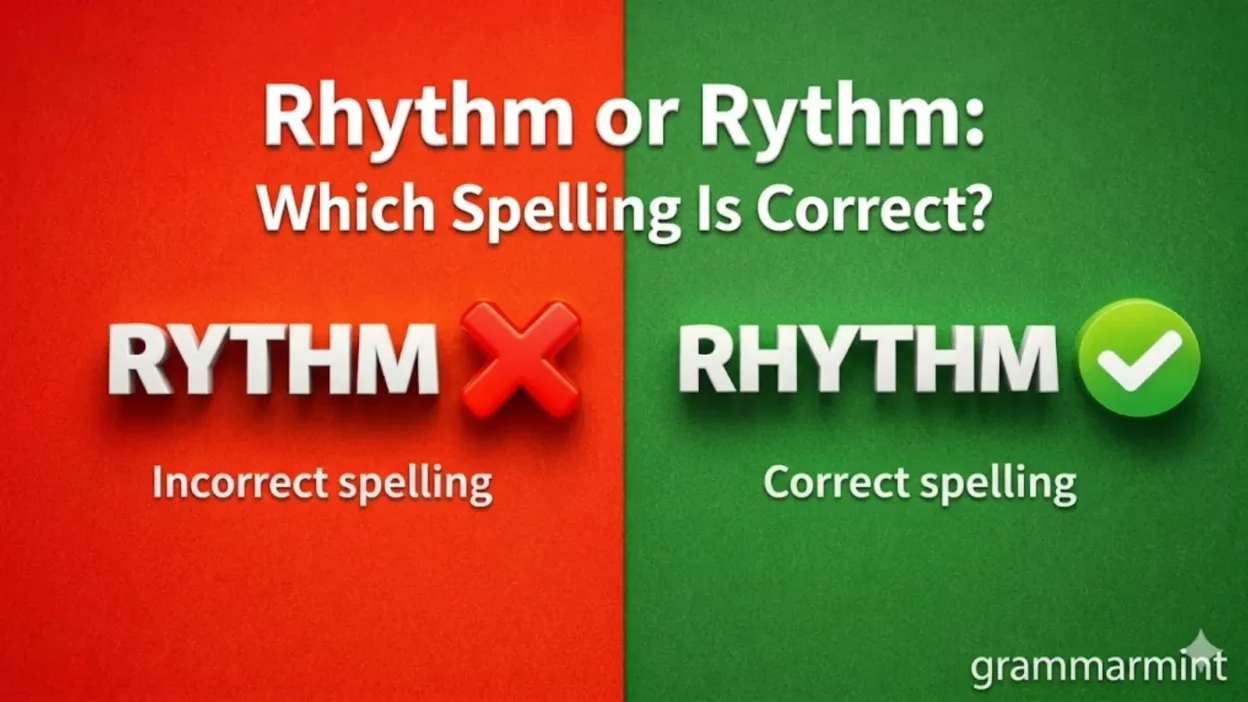
The correct spelling is rhythm.
Rythm is not the standard spelling in American English. It is a common misspelling of rhythm, usually caused by the unusual letter pattern in the word.
Use rhythm when you mean a beat, pattern, flow, or regular movement in music, speech, writing, dance, daily life, or nature.
Do not use rythm in standard writing.
The main difference is simple:
Rhythm is correct.
Rythm is incorrect.
This guide explains why people confuse them, how to use rhythm naturally, and how to avoid the misspelling rythm in everyday writing.
Quick Answer
Rhythm is the correct spelling.
Rythm is a misspelling.
You should write:
Correct: The song has a strong rhythm.
Incorrect: The song has a strong rythm.
Correct: I finally got into a good work rhythm.
Incorrect: I finally got into a good work rythm.
Correct: Her writing has a smooth rhythm.
Incorrect: Her writing has a smooth rythm.
The word rhythm is most often used as a noun. It can describe a musical beat, a repeated pattern, or the flow of something.
Rythm does not have a separate meaning. It is not a different word, a casual version, or a regional spelling. In standard US English, it is simply the wrong spelling.
Why People Confuse Them
People often confuse rhythm and rythm because rhythm looks unusual.
Many English words have a clear vowel pattern, but rhythm has a spelling that can feel strange. It starts with rh, includes y, and ends with thm. That makes it easy to drop the first h by mistake.
The misspelling rythm usually happens because writers hear the word more clearly than they see it. When spoken, the first h in rhythm is not strongly heard. That can make rythm look believable, even though it is not correct.
Another reason is typing speed. People often type rythm when they are moving quickly because it seems simpler.
Still, the standard spelling is always rhythm.
Think of the word this way:
R-H-Y-T-H-M
A common memory trick is:
Rhythm Helps Your Two Hips Move
That sentence is silly, but it works because it helps you remember the letters in order.
Key Differences At A Glance
| Context | Best Choice | Why |
|---|---|---|
| Music | Rhythm | It is the correct spelling for a beat or pattern in music. |
| Dance | Rhythm | It describes timing, movement, and beat. |
| Writing | Rhythm | It can describe sentence flow or pacing. |
| Daily routine | Rhythm | It can describe a regular pattern in life or work. |
| Biology or nature | Rhythm | It can describe repeated natural patterns. |
| School writing | Rhythm | It is the standard spelling expected by teachers. |
| Professional writing | Rhythm | It is the correct spelling in formal and workplace English. |
| Texting or casual writing | Rhythm | Even casually, rythm is still a misspelling. |
| Any standard US English use | Rhythm | Rythm is not a standard alternative. |
Here is the extra comparison in the simplest form:
| Feature | Rhythm | Rythm |
| Correct spelling | Yes | No |
| Standard English word | Yes | No |
| Common meaning | Beat, pattern, flow, timing | No separate meaning |
| Part of speech | Usually a noun | Not standard |
| Safe for school or work | Yes | No |
| Example | The rhythm of the song is catchy. | The rythm of the song is catchy. |
Meaning and Usage Difference
Rhythm means a repeated beat, movement, pattern, or flow.
It is often used in music:
The drummer kept a steady rhythm.
It is also used in dance:
She moved with natural rhythm.
It can describe speech or writing:
The speech had a calm, confident rhythm.
It can describe a routine:
After a few weeks, I found my morning rhythm.
It can describe natural patterns:
Sleep follows a daily rhythm.
Rythm does not have a correct meaning in standard English. It is only a misspelling of rhythm.
That means there is no real meaning difference between the two words. The choice is not about tone, style, or grammar. It is about correct spelling.
Use rhythm every time.
Do not write rythm unless you are showing the error itself, such as in a spelling lesson.
The word rhythm is pronounced like RIH-thum. The first part sounds like “rith,” and the second part sounds like “um.” The spelling is harder than the pronunciation, which is one reason the misspelling happens so often.
Tone, Context, and Formality
Rhythm works in every normal context.
You can use it in casual writing:
I finally got back into my gym rhythm.
You can use it in school writing:
The poem’s rhythm makes it easier to read aloud.
You can use it in professional writing:
The team developed a better meeting rhythm after the schedule changed.
You can use it in creative writing:
The rain tapped a quiet rhythm against the window.
You can use it in music writing:
The bass line gives the song its rhythm.
Rythm does not fit any standard tone or formality level. It looks like a spelling mistake in casual, formal, academic, and professional writing.
In a text message, people may still understand what you mean if you write rythm, but it will still be incorrect.
In a school paper, job application, article, email, report, caption, or professional document, rythm can make the writing look careless.
The safest choice is always rhythm.
Which One Should You Use?
Use rhythm.
Do not use rythm.
This rule applies in all standard American English contexts.
Write:
The rhythm changed halfway through the song.
Not:
The rythm changed halfway through the song.
Write:
Our team has a good weekly rhythm now.
Not:
Our team has a good weekly rythm now.
Write:
The poem has a gentle rhythm.
Not:
The poem has a gentle rythm.
Write:
He has no sense of rhythm.
Not:
He has no sense of rythm.
There is no special case where rythm becomes the better choice in standard writing.
The only time you should write rythm is when you are talking about the misspelling itself.
Example:
Many students spell rhythm as rythm because the first h is easy to forget.
When One Choice Sounds Wrong
Rythm may look close to correct, but it sounds wrong in writing because readers expect rhythm.
These sentences contain the wrong spelling:
The band played with great rythm.
She has a strong sense of rythm.
The rythm of the story feels rushed.
My sleep rythm has been off all week.
The workout class helped me find my rythm.
Each one should use rhythm instead:
The band played with great rhythm.
She has a strong sense of rhythm.
The rhythm of the story feels rushed.
My sleep rhythm has been off all week.
The workout class helped me find my rhythm.
The mistake usually appears in the middle of normal sentences. Because the reader can often guess the meaning, the error may seem small. Still, it is easy to fix and worth correcting.
A misspelled common word can distract readers. That matters most in resumes, school assignments, business writing, published articles, and anything meant to look polished.
Common Mistakes (and Quick Fixes)
One common mistake is leaving out the first h.
Incorrect: rythm
Correct: rhythm
The quick fix is to remember that rhythm begins with rh, not just r.
Another common mistake is trying to spell the word by sound. Since the first h is not clearly heard, people write the word the way it seems to sound.
Incorrect: The dancer had perfect rythm.
Correct: The dancer had perfect rhythm.
A third mistake is assuming rythm might be an accepted short version. It is not.
Incorrect: I used rythm because it looks simpler.
Correct: I used rhythm because it is the standard spelling.
A fourth mistake is confusing rhythm with related words like rhyme. These words look somewhat similar, but they do not mean the same thing.
Rhythm is about beat, movement, or pattern.
Rhyme is about matching sounds, usually at the ends of words.
Example:
The poem has a steady rhythm and a simple rhyme.
That sentence uses both words correctly.
Another common mistake is writing rhythym with an extra letter. That is also incorrect.
Incorrect: rhythym
Correct: rhythm
The correct spelling has six letters:
r h y t h m
No extra vowel is needed.
Everyday Examples
Here are natural examples using rhythm correctly.
The song has a rhythm that makes everyone want to dance.
I lost my rhythm after missing two weeks of practice.
The drummer set the rhythm for the whole band.
She clapped along with the rhythm.
The rhythm of the waves helped me relax.
After summer break, it took a while to get back into a school rhythm.
Our office has a better rhythm now that meetings are shorter.
The writer uses short sentences to create a fast rhythm.
The baby settled into a sleep rhythm after a few months.
Running feels easier once I find my rhythm.
The class moved through the lesson at a steady rhythm.
The city has its own rhythm in the morning.
The speaker’s rhythm made the presentation easy to follow.
The song’s rhythm changes near the end.
He struggled to keep rhythm during the dance routine.
Now compare those with the incorrect spelling:
Incorrect: The song has a catchy rythm.
Correct: The song has a catchy rhythm.
Incorrect: I need to fix my sleep rythm.
Correct: I need to fix my sleep rhythm.
Incorrect: The poem’s rythm is smooth.
Correct: The poem’s rhythm is smooth.
Incorrect: She danced with great rythm.
Correct: She danced with great rhythm.
Incorrect: Our team finally found a good rythm.
Correct: Our team finally found a good rhythm.
In each case, rhythm is the only correct choice.
Dictionary-Style Word Details
Verb
Rhythm: Not commonly used as a verb in standard US English. The word is normally a noun.
Example:
Correct noun use: The rhythm of the music changed.
You may see related forms, but rhythm itself is not normally used as an everyday verb.
Rythm: Not used as a verb in standard US English. It is a misspelling of rhythm, not a separate verb.
Example:
Incorrect: The song rythms nicely.
Better: The song has a nice rhythm.
If you need a verb, use a different structure.
Better options include:
The song moves well.
The beat flows smoothly.
The music keeps a steady rhythm.
Noun
Rhythm: A noun that means a beat, pattern, flow, or regular movement.
Examples:
The rhythm of the song is fast.
The poem has a steady rhythm.
The team found a good rhythm after a slow start.
The rhythm of the rain helped her fall asleep.
Rythm: Not a standard noun. It is a misspelling of rhythm.
Incorrect:
The rythm of the song is fast.
Correct:
The rhythm of the song is fast.
Use rhythm whenever you need the noun.
Synonyms
Rhythm: Exact synonyms depend on the context. The closest plain alternatives are:
beat
tempo
cadence
pattern
flow
pulse
timing
movement
These are not always exact replacements.
For music, beat, tempo, pulse, and cadence may fit.
Example:
The rhythm of the song is strong.
The beat of the song is strong.
For writing or speech, flow, cadence, or pace may fit.
Example:
The rhythm of her speech was calm.
The cadence of her speech was calm.
For routines, pattern or flow may fit.
Example:
I found my work rhythm.
I found my work flow.
Antonyms do not always fit neatly because rhythm has several uses. In some contexts, possible opposites include:
disorder
irregularity
chaos
unevenness
Example:
The band played with rhythm.
The band played with uneven timing.
Rythm: No true synonyms because it is not a standard word. The correct replacement is rhythm.
Example Sentences
Rhythm:
The rhythm of the music made the room feel alive.
She has a natural sense of rhythm.
The poem’s rhythm makes it easy to read aloud.
Our family finally got into a good morning rhythm.
The rhythm of the rain was soft and steady.
He lost his rhythm during the second verse.
The dancers followed the rhythm of the drums.
My sleep rhythm changed after I started working nights.
The speech had a clear rhythm that kept the audience engaged.
The team’s rhythm improved after a few weeks of practice.
Rythm:
Rythm is not correct in standard American English.
Incorrect: The rythm of the music made the room feel alive.
Correct: The rhythm of the music made the room feel alive.
Incorrect: She has a natural sense of rythm.
Correct: She has a natural sense of rhythm.
Incorrect: My sleep rythm changed.
Correct: My sleep rhythm changed.
Incorrect: The poem’s rythm is smooth.
Correct: The poem’s rhythm is smooth.
Incorrect: The team found its rythm.
Correct: The team found its rhythm.
Word History
Rhythm: The spelling rhythm comes through older language history, which explains why it looks unusual in modern English. The important point for today’s writers is that rhythm is the standard spelling.
The word has kept the rh at the beginning, even though many speakers do not strongly hear that h when they say it.
That silent-looking h is the part many writers forget.
The safest practical memory is:
Rhythm = r h y t h m
Or use the memory sentence:
Rhythm Helps Your Two Hips Move
Rythm: Rythm does not have a separate word history as a standard English word. It is best understood as a common misspelling of rhythm.
Do not treat rythm as a variant, older spelling, casual spelling, or shorter spelling in normal writing.
Phrases Containing
Rhythm:
sense of rhythm
natural rhythm
steady rhythm
daily rhythm
sleep rhythm
heart rhythm
rhythm of life
rhythm and blues
rhythm section
rhythm guitar
keep rhythm
find your rhythm
lose your rhythm
get into a rhythm
break the rhythm
change the rhythm
rhythm of speech
rhythm of a poem
rhythm of the music
Examples:
She has a great sense of rhythm.
I’m trying to get into a better daily rhythm.
The rhythm section carried the song.
He lost his rhythm after the interruption.
The rhythm of the poem feels calm and steady.
Rythm:
No standard phrases use rythm correctly.
Incorrect:
sense of rythm
daily rythm
sleep rythm
heart rythm
rythm and blues
find your rythm
keep rythm
Correct:
sense of rhythm
daily rhythm
sleep rhythm
heart rhythm
rhythm and blues
find your rhythm
keep rhythm
Conclusion
Use rhythm, not rythm.
Rhythm is the correct spelling for a beat, pattern, flow, timing, or regular movement. It works in music, dance, writing, speech, routines, and natural patterns.
Rythm is a misspelling. It is not a standard alternative, and it does not have a separate meaning.