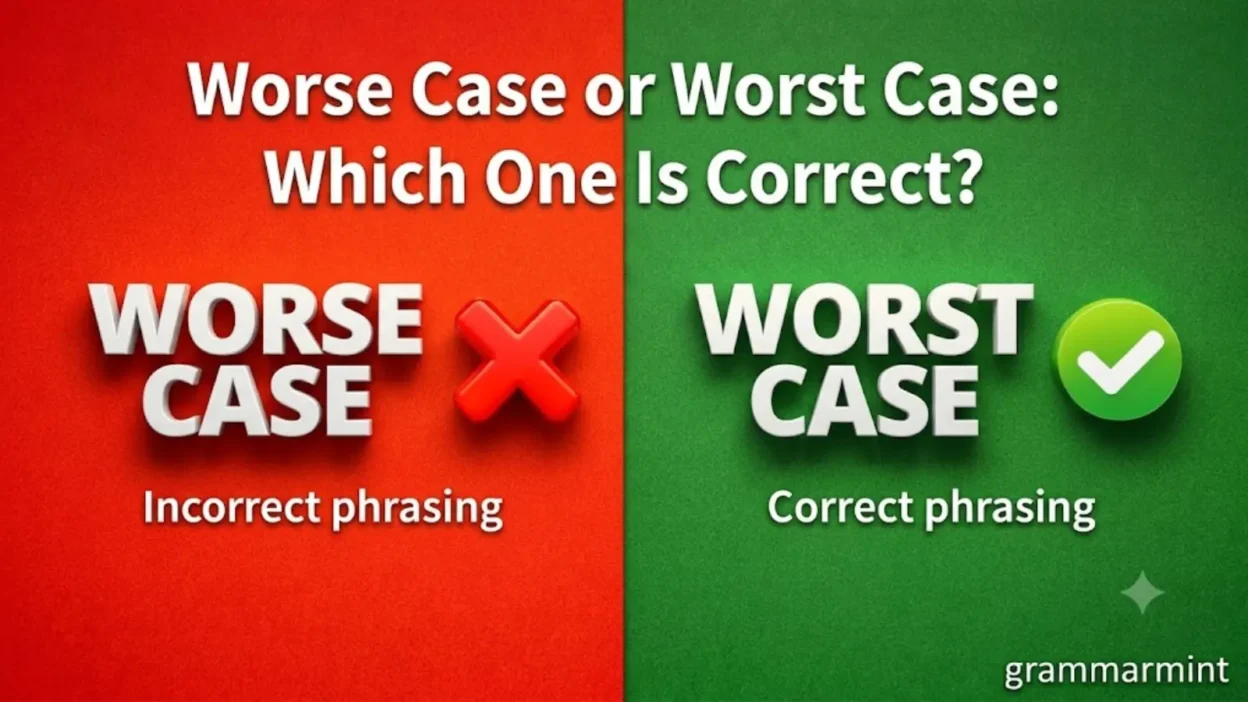
Worst case is the correct choice when you mean the most negative possible situation. Most of the time, worse case is a mistake.
The common phrase is worst case, as in “in the worst case” or “worst-case scenario.” It points to the most serious, most difficult, or most damaging outcome that could happen.
Worse case can be grammatical only in a narrow comparison, such as “This is a worse case than the last one.” In that sentence, you are comparing one case with another. That is different from naming the most extreme possible outcome.
So the simple answer is this: use worst case for the familiar phrase. Use worse case only when you clearly mean “a more serious case than another case.”
Quick Answer
Use worst case when talking about the most negative possible result.
Correct: In the worst case, we will reschedule the meeting.
Correct: We need a worst-case plan for a power outage.
Correct: The worst-case scenario is that the shipment arrives next week.
Do not write worse case when you mean worst case.
Incorrect: In a worse case, we will close the office.
Better: In the worst case, we will close the office.
Use worse case only when a direct comparison is clear.
Correct: This is a worse case than the one we handled yesterday.
That sentence works because worse means “more bad” or “more serious.” It compares two cases. It does not mean “the most serious possible case.”
Why People Confuse Them
People confuse worse case and worst case for two main reasons.
First, worse and worst look and sound similar. They are both forms of bad, but they do different jobs. Worse compares. Worst points to the lowest or most negative level.
Second, the t in worst case can be hard to hear in fast speech. When people say worst case, the final t sound sits right before the hard c sound in case. In casual speech, that can make worst case sound like worse case.
That sound issue does not change the written form. In standard writing, the phrase is still worst case.
Key Differences At A Glance
| Context | Best Choice | Why |
|---|---|---|
| The most negative possible outcome | Worst case | Worst means the most bad or most unfavorable. |
| A plan for the most serious result | Worst-case | It works as a compound modifier before a noun. |
| A direct comparison between two cases | Worse case | Worse means more serious than another case. |
| Casual phrase meaning “if the bad thing happens” | Worst case | This is the standard everyday wording. |
| Formal report or business writing | Worst case | It is clearer and more accepted. |
Meaning and Usage Difference
Worst case means the most unfavorable case. It is the case at the bottom of the range. Nothing in the set is more negative than it.
Example: In the worst case, the repair could cost $2,000.
Here, the speaker is not comparing two cases. The speaker is naming the most expensive or most serious possible result.
Worse case means a case that is more negative than another case. It needs a comparison to make sense.
Example: This is a worse case than the one we reviewed last month.
That sentence works because one case is being compared with another. Without that comparison, worse case sounds unfinished or wrong.
A helpful test is to ask: Can I add “than another case”? If yes, worse case may work. If no, you probably need worst case.
Tone, Context, and Formality
Worst case is standard in everyday, school, business, legal, technical, and news-style writing. It sounds natural because it is the expected phrase.
Worst-case with a hyphen is common before a noun.
Correct: worst-case scenario
Correct: worst-case estimate
Correct: worst-case plan
Without a noun after it, the phrase is usually written without a hyphen.
Correct: In the worst case, we will cancel.
Worse case is not a standard replacement for worst case. In formal writing, it will usually look like an error unless the sentence clearly compares one case with another.
There is no useful US vs. UK split here for the basic choice. For a US audience, worst case is the safe and standard phrase.
Which One Should You Use?
Use worst case in almost every common situation.
Choose worst case when you mean:
- the most serious possible result
- the least favorable situation
- the outcome you want to prepare for
- the final bad limit in a range of outcomes
Examples:
Worst case, we leave early tomorrow.
In the worst case, the app will be offline for one hour.
The team prepared for a worst-case scenario.
Use worse case only when you are comparing cases.
Example:
A missed payment is bad, but a missed court deadline is a worse case.
Even there, many writers would make the comparison clearer:
A missed court deadline is worse than a missed payment.
That rewrite is often smoother.
When One Choice Sounds Wrong
Worse case sounds wrong when it appears in fixed phrases where readers expect worst case.
Wrong: In a worse case, we refund the order.
Right: In the worst case, we refund the order.
Wrong: The worse-case scenario is a total delay.
Right: The worst-case scenario is a total delay.
Wrong: Let’s plan for the worse case.
Right: Let’s plan for the worst case.
The problem is not the word case. The problem is the degree of comparison.
Worse needs something to compare with. Worst does not. It already means the most negative one.
Common Mistakes (and Quick Fixes)
Mistake: Using worse case for the standard phrase
Wrong: Worse case, we call a plumber.
Fix: Worst case, we call a plumber.
Mistake: Forgetting the hyphen before a noun
Less clear: worst case scenario
Better: worst-case scenario
Mistake: Adding a hyphen when the phrase stands alone
Less natural: In the worst-case, we wait.
Better: In the worst case, we wait.
Mistake: Using worse without a comparison
Wrong: This is a worse case.
Better: This is a worse case than the first one.
Mistake: Overusing the phrase when a simpler sentence works
Wordy: The worst-case scenario is that we might possibly need to restart.
Cleaner: At worst, we may need to restart.
Everyday Examples
Worst case, I’ll take the bus home.
In the worst case, we lose the deposit but keep the reservation.
The doctor said the worst-case outcome is unlikely.
Our worst-case budget still keeps the project under control.
The landlord gave us a worst-case repair timeline of two weeks.
This is a worse case than the one we handled in April.
A cracked screen is annoying, but water damage is a worse case.
The first delay was bad; the second delay created a worse case for the team.
Extra comparison block:
- Worse Case: Rare; use only for a clear comparison.
- Worst Case: Standard; use for the most negative possible situation.
- Worst-Case: Hyphenated before a noun, as in worst-case scenario.
Dictionary-Style Word Details
Verb
Worse Case: Not commonly used as a verb in standard US English. The phrase works, rarely, as a noun phrase in direct comparisons.
Worst Case: Not commonly used as a verb in standard US English. The phrase usually works as a noun phrase, or as worst-case before a noun.
Noun
Worse Case: A rare noun phrase meaning a case that is more serious or less favorable than another case. It needs a comparison to sound complete.
Example: This is a worse case than the last one.
Worst Case: A standard noun phrase meaning the most negative or least favorable possible case.
Example: In the worst case, we start again tomorrow.
Synonyms
Worse Case: Closest plain alternatives include more serious case, more difficult case, and more unfavorable case. A clear opposite can be better case when making a direct comparison.
Worst Case: Closest plain alternatives include worst possible outcome, most serious case, most negative result, and least favorable situation. A clear opposite is best case.
Example Sentences
Worse Case:
This is a worse case than the one we solved last week.
The second claim became a worse case after new damage appeared.
Worst Case:
In the worst case, we delay the launch by one week.
We built a worst-case plan for heavy snow.
The worst-case scenario is that we need a full replacement.
Word History
Worse Case: The phrase comes from worse, the comparative form of bad, plus case, meaning a situation or example. It is not the standard fixed phrase for the most negative possible result.
Worst Case: The phrase comes from worst, the superlative form of bad, plus case. That is why it fits the meaning “the most unfavorable case.” No exact first-use date is needed to use the phrase correctly today.
Phrases Containing
Worse Case:
a worse case than
a worse case for the team
a worse case of damage
These phrases need comparison or clear context.
Worst Case:
in the worst case
worst-case scenario
worst-case plan
worst-case estimate
worst-case outcome
These are common and natural in standard US English.
Conclusion
For the phrase most people mean, worst case is correct.
Use worst case when you mean the most negative possible situation. Use worst-case with a hyphen before a noun, as in worst-case scenario.
Use worse case only when you are comparing one case with another, as in “This is a worse case than the first one.”
When in doubt, choose worst case. It is the clear, standard, and expected form for planning, warnings, risk, and everyday speech.