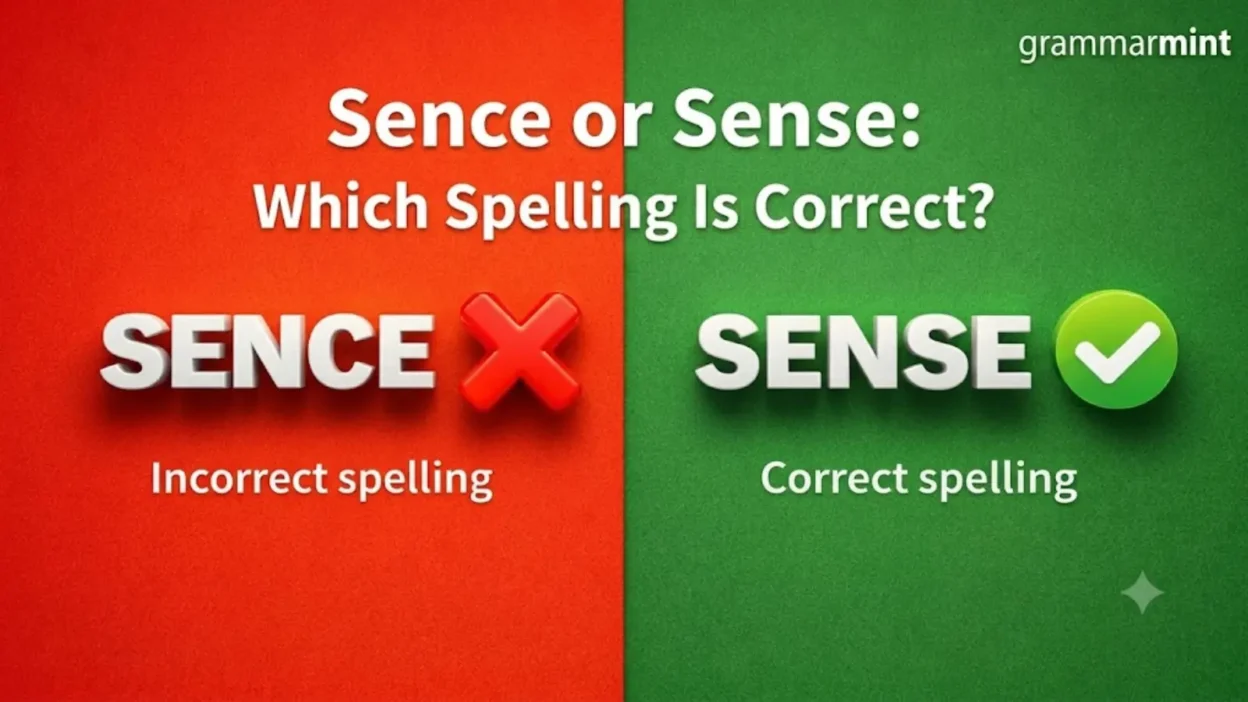
Sense is the correct word in modern standard English. Sence is a misspelling.
Use sense when you mean meaning, good judgment, awareness, a feeling, or one of the physical abilities such as sight, smell, hearing, taste, and touch.
Do not use sence in school writing, business emails, articles, resumes, messages, or professional documents.
The confusion is easy to understand because sense sounds like it could end in -ce. But in standard US English, the correct spelling is always sense.
Quick Answer
The correct spelling is sense.
Sence is a misspelling in modern standard US English.
Use sense when you mean meaning, judgment, awareness, feeling, or physical perception.
Correct: This sentence makes sense.
Incorrect: This sentence makes sence.
Correct: Use your common sense.
Incorrect: Use your common sence.
Correct: I could sense his concern.
Incorrect: I could sence his concern.
Why People Confuse Them
People confuse sence and sense mostly because of sound.
The word sense is pronounced like sens. The final e is silent. Since the sound does not clearly show the spelling, many people guess the ending. Some guess -ce because that ending appears in many English words.
For example:
- fence
- hence
- dance
- chance
- once
Because those words end in -ce, sence may look possible at first. But it is not the accepted spelling for this word.
Another reason for the confusion is typing speed. People often type common phrases quickly, especially in texts, comments, and online posts. A person may write make sence even though they know the correct spelling is make sense.
The mistake also appears because sense has more than one meaning. A word with several uses can feel harder to remember. It can mean logic, meaning, awareness, judgment, or physical ability. But all of those meanings still use the same spelling: sense.
Here are the most common places where the mistake appears:
Wrong: That makes sence.
Right: That makes sense.
Wrong: Use common sence.
Right: Use common sense.
Wrong: I have a good sence of smell.
Right: I have a good sense of smell.
Wrong: She could sence danger.
Right: She could sense danger.
The correction is always the same. Replace sence with sense.
Key Differences At A Glance
| Context | Best Choice | Why |
|---|---|---|
| Meaning or logic | sense | “That makes sense” means something is clear or reasonable. |
| Good judgment | sense | “Common sense” means practical judgment. |
| Physical ability | sense | Sight, smell, hearing, taste, and touch are senses. |
| Feeling or awareness | sense | “I sense a problem” means “I notice or feel it.” |
| Standard school writing | sense | This is the accepted spelling. |
| Business or professional writing | sense | “Sence” looks like an error. |
| Casual texting | sense | Even casual writing uses the standard spelling. |
| Any modern US context | sense | “Sence” is not standard. |
The key difference is not a subtle meaning difference. Sense is correct. Sence is incorrect in modern standard writing.
That makes this comparison easier than many word-choice pairs. You do not need to decide between two correct words. You only need to remember the accepted spelling.
Use sense in all of these cases:
- That makes sense.
- It makes no sense.
- Use common sense.
- She has a great sense of humor.
- He has a strong sense of duty.
- I could sense the problem.
- Dogs have a strong sense of smell.
Do not use sence in these same phrases.
Meaning and Usage Difference
The real difference between sence and sense is that sense is the standard English word, while sence is a spelling mistake in modern use.
Sense has several related meanings.
First, sense can mean meaning.
Example:
The word has a different sense in that sentence.
In this use, sense means the idea or meaning carried by a word, phrase, or sentence.
Second, sense can mean logic or reason.
Example:
Your plan makes sense.
This means the plan seems reasonable, clear, or practical.
Third, sense can mean good judgment.
Example:
She showed good sense by saving money before moving.
In this sentence, sense means practical thinking.
Fourth, sense can mean a physical ability.
Example:
Smell is one of the five senses.
The five main senses are sight, hearing, smell, taste, and touch.
Fifth, sense can mean awareness or feeling.
Example:
He had a strong sense that something was wrong.
Here, sense means an inner feeling or awareness.
Finally, sense can be a verb.
Example:
I could sense that she was nervous.
As a verb, sense means to feel, detect, notice, or become aware of something.
Sence does not carry these meanings in standard modern writing. If you write sence, readers will usually understand what you meant, but they will still see the word as misspelled.
Compact comparison:
- Sence: not standard in modern US English
- Sense: correct spelling
- Sence: should be corrected
- Sense: can be a noun
- Sense: can be a verb
- Sence: does not work in standard phrases
- Sense: works in phrases like make sense, common sense, and sense of humor
So the choice is clear: write sense.
Tone, Context, and Formality
Sense works in both casual and formal writing.
You can use it in a text message:
That makes sense.
You can use it in a school essay:
The final paragraph gives the poem a clearer sense of loss.
You can use it in a work email:
It makes sense to review the budget before we approve the plan.
You can use it in a formal report:
The data gives a strong sense of customer demand.
The word sense does not sound too casual, too formal, too old-fashioned, or too technical. It is a normal everyday English word.
Sence, however, looks wrong in every context. It does not become acceptable because the writing is casual. A quick text may be more forgiving, but the spelling is still incorrect.
In formal writing, sence can make the sentence look careless. In a resume, cover letter, school paper, article, or business message, that small error can distract the reader.
Compare these sentences:
Correct and natural:
Your explanation makes sense.
Incorrect and distracting:
Your explanation makes sence.
Correct and polished:
She has a clear sense of purpose.
Incorrect and unpolished:
She has a clear sence of purpose.
The pronunciation of sense is simple. It sounds like sens. It rhymes with dense. The final e is silent.
This pronunciation can explain the spelling error, but it does not change the correct spelling. Even though the word sounds like it could be spelled another way, the correct form is sense.
Which One Should You Use?
Use sense in every standard situation.
You should write sense in:
- school assignments
- college essays
- emails
- resumes
- cover letters
- work reports
- articles
- social media captions
- text messages
- product descriptions
- comments
- notes
- stories
- instructions
There is no common modern situation where sence is the better choice.
Use sense when you are writing about logic:
This answer makes sense.
Use sense when you are writing about judgment:
He used good sense and waited for help.
Use sense when you are writing about humor:
She has a dry sense of humor.
Use sense when you are writing about direction:
I have no sense of direction.
Use sense when you are writing about smell:
The dog has a sharp sense of smell.
Use sense when you are writing about awareness:
I could sense tension in the room.
Use sense when you are writing about meaning:
That phrase has more than one sense.
If you are ever unsure, ask yourself whether the word is about meaning, judgment, feeling, awareness, or perception. If yes, the spelling is sense.
The word sence should be treated as an error and changed.
When One Choice Sounds Wrong
Sence sounds wrong because readers expect sense.
Even if the sentence is easy to understand, the spelling error stands out. This is especially true in common phrases. Because readers see phrases like make sense and common sense so often, the misspelling make sence or common sence looks awkward right away.
Here are examples where sence sounds wrong:
Wrong: That does not make sence.
Right: That does not make sense.
Wrong: I need to use better sence next time.
Right: I need to use better sense next time.
Wrong: She has a strong sence of right and wrong.
Right: She has a strong sense of right and wrong.
Wrong: His sence of humor is unusual.
Right: His sense of humor is unusual.
Wrong: I can sence that you are upset.
Right: I can sense that you are upset.
Wrong: The word has two different sences.
Right: The word has two different senses.
Notice that the correction may sometimes require a plural form.
Singular:
This word has one sense.
Plural:
This word has two senses.
Do not write sences. The correct plural is senses.
This matters because many writers who spell sense as sence may also spell senses as sences. Both forms are wrong in standard modern writing.
Correct:
Her senses were sharp.
Incorrect:
Her sences were sharp.
Correct:
The phrase has several senses.
Incorrect:
The phrase has several sences.
Common Mistakes (and Quick Fixes)
The most common mistake is using sence where sense belongs.
Mistake: make sence
Fix: make sense
Example:
Wrong: Your idea makes sence.
Right: Your idea makes sense.
Mistake: common sence
Fix: common sense
Example:
Wrong: It is just common sence.
Right: It is just common sense.
Mistake: sence of humor
Fix: sense of humor
Example:
Wrong: He has a great sence of humor.
Right: He has a great sense of humor.
Mistake: sence of direction
Fix: sense of direction
Example:
Wrong: I have a terrible sence of direction.
Right: I have a terrible sense of direction.
Mistake: sence of smell
Fix: sense of smell
Example:
Wrong: A dog has a strong sence of smell.
Right: A dog has a strong sense of smell.
Mistake: I can sence it
Fix: I can sense it
Example:
Wrong: I can sence a problem.
Right: I can sense a problem.
Mistake: in that sence
Fix: in that sense
Example:
Wrong: In that sence, you are right.
Right: In that sense, you are right.
Mistake: no sence
Fix: no sense
Example:
Wrong: There is no sence in waiting.
Right: There is no sense in waiting.
Mistake: sences
Fix: senses
Example:
Wrong: The five sences are important.
Right: The five senses are important.
The fix is direct. Change sence to sense, and change sences to senses.
Everyday Examples
The best way to remember the difference is to see sense in real sentences.
Your answer makes sense.
This schedule makes sense for a busy family.
Her decision makes sense after you hear the full story.
That excuse makes no sense.
There is no sense in paying extra for the same service.
It does not make sense to start over now.
He showed good sense by asking for help.
She had the sense to save the receipt.
My brother has a strange sense of humor.
She has a warm sense of humor that makes people feel comfortable.
I have a poor sense of direction.
He has an amazing sense of direction in new cities.
The soup had a smell that caught my sense of smell right away.
Use sense as a verb:
I could sense that the room was quiet for a reason.
The device can sense movement near the door.
I can sense a change in your tone.
The word has a different sense in that sentence.
In one sense, the plan worked.
The phrase can be read in a positive sense.
Use sense in writing about purpose or identity:
He has a strong sense of purpose.
The team developed a better sense of trust.
The city has a real sense of history.
Every sentence above uses sense, not sence.
Dictionary-Style Word Details
Verb
Sence: Not commonly used as a verb in standard US English. In modern writing, this should be corrected to sense.
Incorrect:
I can sence that something is wrong.
Correct:
I can sense that something is wrong.
As a verb, sence does not fit standard spelling rules for this word.
Sense: Can be a verb meaning to feel, notice, detect, or become aware of something.
Examples:
I could sense her frustration.
He sensed a change in the conversation.
The dog sensed danger before anyone else noticed.
She senses when her students are confused.
In these examples, sense does not mean to think carefully in a direct way. It means to pick up on something, notice something, or become aware of something.
The verb forms are:
- sense
- senses
- sensed
- sensing
Examples:
I sense a problem.
She senses a delay.
They sensed tension in the room.
We are sensing a shift in customer needs.
Do not write:
- sence
- sences
- senced
- sencing
The correct forms use sense.
Noun
Sence: Not a standard noun in modern US English. It is usually a misspelling of sense.
Incorrect:
That sentence has no sence.
Correct:
That sentence has no sense.
Incorrect:
He has a good sence of humor.
Correct:
He has a good sense of humor.
Sense: A noun with several common meanings.
It can mean meaning:
The word has more than one sense.
It can mean good judgment:
She showed good sense by waiting.
It can mean a physical ability:
Taste is one of the five senses.
It can mean awareness or feeling:
He had a strong sense that something was wrong.
It can mean a general feeling created by a place or situation:
The room had a sense of calm.
The plural noun is senses.
Examples:
The five senses help us understand the world.
Her senses were alert.
The word has several possible senses.
Do not write sences. The correct plural is senses.
Synonyms
Sence: No true standard synonyms apply because sence is not a standard modern word. In most cases, the intended word is sense.
If you see sence in a draft, the best correction is usually not a synonym. The best correction is the correct spelling: sense.
Sense: The best synonym depends on the meaning.
Closest plain alternatives for sense as meaning:
- meaning
- idea
- point
- interpretation
- definition
Example:
The word has a different sense in this sentence.
Plain alternative:
The word has a different meaning in this sentence.
Closest plain alternatives for sense as judgment:
- judgment
- wisdom
- reason
- practicality
- good thinking
Example:
She showed good sense.
Plain alternative:
She showed good judgment.
Closest plain alternatives for sense as awareness or feeling:
- feeling
- awareness
- impression
- instinct
- hunch
Example:
I had a sense that something was wrong.
Plain alternative:
I had a feeling that something was wrong.
Closest plain alternatives for sense as physical perception:
- perception
- ability
- faculty
Example:
Dogs have a strong sense of smell.
Plain alternative:
Dogs have a strong ability to smell.
For antonyms, there is no single opposite that fits every meaning of sense. The opposite depends on the use.
For good sense, possible opposites include:
- foolishness
- poor judgment
- nonsense
For make sense, a useful opposite phrase is:
- make no sense
Examples:
That plan makes sense.
That plan makes no sense.
Example Sentences
Sence:
Incorrect: Your answer makes sence.
Correct: Your answer makes sense.
Incorrect: She has a strong sence of duty.
Correct: She has a strong sense of duty.
Incorrect: I could sence that he was nervous.
Correct: I could sense that he was nervous.
Incorrect: My dog has a great sence of smell.
Correct: My dog has a great sense of smell.
Incorrect: There is no sence in arguing.
Correct: There is no sense in arguing.
Sense:
This answer makes sense.
The directions did not make sense at first.
She has a good sense of humor.
He has a strong sense of responsibility.
My sister has a great sense of style.
A cold can affect your sense of smell.
I could sense a change in the room.
The word has a different sense in legal writing.
There is no sense in wasting time.
In one sense, we were lucky.
These examples show the main point clearly. Use sense for the correct noun and verb. Avoid sence.
Word History
Sence: In modern standard US English, sence is not the accepted spelling. It may appear in old, unusual, or nonstandard writing, but that does not make it correct for current everyday use.
For today’s writers, the important rule is simple: do not use sence when you mean sense.
Sense: The word sense has long been used in English for ideas connected with perception, meaning, feeling, and judgment. Those meanings are still active today.
Modern readers know sense in common phrases such as:
- make sense
- common sense
- sense of humor
- sense of direction
- sense of smell
The spelling sense is the form expected in current writing.
A practical way to remember the word is to connect sense with senses. Since the plural is senses, the base word is sense, not sence.
Correct:
sense
senses
Incorrect:
sence
sences
That simple connection can help you avoid the error.
Phrases Containing
Sence: No standard modern phrases use sence.
These are incorrect:
- make sence
- common sence
- sence of humor
- sence of direction
- sence of smell
- in that sence
- no sence
- sixth sence
Each one should use sense.
Sense: Many common phrases use sense.
Make sense
This means to be clear, logical, or reasonable.
Example:
Your explanation makes sense now.
Common sense
This means practical everyday judgment.
Example:
It is common sense to lock the door when you leave.
Sense of humor
This means the ability to understand or enjoy jokes.
Example:
She has a great sense of humor.
Sense of direction
This means the ability to know where you are or where to go.
Example:
He has a strong sense of direction.
Sense of smell
This means the ability to smell.
Example:
The puppy has a sharp sense of smell.
Sense of purpose
This means a clear feeling of aim or direction in life or work.
Example:
The new project gave the team a stronger sense of purpose.
Sense of urgency
This means a feeling that something needs quick action.
Example:
The manager wanted everyone to feel a sense of urgency.
Sixth sense
This means an unusual feeling or instinct about something.
Example:
She had a sixth sense that the plan would fail.
No sense
This means no reason, no logic, or no value.
Example:
There is no sense in starting over now.
In a sense
This means in one way or from one point of view.
Example:
In a sense, the delay helped us improve the project.
All of these phrases use sense. None use sence.
Conclusion
The correct choice is sense.
Sence is a common misspelling, not a standard modern word. Use sense when you mean meaning, logic, good judgment, awareness, feeling, or physical perception.