
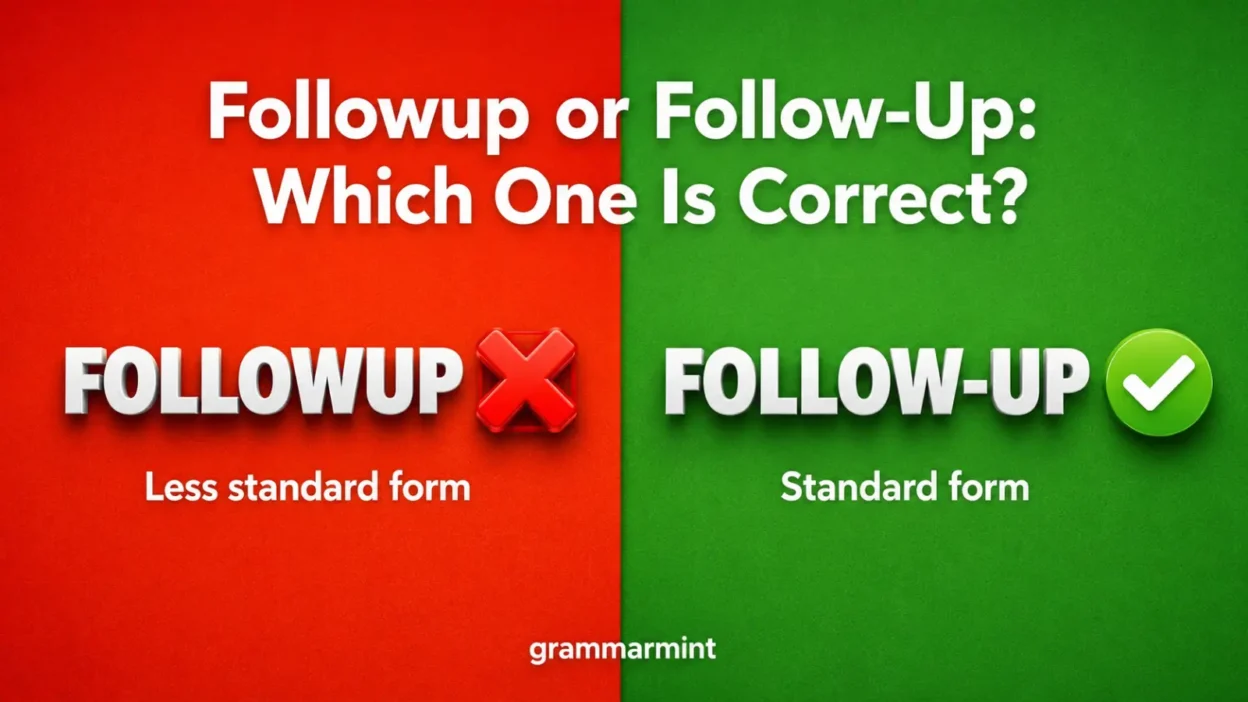
If you are choosing between Followup or Follow-Up, use Follow-Up in most standard US writing when you need a noun or adjective.
The one-word form Followup is sometimes seen, and at least some references list it as a variant. Still, it is not the safest choice for polished writing. In emails, reports, school papers, medical writing, and business documents, follow-up is the form readers usually expect.
One more point matters: in normal sentences, write it as follow-up, not Follow-Up, unless it appears in a title or heading.
Quick Answer
Follow-Up is the better choice when you mean a later action, message, visit, question, or item that continues something earlier.
Use it like this:
I sent a follow-up email after the interview.
The doctor scheduled a follow-up for next week.
Avoid Followup in most formal or professional writing:
Incorrect or risky: I sent a followup email.
Better: I sent a follow-up email.
So the practical answer is simple: choose Follow-Up for the noun or adjective form. Treat Followup as a less common variant, not your default.
Why People Confuse Them
People confuse Followup and Follow-Up because English compound words do not all behave the same way. Some compounds are open, some are hyphenated, and some are closed into one word.
This word family creates extra confusion because there is also the verb phrase follow up.
For example:
Please follow up with the client tomorrow.
Here, follow up is an action. It works as a verb phrase, so it stays two words.
But when the same idea becomes a thing or a description, the hyphenated form is standard:
Please send a follow-up tomorrow.
Please send a follow-up email tomorrow.
That is why followup looks tempting. It seems like the natural next step from a phrase to a single word. However, standard US writing still strongly favors the hyphenated noun and adjective.
Key Differences At A Glance
| Context | Best Choice | Why |
|---|---|---|
| A later email | Follow-Up | It describes the email. |
| A later meeting | Follow-Up | It works as an adjective before “meeting.” |
| A later medical visit | Follow-Up | It is the standard noun form. |
| A later question | Follow-Up | It describes a question asked after an earlier answer. |
| A brand name or product name | Followup may appear | Closed spelling is sometimes used in names. |
| A polished report, resume, or school paper | Follow-Up | It is the safer standard form. |
Meaning and Usage Difference
Follow-Up means something that comes after an earlier action and continues, checks, reviews, or adds to it.
A follow-up email comes after a first email, meeting, interview, purchase, or request.
Doctors may schedule a follow-up visit after an earlier appointment or treatment.
When someone asks a follow-up question, they are responding to an earlier answer and asking for more detail.
Followup can carry the same basic meaning when people use it as a closed variant. The difference is not a new meaning. The difference is acceptance and reader expectation.
Here is the compact comparison:
| Feature | Followup | Follow-Up |
| Spelling | One word | Hyphenated compound |
| Standardness | Less safe; sometimes listed or used as a variant | Safer standard noun/adjective |
| Best use | Brand names, product names, or quoted wording | Regular US writing |
| Reader reaction | May look casual or mistaken | Looks polished and expected |
The pronunciation does not create a useful difference here. Both forms are read the same way: FAH-loh-up.
Tone, Context, and Formality
Follow-Up fits professional, academic, medical, workplace, and customer-service writing.
Use it in sentences like these:
The recruiter asked for a follow-up call.
The clinic sent follow-up instructions.
The teacher gave us a follow-up assignment.
Followup feels more informal and less polished. It may appear in app names, product names, internal labels, file names, or quick notes. That does not make it the best spelling for regular sentences.
In a job application, business email, article, school assignment, or patient document, follow-up is clearer and safer.
Which One Should You Use?
Use Follow-Up when the word is a noun.
A follow-up is a later action, message, visit, report, question, or check.
Examples:
The manager requested a follow-up by Friday.
My appointment is a follow-up from last month.
The article included a follow-up to the first report.
Use Follow-Up when the word is an adjective before a noun.
Examples:
Send a follow-up email.
Book a follow-up appointment.
Ask one follow-up question.
Do not use Followup as your main spelling unless you are copying a name, label, or style that intentionally uses the closed form.
When One Choice Sounds Wrong
Followup can sound wrong when readers expect standard edited English.
Weak: We need a followup call next week.
Better: We need a follow-up call next week.
Weak: The nurse gave me followup instructions.
Better: The nurse gave me follow-up instructions.
Weak: I added a followup to the report.
Better: I added a follow-up to the report.
The hyphenated form can also be wrong if you use it as a verb phrase. This is a related issue, but it matters because it causes many mistakes.
Wrong: I will follow-up tomorrow.
Correct: I will follow up tomorrow.
Wrong: Please follow-up with the client.
Correct: Please follow up with the client.
So, use follow-up for the thing or description. Use follow up for the action.
Common Mistakes (and Quick Fixes)
Mistake 1: Using Followup in polished writing.
Risky: Send a followup email after the meeting.
Fixed: Send a follow-up email after the meeting.
Mistake 2: Hyphenating the verb.
Wrong: I’ll follow-up next week.
Fixed: I’ll follow up next week.
Mistake 3: Removing the hyphen before a noun.
Weak: She asked a followup question.
Fixed: She asked a follow-up question.
Mistake 4: Capitalizing it in the middle of a sentence.
Wrong: I sent a Follow-Up email.
Fixed: I sent a follow-up email.
Capitalize it only when title style calls for it, such as in a headline.
Everyday Examples
I sent a follow-up email after the interview.
The sales team made a follow-up call the next morning.
Please add a follow-up note to the customer file.
The doctor wants a follow-up in six weeks.
We scheduled a follow-up meeting for Monday.
The reporter asked a sharp follow-up question.
Her follow-up message was short and polite.
The school sent follow-up instructions to parents.
A follow-up survey went out after the event.
The client asked for a follow-up report by Friday.
These examples all use follow-up as either a noun or an adjective. That is where the hyphenated form is strongest.
Dictionary-Style Word Details
Verb
Followup: Not commonly used as a verb in standard US English. Do not write “I will followup tomorrow” in polished writing.
Follow-Up: Not used as a standard verb form. Do not write “I will follow-up tomorrow.”
For the action, use the two-word verb phrase:
I will follow up tomorrow.
She needs to follow up with the office.
Noun
Followup: Sometimes used as a closed variant meaning a later action, visit, or item. It may appear in some references, names, and informal contexts. Still, it is not the safest default for careful writing.
Follow-Up: The standard noun choice. It means an action, message, visit, report, or item that comes after an earlier one.
Examples:
The follow-up answered our remaining questions.
The clinic scheduled a follow-up for July.
Synonyms
Followup: Closest plain alternatives are the same as for follow-up when the one-word form is being used as a noun: later check, next step, review, check-in, update, continuation.
Follow-Up: Closest plain alternatives include check-in, next step, later action, review, update, continuation, and sequel. The best choice depends on context.
There is no single clean antonym that works in every sentence. In some contexts, possible opposites are first contact, initial visit, or first step, but these are context-based opposites, not exact all-purpose antonyms.
Example Sentences
Followup: The closed spelling may appear in labels or names, but it can look too informal in regular prose. Example: The file name was “client-followup-notes.”
Follow-Up: The assistant sent a follow-up after the meeting.
Followup: In polished writing, revise “followup email” to “follow-up email.”
Follow-Up: The doctor recommended a follow-up appointment.
Word History
Followup: The one-word form reflects a common pattern in English: some compounds eventually close up into one word. However, this form has not replaced the hyphenated spelling as the safest standard choice.
Follow-Up: The hyphenated form grew from the idea of following up after something earlier. The hyphen helps show that the two words work together as one noun or as one modifier before another noun.
The useful history point is practical: English often moves from open phrase to hyphenated compound to closed compound, but not every word completes that shift. For this comparison, follow-up remains the form to use in careful US writing.
Phrases Containing
Followup: Not recommended in most standard phrases. You may see it in file names, product names, or informal labels.
Follow-Up: Common phrases include:
follow-up email
follow-up call
follow-up meeting
follow-up appointment
follow-up visit
follow-up question
follow-up report
follow-up study
follow-up care
follow-up instructions
In everyday writing, these phrases look most natural with the hyphen.
Conclusion
For Followup or Follow-Up, the safer answer is Follow-Up when you need a noun or adjective.
Use follow-up for a later email, call, question, visit, report, meeting, or action that continues something earlier. Avoid followup in polished US writing unless you are copying a specific name, label, or style.