If you write in English, you’ve probably seen both realize and realise and wondered which one is correct. They look almost identical, and they are used in very similar ways. That is exactly why so many people get confused.
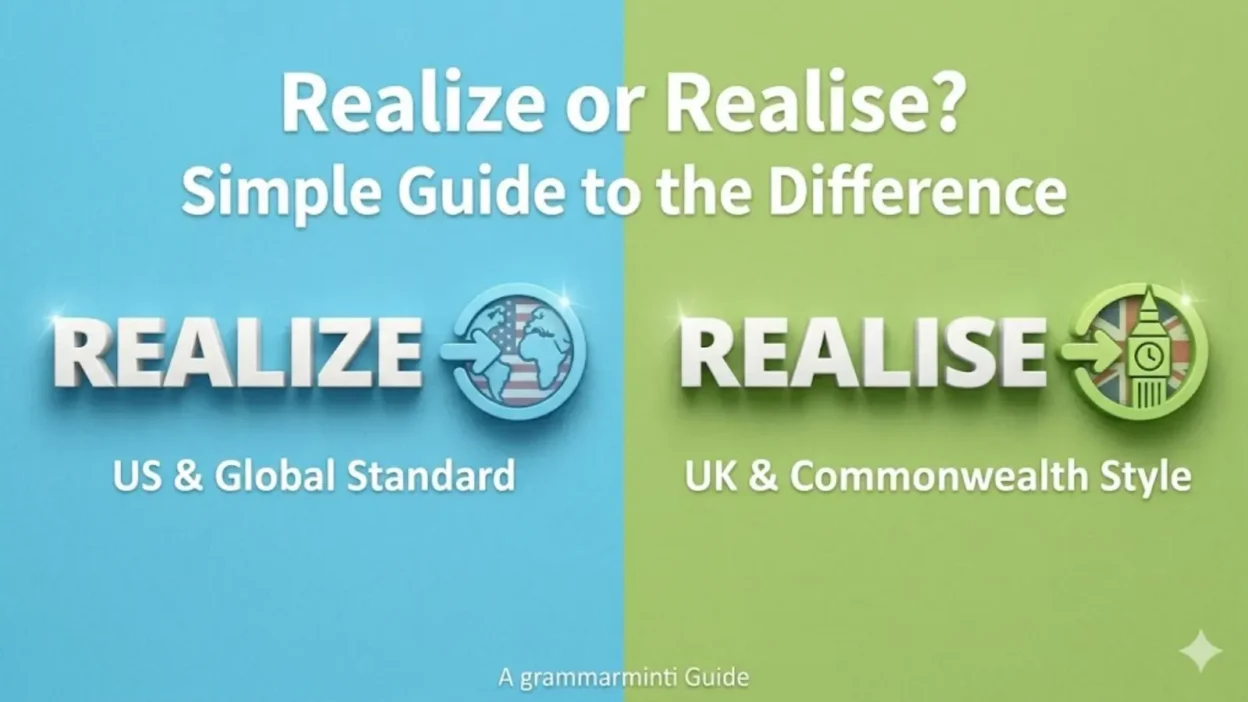
Here’s the simple truth: both spellings are correct. The difference is not meaning or grammar. The difference is regional spelling style.
In American English, realize is the standard form. In British English, realise is more common. Both are accepted in global writing, but your audience usually decides which one you should use.
This guide breaks everything down in a clear, practical way so you never have to guess again.
Quick Answer
Both words mean the same thing.
- Realize = American English spelling
- Realise = British English spelling
They have:
- Same meaning
- Same pronunciation
- Same grammar role
The only real difference is spelling preference based on region.
Why People Confuse Them
The confusion comes from exposure to different types of English.
You might read:
- American books using realize
- British articles using realise
- Global websites mixing both styles
Because both appear in real, correct writing, people assume one must be wrong. That’s not the case.
Another reason for confusion is consistency. Many writers accidentally mix both spellings in the same document, which makes it feel like there is a hidden rule. There isn’t.
The word is the same concept, just written differently depending on style.
Key Differences At A Glance
| Context | Best Choice | Why |
|---|---|---|
| US school writing | Realize | Standard American spelling |
| UK school writing | Realise | Standard British spelling |
| Business writing in US | Realize | Matches US style guides |
| British publishing | Realise | Common editorial standard |
| International neutral content | Either (pick one) | Depends on chosen style guide |
Quick Feature Comparison
| Feature | Realize | Realise |
|---|---|---|
| Meaning | Become aware / achieve | Become aware / achieve |
| Pronunciation | Same | Same |
| Grammar role | Verb | Verb |
| Region preference | US English | UK English |
Meaning and Usage Difference
There is no meaning difference between realize and realise.
Both are used as a verb with several related meanings:
1. To become aware
- I didn’t realize how late it was.
- I didn’t realise how late it was.
2. To understand something clearly
- She realized what the message meant.
- She realised what the message meant.
3. To achieve or accomplish something
- He realized his goal of becoming a pilot.
- He realised his goal of becoming a pilot.
4. To make something real or actual
- The plan was finally realized after months of work.
- The plan was finally realised after months of work.
In all cases, only the spelling changes. The meaning stays identical.
Tone, Context, and Formality
Neither spelling is more formal than the other.
What matters is consistency and audience expectation.
In US writing:
- “Realize” looks natural and standard
- Used in schools, business, and media
In UK writing:
- “Realise” looks natural and standard
- Common in education and publishing
If you mix both in one document, it can feel unpolished, even though both forms are correct individually.
Example of inconsistency:
- I realized I had forgotten my keys, and then I realised I left my phone too.
This should be avoided.
Pick one style and stay with it throughout.
Which One Should You Use?
The correct choice depends on your audience.
Use realize if:
- Your readers are in the United States
- You are following American writing style
- Your website or institution uses US English
Use realise if:
- Your audience is in the UK or Ireland
- You follow British writing standards
- Your editor or publisher prefers UK English
If your audience is global, choose one and stay consistent.
Most US-based content naturally uses realize.
When One Choice Sounds Wrong
Neither spelling is “wrong,” but mixing them can feel inconsistent.
Here’s what can feel off:
- Switching between realize and realise in the same paragraph
- Using American spelling in one section and British spelling later
- Copying text from different sources without standardizing spelling
Correct approach:
- Choose one spelling system
- Apply it throughout the entire document
- Keep all related words consistent (like realize/realized/realization)
Consistency matters more than the specific choice.
Common Mistakes (and Quick Fixes)
Mistake 1: Thinking one spelling is incorrect
❌ Realise is wrong
❌ Realize is wrong
✔ Both are correct depending on region
Mistake 2: Mixing spelling styles
❌ I realized I needed to apologise for the mistake.
✔ I realized I needed to apologize for the mistake. (US style)
✔ I realised I needed to apologise for the mistake. (UK style)
Mistake 3: Assuming meaning changes
❌ Realize = understand, realise = achieve
✔ Both can mean understand or achieve
Mistake 4: Changing spelling randomly
❌ Using both forms in the same paragraph
✔ Stick to one system per document
Everyday Examples
American English (Realize)
- I didn’t realize the meeting started early.
- She realized she had left her wallet at home.
- We realized the plan needed changes.
- He suddenly realized the truth.
- They realized their mistake too late.
British English (Realise)
- I didn’t realise the meeting started early.
- She realised she had left her wallet at home.
- We realised the plan needed changes.
- He suddenly realised the truth.
- They realised their mistake too late.
The meaning stays exactly the same in every sentence.
Dictionary-Style Word Details
Verb
- Realize: To become aware of something, understand something, or achieve something.
- Realise: British spelling of the same verb with identical meanings.
Both are standard verb forms used in formal and informal writing.
Noun
- Realize: Not used as a noun in standard English.
- Realise: Not used as a noun in standard English.
Related noun forms:
- realization (US)
- realisation (UK)
These refer to the act of understanding or achieving something.
Synonyms
Realize (and Realise):
Closest plain alternatives:
- Understand
- Recognize
- Notice
- Discover
- Comprehend
- Achieve (in goal context)
- Accomplish (in goal context)
Antonyms (context-based):
- Ignore
- Overlook
- Miss
- Disregard
- Fail (for achievement meaning)
No exact single-word replacement fits all meanings perfectly.
Example Sentences
Realize
- I didn’t realize how important this was.
- She realized the mistake immediately.
- They realized their dream after years of effort.
Realise
- I didn’t realise how important this was.
- She realised the mistake immediately.
- They realised their dream after years of effort.
Word History
Both spellings come from the same verb in English history. Over time, English spelling developed regional differences.
American English generally prefers simplified spelling forms, which led to realize becoming standard in the United States. British English retained the alternative form realise more commonly.
Both forms are still widely accepted today, depending on region and style preference.
Phrases Containing
Realize
- Realize your potential
- Realize a dream
- Realize the importance
- Suddenly realize
- Realize a goal
Realise
- Realise your potential
- Realise a dream
- Realise the importance
- Suddenly realise
- Realise a goal
All phrases remain identical except for spelling.
FAQs
1. Is “realize” or “realise” correct?
Both are correct. “Realize” is used in American English, while “realise” is used in British English. The meaning is the same.
2. Do “realize” and “realise” have different meanings?
No. They mean exactly the same thing, such as becoming aware of something, understanding something, or achieving a goal. Only the spelling differs.
3. Which spelling should I use in the United States?
In the United States, “realize” is the standard spelling and is used in schools, business writing, and publications.
4. Is “realise” wrong in American English?
It is not “wrong,” but it is not the standard US spelling. In American English writing, “realize” is preferred.
5. Why does British English use “realise”?
British English often keeps traditional spellings with “-ise” endings. That’s why “realise” is more common in the UK, even though both forms are accepted.
6. Do “realize” and “realise” sound different when spoken?
No. Both are pronounced the same way in modern English. The difference is only in spelling, not pronunciation.
7. Can I mix “realize” and “realise” in the same document?
It is not recommended. Mixing both forms can look inconsistent. It’s better to choose one spelling style and stick with it throughout your writing.
8. Which is more common worldwide?
Globally, both are widely used. However, “realize” dominates American English, while “realise” is more common in British and Commonwealth English.
9. Is there any grammar rule that forces one spelling?
No strict grammar rule exists. The choice depends on regional writing standards or the style guide you are following.
10. What about other words like “realization” or “realisation”?
They follow the same pattern:
- US English: realization
- UK English: realisation
Conclusion
The difference between realize or realise is simple once you understand it.
They are the same word with the same meaning, same grammar use, and same pronunciation. The only difference is regional spelling style.
Use realize for American English writing and realise for British English writing. The most important rule is consistency—choose one style and stick with it.
Once you do that, you’ll never confuse them again.