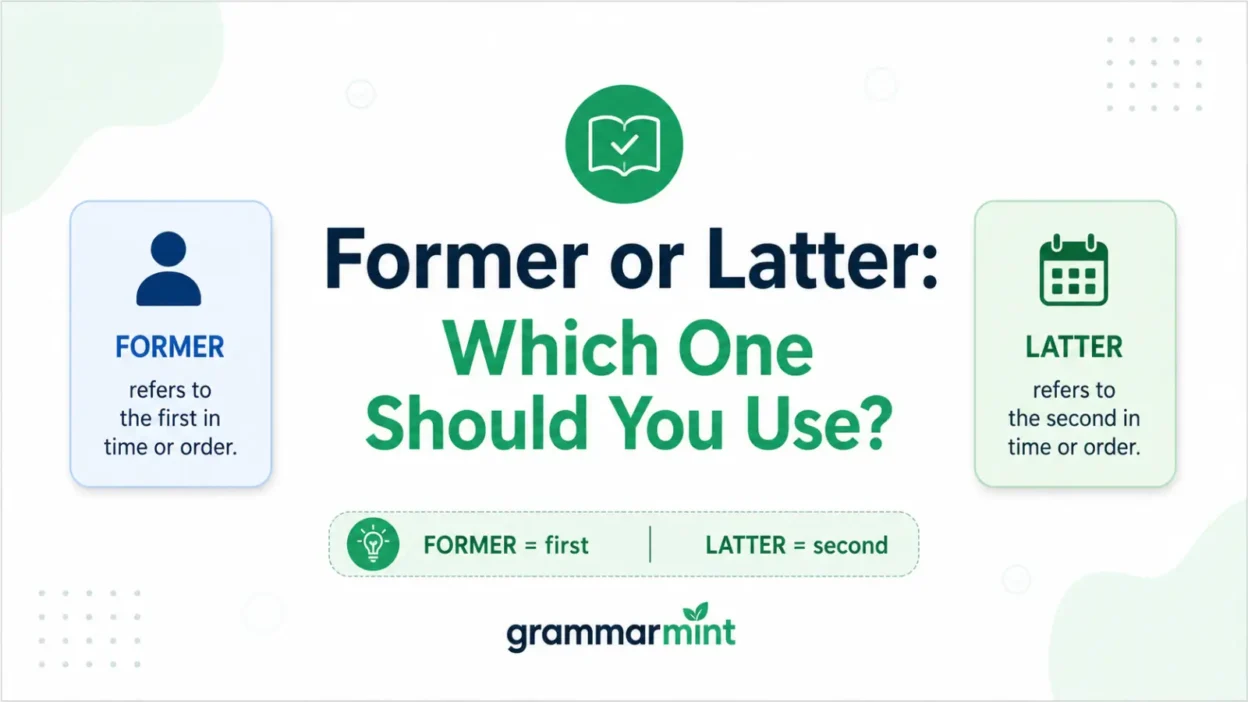
Former or latter is a choice about order. Use former for the first of two people, things, or ideas already named. Use latter for the second.
Here is the simple version:
“I can take the bus or the train. The former is cheaper, but the latter is faster.”
In that sentence, the former means the bus, and the latter means the train.
Quick Answer
Use former when you mean the first one mentioned.
Use latter when you mean the second one mentioned.
Most of the time, these words appear with the:
Correct: “Between coffee and tea, I prefer the latter.”
Incorrect: “Between coffee and tea, I prefer latter.”
The safest rule is this: use them only when the sentence has two clear choices. If there are three or more items, write the first, the second, or the last instead.
Why People Confuse Them
People confuse former and latter because both point backward in a sentence. Neither word names the thing directly. You have to remember which item came first and which came second.
They can also feel a little formal. In a quick text, many people would write “the first one” or “the second one” instead.
The confusion grows when former has another common meaning: previous. A “former boss” is a past boss. That use is different from the former, which means the first of two things just named.
Key Differences At A Glance
| Context | Best Choice | Why |
|---|---|---|
| You mean the first of two named items | former | It points to the first item mentioned |
| You mean the second of two named items | latter | It points to the second item mentioned |
| You mean a past role, job, or status | former | It can mean previous |
| You mean the later part of a time period | latter | It can mean closer to the end |
| You listed three or more items | first, second, or last | Clearer than former or latter |
| You are writing casually | first one or second one | Sounds more natural in everyday speech |
Meaning and Usage Difference
Former points to the first item in a pair.
Example: “We visited Austin and Dallas. The former felt more relaxed.”
Meaning: Austin felt more relaxed.
Latter points to the second item in a pair.
Example: “We visited Austin and Dallas. The latter had better nightlife.”
Meaning: Dallas had better nightlife.
Compact comparison:
- Former = the first one mentioned.
- Latter = the second one mentioned.
- Former can also mean previous, as in “former teacher.”
- Latter can also describe a later part, as in “the latter half of the year.”
- In clear everyday writing, use these words only when the two choices are easy to track.
Tone, Context, and Formality
Former and latter sound more formal than first one and second one. They fit well in essays, reports, reviews, and careful explanations.
They can sound stiff in casual conversation.
Natural in formal writing:
“The company tested two plans. The former reduced costs; the latter improved service.”
More natural in casual speech:
“We tried two places. The first one was cheaper, but the second one was better.”
Use former and latter when they make the sentence shorter and still clear. Skip them if the reader has to stop and count backward.
Which One Should You Use?
Choose former if you are pointing to the first thing you named.
“I’m deciding between a sedan and an SUV. The former is easier to park.”
Choose latter if you are pointing to the second thing you named.
“I’m deciding between a sedan and an SUV. The latter has more cargo space.”
When in doubt, replace the word with the actual noun. If the sentence becomes clearer, keep the noun instead.
Less clear: “The latter is better for our team.”
Clearer: “The afternoon meeting is better for our team.”
When One Choice Sounds Wrong
Former sounds wrong when you mean the second item.
Wrong: “We can order pizza or tacos. The former sounds better.”
If you mean tacos, use latter.
Correct: “We can order pizza or tacos. The latter sounds better.”
Latter sounds wrong when you mean a past role.
Wrong: “My latter manager taught me a lot.”
Correct: “My former manager taught me a lot.”
Use former for past jobs, past roles, past homes, and past relationships.
Examples:
“former employee”
“former roommate”
“former president”
“former address”
Use latter for the second of two items or the later part of something.
Examples:
“the latter option”
“the latter half of the movie”
“the latter part of the week”
Common Mistakes (and Quick Fixes)
Mistake 1: Using them without two clear choices.
Wrong: “I liked the latter.”
Better: “I liked the second option.”
Mistake 2: Using them after a long list.
Unclear: “We reviewed rent, payroll, software, and insurance. The latter increased.”
Better: “Insurance increased.”
Mistake 3: Forgetting the.
Wrong: “Former is cheaper.”
Correct: “The former is cheaper.”
Mistake 4: Using latter to mean previous.
Wrong: “She called her latter landlord.”
Correct: “She called her former landlord.”
Mistake 5: Making the reader work too hard.
Unclear: “The former was approved, while the latter was delayed.”
Clearer: “The budget was approved, while the launch was delayed.”
Everyday Examples
“I can meet Monday or Wednesday. The latter works better for me.”
“We looked at the basic plan and the premium plan. The former is cheaper.”
“She has lived in Chicago and Phoenix. The latter has warmer winters.”
“I spoke with my former coach last weekend.”
“The latter half of the game was much more exciting.”
“We can send an email or make a call. The former leaves a record, but the latter may get a faster reply.”
“He chose the apartment over the house because the former was closer to work.”
“We tried the old recipe and the new one. The latter tasted fresher.”
Dictionary-Style Word Details
Verb
Former: Not commonly used as a verb in standard US English for this comparison.
Latter: Not commonly used as a verb in standard US English.
Noun
Former: In this comparison, it usually appears as the former, a noun-like phrase meaning the first of two mentioned items. It can also be an adjective, as in “former employee.”
Latter: In this comparison, it usually appears as the latter, a noun-like phrase meaning the second of two mentioned items. It can also be an adjective, as in “the latter part.”
Synonyms
Former: Closest plain alternatives are the first one, the first-mentioned one, previous, or past, depending on the sentence.
Latter: Closest plain alternatives are the second one, the second-mentioned one, later, or near the end, depending on the sentence.
In the paired-reference use, former and latter work as opposites. Outside that use, the opposite may change. For example, the opposite of “former employee” is closer to “current employee.”
Example Sentences
Former: “We can drive or fly, but the former will cost less.”
Former: “Her former apartment was near campus.”
Latter: “We can drive or fly, but the latter will save time.”
Latter: “The latter part of the meeting focused on next month’s budget.”
Word History
Former: The useful modern idea is “coming before.” That is why it can mean the first of two items or something from the past.
Latter: The useful modern idea is “later” or “near the end.” That is why it can mean the second of two items or the later part of a period.
For everyday word choice, the history matters less than the sentence structure: first item takes former, second item takes latter.
Phrases Containing
Former:
“the former”
“former employee”
“former student”
“former president”
“former home”
“former self”
Latter:
“the latter”
“the latter option”
“the latter half”
“the latter part”
“latter-day”
“in the latter stages”
FAQs
Is it former or latter?
Use former when you mean the first of two things already mentioned. Use latter when you mean the second.
Example:
I can work Friday or Saturday, but I prefer the latter.
This means Saturday.
What does “the former” mean?
The former means the first person, thing, or idea in a pair that was just mentioned.
Example:
We discussed rent and utilities. The former is due on the first.
Here, the former means rent.
What does “the latter” mean?
The latter means the second person, thing, or idea in a pair that was just mentioned.
Example:
She studied marketing and finance, but the latter became her career.
Here, the latter means finance.
Can I use former and latter for three things?
It is usually clearer not to. In standard modern writing, former and latter work best with two items. For three or more, use first, second, third, or repeat the noun.
Clearer:
We offer coffee, tea, and juice. The tea is the most popular.
Less clear:
We offer coffee, tea, and juice. The latter is the most popular.
Do I need “the” before former and latter?
Yes, when they stand in for already mentioned items, use the former and the latter.
Correct:
I like both plans, but the former is cheaper.
Incorrect:
I like both plans, but former is cheaper.
Is former the same as first?
In this comparison, yes. Former means the first of two things already named. But former can also mean previous, as in a former employee or a former president.
Is latter the same as last?
Sometimes, but be careful. In a pair, latter means the second one, which is also the last one. For longer lists, last is usually clearer than latter.
Are former and latter formal?
Yes, they sound more formal than simply repeating the word. They are common in essays, reports, business writing, and careful explanations. In casual speech, repeating the noun often sounds more natural.
Formal:
Of the two options, the latter is safer.
More casual:
The second option is safer.
What is an easy way to remember former vs latter?
Think: former = first and latter = later.
The former comes first in the pair. The latter comes later in the pair.
Should I use former and latter in everyday writing?
Use them only when the reference is clear. If readers might have to look back and figure out what you mean, repeat the noun instead.
Conclusion
Use former for the first of two things already named. Use latter for the second.
The best test is simple: count the two choices in order. The first is the former. The second is the latter.
For casual writing, first one and second one often sound clearer. For formal or polished writing, the former and the latter are useful as long as the pair is easy to follow.