
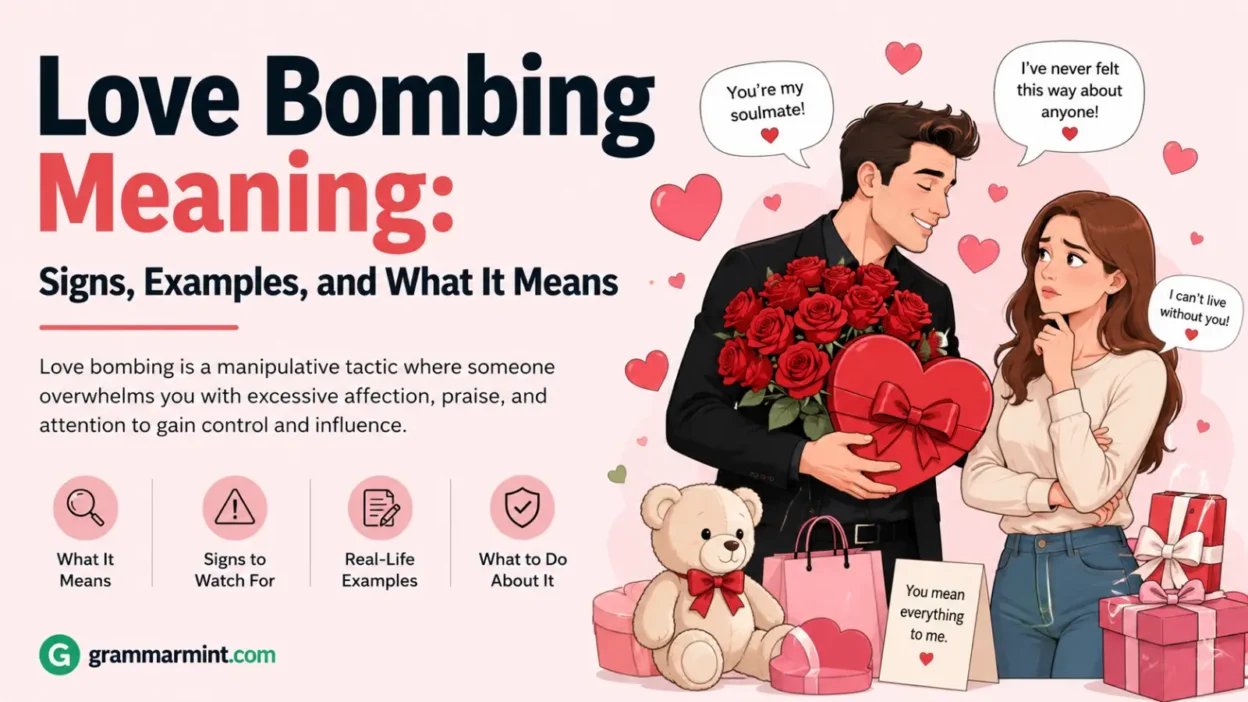
You may hear the phrase love bombing in dating conversations, videos, relationship advice, or discussions about unhealthy behavior. At first, the behavior it describes can look surprisingly romantic.
Someone may give constant compliments, send endless messages, buy expensive gifts, or talk about a future together very quickly. The attention can feel exciting and flattering.
However, the phrase usually describes more than simply being affectionate. It refers to an overwhelming pattern of attention that creates pressure, influence, dependency, or control.
Context matters because healthy relationships can also begin with excitement and strong feelings. One grand gesture does not automatically prove someone is manipulative.
This guide explains what love bombing means, its common signs, realistic examples, related terms, pronunciation, and how it differs from genuine affection.
Quick Answer
The love bombing meaning is the use of unusually intense affection, praise, attention, gifts, or romantic gestures to quickly influence another person.
The key issue is not simply “too much love.” It is the pressure, control, dependency, or repeated disregard for boundaries connected with the behavior.
TL;DR
• Overwhelming attention or affection can be a sign of love bombing.
• This behavior often appears early in a new relationship.
• Gifts and compliments by themselves do not prove manipulation.
• Warning signs include pressure, control, and ignored boundaries.
• In healthy relationships, both people have time, choice, and personal space.
What Love Bombing Means in Plain English
In plain English, love bombing means overwhelming someone with affection and attention to create a powerful emotional bond very quickly.
This may involve nonstop messages, dramatic compliments, expensive gifts, or premature promises about marriage and the future.
The person receiving the attention may initially feel special. Later, however, they may feel pressured to give more time, commitment, loyalty, or obedience.
A simple example would be someone you recently met saying:
“You are my soulmate. Nobody understands me like you do. We should move in together.”
The words themselves are not proof of manipulation. The larger pattern matters.
For example, concern increases when the person becomes angry because you want to slow down. Ignoring your boundaries is more meaningful than simply showing enthusiasm.
Love bombing is usually discussed negatively. It often refers to affection being used as a way to influence another person rather than build a balanced connection.
Common Signs and Real-Life Examples
Love bombing does not always look the same. However, several behaviors commonly appear together.
Excessive compliments
A person may constantly describe you as perfect or unlike anyone they have ever met.
Example:
“We have only known each other for three days, but you are everything I ever wanted.”
A compliment can be genuine. The concern comes from extreme intensity that does not match how well the person knows you.
Constant communication
A new partner may text, call, and message throughout the day.
Frequent communication can be normal when two people are excited. It becomes concerning when they demand immediate replies or become angry when you are unavailable.
Large or unwanted gifts
Someone may buy expensive presents very early.
The gift becomes more concerning when it creates obligation.
For example:
“I bought you this expensive phone. The least you can do is spend tonight with me.”
Rushing commitment
A person may push for exclusivity, marriage, moving in, or major plans almost immediately.
They may say:
“Why wait? We already know we belong together.”
Healthy excitement still allows both people to choose a comfortable pace.
Demanding your attention
Someone may expect increasing amounts of your time.
They might become jealous when you see friends or family.
Ignoring boundaries
You may clearly ask to slow down, receive fewer messages, or have personal space.
A respectful person listens. Repeatedly ignoring that request is a stronger warning sign.
Sudden changes in behavior
In some unhealthy relationships, intense affection later changes into criticism, withdrawal, jealousy, or controlling behavior.
The contrast can leave the other person wondering what happened to the loving person they first met.
Love Bombing vs. Genuine Affection
Strong feelings do not automatically equal love bombing.
Two people can genuinely feel excited about each other very quickly. They may text often, give gifts, or enjoy spending most of a weekend together.
The clearest differences usually involve pressure, boundaries, consistency, and control.
| Context | Best Choice | Why |
|---|---|---|
| Warm attention with respected boundaries | Genuine affection | Both people remain comfortable and free |
| Intense attention followed by pressure | Possible love bombing | Affection may create obligation |
| Gifts with no demands attached | Healthy generosity | The receiver owes nothing |
| Gifts used to demand loyalty | Concerning behavior | Generosity becomes leverage |
| Fast romance both people freely enjoy | Not automatically love bombing | Mutual comfort matters |
Genuine affection usually leaves room for independence.
You can spend time with friends, disagree, say no, and move slowly without being punished.
Love bombing often feels more conditional.
The message may become: “I gave you all this attention, so now you owe me.”
That difference matters more than the number of flowers, texts, or compliments someone gives.
Why People Love Bomb
There is no single reason behind every case.
Some people may consciously use intense affection to gain influence or control. They may want quick commitment before the other person has time to evaluate the relationship.
Others may behave intensely because of insecurity or fear of rejection. They may not fully understand how overwhelming their behavior feels.
Poor relationship boundaries can also play a role.
Someone may believe constant attention proves love because that is what they learned from earlier relationships.
Love bombing is also often discussed alongside narcissistic behavior. However, you should not diagnose someone with a personality disorder simply because they are intense or overly affectionate.
A behavioral description and a medical diagnosis are different things.
Instead of guessing someone’s diagnosis, look at what actually happens.
Do they respect your boundaries? Can you say no safely? Can the relationship move at a comfortable pace?
Those questions are often more useful.
Where Love Bombing Can Happen
People most often discuss love bombing in romantic relationships.
However, similar patterns can appear in other relationships.
Dating and romantic relationships
This is the most familiar context.
A new partner may create instant intimacy through gifts, praise, constant communication, and promises about the future.
Friendships
A new friend may immediately treat you like their closest companion.
They may demand most of your time and become upset when you maintain other friendships.
Family relationships
Affection, gifts, or favors can sometimes be used to create guilt or obligation within families.
However, normal family affection should not automatically receive this label.
Online relationships
Constant messaging makes intense attention easier to deliver quickly.
Someone can send hundreds of messages, make dramatic promises, or create emotional closeness before meeting in person.
This can also appear in deceptive online relationships and romance scams.
Groups and recruitment
Historically, the phrase has also been connected with intense positive attention used to make newcomers feel immediately accepted by a group.
The context changes, but the central idea remains similar: overwhelming attention can create fast emotional attachment.
Pronunciation, Part of Speech, and Origin
Pronunciation: LUV BOM-ing
In American English, the stress falls mainly on love, followed by bombing.
Love bombing is primarily used as a noun or noun phrase.
Example:
“Her friend was worried that the intense attention looked like love bombing.”
It is often treated as an uncountable noun.
You may also see these spellings:
• love bombing
• love-bombing
• lovebombing
The open form, love bombing, is very common.
People also use love bomb as a verb.
Example:
“He seemed to love bomb her with gifts and constant messages.”
The past form may appear as love-bombed.
Example:
“She said she felt love-bombed during the first month.”
A person who engages in this behavior may informally be called a love bomber.
Origin
The phrase has documented use dating back to the 1970s.
Early uses were associated with intense attention given to people during religious recruitment. Over time, the expression became much more common in discussions about romantic and interpersonal relationships.
Today, people usually use it negatively.
It describes a pattern in which affection or attention becomes connected with influence, pressure, dependency, or control.
How to Respond and Set Boundaries
You do not need to decide immediately whether someone “is a love bomber.”
Focus first on the behavior and how it affects you.
Slow the pace
You can say:
“I like getting to know you, but I want to take things more slowly.”
Their response can tell you a great deal.
Set a clear boundary
For example:
“I cannot text throughout my workday. I will reply when I have time.”
A healthy relationship should allow reasonable boundaries.
Notice how they handle no
Pay attention when you decline a gift, invitation, commitment, or request.
Respect is important even when someone feels disappointed.
Maintain your other relationships
Continue seeing trusted friends and family.
A new relationship should not require immediate isolation from everyone else.
Give yourself time
Major commitments deserve careful thought.
You do not owe someone quick commitment because they gave you gifts or intense attention.
Seek support when behavior becomes controlling
Talk with someone you trust if you feel confused, pressured, isolated, or afraid.
Professional support may also help you understand the situation more clearly.
If you believe you may be in immediate danger, prioritize your safety and seek appropriate local emergency assistance.
Related Terms and Common Confusions
Several relationship terms appear near love bombing, but they do not mean exactly the same thing.
Gaslighting
Gaslighting involves manipulating someone so they question their memory, perception, or understanding of events.
Love bombing involves overwhelming affection or attention.
They can appear in the same unhealthy relationship, but they are different behaviors.
Future faking
Future faking involves making impressive promises about a shared future without genuine follow-through.
Someone might discuss marriage, children, vacations, or a dream home very early.
Future faking can appear during love bombing, but the terms are not synonyms.
Breadcrumbing
Breadcrumbing means giving small amounts of attention to keep someone interested without offering a clear or meaningful commitment.
Love bombing is almost the opposite in intensity.
Breadcrumbing gives just enough attention. Love bombing overwhelms someone with it.
Narcissism
Narcissism is not another word for love bombing.
A person may show manipulative relationship behaviors without having narcissistic personality disorder.
Avoid using a clinical label based only on dating behavior.
Synonyms and antonyms
There is no perfect one-word synonym for love bombing.
Close descriptions include:
• manipulative affection
• excessive flattery
• overwhelming attention
• emotional manipulation
These expressions describe parts of the concept but are not exact replacements.
There is also no exact antonym.
Healthy affection, respectful courtship, and mutual love can serve as useful contrasts.
Mini Quiz
1. Which example best shows a possible warning sign?
A. Someone gives you flowers after several dates.
B. Someone becomes angry because you ask to slow down.
C. Someone tells you they enjoyed your date.
2. True or false: Frequent texting always means love bombing.
3. Which matters most when judging intense affection?
A. The price of every gift
B. The number of dates
C. Patterns involving pressure and boundaries
4. Can love bombing occur outside romantic relationships?
A. Yes
B. No
5. Is love bombing the same as gaslighting?
A. Yes
B. No
Answer Key:
- B
- False
- C
- A
- B
Frequently Asked Questions
What is love bombing?
Love bombing is overwhelming someone with intense affection, attention, praise, gifts, or romantic gestures.
The phrase usually refers to a pattern that creates pressure, dependency, influence, or control.
How long does love bombing usually last?
There is no fixed timeline.
It may last days, weeks, or longer depending on the relationship. Focus on patterns and changes in behavior rather than expecting a specific schedule.
Can love bombing happen in friendships?
Yes. Similar patterns can occur in friendships as well as romantic relationships.
A new friend might create instant closeness, demand constant attention, and react badly when you spend time with others.
Is love bombing always a red flag?
The term normally describes concerning behavior, but intense affection alone does not prove manipulation.
Look at boundaries, pressure, control, consistency, and how the person responds when you say no.
How can you tell love bombing from genuine affection?
Genuine affection respects your pace, boundaries, independence, and choices.
Love bombing becomes concerning when intense affection creates obligation or pressure and your limits are repeatedly ignored.
What should someone do after being love bombed?
Reconnect with trusted people and give yourself space to understand what happened.
Strong boundaries and professional support may help, especially if the relationship involved emotional abuse, fear, or controlling behavior.
What is future faking?
Future faking means making dramatic promises about a shared future without genuine commitment or follow-through.
It can appear alongside love bombing when someone uses exciting future plans to create fast emotional attachment.
Conclusion
Understanding the love bombing meaning helps you separate intense romance from affection that creates pressure or control.
Look beyond big words and grand gestures. Healthy relationships make room for respect, boundaries, independence, and time.


