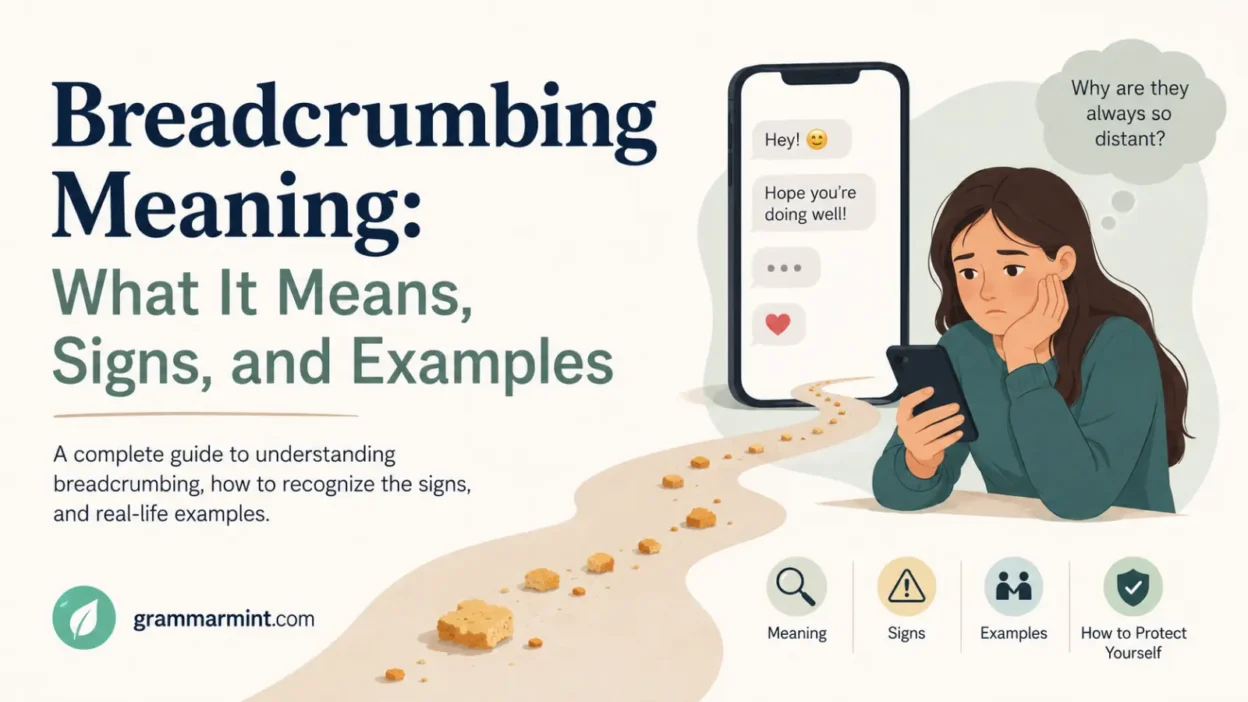
You may hear breadcrumbing when people discuss dating, texting, or confusing relationships. The term describes a pattern of small signals that keep someone interested without real progress.
A person might send a sweet text after days of silence. They may flirt online but avoid making actual plans. These actions can create hope while leaving the relationship unclear.
Breadcrumbing appears most often in modern dating conversations. However, similar behavior can happen with friends, ex-partners, family members, or even at work.
This guide explains the breadcrumbing meaning, common signs, examples, word usage, and related terms. You will also learn how to recognize the pattern and respond clearly.
Quick Answer
Breadcrumbing meaning refers to giving someone occasional attention or signs of interest without making a genuine effort to move the relationship forward.
The person leaves small emotional “breadcrumbs” that keep the other person interested.
TL;DR
• Breadcrumbing involves small, inconsistent signs of interest.
• It often appears through texts or social media.
• Words and actions usually do not match.
• Plans may remain vague or never happen.
• It can occur outside romantic relationships.
• Consistent behavior matters more than occasional attention.
What Breadcrumbing Means in Plain English
In plain English, breadcrumbing means keeping someone interested with just enough attention to maintain hope.
Imagine someone who rarely talks to you. Just as you start losing interest, they send a warm message.
They might say:
“Miss talking to you.”
“You looked amazing in that photo.”
“We should definitely hang out soon.”
Those messages may sound promising. However, the person never takes meaningful steps toward a stronger connection.
A single delayed reply does not automatically mean breadcrumbing. The word usually describes a repeated pattern of inconsistent interest and little follow-through.
Simple example
Maya matches with someone on a dating app. He sends flirty messages every few days.
Whenever Maya suggests meeting, he gives a vague answer. Later, he returns with another affectionate message.
That repeated cycle is a typical example of breadcrumbing.
How Breadcrumbing Works
Breadcrumbing often follows a push-and-pull pattern.
First, someone gives attention. Then, they become distant or unavailable.
Later, they return with another small sign of interest.
Common “breadcrumbs” may include:
• Random “Hey, how are you?” texts
• Flirty messages after long periods of silence
• Likes or reactions to older social posts
• Statements such as “We should meet sometime”
• Compliments without deeper conversation
• Reappearing whenever the other person pulls away
The main issue is the gap between interest and action.
Someone may repeatedly sound interested while making little effort to build the relationship.
Common mistake
Not every inconsistent texter is breadcrumbing.
People get busy, forget messages, or communicate differently. Look for a repeated pattern rather than one isolated event.
Common Signs and Examples of Breadcrumbing
Breadcrumbing can look different in every relationship. Still, several patterns appear often.
Communication is inconsistent
The person may disappear for days or weeks. Then, they suddenly return with warmth or affection.
Example:
“I’ve been thinking about you lately.”
After you reply, the conversation quickly fades again.
Plans stay vague
They talk about meeting but rarely choose a real date or time.
Example:
“We seriously need to get coffee soon.”
When you suggest Saturday, they avoid confirming anything.
They appear when you pull away
You stop reaching out, and suddenly they become interested again.
They may send a meme, compliment, or casual message.
Social media replaces real connection
Someone regularly likes your posts or reacts to your stories.
However, they make little effort to have meaningful conversations.
Their words and actions do not match
They may say they miss you but never make time for you.
This mismatch is one of the clearest warning patterns.
| Context | Best Interpretation | Why |
|---|---|---|
| One late reply | Not enough evidence | Anyone can become busy |
| Repeated vague promises | Possible breadcrumbing | Interest lacks follow-through |
| Regular effort and clear plans | Genuine interest is more likely | Actions support words |
| Random flirting after silence | Possible breadcrumb | Attention keeps returning without progress |
Why People Breadcrumb
There is no single reason that explains every case.
Some people may enjoy attention or validation. Others may feel uncertain about what they want.
Possible reasons include:
• Wanting attention without commitment
• Keeping romantic options open
• Feeling lonely and seeking connection
• Enjoying validation from another person
• Avoiding difficult conversations
• Feeling unsure about ending a connection
Intent can also be difficult to know from the outside.
Someone may act selfishly without carefully planning the behavior. Another person may knowingly use attention to keep someone interested.
For that reason, focus on the pattern rather than guessing someone’s personality.
You do not need to diagnose a person to notice that their actions are inconsistent.
Breadcrumbing vs. Similar Dating Behaviors
Several modern relationship terms describe confusing communication. However, they do not mean exactly the same thing.
Breadcrumbing vs. ghosting
Ghosting means suddenly ending communication without an explanation.
Breadcrumbing keeps some communication alive.
A ghost may disappear completely. A breadcrumber keeps dropping occasional signs of interest.
Breadcrumbing vs. orbiting
Orbiting usually involves staying visible around someone online without maintaining meaningful direct contact.
For example, an ex may watch your stories but never speak to you.
Breadcrumbing usually involves more active signals that encourage continued interest.
Breadcrumbing vs. benching
Benching means keeping someone as a possible romantic option without fully pursuing them.
Breadcrumbing can be one behavior used to keep that person interested.
Breadcrumbing vs. love bombing
Love bombing involves unusually intense attention, affection, or praise.
Breadcrumbing usually gives the opposite amount: small and inconsistent doses of attention.
These terms can sometimes overlap, but they describe different patterns.
Where Breadcrumbing Can Happen
Dating is the most common context for the term, especially online dating.
Still, breadcrumbing can describe similar patterns elsewhere.
Romantic relationships
Someone flirts, disappears, returns, and repeatedly avoids commitment.
Ex-partners
An ex may occasionally send affectionate messages without showing a clear desire to rebuild the relationship.
Friendships
A friend may repeatedly promise to meet but only contact you when they need attention or support.
However, occasional canceled plans alone do not prove breadcrumbing.
Workplace situations
The term can also be used metaphorically at work.
For example, a manager might repeatedly suggest that a promotion is coming without providing clear steps or follow-through.
Because the word began as informal relationship language, use it carefully in professional writing.
How to Respond to Breadcrumbing
Start by looking at actions rather than isolated messages.
Ask yourself whether communication and effort remain consistent over time.
Ask for clarity
Direct communication can reduce confusion.
You might say:
“I enjoy talking with you, but I’m looking for something more consistent.”
This statement explains your needs without making an accusation.
Request specific plans
Move vague promises toward something concrete.
Instead of continuing “sometime” conversations, suggest an actual day.
Their response may reveal whether they truly want to move forward.
Set boundaries
Decide what level of inconsistency you are willing to accept.
You do not have to keep responding to communication that repeatedly leaves you confused or disappointed.
Watch behavior after the conversation
Promises matter less than consistent action.
Someone who wants a real connection usually shows that interest through repeated effort.
Pronunciation, Part of Speech, and Origin
Pronunciation
Breadcrumbing is pronounced roughly:
BRED-krum-ing
The first part sounds like bread crumb.
Part of speech
In modern informal usage, breadcrumb can function as a verb.
Present: breadcrumb
Third-person present: breadcrumbs
Past: breadcrumbed
-ing form: breadcrumbing
Examples:
“She keeps breadcrumbing him.”
“He breadcrumbed me for several months.”
“Some people breadcrumb former partners.”
Breadcrumbing can also work as a noun naming the behavior.
Example:
“Breadcrumbing made the relationship confusing.”
Is breadcrumbing slang?
Yes. In this relationship sense, breadcrumbing is an informal slang term.
It is not the same as the literal food meaning of breadcrumb.
Where did the term come from?
The expression uses the image of leaving small breadcrumbs along a path.
In dating, the “crumbs” are tiny signs of attention that encourage someone to keep following the connection.
The metaphor is commonly associated with the breadcrumb trail in the story of Hansel and Gretel.
FAQs About Breadcrumbing
What does breadcrumbing mean in dating?
Breadcrumbing means giving a romantic interest small amounts of attention without building a clear relationship. The communication keeps hope alive but lacks consistent effort or commitment.
What is an example of breadcrumbing?
Someone may disappear for two weeks and then text, “I miss you.” They become distant again when you suggest meeting. A repeated cycle like this can be breadcrumbing.
How can you tell if someone is breadcrumbing you?
Look for repeated inconsistency. Common signs include vague plans, random flirting, long disappearances, and attention that returns when you pull away.
One incident alone usually does not prove anything.
Is breadcrumbing manipulation?
Breadcrumbing can function as manipulative behavior because it may keep someone emotionally invested through inconsistent attention. However, you cannot always know another person’s intentions.
Focus on their repeated actions and their effect on the relationship.
Why do people breadcrumb?
Reasons vary. Someone may want attention, validation, companionship, or romantic options without commitment.
Others may feel uncertain or avoid direct conversations about ending a connection.
What is the difference between ghosting and breadcrumbing?
Ghosting involves cutting off communication.
Breadcrumbing keeps occasional communication going, which can leave the relationship uncertain.
Can breadcrumbing happen outside dating?
Yes. People also use the term for patterns involving friendships, ex-partners, family relationships, and workplaces.
The romantic dating meaning remains the most common use.
Mini Quiz
1. Which situation best shows breadcrumbing?
A. Someone clearly says they do not want a relationship.
B. Someone sends occasional flirty messages but avoids real plans.
C. Someone replies late once because they were working.
2. Which behavior is closer to ghosting?
A. Suddenly stopping all communication
B. Sending occasional romantic messages
C. Making clear weekly plans
3. Which sentence uses “breadcrumbing” naturally?
A. She was breadcrumbing him with occasional flirty texts.
B. She breadcrumbing him yesterday.
C. She is a breadcrumb relationship.
4. What should you examine when spotting breadcrumbing?
A. One delayed message
B. A repeated pattern of words and actions
C. Someone’s favorite social app
Answer Key
- B
- A
- A
- B
Conclusion
Understanding breadcrumbing meaning can help you recognize confusing patterns of inconsistent attention.
Look beyond occasional messages and notice whether actions show steady, genuine interest. Clear communication and healthy boundaries can help you decide what connection deserves your time.