You may see “canon ship” in fanfiction tags, videos, comments, forums, or character discussions. The phrase often appears when fans debate whether two characters are officially together.
New fans can find the phrase confusing. The word “canon” has several meanings outside fandom. The word “ship” usually names a vessel in everyday English.
Inside fandom, both words take special meanings. Together, they describe a relationship supported or confirmed by the official story.
Knowing this phrase helps you understand fan posts and avoid common misunderstandings. It also helps you separate confirmed story events from fan ideas.
The term also appears in spoiler-heavy debates.
This guide explains the meaning, pronunciation, grammar, and proper use of “canon ship.” It also covers related terms, examples, common mistakes, and frequent questions.
Quick Answer
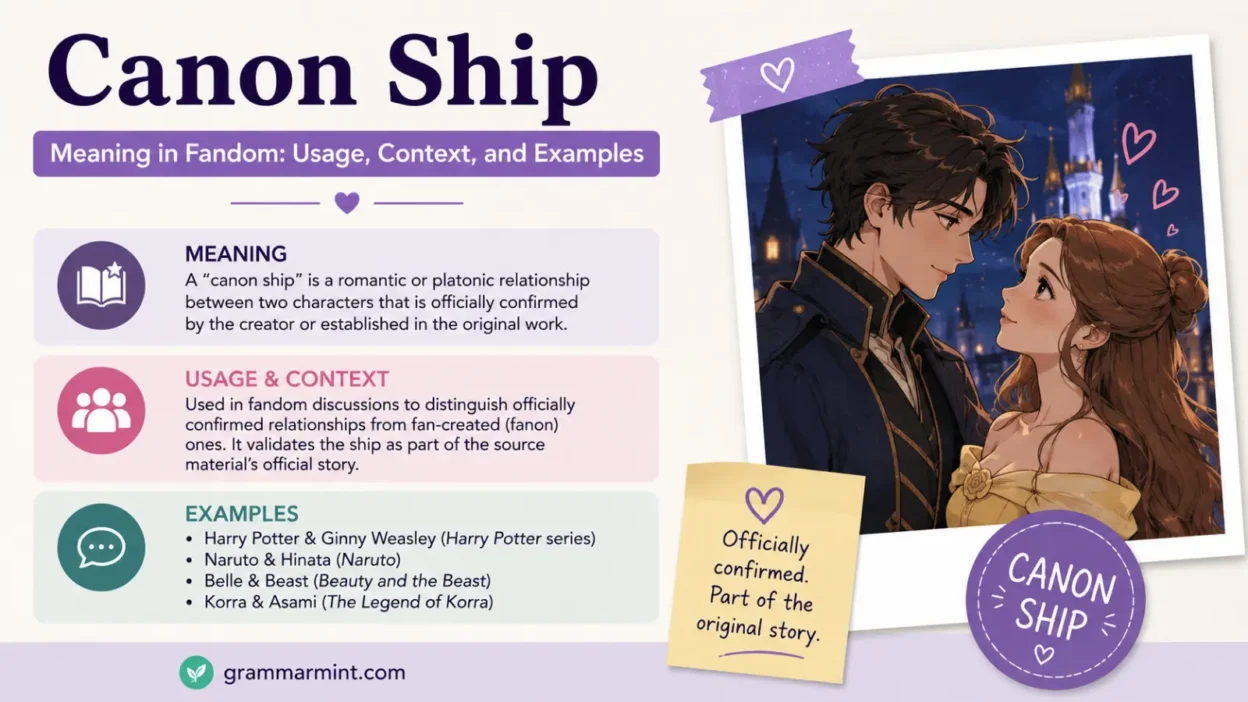
The canon ship meaning is an officially confirmed relationship between characters in a story. The book, show, movie, comic, or game supports the pairing.
A canon ship is different from a fan-created or only imagined relationship.
TL;DR
• A canon ship is official within the story.
• “Ship” means a supported character pairing.
• “Canon” means confirmed by official material.
• Popularity alone does not make a ship canon.
• Different adaptations may have different canon relationships.
Canon Ship Meaning in Plain English
A canon ship is a character relationship that officially exists within a fictional work. The relationship is not based only on fan wishes.
The story may show the characters dating, kissing, marrying, or expressing mutual love. Other clear confirmation may also establish the relationship.
For example, a couple becomes canon when the story clearly presents them as romantic partners. Fans may have supported them before that moment.
The phrase usually refers to romantic relationships. However, some communities use “ship” more broadly for important relationship dynamics.
Most readers should understand “canon ship” as an official romantic pairing. That is the safest meaning in common fandom use.
A canon ship can appear in many forms:
• A couple starts dating during the story.
• Two characters admit mutual romantic feelings.
• The ending confirms their future together.
• An official sequel shows them as partners.
• A trusted official source confirms the relationship.
The exact evidence can vary by fandom. Some fans accept creator comments, while others require confirmation inside the story.
How “Canon” and “Ship” Work Together
The phrase combines two pieces of fandom language. Each word adds a different idea.
“Canon” means the accepted or official story material. It includes events and facts treated as true within that fictional world.
“Ship” is shortened from “relationship.” As a noun, it means a pairing that fans support, discuss, or enjoy.
Together, “canon ship” means an official relationship pairing. The phrase describes the pairing’s status, not its quality.
A canon ship can be loved, disliked, healthy, messy, popular, or unpopular. Canon status only answers one question: Is it official?
That point matters during fandom debates. A fan can dislike a canon ship without denying that it exists.
Likewise, a fan can love a non-canon ship. Personal preference and official status are separate ideas.
Consider these sentences:
• “They are my favorite canon ship.”
• “I dislike the canon ship, but I understand the ending.”
• “The latest episode made their ship canon.”
• “That pairing is popular, but it is not canon.”
Each sentence separates story evidence from personal taste.
Canon Ship vs Fanon and Semi-Canon
Fandom uses several labels for relationship status. These labels help fans describe how much support a pairing receives.
| Context | Best Choice | Why |
| The story confirms the relationship | Canon ship | The pairing is official |
| Fans created or widely support it | Fanon ship | The source does not confirm it |
| The story strongly hints at romance | Semi-canon ship | Confirmation remains incomplete |
| One fan personally imagines it | Headcanon ship | The idea belongs mainly to that fan |
| The story rules it out | Sunk ship | Canon prevents the pairing |
A fanon ship may become popular across a community. However, broad support does not make the pairing official.
A semi-canon ship has meaningful story support. One character may have a confirmed crush, or both may show romantic tension.
Still, semi-canon is not a fixed legal category. Different fandoms may apply the label differently.
A headcanon ship often begins as one fan’s personal reading. Other fans may share that idea later.
A sunk ship has become impossible within the current story. A final relationship or clear rejection may sink it.
Some fans also use endgame ship for the relationship expected to last. An endgame ship usually becomes canon, but predictions can fail.
How to Use “Canon Ship” Correctly
Use “canon ship” when discussing an officially supported relationship. The phrase works best in informal fandom conversations.
You can use it in posts, comments, reviews, fanfiction notes, and character discussions. It may sound unclear outside fandom spaces.
Correct examples:
• “The finale confirmed my favorite canon ship.”
• “Is this pairing a canon ship in the manga?”
• “The adaptation changed the original canon ship.”
• “Their relationship became canon during season three.”
• “I prefer a fanon pairing over the canon ship.”
You can also place “canon” after a linking verb:
• “That ship is canon.”
• “The pairing became canon.”
• “Their romance was never canon.”
Avoid saying a ship is canon only because many fans support it. Look for clear evidence from official material.
Spoilers also matter. A late relationship reveal may surprise new viewers.
Use a spoiler warning before naming a newly confirmed canon ship. This small step shows respect for other fans.
Common Contexts and Realistic Examples
The phrase appears across television, anime, manga, books, comics, movies, and games. Its meaning stays mostly consistent.
Television and Streaming Shows
A season finale may confirm that two characters choose each other. Fans may then call them a canon ship.
Example: “After the final scene, nobody doubted that the ship was canon.”
Anime and Manga
An anime adaptation may stop before the manga confirms a relationship. That creates two different discussion points.
Example: “The ship is canon in the manga, but not yet in the anime.”
Books and Novel Series
A later book may change a character’s romantic future. Earlier fan predictions may then become correct or incorrect.
Example: “The final novel made the childhood friends a canon couple.”
Comics and Multiple Timelines
Comic franchises often contain reboots, alternate worlds, and separate timelines. A ship may be canon in one version only.
Example: “They are canon in that universe, but not in the main timeline.”
Video Games
Games may offer different romance routes. A player choice may create one possible relationship without one universal pairing.
Example: “That romance is available in the game, but its canon status remains debated.”
Fanfiction Tags
Writers may label stories as canon-compliant or canon-divergent. These labels explain how closely the story follows official events.
Example: “This story keeps the canon ship but changes the ending.”
Pronunciation and Part of Speech
Pronounce “canon” as KAN-un. It has two syllables and begins like “can.”
“Ship” sounds like the everyday word for a vessel. The full phrase sounds like KAN-un ship.
Do not pronounce or spell “canon” as “cannon.” A cannon is a large weapon, not official story material.
“Canon ship” functions as a noun phrase. The main noun is “ship,” while “canon” describes its official status.
Example: “Their canon ship surprised many viewers.”
The word “ship” can also function as a verb in fandom language.
Example: “Many fans ship those two characters.”
The adjective-like word “canon” can follow a linking verb.
Example: “Their relationship is canon.”
In careful writing, keep the phrase lowercase unless it begins a sentence. Character ship names may use capitals as proper names.
Related Fandom Terms
Several nearby terms often appear beside “canon ship.” Understanding them makes fandom discussions easier.
Shipping: Supporting, imagining, or discussing a relationship pairing.
Shipper: A person who supports or enjoys a particular pairing.
OTP: “One true pairing,” meaning a fan’s favorite ship.
Fanon: An idea widely accepted by fans but not officially confirmed.
Headcanon: A personal belief or interpretation about the story.
Canon-compliant: A fan work that does not conflict with official events.
Canon-divergent: A fan work that changes one or more official events.
Rarepair: A ship with a smaller fan following.
Crack ship: An unusual or highly unlikely pairing, often enjoyed playfully.
Ship name: A combined name used for a pairing.
Ship war: A heated disagreement between supporters of different pairings.
Endgame: The relationship expected or confirmed to remain together at the end.
An OTP does not need to be canon. A fan’s favorite pairing can remain completely unofficial.
Likewise, a canon ship does not automatically become everyone’s OTP. Fans can prefer another relationship.
Common Mistakes and Clarifications
The biggest mistake is confusing canon with cannon. Only “canon” refers to official story material.
Incorrect: “They are a cannon ship.”
Correct: “They are a canon ship.”
Another mistake is treating popularity as proof. Thousands of posts cannot officially confirm a relationship.
Incorrect idea: “Everyone ships them, so they are canon.”
Correct idea: “Everyone ships them, but the story has not confirmed them.”
Fans also confuse romantic tension with confirmation. Flirting, close friendship, or emotional scenes may support several readings.
Use “semi-canon,” “implied,” or “possible” when the evidence remains incomplete. These words show the correct level of certainty.
Adaptations can create another problem. A pairing may be canon in a book but absent from its screen version.
Always name the version when the franchise contains several timelines. This makes your claim more precise.
Creator comments can also cause debate. Some fandoms treat them as official confirmation, while others prioritize published material.
State your evidence clearly. You might say, “The creator confirmed it, but the series has not shown it.”
Finally, avoid presenting real people as a confirmed couple without reliable public confirmation. Fictional shipping rules do not establish real relationships.
Mini Quiz
Choose the best answer for each question.
1. What makes a ship canon?
A. It has many fan edits.
B. The official story confirms it.
C. The actors like it.
2. What is a fanon ship?
A. A fan-supported pairing without official confirmation.
B. A married couple in the story.
C. A relationship from a sequel.
3. Which spelling is correct?
A. Cannon ship
B. Canon ship
C. Cannan ship
4. Can an OTP be non-canon?
A. Yes
B. No
5. Why should fans name the adaptation?
A. Different versions may have different relationships.
B. Every adaptation has identical canon.
Answer Key: 1-B, 2-A, 3-B, 4-A, 5-A.
FAQs
What does canon ship mean?
A canon ship is an officially confirmed relationship between characters. The source story supports the pairing as real within its world.
Can a ship be canon?
Yes. A ship becomes canon when official material clearly confirms the relationship.
Fans can continue calling it a ship after confirmation. The word still identifies the relationship pairing.
What is the difference between a canon ship and a fanon ship?
A canon ship exists in official story material. A fanon ship comes mainly from fan ideas, support, or shared interpretation.
A fanon ship can be more popular than a canon ship. Popularity does not change its official status.
Does canon ship always mean the characters are dating?
Not always. Marriage, mutual love, or a confirmed future can also establish a canon ship.
Some fandoms require a formal relationship. Others accept direct romantic confirmation.
What does semi-canon ship mean?
A semi-canon ship has strong story support without complete confirmation. The story may show attraction, tension, or one-sided feelings.
Because fandom standards differ, explain the evidence when using this label.
Is a headcanon the same as a canon ship?
No. A headcanon is a personal belief that official material has not confirmed.
A canon ship has support from the accepted story. A headcanon may later become canon, but it starts unofficially.
Can a canon ship stop being canon?
A breakup does not erase the past relationship. The characters were still canon at that earlier point.
However, a reboot may create a different timeline. The ship may remain canon only within the original version.
Conclusion
The canon ship meaning is simple: the official story confirms the character relationship. Fan support alone cannot create that status.
Check the source, name the version, and use spoiler warnings when needed. These habits keep fandom discussions clear and respectful.