If you’ve ever paused before writing about someone moving countries, this guide is for you. Emigrate vs Immigrate can feel tricky because both words deal with migration, relocation, definitions, grammar, examples, and sentence choice. However, the difference is simple once you look at direction. Think of the United States, Canada, Mexico, and Ireland as places in a sentence. Are you talking about the country someone leaves, or the country someone enters? That one question usually gives you the right word. This guide keeps the rule clear, practical, and easy to remember.
Quick Answer
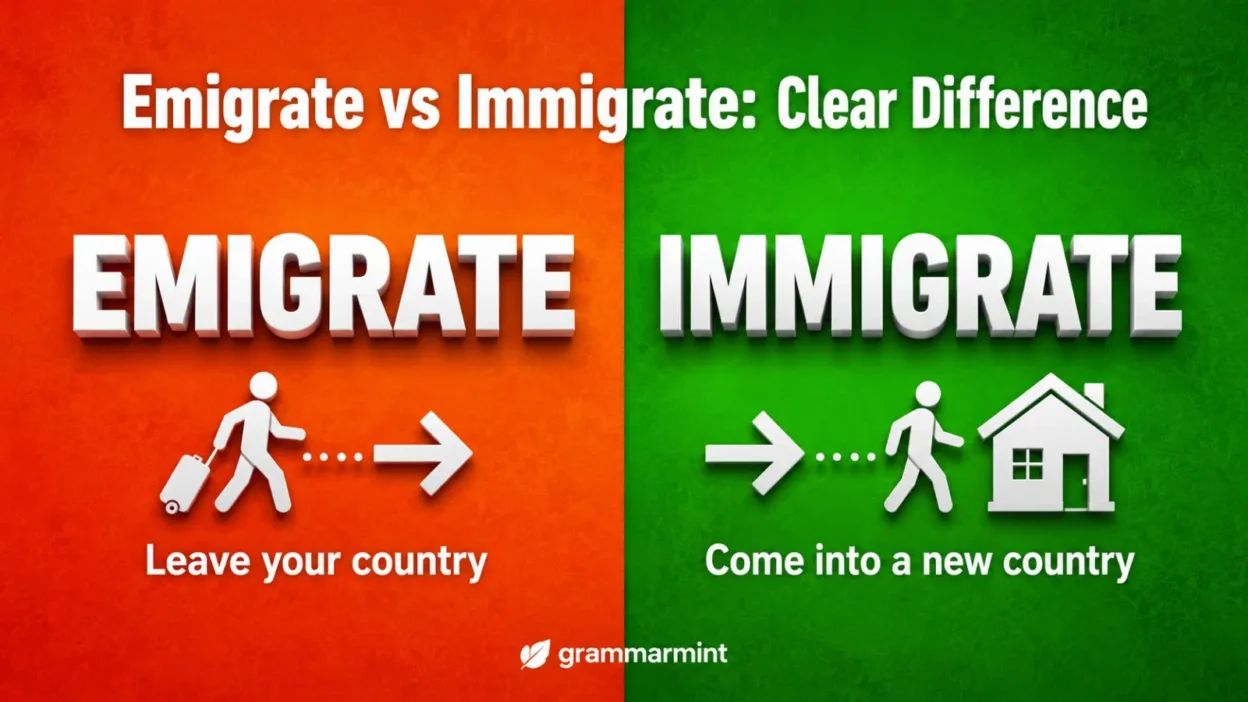
Emigrate vs immigrate comes down to direction: emigrate means to leave a country, while immigrate means to enter a new country to live there.
TL;DR
• Emigrate points away from the old country.
• Immigrate points toward the new country.
• Use emigrate from for departure.
• Use immigrate to for arrival.
• One person can do both.
• Migrate is the broader word.
Emigrate Vs Immigrate Meaning
The basic meaning is simple. Leave a country points to emigrate, while enter a country points to immigrate.
Both words can describe a move to live elsewhere. However, each word looks from a different side.
• Emigrate means leave one country.
• Immigrate means enter another country.
• Both involve moving across borders.
• Direction decides the right verb.
• Emigrate looks at the starting place.
• Immigrate looks at the ending place.
• The action may be identical.
• The sentence angle changes everything.
• Emigrate often sounds more departure-focused.
• Immigrate often sounds more arrival-focused.
• Both words can be formal.
• Neither word is a spelling variant.
Difference Between Emigrate And Immigrate
The difference is about viewpoint, not distance. Departure means emigrate, while arrival means immigrate.
So, your sentence focus matters most. First choose the place you want readers to notice.
• Use emigrate for leaving.
• Use immigrate for arriving.
• Emigrate highlights the old country.
• Immigrate highlights the new country.
• Both words describe human relocation.
• The same move can fit both.
• Viewpoint controls the verb choice.
• Country names can guide you.
• From usually signals emigrate.
• To usually signals immigrate.
• Clear direction prevents confusion.
• The words are related, not identical.
Emigrate From Or Immigrate To
The easiest rule is preposition-based. Use from with emigrate and to with immigrate.
Also, the country of origin usually follows emigrate. Meanwhile, the new country usually follows immigrate.
• She emigrated from Poland.
• He immigrated to Canada.
• They emigrated from Brazil.
• We immigrated to Australia.
• From shows the leaving point.
• To shows the arrival point.
• Add both places when helpful.
• Keep the viewpoint consistent.
• Avoid switching direction mid-sentence.
• Use from for old homes.
• Use to for new homes.
• Let the preposition guide you.
Immigrate To Or From
Immigrate usually works best with to. The destination country is the main idea.
You may still add the old country later. However, the sentence should show someone settled there in a new home.
• She immigrated to the United States.
• He immigrated to New Zealand.
• They immigrated to Germany together.
• My grandparents immigrated to Canada.
• Add from after the destination.
• Immigrated from can sound incomplete.
• The focus should remain arrival.
• Mention origin only when useful.
• To keeps the sentence natural.
• Into can work in some cases.
• In everyday writing, choose to.
• Destination comes first with immigrate.
Emigrate Vs Immigrate Examples
Examples make the rule stick. These sample sentences show the correct word in real context.
Notice how each sentence points somewhere. First, find the country being emphasized.
• Maria emigrated from Mexico.
• Maria immigrated to Spain.
• Ahmed emigrated from Egypt.
• Ahmed immigrated to France.
• My aunt emigrated from Korea.
• My aunt immigrated to Texas.
• They emigrated from Ireland together.
• They immigrated to Boston later.
• We emigrated from our homeland.
• We immigrated to a safer place.
• He emigrated after college.
• He immigrated for family reasons.
Emigrant Vs Immigrant
A person can be named by direction, too. An emigrant is viewed as leaving.
An immigrant is viewed as entering. After settling, that person may become a resident of the new country.
• An emigrant leaves a country.
• An immigrant enters a country.
• One traveler can be both.
• Context chooses the label.
• Home-country records may say emigrant.
• New-country records may say immigrant.
• Emigrant focuses on departure.
• Immigrant focuses on arrival.
• Both words describe people.
• Neither word describes citizenship alone.
• Resident describes where someone lives.
• Use the noun that matches direction.
Emigration Vs Immigration
The noun forms follow the same pattern. Emigration means the act of leaving.
Immigration means the act of entering. Both describe movement, but from opposite views.
• Emigration is outward movement.
• Immigration is inward movement.
• Emigration records track departures.
• Immigration records track arrivals.
• Laws often mention immigration.
• History books mention both.
• Statistics may compare both flows.
• Families may discuss emigration stories.
• Countries monitor immigration patterns.
• The nouns mirror the verbs.
• Direction still controls meaning.
• Use the noun your angle needs.
Migrate Vs Emigrate Vs Immigrate
Migrate is broader than both words. Migrate means move from one place to another.
Because it is a broader term, it can describe people, animals, or jobs. Emigrate and immigrate often involve crossing borders.
• Birds migrate every year.
• Workers migrate for seasonal jobs.
• Families may migrate within countries.
• Emigrate means leave a country.
• Immigrate means enter a country.
• Migrate does not show direction.
• Emigrate shows an outward angle.
• Immigrate shows an inward angle.
• Use migrate for broad movement.
• Use emigrate for departure.
• Use immigrate for arrival.
• Border context matters here.
Immigrate Vs Migrate
Immigrate is more specific than migrate. It often suggests a permanent move into another country.
Migrate can describe many kinds of general movement. So, use immigrate when relocation ends in a new country.
• People immigrate to settle.
• Animals usually migrate seasonally.
• Workers may migrate temporarily.
• Families immigrate to new countries.
• Data can migrate between systems.
• Students may migrate between cities.
• Immigrate implies a destination country.
• Migrate may stay local.
• Immigrate is not for birds.
• Migrate is less exact.
• Choose immigrate for settlement.
• Choose migrate for broad movement.
Can One Person Emigrate And Immigrate
Yes, one person can do both. The same person makes one journey.
However, each sentence uses two angles. One angle looks back, while the other looks ahead.
• Ana emigrated from Chile.
• Ana immigrated to Italy.
• Both sentences can be true.
• The journey did not change.
• Only the viewpoint changed.
• Departure creates the emigration angle.
• Arrival creates the immigration angle.
• Old country sees an emigrant.
• New country sees an immigrant.
• One move has two descriptions.
• Use both when comparing places.
• Avoid treating them as duplicates.
How To Remember Emigrate And Immigrate
A small trick helps. Think exit for emigrate and in for immigrate.
This memory trick works because the first letters match. Still, always check the sentence direction.
• E in emigrate means exit.
• I in immigrate means in.
• Exit points away from home.
• In points toward arrival.
• Emigrate from the old place.
• Immigrate to the new place.
• Draw an arrow if needed.
• Ask, “Leaving or entering?”
• Leaving means choose emigrate.
• Entering means choose immigrate.
• The trick supports the rule.
• Direction remains the final test.
Common Mistakes With Emigrate And Immigrate
These mixed-up words often cause small but important errors. Usually, the problem is a wrong preposition.
Sometimes, the sentence has unclear meaning because the viewpoint shifts. A quick direction check fixes most mistakes.
• Don’t call them exact synonyms.
• Don’t ignore the country named.
• Don’t write immigrated from alone.
• Don’t write emigrated to loosely.
• Add from after emigrate.
• Add to after immigrate.
• Match the verb to direction.
• Avoid changing angles mid-thought.
• Check noun forms carefully.
• Use migrate only when broader.
• Read the sentence aloud.
• Fix the viewpoint first.
Emigrate In A Sentence
Emigrate works when leaving is the point. The basic grammar pattern is emigrate from a place.
You can also use past tense naturally. In a formal sentence, include both origin and destination.
• My parents emigrated from Peru.
• She emigrated from Japan in 2018.
• Many families emigrated after the war.
• He plans to emigrate next year.
• They emigrated from Sweden to Norway.
• Our neighbors emigrated for work.
• The artist emigrated from Russia.
• Several cousins emigrated together.
• Her grandparents emigrated in 1965.
• He may emigrate after graduation.
• The family emigrated from Lebanon.
• Emigrate fits the leaving angle.
Immigrate In A Sentence
Immigrate works when arrival is the point. An everyday sentence often uses immigrate to a country.
The destination phrase carries the main meaning. This keeps the sentence clear and natural English.
• My parents immigrated to Peru.
• She immigrated to Japan in 2018.
• Many families immigrated after approval.
• He hopes to immigrate next year.
• They immigrated to Norway together.
• Our neighbors immigrated for work.
• The artist immigrated to France.
• Several cousins immigrated together.
• Her grandparents immigrated in 1965.
• He may immigrate after graduation.
• The family immigrated to Lebanon.
• Immigrate fits the arrival angle.
When To Use Emigrate In Formal Writing
Use emigrate when the old country matters. Careful writing should make that direction obvious.
This is useful in documents and historical writing. Readers need to know where someone left.
• Use emigrate in biographies.
• Use it in family histories.
• Use it for departure records.
• Use it when origin matters.
• Use it with from.
• Include dates when needed.
• Name the starting country clearly.
• Avoid vague country references.
• Keep the sentence direct.
• Check tone in sensitive contexts.
• Prefer people-first wording.
• Explain cause only if relevant.
When To Use Immigrate In Everyday English
Use immigrate when the new country matters. In conversation, this usually sounds natural and clear.
A simple rule helps: arrival equals immigrate. That keeps your plain English easy to follow.
• Use immigrate for arrival stories.
• Use it with to.
• Say immigrated to Canada.
• Say immigrated to America.
• Add origin after needed context.
• Keep family stories clear.
• Use it for settlement plans.
• Use it in school essays.
• Use it in personal writing.
• Avoid overexplaining simple sentences.
• Choose the clearest direction.
• Let the destination lead.
FAQs
What Is The Difference Between Immigrate And Emigrate?
Emigrate means to leave a country and live somewhere else. Immigrate means to enter another country to live there.
So, the difference is direction. Emigrate looks back at departure, while immigrate looks forward to arrival.
Do You Emigrate From Or To A Country?
The safest pattern is emigrate from a country. For example, she emigrated from Spain.
You can add the destination after that. For example, she emigrated from Spain to Argentina.
Do You Immigrate To Or From A Country?
The safest pattern is immigrate to a country. For example, he immigrated to Canada.
You can add the old country afterward. For example, he immigrated to Canada from India.
Can One Person Emigrate And Immigrate At The Same Time?
Yes. One person can emigrate from one country and immigrate to another.
The move is the same. The word changes because the viewpoint changes.
What Is The Noun Form Of Emigrate?
The action noun is emigration. The person noun is emigrant.
For example, emigration describes leaving. An emigrant is the person who leaves.
Can Immigrate And Emigrate Be Used Interchangeably?
Not usually. They talk about the same type of move, but from different directions.
Use the word that matches the sentence’s focus. That makes your meaning cleaner.
Conclusion
Emigrate vs Immigrate is easy once you check direction. Use emigrate for leaving and immigrate for entering.