If you write for school, work, emails, or online posts, among vs amongst can feel oddly tricky. Both words are prepositions, and they share the same meaning, yet their usage changes by American English, British English, examples, and formal tone. So, the real choice is not about right or wrong. Instead, it’s about what sounds clear, current, and natural. In this guide, you’ll learn the difference, see simple examples, compare them with between, and fix common mistakes fast.
Quick Answer
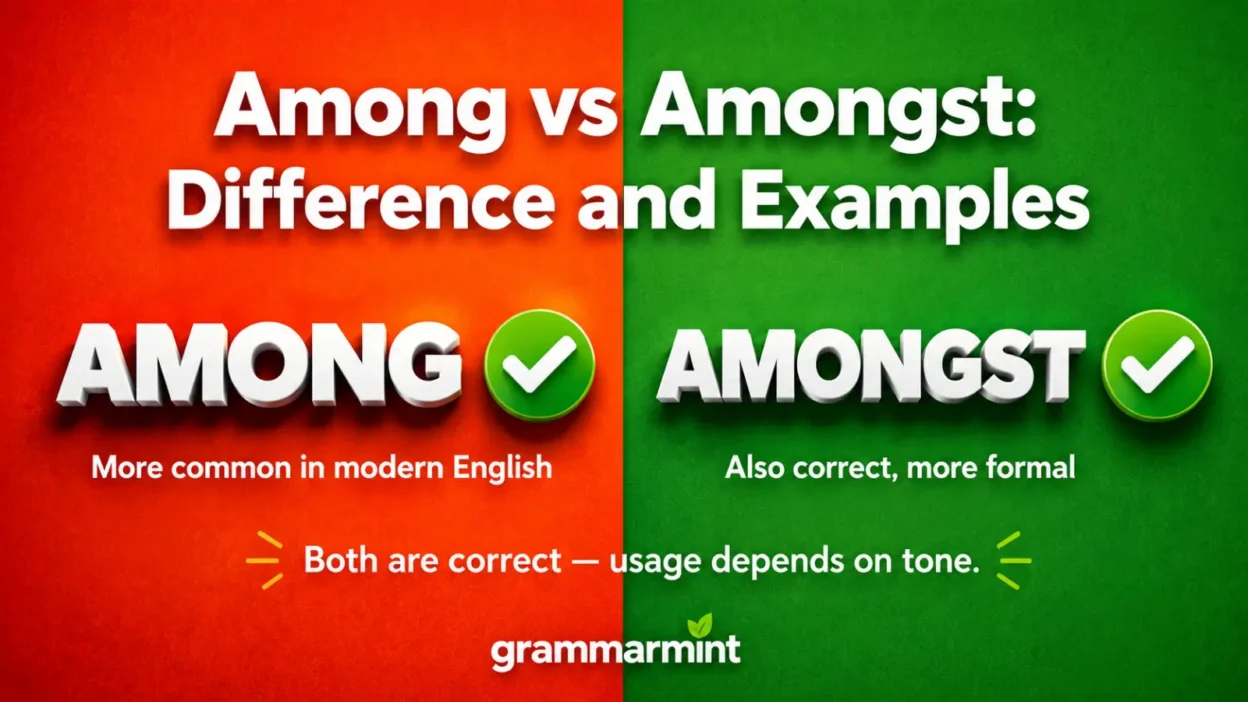
Among vs amongst is simple: both words mean the same thing, but among is more common in modern American English. Use amongst only when you want a formal, literary, or old-fashioned tone.
TL;DR
• Both words are correct prepositions.
• Among is best for U.S. readers.
• Amongst sounds formal or literary.
• Use among for most sentences.
• Use between for distinct items.
Among Vs Amongst: Quick Difference
The quick difference is mostly style, not meaning. Both words have the same meaning, but your style choice changes the feel.
• Among feels simple and modern.
• Amongst feels formal and older.
• Both can mean surrounded by.
• Both can mean included in.
• Among suits most U.S. writing.
• Amongst appears more in British style.
• Among usually sounds less dramatic.
• Amongst can sound poetic.
• Among works in casual speech.
• Amongst may feel too fancy.
• Editors usually prefer among.
• Meaning rarely changes between them.
Among Or Amongst: Which Should You Use?
For a U.S. audience, the better choice is almost always among. It fits modern writing and sounds like natural English.
• Choose among for everyday writing.
• Choose among for school essays.
• Choose among for business emails.
• Choose among for news-style writing.
• Choose among for clear directions.
• Choose among for web articles.
• Choose amongst for literary mood.
• Choose amongst for historical flavor.
• Choose amongst in poetic scenes.
• Avoid amongst in plain instructions.
• Avoid amongst in casual texts.
• Pick the word your reader expects.
Amongst Meaning In Plain English
The amongst meaning is “in the middle of” or “included in a group.” However, it often brings a formal tone or literary style.
• She walked amongst the trees.
• The castle stood amongst ruins.
• He felt calm amongst friends.
• The letter was hidden amongst papers.
• It can mean surrounded by.
• It can mean included with.
• It can mean shared within.
• It can sound old-fashioned.
• It can sound elegant.
• It fits stories well.
• It may distract in emails.
• It is correct, not wrong.
Among Meaning In Plain English
The among meaning is also “in the middle of” or “part of a group.” It is a preposition that usually points to a larger group.
• She sat among her friends.
• The keys were among the papers.
• He is popular among teachers.
• The rumor spread among students.
• It shows group location.
• It shows group membership.
• It shows shared action.
• It works with plural nouns.
• It sounds normal today.
• It fits formal writing too.
• It rarely feels distracting.
• It is the safest choice.
Among Vs Amongst Examples
Good sentence examples make the difference easier. In most cases, both show correct usage, but the writing tone changes.
• She found peace among friends.
• She found peace amongst friends.
• The cat hid among boxes.
• The cat hid amongst boxes.
• Among sounds clear and simple.
• Amongst sounds softer and older.
• Use among in reports.
• Use amongst in fiction.
• Among fits a classroom sentence.
• Amongst fits a fantasy scene.
• Both sentences can be correct.
• Tone decides the better word.
Among Vs Amongst In American English
In American English, among is the normal choice. It works better in everyday writing because it gives a clear style.
• Americans usually write among.
• Amongst may sound affected.
• Among fits workplace messages.
• Among fits college assignments.
• Among fits news articles.
• Among fits product copy.
• Among sounds natural aloud.
• Amongst can sound theatrical.
• Use among for broad clarity.
• Save amongst for special tone.
• Readers notice amongst more.
• Among keeps attention on meaning.
Among Vs Amongst In British English
In British English, both words appear, though among is still very common. Formal style and regional preference may make amongst feel more acceptable.
• British readers know both forms.
• Among remains widely used.
• Amongst sounds less unusual there.
• Formal prose may use amongst.
• Literary writing may prefer amongst.
• Everyday writing still favors among.
• Tone matters more than grammar.
• Audience matters more than habit.
• Among is globally safer.
• Amongst can mark regional flavor.
• British style is not a rule.
• Use consistency within one piece.
Is Amongst A Word?
Yes, amongst is a proper word. It is an accepted spelling, even though many U.S. readers hear it as old-fashioned.
• Amongst is real English.
• It is not a typo.
• It is not slang.
• It is not incorrect grammar.
• It has the same meaning.
• It works as a preposition.
• It appears in formal prose.
• It appears in literary writing.
• It appears in British writing.
• It can feel dated.
• It can feel too grand.
• Use it with purpose.
When To Use Among
You should use among when you want a clean, direct sentence. It handles group meaning well and is the natural choice for most readers.
• Use among with people groups.
• Use among with object groups.
• Use among with plural nouns.
• Use among in everyday speech.
• Use among in academic writing.
• Use among in business writing.
• Use among for shared feelings.
• Use among for group membership.
• Use among for hidden things.
• Use among for common phrases.
• Use among when unsure.
• Use among for U.S. audiences.
When To Use Amongst
You can use amongst when tone matters more than plainness. It adds a poetic tone and may create an elevated style.
• Use amongst in fiction.
• Use amongst for historical mood.
• Use amongst in lyrical prose.
• Use amongst for dramatic scenes.
• Use amongst in character voice.
• Use amongst sparingly in essays.
• Use amongst for British flavor.
• Avoid it in simple instructions.
• Avoid it in technical directions.
• Avoid it in quick emails.
• Check whether tone fits.
• Keep usage consistent nearby.
Among Vs Between
Here’s the real rule: use between for distinct items and among for a collective group. The common mistake is treating it only as a counting rule.
• Use between for two points.
• Use between for clear choices.
• Use between for separate items.
• Use between for time ranges.
• Use between for number ranges.
• Use among for loose groups.
• Use among for crowds.
• Use among for mixed objects.
• Use among for shared feelings.
• Three items can take between.
• Groups of two can take among.
• Meaning decides the preposition.
Among Others Or Amongst Others
The phrase among others means more examples exist, but you are not naming all of them. Amongst others can work too, yet it sounds more formal than unnamed examples need.
• Use among others in U.S. writing.
• Use amongst others for formal tone.
• Both phrases can be correct.
• Among others sounds more natural.
• Amongst others sounds older.
• Place commas by sentence flow.
• Don’t overuse the phrase.
• Name enough examples first.
• Keep the group idea clear.
• Avoid it after one item.
• Use it for partial lists.
• Choose one form consistently.
Among Other Things Meaning
Among other things means “in addition to other items not listed.” The additional items stay unnamed, but the phrase meaning stays clear.
• It adds unstated details.
• It points to a longer list.
• It avoids naming everything.
• It works in casual writing.
• It works in formal writing.
• Use it after examples.
• Don’t use it alone vaguely.
• Keep the sentence specific.
• It often follows a comma.
• It can soften long lists.
• It helps avoid clutter.
• Amongst other things sounds formal.
Among Themselves Or Amongst Themselves
Among themselves means people in a group do something with one another. Amongst themselves means the same thing, but the group action sounds more formal.
• They discussed it among themselves.
• They argued among themselves.
• They shared duties among themselves.
• Among themselves sounds natural.
• Amongst themselves sounds formal.
• Both phrases can be correct.
• Use among for conversations.
• Use among for teamwork.
• Use among for shared decisions.
• Use amongst for older tone.
• Avoid mixing both nearby.
• Match your audience’s style.
Amongst Synonyms And Alternatives
Good synonyms depend on the sentence. Sometimes alternatives like amid, within, or surrounded by improve your word choice.
• Use amid for surrounding conditions.
• Use within for boundaries.
• Use in for simple location.
• Use surrounded by for clarity.
• Use with for company.
• Use between for distinct items.
• Use amid for dramatic tone.
• Use inside for physical spaces.
• Avoid fancy swaps needlessly.
• Choose the clearest preposition.
• Check the sentence meaning.
• Replace only when helpful.
Common Mistakes With Among And Amongst
Most common mistakes come from tone, not definition. A few grammar errors disappear quickly with these quick fixes.
• Don’t call amongst incorrect.
• Don’t overuse amongst casually.
• Don’t force among before ranges.
• Don’t use among for dates.
• Don’t mix styles randomly.
• Don’t ignore your audience.
• Don’t treat between too narrowly.
• Don’t use amongst for clarity.
• Don’t choose by sound alone.
• Don’t forget plural group nouns.
• Don’t copy old examples blindly.
• Don’t make tone accidental.
FAQs
What Is The Difference Between Among And Amongst?
Among and amongst mean the same thing. The difference is tone and usage, not basic definition. Among sounds modern and natural, while amongst sounds more formal or literary.
Is Amongst A Word?
Yes, amongst is a real word. It is a correct preposition and can replace among in many sentences. Still, American readers usually expect among.
Can Among And Amongst Be Used Interchangeably?
Yes, they often can be swapped without changing meaning. However, the sentence may feel different after the swap. Among sounds plain, while amongst sounds more stylized.
Is Among Or Amongst Better In American English?
Among is better for most American English writing. It sounds clearer, simpler, and more current. Use amongst only when you want a special tone.
What Does Among Others Mean?
Among others means the list is not complete. For example, “teachers, writers, and editors, among others” means more people are included too.
Is It Among Others Or Amongst Others?
Both can be correct. Among others is the better everyday choice, especially for U.S. readers. Amongst others sounds more formal.
Is It Okay To Use Amongst?
Yes, it is okay to use amongst. Just use it with care. In casual American writing, among usually sounds better.
Conclusion
Among vs amongst is easy once you focus on tone. Choose among for clear modern writing, and save amongst for a formal, literary, or old-fashioned feel.