You may see “moots” in TikTok comments, X posts, Instagram captions, or fandom conversations. The word often appears when users discuss people they follow online. It may also show up in posts asking for new connections.
Understanding the term matters because “moots” does not simply mean all followers. It usually describes people who follow each other. Some users also expect regular likes, replies, or friendly conversations from their moots.
The spelling can create extra confusion. In standard English, “moots” can be a verb related to discussion. It also resembles the adjective in “moot point.” Those meanings are separate from the slang use.
This guide explains the slang definition, pronunciation, grammar, tone, and common contexts. It also shows how moots differ from followers, mutuals, and close friends.
Quick Answer
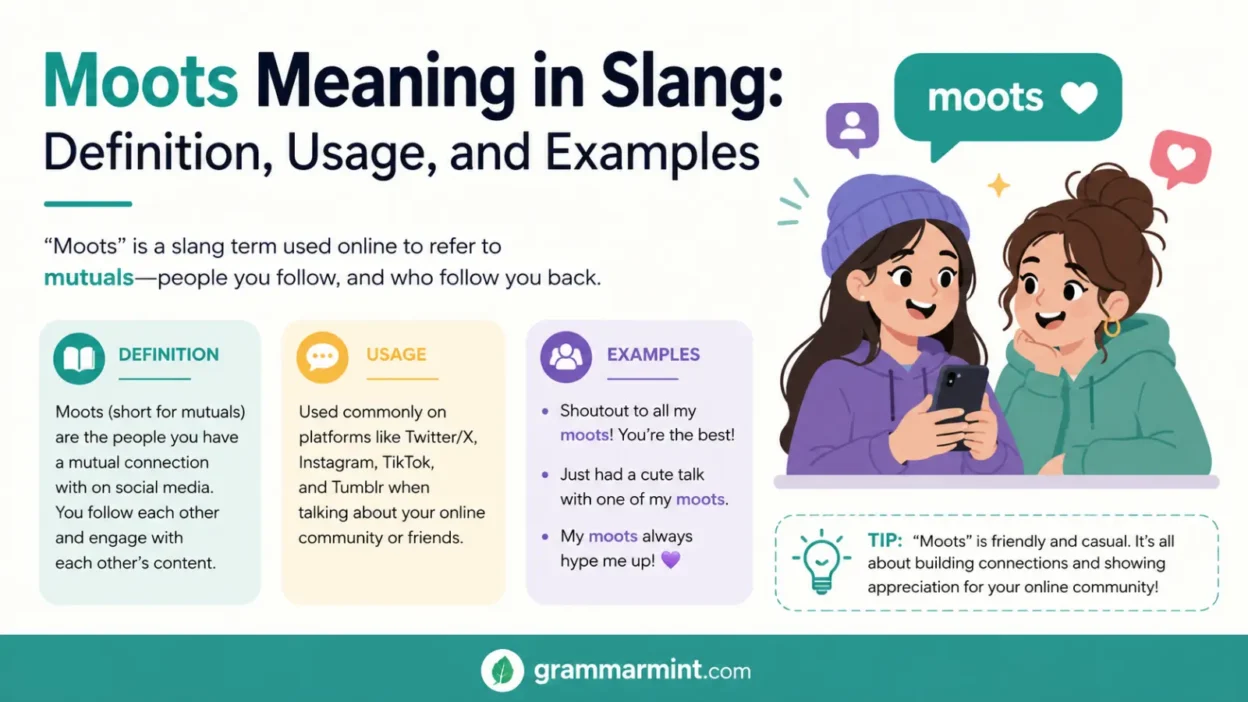
The moots meaning is “mutual followers.” Your moots are people you follow who also follow you back.
The term is informal and mainly used in online communities.
TL;DR
• Moots means mutual followers.
• A single person can be called a moot.
• Moots follow each other online.
• They are not always close friends.
• The term suits casual online conversations.
• Standard “moots” can also be a verb.
What Moots Means in Slang
In slang, “moots” means people who have a two-way following connection. You follow them, and they follow you.
Many users treat moots as part of their online circle. They may like posts, leave comments, share content, or chat privately.
However, interaction is not always required. Two accounts can technically be mutuals without speaking often. The word may suggest friendliness, but it does not guarantee a close friendship.
For example:
• “My moots always support my art.”
• “I found several new gaming moots today.”
• “Any book-loving moots online?”
• “She is one of my oldest moots.”
The singular form is “moot.” You might say, “Jordan is my moot on TikTok.”
Pronunciation and Part of Speech
“Moots” is pronounced like “boots” with an “m” at the start. A simple pronunciation guide is MOOTS.
In the slang sense, “moots” is a plural noun. It names two or more mutual followers.
• Singular noun: moot
• Plural noun: moots
• Longer form: mutual or mutual follower
Example: “One of my moots sent me that post.”
Standard English has another form. “Moots” can be a verb meaning “raises for discussion.”
For example:
“She moots a different plan during the meeting.”
That verb is unrelated to mutual followers. Context usually makes the intended meaning clear.
How Moots Is Used Online
People often use “moots” to address or describe their online circle. The term is common in short, casual posts.
Common uses include:
• Asking for connections: “Looking for new music moots.”
• Greeting a group: “Good morning, moots!”
• Requesting opinions: “Moots, which photo should I post?”
• Showing appreciation: “I love how supportive my moots are.”
• Finding shared interests: “Any horror movie moots here?”
Fandom communities often use the word to find like-minded users. Artists, readers, gamers, and creators may use it similarly.
The phrase “let’s be moots” usually means “let’s follow each other.” It may also invite future interaction.
Someone might comment:
“Your book recommendations are great. Let’s be moots!”
The person wants a mutual connection. However, the other user is not required to follow back.
Moots, Mutuals, Followers, and Friends
These terms overlap, but they are not identical. The main difference involves whether the connection is one-way or two-way.
| Context | Best Choice | Why |
| You both follow each other | moots or mutuals | The connection is reciprocal |
| Someone follows you only | follower | You may not follow back |
| You know each other closely | friend | The relationship is personal |
| Formal communication | mutual followers | The meaning is clear and neutral |
“Moots” and “mutuals” usually mean the same thing. However, “moots” sounds more playful and informal.
A follower becomes a moot only when you follow that person back. Therefore, not every follower is one of your moots.
A moot may eventually become a friend. Still, the mutual following connection alone does not prove friendship.
Suppose you and Maya follow each other but never speak. Maya can still be your moot.
By contrast, your close friend might not use the same social platform. That friend would not be your moot there.
Common Examples of Moots
The following examples show natural uses in posts, messages, and comments.
- “My moots recommended this new show.”
- “I need more photography moots.”
- “One of my moots made this drawing.”
- “Moots, please send your favorite recipes.”
- “We became moots after discussing the same book.”
- “I follow many people, but only some are moots.”
- “She unfollowed me, so we are no longer moots.”
- “Are any of my baseball moots going to the game?”
- “Thanks to my moots for checking on me.”
- “Let’s be moots if you enjoy mystery novels.”
- “My art moots helped me choose a new design.”
- “I met one of my longtime moots at the concert.”
The word can address a whole group. It can also describe one relationship through the singular “moot.”
The examples also show its friendly tone. Most people use it positively or neutrally.
When to Use Moots—and When Not To
Use “moots” in relaxed online spaces where readers understand current slang. It works well in captions, comments, casual messages, and fandom posts.
Choose clearer wording when the audience may not know the term. “Mutual followers” is safer in formal or instructional writing.
Use “moots” when:
• Talking with online friends or followers
• Posting in a fandom community
• Seeking people with shared interests
• Addressing mutual followers as a group
• Writing a relaxed caption or comment
Avoid it when:
• Writing a résumé or business email
• Explaining account information to beginners
• Speaking to an unfamiliar formal audience
• Discussing a legal or academic moot
• Using the expression “moot point”
The slang is friendly and generally neutral. Still, it may sound overly casual outside online conversation.
For example, avoid this sentence in a business report:
“Our brand gained 300 new moots.”
A clearer version would be:
“Our account formed more mutual follower connections.”
Origin and Related Terms
“Moots” developed as a shortened, playful form of “mutuals” or “mutual followers.” The exact first use is unclear.
The term spread through social networks and interest-based communities. Fandom conversations helped make it more visible.
Related terms include:
• Mutuals: People who follow each other
• Mutual followers: The clear, full expression
• Moot: One mutual follower
• Moot up: A casual request to follow each other
• Follow back: To follow someone who already follows you
• Oomf: “One of my followers,” without naming the person
“Moot up” may appear in comments such as:
“Your content is great. Moot up?”
The writer is asking for a mutual follow. However, this expression is less established than “moots.”
“Oomf” is also different from “moot.” The person described as “one of my followers” may not be followed back.
There is no exact antonym for “moots.” The phrase “one-way follower” describes the opposite relationship more clearly.
Common Mistakes and Confusions
The biggest mistake is confusing slang “moots” with standard “moot.” These forms share a spelling but carry different meanings.
Incorrect idea: “Moots means an unimportant question.”
Correction: “Moot” can describe something without practical importance. Slang “moots” means mutual followers.
Another mistake is treating every follower as a moot.
Incorrect: “All 500 people who follow me are my moots.”
Correction: They are moots only when you follow them back.
Some people also assume moots must be close friends. That is not required. The relationship may involve frequent conversation or only a mutual follow.
Do not confuse these sentences:
• “My moots liked the photo.”
• “The new evidence moots that argument.”
• “The question became moot after the deadline.”
The first sentence uses the slang noun. The second uses “moots” as a verb.
In the third sentence, “moot” is an adjective. It describes a question that no longer has practical importance.
Finally, avoid using “moots” in formal writing without explanation. Many readers will understand “mutual followers” more quickly.
Mini Quiz
Choose the best answer.
1. What does “moots” usually mean online?
a) Deleted posts
b) Mutual followers
c) Private messages
2. Which sentence uses the slang correctly?
a) “My moots follow me, and I follow them.”
b) “The deadline moots yesterday.”
c) “That answer is moots.”
3. Is every follower a moot?
a) Yes
b) No
4. What is the singular form?
a) Moot
b) Mooter
c) Mooting
5. Which phrase is best in a formal report?
a) My moots
b) Mutual followers
Answer key: 1-b, 2-a, 3-b, 4-a, 5-b.
Frequently Asked Questions
What does moots mean in text?
“Moots” means mutual followers in casual messages. It describes people who follow each other on a social platform.
The word may also refer warmly to someone’s regular online circle.
What does moots mean on TikTok?
On TikTok, moots are users who follow each other. They may interact through likes, comments, reposts, or messages.
Users sometimes ask for new moots based on shared interests.
Are moots the same as friends?
Not always. Moots share a mutual follow, while friendship usually suggests a deeper personal relationship.
Some moots become friends after talking regularly. Others rarely communicate.
What does “let’s be moots” mean?
It usually means “let’s follow each other.” The speaker may also want future conversation or shared engagement.
You are free to accept or ignore the request.
Can one person be called a moot?
Yes. “Moot” is the singular form, while “moots” is plural.
You could say, “Riley is one of my favorite moots.”
Is moots a bad word?
No. It is usually friendly, neutral slang.
However, it may sound too casual in business, academic, or professional settings.
Is “moots” related to “moot point”?
No. Slang “moots” means mutual followers.
A “moot point” is debatable or lacks practical importance. The meanings should not be mixed.
Conclusion
The moots meaning is simple: people who follow each other online. Use it in casual spaces where the audience understands internet slang.
For formal writing, choose “mutual followers” instead.