You may hear “Fanum tax” in school, group chats, gaming videos, or short online clips. Someone may shout it before taking a french fry from a friend. Others use it as random meme language with words such as “rizz” and “skibidi.”
The phrase sounds like a real fee, but it is not one. It usually names a playful act of taking part of someone’s food. The joke works because the person treats one bite as a required payment.
Understanding the phrase helps parents, students, and new English learners follow modern online conversations. It also helps you tell a harmless joke from rude behavior. This guide explains the meaning, pronunciation, grammar, origin, common uses, and clear examples. It also shows when the phrase fits and when plain English works better.
Quick Answer
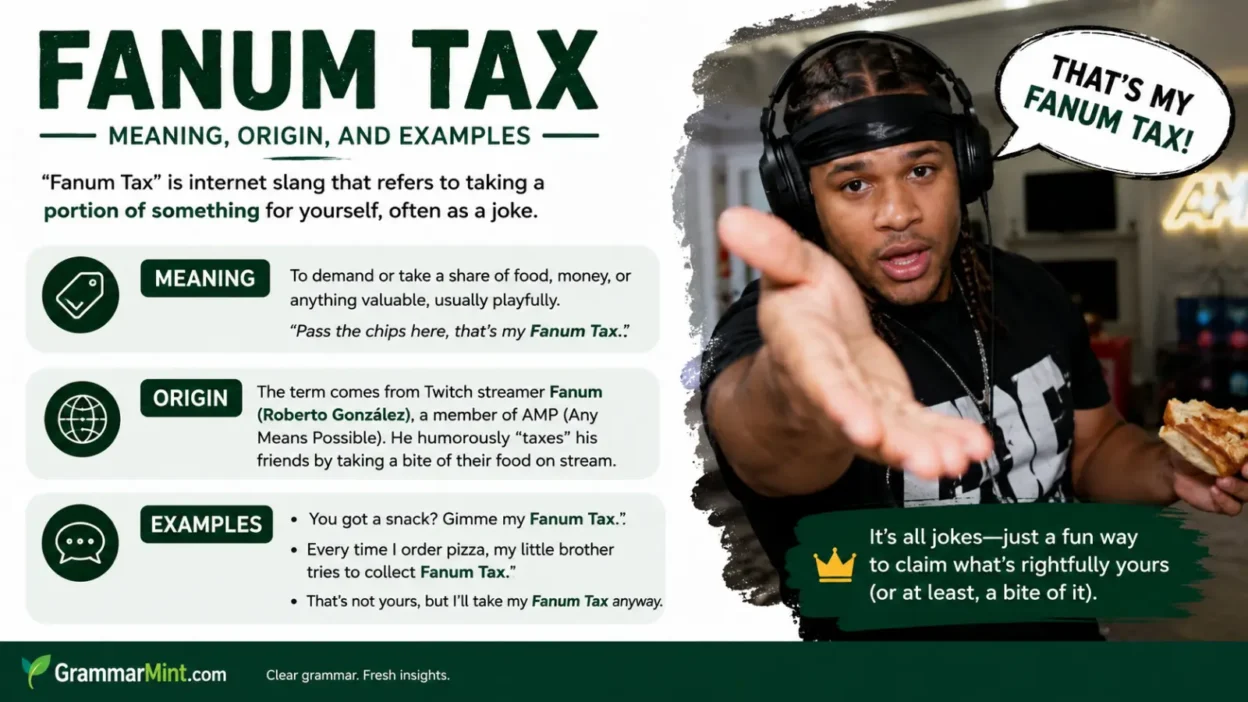
The Fanum tax meaning is taking a small part of someone’s food as a playful “tax.” It can also describe taking another item or appear as random meme slang.
TL;DR
• It usually means taking a friend’s food.
• The tone is playful and very informal.
• The phrase comes from streamer Fanum.
• “Fanum taxed” is a common verb-like form.
• It is not a real tax or formal expression.
What Fanum Tax Means in Slang
In slang, a Fanum tax is a joking claim to part of another person’s food. The “payment” might be one fry, one chip, or a bite.
The person taking it acts as though the share is required. However, no real rule or payment exists.
Example:
“My brother opened his chips, so I collected the Fanum tax.”
Here, the speaker jokingly took some chips. The phrase makes the small act sound official.
The core meaning involves food between friends. Some speakers extend it to drinks, game items, seats, or other things. That broader use means someone took a portion, advantage, or resource.
The phrase can also appear without a clear meaning. People may combine it with other meme words for absurd humor. In those cases, the social joke matters more than the definition.
Pronunciation and Part of Speech
Pronounce the phrase as FAN-um taks. Stress the first part of “Fanum” and say “tax” normally.
“Fanum tax” mainly works as a noun phrase. It names the playful share or the act of taking it.
Noun phrase:
“That bite was the Fanum tax.”
People also turn the phrase into a verb during casual speech. This creates forms such as “Fanum tax,” “Fanum taxed,” and “Fanum taxing.”
Verb-like use:
“She Fanum taxed two of my fries.”
These verb forms are common in jokes and online posts. They do not suit formal papers or professional messages.
Because Fanum is a creator’s name, capitalizing “Fanum” is the clearest choice. Lowercase versions are still common in quick comments and texts.
Where Fanum Tax Came From
The phrase comes from Fanum, an American streamer and member of AMP. He became known for taking bites from friends’ meals during streams.
The group treated those bites as a humorous tax. Viewers repeated the phrase when clips spread across video and social platforms.
The gag began around 2022 and grew much more visible during 2023. A viral parody song placed “Fanum tax” beside other online slang. That song helped the phrase reach people outside Fanum’s regular audience.
Fanum has explained the idea as sharing food with friends. Online users often describe it more bluntly as stealing a bite.
Both descriptions point to the same basic event. One friend claims a small part of another friend’s meal.
The exact meaning can shift with context. In original uses, the phrase refers to food. Later meme uses may be broader, ironic, or intentionally meaningless.
How Fanum Tax Is Used
People use the phrase in several short patterns. Most appear in speech, comments, captions, or messages.
Naming the Act
“That was a Fanum tax.”
This means someone took a small share of food.
Demanding a Playful Share
“Pay the Fanum tax.”
This means “Give me a bite” or “Share some with me.”
Describing What Happened
“He Fanum taxed my pizza.”
This means he took some pizza, usually as a joke.
Refusing the Joke
“No Fanum tax today.”
The speaker does not want to share or lose any food.
Using It as Nonsense
“You’re so skibidi, so Fanum tax.”
Here, the phrase may not keep its food meaning. It joins other meme words for comic confusion.
| Context | Best Choice | Why |
|---|---|---|
| A friend takes one fry | “Fanum tax” | The playful food joke fits |
| Someone takes property | “stole” or “took” | The situation is serious |
| A school paper explains sharing | “shared some food” | Plain English is clearer |
Common Contexts and Examples
The phrase appears most often around snacks and casual meals. It also shows up in messages about those moments.
Food and Snacks
• “You bought nuggets, so the Fanum tax applies.”
• “Jordan took one cookie as his Fanum tax.”
• “My sister Fanum taxed the last mozzarella stick.”
• “I protected my fries from the Fanum tax.”
Text Messages
Friend: “I just ordered pizza.”
Reply: “Save me a slice for the Fanum tax.”
The reply jokingly asks for a share.
School or Lunch Settings
“Everyone reached for her chips and called it a Fanum tax.”
This sentence reports the joke. It does not suggest that taking food is automatically acceptable.
Gaming and Online Communities
“He Fanum taxed my loot before I could pick it up.”
This broader example applies the idea to a virtual item. Food remains the phrase’s clearest and most recognized meaning.
Ironic Meme Use
“Bro said rizz, sigma, and Fanum tax in one sentence.”
The speaker is commenting on a cluster of youth slang. The phrase may function as a cultural reference rather than a food term.
When to Use It—and When Not To
Use “Fanum tax” in relaxed situations where everyone understands the joke. It works best among friends who already share food comfortably.
Good situations include:
• joking about one fry or chip
• describing a funny food-sharing moment
• commenting on a related meme
• teasing a friend who always asks for bites
Do not use the phrase to excuse unwanted touching or taking. A joke does not replace permission.
Avoid it when:
• the other person dislikes food sharing
• allergies or dietary needs are involved
• the food belongs to a stranger
• the situation is formal or serious
• the action would clearly be stealing
Tone matters as much as meaning. A close friend may laugh, while another person may find the act rude.
When clarity matters, ask directly: “May I try a bite?” That sentence is polite and easy to understand.
Related Terms and Common Confusions
“Food tax” is the closest alternative. It describes the same joking idea without naming Fanum.
Other close expressions include:
• snack tax — a playful claim to someone’s snack
• take a bite — a neutral description
• snag a fry — casual wording for taking one fry
• share some — a direct request
These are close phrases, not perfect synonyms. “Fanum tax” carries a specific streamer and meme reference.
The word “tax” can confuse learners. In normal English, a tax is a required government charge. In this phrase, “tax” is only a humorous metaphor.
“Rizz,” “skibidi,” “gyatt,” and “sigma” often appear near “Fanum tax.” They are not synonyms. They became linked through online memes and parody language.
No exact antonym exists. “Keeping your food” and “sharing freely” describe opposite situations. However, they are not direct word opposites.
Mini Quiz
Choose the best answer.
1. What does “Fanum tax” usually involve?
A. Paying money
B. Taking some food
C. Buying a game
2. Which sentence uses the phrase naturally?
A. “The city charged a Fanum tax.”
B. “He Fanum taxed one of my fries.”
C. “The report measured Fanum tax rates.”
3. Is “Fanum tax” formal English?
A. Yes
B. No
4. What does “Pay the Fanum tax” usually mean?
A. Share a bite
B. File a return
C. Pay a parking fee
5. Should the phrase excuse taking food without permission?
A. Yes
B. No
Answer key: 1-B, 2-B, 3-B, 4-A, 5-B.
FAQs
What Does Fanum Tax Mean?
It means taking a small part of someone’s food as a joke. One fry, chip, or bite may count as the “tax.”
What Does “Pay the Fanum Tax” Mean?
It means someone wants you to share part of your food. The speaker may say it before taking or requesting a bite.
Who Is Fanum?
Fanum is the online creator whose food-sharing gag inspired the phrase. He used the joke while streaming with friends and other AMP members.
Why Is It Called Fanum Tax?
The name combines Fanum’s creator name with the word “tax.” The food portion is jokingly treated as a required payment.
Is Fanum Tax a Bad Word?
No, it is not a swear word or an explicit term. Still, grabbing food without permission can be rude.
Is Fanum Tax Gen Z or Gen Alpha Slang?
Both groups may recognize it, but it is strongly linked with Gen Alpha meme culture. Its audience grew through streaming clips and short videos.
Can Fanum Tax Mean Something Besides Food?
Yes, speakers sometimes apply it to drinks, game items, or other resources. Those extended meanings are less central than the food meaning.
Conclusion
Understanding the Fanum tax meaning makes modern meme conversations easier to follow. Use the phrase for playful food-sharing jokes, but respect personal boundaries.
When unsure, ask for a bite instead of claiming a tax.