You may see unalive in TikTok captions, YouTube videos, memes, gaming posts, or private messages. The word often replaces direct terms about death, killing, or suicide. Its meaning depends on the sentence and the speaker’s tone.
Parents and teachers may also hear it when young people discuss online content. Understanding the term matters because it can sound playful in one post and serious in another.
A joke about a fictional character differs from someone saying they may “unalive” themselves. Readers should use context and avoid assuming every use is harmless.
This guide explains the unalive meaning in plain English. It covers slang usage, pronunciation, grammar, sentence patterns, and common contexts. It also explains the term’s likely modern origin and when clearer wording is more suitable.
Quick Answer
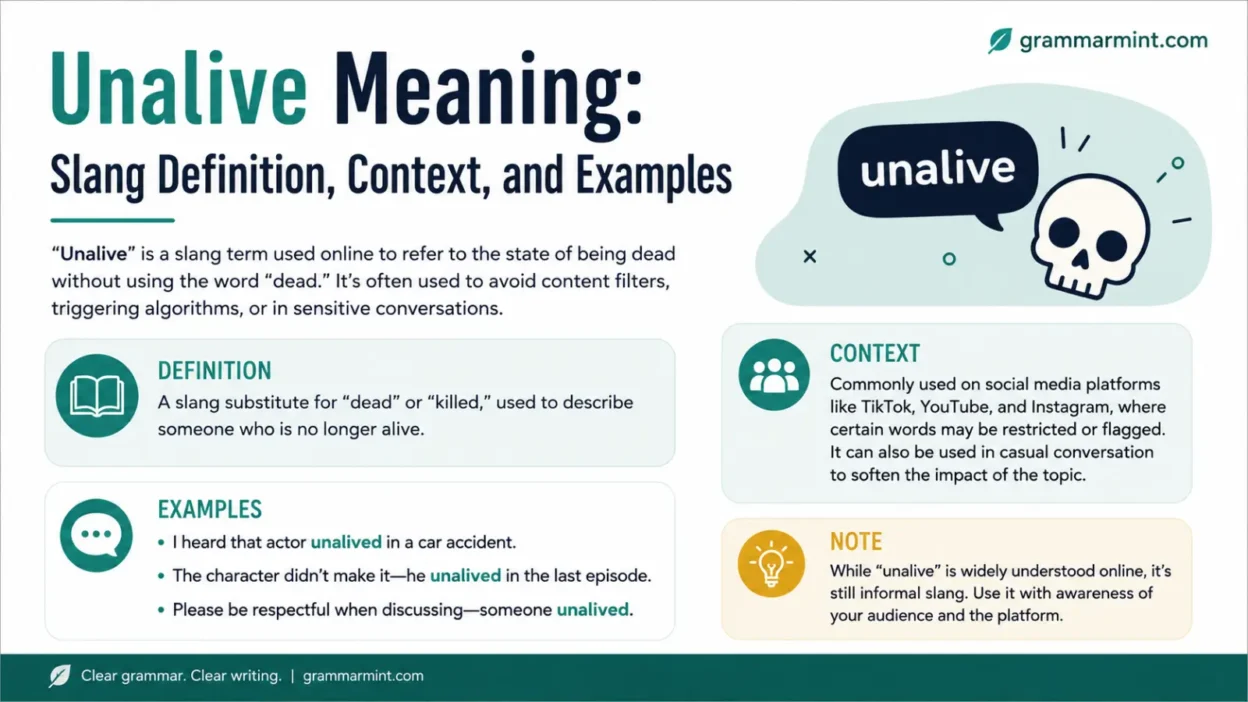
The unalive meaning is usually “to kill,” “to die,” or “dead.” It is informal online slang that replaces direct death-related words.
TL;DR
• Unalive is informal internet slang.
• It may mean kill, die, or dead.
• Context decides the exact meaning.
• It works mainly as a verb or adjective.
• Direct wording is better in serious communication.
What Unalive Means in Plain English
In modern slang, unalive is a euphemism. A euphemism replaces a direct or uncomfortable word with softer wording.
The term can carry three closely related meanings:
• To kill: “The villain tried to unalive the hero.”
• To die: “Did that character unalive in the final episode?”
• Dead: “The meme showed an unalive cartoon fish.”
The first two uses treat unalive as a verb. The third use treats it as an adjective.
The exact meaning comes from the sentence. “Someone unalived him” means someone killed him. “He unalived” means he died.
“He is unalive” means he is dead. These meanings are understandable online.
However, they remain informal and can sound strange in careful writing.
Meaning in Slang and Online Context
Online, unalive often replaces words such as kill, die, dead, or suicide. Creators may use it in captions, voiceovers, comments, and subtitles.
The term appears in several common settings:
• Gaming discussions about defeating characters
• Videos about crime stories or fictional deaths
• Memes using exaggerated threats for humor
• Posts discussing suicide or self-harm
• Comments written to avoid content filters
Tone changes the meaning. “My coach will unalive me for being late” is usually exaggeration. It normally means the coach will be extremely angry.
A sentence about someone wanting to “unalive themselves” is different. That phrase can refer to suicide and should be taken seriously.
The word can reduce emotional intensity for some speakers. For others, it may make a serious subject sound too casual.
People sometimes use it for failed devices or lifeless objects. That playful adjective use is less common than the verb.
Pronunciation and Part of Speech
Unalive is pronounced un-uh-LYVE. The strongest stress falls on the final syllable.
The word has two main roles in current usage.
Verb
As a verb, unalive can mean kill or die.
• Present: unalive
• Third person: unalives
• Past: unalived
• Present participle: unaliving
Examples:
• “The player unalives the final boss.”
• “The character was unalived off-screen.”
• “The show avoided showing anyone unaliving.”
Some speakers use the verb without an object. However, many readers expect an object after it.
Adjective
As an adjective, unalive can mean dead, lifeless, or sometimes unresponsive.
• “The joke showed an unalive robot.”
• “The old description called him unalive to beauty.”
The second example reflects an older, rare sense. It means unaware of or unmoved by something.
Unalive is not normally used as a noun in modern standard writing.
How to Use Unalive in Sentences
Use unalive only when the audience understands internet slang. The sentence must also make the intended meaning clear.
To Mean “Kill”
Pattern: unalive + person or thing
• “The monster tries to unalive the player.”
• “The creator said the villain unalived three characters.”
To Mean “Die”
Pattern: person or character + unalive
• “Did the side character unalive?”
• “Everyone thought the pet would unalive, but it recovered.”
This pattern is less common. Some readers may find die clearer.
To Mean “Dead”
Pattern: unalive + noun or be + unalive
• “The post showed an unalive fish.”
• “That fictional character is definitely unalive.”
With Passive Voice
Pattern: be + unalived
• “The villain was unalived before the final scene.”
• “Several game characters were unalived during the battle.”
The forms are grammatically regular. Still, the word’s informality limits where it fits.
Do not confuse “was unalive” with “was unalived.” The first is an adjective, while the second is a passive verb.
Why People Say Unalive Online
People often use unalive to avoid automated content filters. They may fear that direct death-related terms could reduce visibility or cause removal.
Creators also use it for other reasons:
• To soften a disturbing topic
• To keep a joke less graphic
• To match an online community’s language
• To discuss fictional violence playfully
• To repeat wording common in short videos
The term belongs to a wider style called algospeak. This style uses altered words, symbols, or phrases to avoid automated review.
However, not every user chooses the term for the same reason. Some use it naturally because they hear it often.
Others use it because direct language feels uncomfortable. Some simply repeat a popular joke or familiar phrase.
The word has also moved beyond social media. People sometimes use it in speech, school discussions, and casual messages.
Tone, Context, and When Not to Use It
Unalive is casual, coded, and often humorous. It does not fit every situation.
| Context | Best Choice | Why |
|---|---|---|
| Meme or gaming chat | Unalive may fit | The audience expects slang |
| Fictional video recap | Unalive or killed | Tone decides the choice |
| News or academic writing | Died, killed, or suicide | Direct wording is clearer |
| Medical or safety discussion | Precise wording | Clarity matters most |
| Personal crisis message | Direct, caring language | The meaning must not be missed |
Avoid unalive in police reports, legal writing, medical records, school essays, and formal news reports. These settings require exact language.
It may also be unsuitable when discussing a real person’s death. Families and readers may find the term dismissive or disrespectful.
When someone uses the word about themselves, focus on the message rather than the slang. A serious statement needs a direct and caring response.
Ask what the person means instead of treating the phrase as a joke. Seek immediate local support when someone may be in danger.
Origin and How the Term Spread
The adjective unalive existed before modern social media slang. Older uses could mean lifeless, unaware, or lacking feeling.
The newer verb sense is commonly linked to a 2013 episode of Ultimate Spider-Man. In the episode, Deadpool uses the term while avoiding the word kill.
That appearance likely helped popularize the joke-like verb. Later, social media creators adopted the term because of content moderation concerns.
Use grew across TikTok, YouTube, Reddit, and other platforms. By the early 2020s, many users understood unalived as killed or dead.
The history is not a simple invention story. The older adjective already existed.
Modern internet culture gave the word a new grammatical role. It also helped the term reach a much larger audience.
Related Terms, Synonyms, and Antonyms
No single synonym fits every use of unalive. The best replacement depends on context.
Close Alternatives
• Kill: best when someone causes another death
• Die: best when a person or character loses life
• Dead: best as a direct adjective
• Deceased: formal and respectful in some settings
• Lifeless: describes a body, object, or scene
• Died by suicide: clear wording for a confirmed death
Related Terms
• Euphemism: softer wording for a difficult subject
• Algospeak: coded online wording shaped by content filters
• Content moderation: review of posts under platform rules
• Demonetization: loss of advertising income from a post
• Self-harm: intentional injury to oneself
Antonyms
For the adjective sense, alive and living are direct opposites.
The verb sense has no single exact antonym. Depending on context, save, protect, spare, or revive may provide a contrast.
Common Mistakes and Clearer Alternatives
Mistake 1: Treating Every Use as a Joke
A meme may be playful. However, a personal statement may signal real danger.
Correction: Read the full message and respond seriously when self-harm is possible.
Mistake 2: Using Unalive in Formal Writing
“Lincoln was unalived in 1865” sounds careless and unsuitable.
Correction: Write “Lincoln was assassinated in 1865.”
Mistake 3: Assuming It Only Means Suicide
The term can also mean murder, death, or being dead.
Correction: Use nearby words to identify the intended meaning.
Mistake 4: Calling It Only an Adjective
Modern slang commonly uses unalive as a verb.
Correction: Recognize forms such as unalived, unaliving, and unalives.
Mistake 5: Using Vague Wording in Safety Discussions
Soft wording can hide the seriousness of a message.
Correction: Use clear terms when checking whether someone may be in danger.
Mistake 6: Confusing Unalive With Unlive
Unlive is a different, rare verb. It may refer to reversing or undoing past experiences.
Correction: Use unalive only for the slang meanings explained here.
Mini Quiz
Choose the best answer.
- In “The villain unalived the guard,” what does unalived mean?
A. Ignored
B. Killed
C. Surprised - Which setting usually requires clearer wording?
A. A gaming meme
B. A formal report
C. A casual group chat - What part of speech is unalive in “The fish is unalive”?
A. Adjective
B. Noun
C. Adverb - Why do some creators use unalive?
A. To avoid content filters
B. To make every sentence formal
C. To describe happiness
Answer key: 1-B, 2-B, 3-A, 4-A.
FAQs
What Does Unalive Mean in Slang?
It usually means kill, die, or dead. The intended meaning depends on the sentence and context.
Does Unalive Mean Suicide?
It can refer to suicide, especially in phrases about “unaliving oneself.” It may also refer to murder or fictional death.
Context determines which meaning applies.
Why Do People Say Unalive Instead of Kill?
Many users believe direct death-related terms may trigger content restrictions. Others use the word because it feels softer or more familiar online.
Is Unalive a Real Word?
Yes, the word exists and appears in major dictionaries. Its older adjective sense differs from its newer slang verb use.
Is Unalive a Verb or an Adjective?
It can be both. As a verb, it means kill or die.
As an adjective, it may mean dead or lifeless.
What Does Unalived Mean?
Unalived is the past form or past participle of unalive. It usually means killed, died, or dead, depending on grammar.
Should I Use Unalive in Formal Writing?
Usually not. Use precise words such as died, killed, murdered, or died by suicide when facts support them.
Conclusion
The unalive meaning changes slightly with grammar and context. It can mean kill, die, dead, or suicide-related language.
Use it carefully in casual online spaces. Choose direct, respectful wording when accuracy and safety matter.