
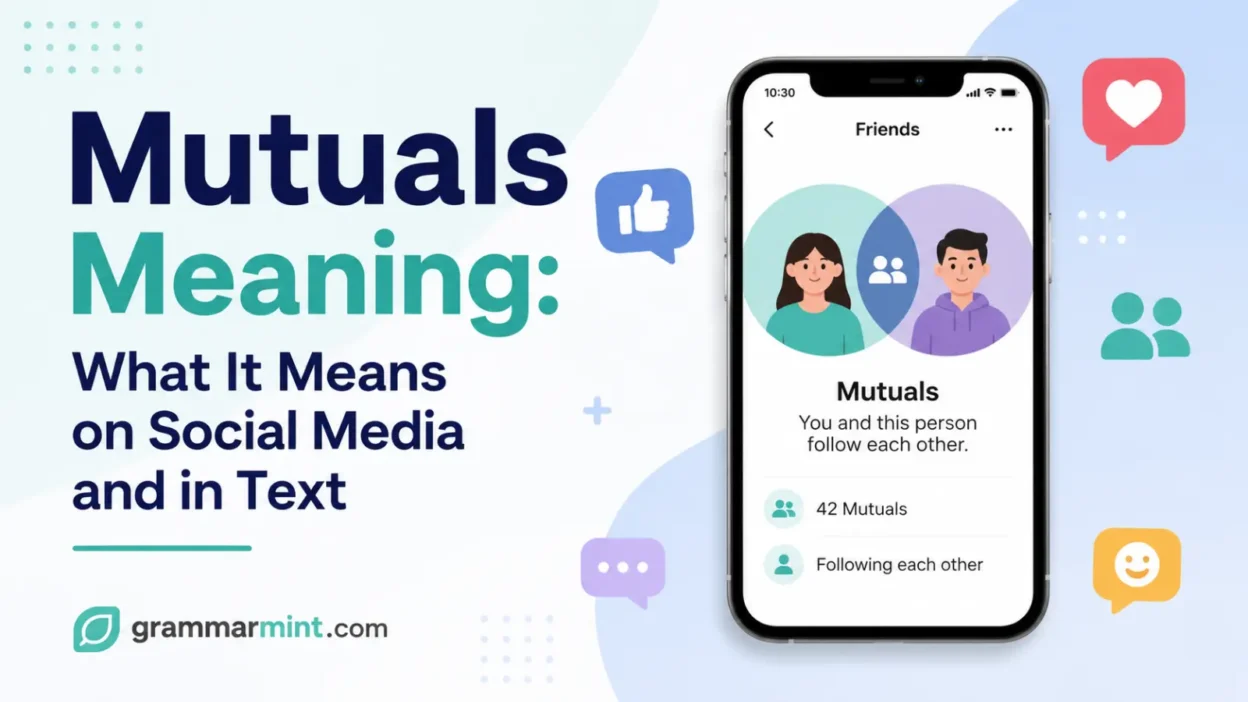
You may see “mutuals” in comments, direct messages, bios, or posts. The word appears often on TikTok, Instagram, X, Tumblr, and Bluesky. Someone may ask, “Want to be mutuals?” Another person might thank their mutuals for supporting a post.
The term matters because online connections have different levels. A follower watches your posts, but you may not follow that person. A mutual has a two-way following connection with you. Still, that connection does not always mean close friendship.
This guide explains the mutuals meaning in clear English. You will learn its slang use, pronunciation, grammar, and common contexts. The guide also includes examples, related terms, and mistakes to avoid.
The term commonly appears in fan communities, creator circles, and hobby groups.Understanding it helps you read online conversations accurately.
Quick Answer
The mutuals meaning is people on social media who follow each other. Each person follows the other account, creating a two-way connection.
TL;DR
• Mutuals follow each other on the same platform.
• A mutual is not always a close friend.
• “Moots” is a shorter slang form.
• The word is an informal countable noun.
• Mutual status can change after an unfollow.
What Does Mutuals Mean?
In social media slang, “mutuals” means two or more users who follow each other. The singular form is “mutual.”
For example, Ava follows Mia, and Mia follows Ava. Ava and Mia are mutuals on that platform.
People often use the word for recognized online connections. Mutuals may like posts, reply to updates, or share common interests. However, regular interaction is not required for the basic meaning.
The word can describe one person from your viewpoint:
• “Jordan is one of my mutuals.”
• “I saw that post through a mutual.”
• “She became my newest mutual yesterday.”
Outside this slang sense, “mutual” often means shared or reciprocal. That older meaning explains the social media use. The following relationship goes both ways.
How Mutuals Work on Social Media
Most social platforms allow one account to follow another. That action is often one-way at first. The connection becomes mutual after the second account follows back.
Here is a simple pattern:
- You follow an account.
- That account follows you back.
- You are now mutuals on that platform.
Being mutuals may make conversation feel more familiar. People often notice mutuals in replies, group discussions, or fan communities. Some users also treat mutuals as part of their online circle.
Still, a mutual follow does not promise trust or friendship. Two users may follow each other without speaking. Others may become close online friends over time.
A mutual relationship can also end quickly. If either person unfollows, the two accounts are no longer mutuals.
Meaning Across TikTok, Instagram, X, and Other Platforms
The central meaning stays similar across most platforms. Both users follow each other on the same service. However, the social tone can vary by community.
| Context | Best Meaning | Why |
|---|---|---|
| TikTok or Instagram | Accounts following each other | The follow is reciprocal |
| X, Tumblr, or Bluesky | Mutual followers in a community | Users may share interests |
| A direct message | An invitation to follow each other | It requests a follow-back |
| Everyday conversation | Online connection or shared friend | Context decides the sense |
On TikTok, users may call mutuals “friends” in a loose sense. The term often appears in fandom discussions on X and Tumblr. Instagram users may simply use it for a reciprocal follow.
Discord and Snapchat can use “mutual” differently. “Mutual friends” means shared contacts, not two people following each other. Always check the platform and sentence.
Pronunciation and Part of Speech
“Mutuals” is pronounced MYOO-choo-uhlz. The first part sounds like “mew,” followed by “choo-uhlz.”
The word is usually a plural countable noun in social media slang. Its singular form is “mutual.”
• Singular: “Kai is a mutual.”
• Plural: “Kai and Lena are mutuals.”
• Possessive: “My mutual’s post went viral.”
• Plural possessive: “My mutuals’ replies were helpful.”
The base word “mutual” is also an adjective in standard English. It describes something shared or felt by both sides.
• “They have mutual respect.”
• “We share a mutual friend.”
• “The decision was mutual.”
In “my mutuals,” however, the word functions as a noun. It refers to people or accounts.
How to Use Mutuals in Text and Conversation
Use “mutuals” in casual online writing or relaxed conversation. It works well when the audience understands social media language.
Common patterns include:
• be mutuals: “We have similar pages. Want to be mutuals?”
• become mutuals: “We became mutuals after the event.”
• my mutuals: “My mutuals always share great book ideas.”
• a mutual: “A mutual sent me that video.”
• Instagram mutuals: “We are Instagram mutuals, but we have never met.”
The phrase “let’s be mutuals” usually means “let’s follow each other.” It may also suggest future interaction or support. That extra meaning depends on the speaker.
Do not assume the request requires personal conversation. Some people only want a reciprocal follow. Others hope to build a genuine online friendship.
Use the term carefully in professional writing. “Mutual follower” or “reciprocal follower” is clearer in reports, policies, and formal explanations.
Mutuals vs Followers, Friends, and Mutual Friends
These terms describe different online relationships. Mixing them can change the meaning.
A follower follows your account. You do not need to follow that person back.
A mutual follows you, and you follow that person. The connection is two-way on one platform.
A friend usually suggests a personal relationship. Online, the word may also describe an approved contact on certain services.
A mutual friend is a person shared by two people. For example, Sam may be friends with both Nora and Eli. Sam is their mutual friend.
Consider these examples:
• “I have 500 followers, but only 80 mutuals.”
• “We are mutuals, although we rarely talk.”
• “We met through a mutual friend.”
• “She follows me, but I do not follow her back.”
The safest distinction is simple. Mutuals follow each other, while mutual friends connect two other people.
Related Terms: Moots, OOMF, and Follow-Back
Several online terms appear near “mutuals.” They are related, but they are not always interchangeable.
Moots is an informal shortened form of “mutuals.” It often describes mutual followers in the same online community.
Mutual follower is the clearer full phrase. It works in casual explanations and more neutral writing.
Follow-back means returning someone’s follow. A follow-back creates mutual status when the first person still follows you.
OOMF can mean “one of my followers” or “one of my friends.” The person mentioned is not always a mutual.
Online friend suggests more personal interaction. A mutual can become an online friend, but the words are not exact synonyms.
The closest synonyms are “mutual followers” and “moots.” “Online connections” and “online acquaintances” are only loose alternatives.
There is no exact single-word antonym. “One-way follower” or “non-mutual follower” expresses the opposite relationship more clearly.
Common Mistakes and When Not to Use Mutuals
A common mistake is treating every follower as a mutual. The word applies only when both accounts follow each other.
Incorrect: “All my followers are my mutuals.”
Correct: “Some followers are mutuals because I follow them back.”
Another mistake is assuming mutuals are close friends. Mutual status describes a platform connection, not emotional closeness.
Unclear: “She is my best friend because she is my mutual.”
Better: “She started as a mutual and later became a close friend.”
Writers also confuse “mutuals” with “mutual friends.” These phrases describe different relationship patterns.
Incorrect: “We met through a mutual.”
Clearer: “We met through a mutual friend.”
The shorter sentence can work online, but it may sound unclear elsewhere. Use “mutual friend” when you mean a shared friend.
Avoid “mutuals” in very formal documents unless you define it first. Also avoid it when the platform uses “friends” rather than followers.
The exact history of the slang noun is unclear. It likely developed as a shortened form of “mutual follower.” The meaning follows the older idea of reciprocity.
Mini Quiz
Choose the best answer for each question.
- Leo follows Max, and Max follows Leo. What are they?
a) Mutuals
b) Strangers
c) One-way followers - Tia follows Rose, but Rose does not follow Tia. Are they mutuals?
a) Yes
b) No - What does “Want to be mutuals?” usually request?
a) A phone call
b) A reciprocal follow
c) A shared password - Which phrase means a friend shared by two people?
a) Mutual follower
b) Mutual friend
c) Moot
Answer key: 1-a, 2-b, 3-b, 4-b.
FAQs
What does mutuals mean in text?
In text, “mutuals” usually means people who follow each other online. The exact platform may be stated or understood from context.
What does it mean when someone asks to be mutuals?
The person usually wants you both to follow each other. The request may also suggest friendly interaction or shared support.
Are mutuals the same as friends?
Not always. Mutuals have a reciprocal online connection, but they may never speak. Some mutuals later become real friends.
Can someone be your mutual on one platform only?
Yes. Two people may follow each other on Instagram but not TikTok. Mutual status is usually platform-specific.
What is the difference between mutuals and mutual friends?
Mutuals follow each other directly. A mutual friend is a third person connected to two different people.
What does moots mean?
“Moots” is a shorter slang form of “mutuals.” It usually refers to mutual followers, often within active online communities.
Is mutuals formal English?
The social media noun is informal. It fits posts, comments, messages, and casual speech. Use “mutual followers” in formal writing.
Conclusion
The mutuals meaning is simple: people or accounts that follow each other. The term suggests reciprocity, but not automatic friendship.
Check the platform and context before using it. Then choose “mutuals,” “mutual followers,” or “mutual friends” for the exact relationship
[…] The confusion around “thier” vs. “their” often appears in school work, text messages, blog posts, and social media. […]