If you’re writing an email, paper, caption, or text, Nevermind or Never Mind can feel confusing fast. The problem is simple: both forms look familiar, but they do not work the same way in modern English. Usually, the safe choice is the correct spelling with a space. Still, people also see the one-word form in text messages, casual posts, older expressions like pay no nevermind, and shorthand like NVM. So this guide clears up the meaning, the formality, the one word or two question, and the let alone use. By the end, you’ll know which form to use, when to avoid it, and how to remember the rule.
Quick Answer
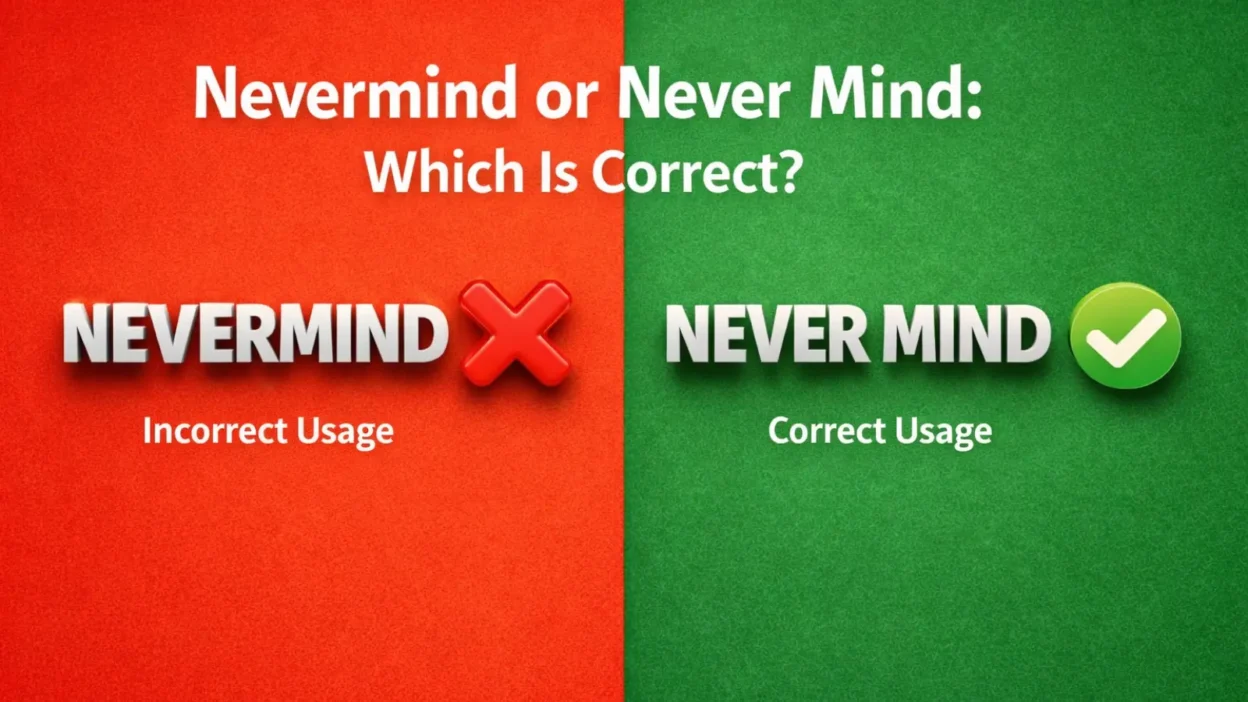
Nevermind or Never Mind? In standard American English, never mind is the correct choice in almost every sentence. Use nevermind only for the older, dialectal noun found in expressions like pay no nevermind.
TL;DR
• Use never mind in standard writing.
• Keep one word for rare noun use.
• It can mean don’t worry.
• It can also mean forget it.
• It can also mean let alone.
Nevermind Or Never Mind: Which Is Correct?
Here’s the simple rule. In standard US writing, the spaced form wins almost every time.
• Choose standard spelling for essays, emails, and posts.
• Write never mind when you mean forget it.
• Write never mind when you mean don’t worry.
• Write never mind when you mean let alone.
• Avoid one word in reports.
• Avoid one word in school papers.
• Avoid one word in résumés.
• Avoid one word in most headlines.
• Use the two-word form by default.
• Pause before typing the shortcut spelling.
• Check context before changing the form.
• When unsure, pick the spaced version.
What Never Mind Means
This phrase does more than one job. So the meaning depends on tone and sentence shape.
• It can reassure someone gently.
• It can dismiss a small mistake.
• It can withdraw a request.
• It can drop a topic fast.
• It can compare degrees of difficulty.
• It often acts like an idiom.
• It often sounds conversational.
• Tone changes the message.
• Punctuation can soften the reply.
• Spoken English uses it often.
• Written English uses it too.
• Context decides the exact sense.
What Nevermind Means
The one-word form is much narrower. Instead, think of it as an older or dialectal noun.
• It means attention in older usage.
• It can mean concern or notice.
• It can mean business or affair.
• It usually appears after no.
• It often sounds regional.
• It works as a dialectal noun.
• It reflects older usage more than current usage.
• It may appear in regional speech.
• It can look like a typo.
• It may appear in dialogue.
• It is not the default spelling.
• Most writers can skip it safely.
How To Use Never Mind For Don’t Worry
This is one of the most common uses. It usually answers an apology or a small problem.
• “Never mind, accidents happen.”
• “Never mind, we can fix it.”
• “Never mind, you did your best.”
• “Never mind, I’ll replace it.”
• Use it after apologies.
• Use it after small mishaps.
• Use it to calm someone.
• Keep your calm tone steady.
• Add a comma after it.
• Pair it with reassurance.
• Avoid it if you sound annoyed.
• Kind wording makes it land better.
How To Use Never Mind For Forget It
Sometimes you change course mid-conversation. In that case, this phrase means drop the request or stop the topic.
• “Never mind, I found the file.”
• “Never mind, I’ll do it later.”
• “Never mind, the question is answered.”
• “Never mind, I changed plans.”
• Use it to retract request meaning.
• Use it after finding the answer.
• Use it when plans shift.
• It can sound abrupt.
• Add context when needed.
• Softer follow-ups help clarity.
• Texting makes this use common.
• It works well in quick exchanges.
How To Use Never Mind For Let Alone
This use adds emphasis. Usually, the second idea is harder, bigger, or less likely.
• “I can barely walk, never mind run.”
• “She can’t boil pasta, never mind host.”
• “We can’t fund lunch, never mind travel.”
• “He won’t call back, never mind apologize.”
• This use means let alone.
• It can also echo much less.
• Build a stronger second idea after it.
• It often follows a negative clause.
• It adds strong emphasis.
• It works in speech.
• It works in writing.
• Don’t replace it with one word.
Never Mind In Professional Writing
At work, spelling matters, but tone matters too. So use the standard form, then choose the warmest phrasing for the moment.
• Use the spaced form in emails.
• Use it in meeting notes carefully.
• Use it in customer replies gently.
• Use it in drafts with caution.
• Prefer clearer wording in formal writing.
• “Please disregard” sounds more official.
• “That’s fine” sounds warmer.
• “No problem” sounds more casual.
• Protect your professional tone.
• Watch it in a business email.
• Short replies can feel blunt.
• Choose clarity over habit.
Never Mind In Casual Writing And Texts
Casual spaces bend rules more often. Even so, the spaced form still looks cleaner and clearer.
• Text messages shorten everything fast.
• Friends may write it as one word.
• Social posts often ignore spacing.
• Group chats reward speed.
• Casual tone forgives more variation.
• Still, the spaced form looks cleaner.
• One word can seem playful.
• One word can seem rushed.
• Memes may break the rule.
• DMs often use shortcuts.
• Social media changes expectations.
• Text messages favor speed over polish.
Is Nevermind Ever Correct?
Yes, but only in narrow situations. That said, most modern polished writing still avoids it.
• Yes, but only in narrow cases.
• Think older noun, not standard phrase.
• “Pay it no nevermind” fits that use.
• “It’s no nevermind of yours” does too.
• Most modern prose won’t need it.
• Most teachers will flag it.
• Most editors will change it.
• Most readers expect two words.
• Creative dialogue can allow it.
• Editorial standard still prefers spacing.
• Intentional style differs from plain error.
• Use it only when meaning demands it.
Pay No Nevermind And Other Older Expressions
These expressions still show up in regional speech, quoted dialogue, and older-flavored writing. However, they usually sound marked in standard modern prose.
• “Pay him no nevermind” means ignore him.
• “It’s no nevermind of yours” means not your business.
• These forms sound old-fashioned now.
• They can sound Southern or regional.
• They often carry folk speech flavor.
• They reflect an old-fashioned expression pattern.
• They work like a regional phrase.
• They rarely suit school writing.
• They rarely suit office writing.
• They may suit fiction dialogue.
• Keep them for voice effects.
• Readers may read them as errors.
Never Mind, NVM, And NM
Online writing brings shortcuts. So it helps to know which ones stay casual and which ones travel well.
• NVM means never mind.
• NM can mean never mind.
• NVM is clearer online.
• NM can mean not much.
• Use abbreviations only informally.
• Don’t use them in reports.
• Don’t use them in applications.
• Don’t use them with clients.
• Lowercase versions are common.
• Full words look more polished.
• Abbreviations fit fast chats.
• Online shorthand depends on audience.
Common Mistakes With Never Mind
Most errors happen because the form feels familiar. So writers trust instinct and skip the context check.
• Writing one word in essays.
• Using one word after an apology.
• Forgetting the comma in replies.
• Confusing it with never you mind.
• Mixing up phrase and noun.
• Treating all casual forms as standard.
• Forcing it into stiff legal prose.
• Using it to dodge clarity.
• Creating a tone problem accidentally.
• Missing basic comma use in dialogue.
• Repeating the same common error in emails.
• Assuming the album title sets the rule.
Example Sentences For Everyday Use
Real examples make the pattern stick. So here are simple lines you could actually say.
• “Never mind, dinner will still taste great.”
• “Never mind, I already found parking.”
• “Never mind, the kids are fine.”
• “Never mind, I can carry that.”
• “Never mind, let’s start over.”
• “Never mind, I was joking.”
• “Never mind, the store opens later.”
• “Never mind, I’ll text her instead.”
• “Never mind, we have enough chairs.”
• “Never mind, your coffee is safe.”
• “Never mind, this happens sometimes.”
• “Never mind, we’ll laugh about it.”
Example Sentences For School And Work
These examples show how the phrase works in practical settings. In other words, they help you sound clear without sounding stiff.
• “Never mind that draft; use the new file.”
• “Never mind my earlier note; it’s fixed.”
• “Never mind the typo; send it now.”
• “Never mind Friday; Tuesday works better.”
• “Never mind the slide deck; share summaries.”
• “Never mind lunch; finish the meeting first.”
• “Never mind the sample; check the final version.”
• “Never mind the rumor; read the memo.”
• “Never mind my question; I solved it.”
• “Never mind the delay; the update helped.”
• “Never mind the printer; send a PDF.”
• “Never mind the old rubric; use this one.”
US Vs UK Usage Check
There isn’t a big split here. Both varieties strongly favor the spaced form in standard writing.
• Both varieties strongly prefer two words.
• Both understand the standard phrase.
• Both use the let-alone sense.
• Both use the reassurance sense.
• One word stays marginal in each.
• Formal rules stay similar.
• Casual writing bends more.
• Dictionaries agree on the core point.
• Regional speech creates small differences.
• Readers on both sides understand it.
• Safer choice stays the same.
• The space travels well.
Easy Memory Trick
A fast rule beats a long explanation. So use this test whenever your fingers want the shortcut spelling.
• If you can say forget it, add space.
• If you can say don’t worry, add space.
• If you can say let alone, add space.
• If you mean concern, question one word.
• Default to the open form.
• Use a simple memory trick.
• Save one word for rare noun cases.
• Think phrase before typo.
• Hear two beats in speech.
• Picture two jobs, two words.
• Editors love the simple rule.
• The space keeps you safe.
FAQs
Is nevermind one word or two?
In standard modern English, use never mind as two words in almost every sentence. The one-word form survives mainly as an older or dialectal noun, not as the usual everyday phrase.
Is nevermind ever correct?
Yes, but only in narrow cases. It can work as a noun in expressions like pay no nevermind, especially in quoted, regional, or voice-driven writing.
What does never mind mean?
It usually means don’t worry, forget it, or it doesn’t matter. It can also mean let alone when it links one idea to a stronger second one.
What does nevermind mean?
As one word, it usually means attention, concern, or business in older or dialectal usage. Most modern writers do not need it unless they are matching a specific voice.
Can never mind mean “let alone”?
Yes. In sentences like “I can barely stand, never mind dance,” it means something like let alone or much less.
Is never mind formal enough for writing?
Yes, the spelling is standard. Still, in very formal writing, phrases like please disregard or that is not necessary may sound smoother, depending on tone.
What does pay no nevermind mean?
It means something like pay no attention or ignore it. Today, it usually sounds older, regional, or stylized rather than neutral and standard.
Conclusion
Nevermind or Never Mind becomes easy once you remember the rule: the spaced form is the safe, standard choice. Keep the one-word version for rare older noun uses, and your writing will look clear, natural, and polished.