If you’ve searched Suing or Sueing suing-or-sueing, you probably want a fast, clear answer before you use the word in school, work, email, or legal writing. This spelling trips people up because legal action terms can look formal, the present participle form feels unusual, and the silent e rule is easy to second-guess. On top of that, words like complaint, lawsuit, damages, claim, and court case can make the whole topic feel heavier than it really is. The good news is that this one is simple once you see the pattern. Below, you’ll get the correct spelling, the reason behind it, common mistakes, and plenty of natural examples.
Quick Answer
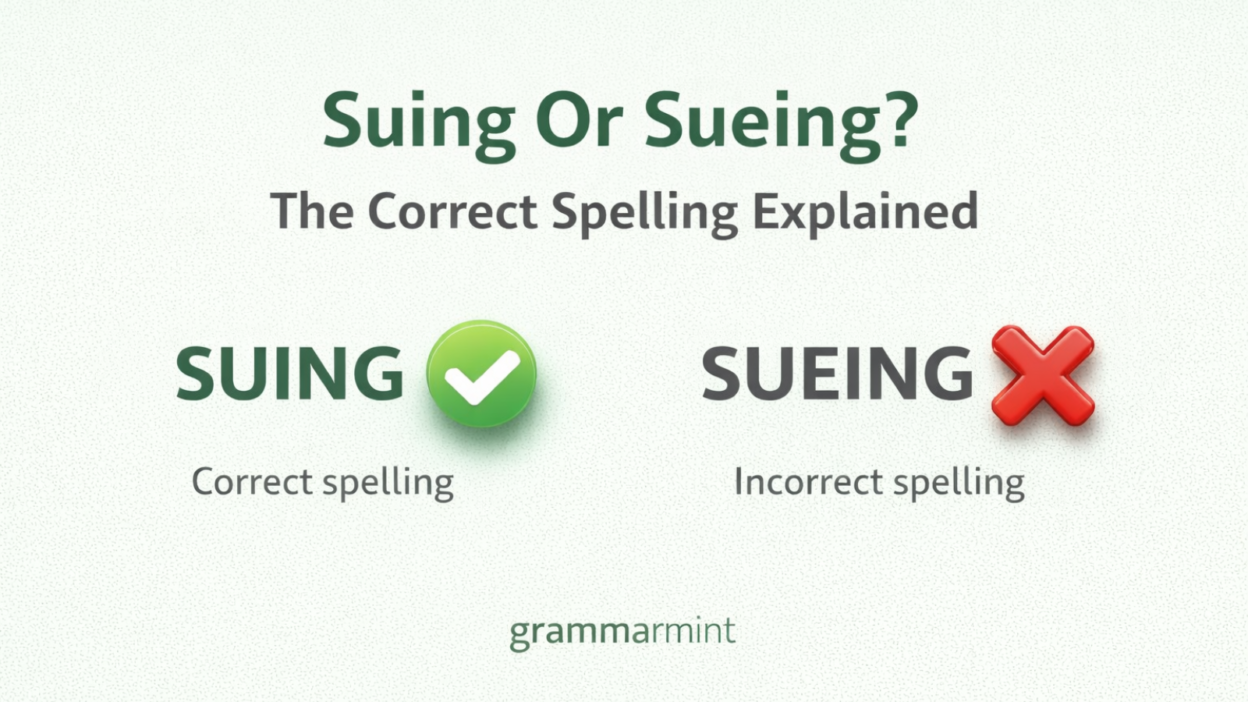
Suing is the correct spelling. Sueing is a misspelling, even though it may look logical at first.
TL;DR
• Use suing, not sueing
• Drop the final e before -ing
• Sueing isn’t a standard spelling
• US and UK both use suing
• It works in legal and everyday writing
• When in doubt, choose suing
Which Spelling Is Correct
The answer is simple, and thankfully, it doesn’t depend on tone or region. Use the standard form every time.
• Correct spelling is suing
• Common misspelling is sueing
• Suing is the accepted form
• Sueing looks plausible, but wrong
• Use suing in formal writing
• Use suing in casual writing
• Use suing in school papers
• Use suing in legal notes
• Use suing in headlines
• Use suing in emails
• Use suing in text messages
• Suing is the safer choice
What Suing Means
Before you worry about spelling, it helps to know what the word actually means. In plain English, it means starting a legal case against someone.
• Legal action against a person
• A claim in court
• Asking a court for relief
• Often linked to damages
• Used in civil disputes
• Can involve a company
• Can involve an individual
• Often follows alleged harm
• Means taking someone to court
• Fits legal and news writing
• Sometimes used more broadly
• Still carries a formal tone
Why The E Disappears
This is where most of the confusion begins. Since the base word ends in e, many writers expect that e to stay.
• Drop the silent e
• Add the -ing ending
• Follow the basic spelling rule
• Sue becomes suing
• Hope becomes hoping
• Care becomes caring
• The pattern feels consistent
• The extra e doesn’t stay
• English often trims silent e
• This keeps the form standard
• The shorter spelling is expected
• That’s why sueing looks off
Why Seeing Looks Different
A lot of people compare suing with seeing. That comparison makes sense, but the words follow different patterns.
• Present participle forms can vary
• Watch the vowel pattern closely
• Always compare forms carefully
• See already ends in ee
• Sue ends with silent e
• Seeing keeps both e’s
• Suing drops one e
• The endings look similar
• The spelling rules differ
• Don’t force one pattern
• Treat each base word separately
• Similar sound, different spelling logic
Is Sueing Ever Correct
This is the myth-check section. Some people assume sueing might be a British form, an older form, or an informal option.
• Nonstandard spelling stays nonstandard
• It’s usually just a typo
• Treat it as the wrong form
• Not a US variant
• Not a UK variant
• Not a formal variant
• Not a legal variant
• Not a helpful stylistic choice
• Spellcheck may flag it
• Editors will usually change it
• Readers may notice it quickly
• Best to avoid it completely
Verb Forms You Need
Sometimes the easiest fix is to look at the whole verb family. Once you see the set together, the correct spelling becomes much easier to remember.
• Base form: sue
• Past form: sued
• Think of simple conjugation
• Third person: sues
• Present participle: suing
• Past participle: sued
• “She sues for damages”
• “They sued last year”
• “He is suing now”
• “The company was sued”
• One family, one clear pattern
• Suing fits the full set
How Suing Works In A Sentence
Suing can act in more than one way. Most often, it works as part of a verb phrase, but it can also act like a noun.
• It’s often a verb
• It can be a gerund
• Watch the sentence pattern
• “They are suing the landlord”
• “She is suing for damages”
• “Suing takes time”
• “Suing can be expensive”
• It may name an action
• It may describe ongoing action
• The context makes it clear
• Legal tone changes the feel
• Grammar stays straightforward
US Vs UK Check
This is one of the most common assumptions online. People often wonder whether sueing might be British while suing is American.
• American English uses suing
• British English uses suing
• No regional variant spelling here
• This one isn’t like color/colour
• It isn’t a US-only form
• It isn’t a UK-only form
• Professional writing matches on both sides
• Legal writing matches too
• Dictionaries stay consistent
• So does standard editing
• Don’t switch by audience
• Suing works everywhere
Formal And Professional Writing
Spelling matters more when the subject already sounds serious. Because the word appears in legal, academic, workplace, and news contexts, mistakes stand out fast.
• Use formal writing standards
• Keep a professional tone
• Respect legal writing accuracy
• Don’t write sueing in reports
• Don’t write sueing in briefs
• Don’t write sueing in resumes
• Don’t write sueing in articles
• Correct spelling builds trust
• Wrong spelling looks careless
• Precise wording helps readers
• Accuracy matters with legal topics
• Suing is the polished choice
Everyday Examples
You don’t need to sound like a lawyer to use this word well. Here are natural ways it can appear in regular writing and speech.
• Examples make the rule stick
• Use everyday English when possible
• Aim for natural phrasing
• She’s suing the contractor
• They’re suing for unpaid wages
• He joked about suing them
• I thought she was suing
• The artist is suing the brand
• Nobody wants to keep suing
• Suing over that seems extreme
• Are they really suing again?
• The city is suing the company
Common Mistakes People Make
Most errors happen for predictable reasons. Once you know them, they’re easy to spot during revision.
• A spelling mistake adds extra e
• A quick mix-up with seeing
• Missing an editing tip step
• Writing sueing by instinct
• Assuming longer means more correct
• Thinking legal words break rules
• Guessing it’s a UK version
• Trusting memory too quickly
• Skipping a final proofread
• Copying an online typo
• Confusing sue with lawsuit
• Forgetting the base verb pattern
Memory Tricks That Help
You don’t need a complicated rule sheet. A few short reminders can make the correct form feel automatic.
• Use a memory trick
• Keep a quick fix handy
• Stick to one easy rule
• Drop e, then add ing
• Sue → suing, not sueing
• Match hope → hoping
• Match care → caring
• Think short, clean spelling
• Say it once out loud
• Check the whole verb family
• Compare sued and suing
• Trust the simpler standard form
Sue, Lawsuit, And Legal Action
These words are related, but they aren’t identical. Knowing the difference helps your writing sound cleaner and more exact.
• A lawsuit is the case
• A complaint starts the case
• A court case is broader
• Sue is the verb
• Suing names the action
• Lawsuit names the matter
• Complaint names the filing
• Legal action is a broad phrase
• “Sue” sounds active and direct
• “Lawsuit” sounds more formal
• Pick the most exact term
• Don’t use them as twins
Better Alternatives In Plain English
Sometimes suing is correct, but not always the clearest choice for your audience. A simpler phrase may work better.
• Use plain English first
• Try a cleaner rewrite
• Choose clearer wording when needed
• taking them to court
• filing a legal claim
• starting a lawsuit
• bringing a case
• seeking damages
• pursuing legal action
• making a claim
• taking legal steps
• filing in court
• choose tone by audience
Practice Sentences And Fixes
These fast fixes can help you train your eye. Read the wrong form, then swap in the correct one.
• Practice catches weak habits
• Choose the correct form fast
• Use a quick self-check
• Wrong: She is sueing
• Fix: She is suing
• Wrong: They kept sueing
• Fix: They kept suing
• Wrong: We’re sueing them
• Fix: We’re suing them
• Wrong: He mentioned sueing
• Fix: He mentioned suing
• Wrong: Are you sueing?
Final Choice For Real Writing
At this point, the decision should feel easy. You don’t need to keep debating the spelling every time it appears.
• Pick the best choice once
• Aim for clear writing always
• Build confident use through repetition
• Use suing in every context
• Skip sueing completely
• Trust the standard form
• Trust the shorter spelling
• Trust the verb family
• Trust the simple rule
• Keep your wording clean
• Keep your editing sharp
• Move on without second-guessing
FAQs
Is It Suing Or Sueing?
It’s suing. Sueing is a misspelling, even though it may look reasonable at first glance.
Why Do We Drop The E In Suing?
Because the base verb ends with a silent e, and that e usually drops before adding -ing. That gives you suing, not sueing.
Is Sueing Ever Acceptable?
No, not in standard English. It’s best treated as an error and corrected before you publish or send your writing.
What Is The Past Tense Of Sue?
The past tense is sued. The same form also works as the past participle.
Is Suing A Verb Or A Noun?
It can work both ways. In “They are suing,” it’s part of a verb phrase, and in “Suing is expensive,” it acts like a noun.
Is Suing Formal?
Yes, it often appears in formal contexts because it relates to legal action. Still, people also use it in everyday conversation and news writing.
Is The Spelling Different In British English?
No. American and British English both use suing as the standard spelling.
Conclusion
Suing or Sueing suing-or-sueing has one clear answer: use suing every time.
Once you remember the dropped e rule, the spelling gets much easier to trust.