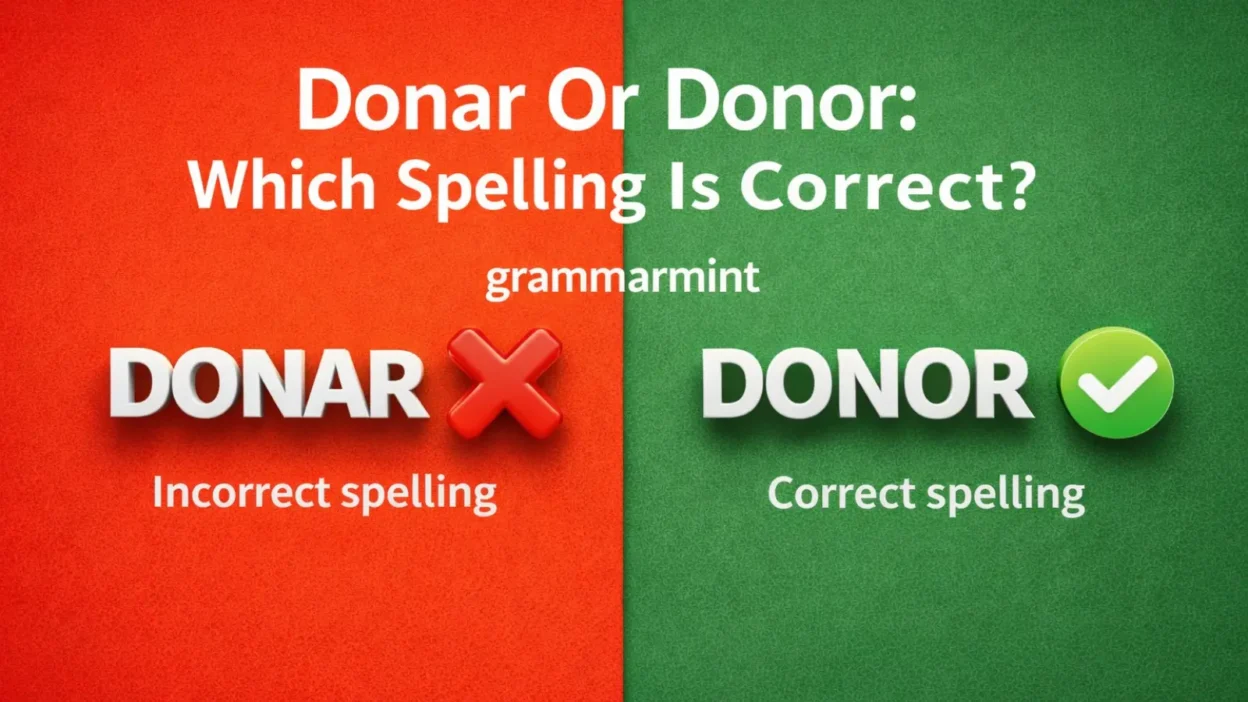
If you’re writing about charity, blood donation, fundraising, or medical care, you may wonder whether the correct spelling is donar or donor. Although the two forms look and sound similar, they are not interchangeable in standard English.
The correct spelling is donor. It refers to a person or organization that gives money, blood, an organ, tissue, or something else of value.
Donar is usually a misspelling when you mean someone who gives something. However, Donar can appear as a proper name in mythology, which is a separate use.
This guide explains the difference between donar and donor, their meanings, common phrases, pronunciation, examples, and an easy way to remember the correct spelling.
Quick Answer
Donor is the correct standard English spelling when you mean a person who gives something.
Donar is usually incorrect in everyday English and is most often a spelling mistake.
- Donor = the correct spelling
- Donar = usually a misspelling
- Donor is used for money, blood, organs, tissue, and other gifts
- Donar may appear as a mythology name
- Donator is a real word, but donor is more natural in most situations
TL;DR
If you are talking about someone who gives money, blood, an organ, or another valuable thing, use donor.
Example:
The hospital thanked every blood donor for their help.
What Does Donor Mean?
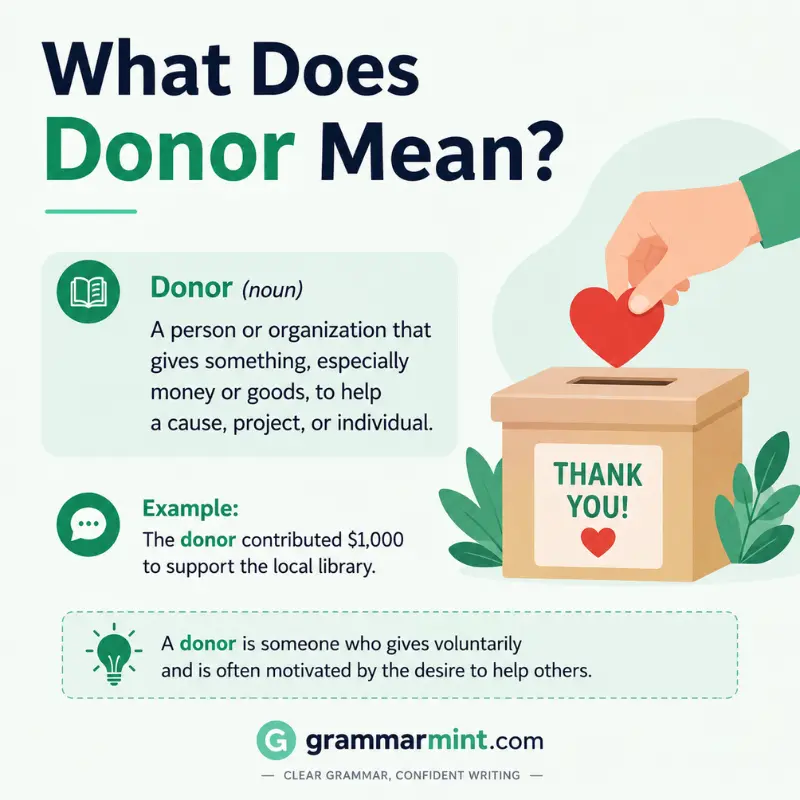
Donor is a noun for a person, organization, or other source that gives something.
The word is commonly used when someone gives money, blood, an organ, tissue, or other valuable resources. It can also have more specialized meanings in science and medicine.
For example:
- A donor gives money to a charity.
- A blood donor gives blood for medical use.
- An organ donor provides an organ for transplantation.
- A tissue donor provides tissue for medical purposes.
- A donor can be an individual, company, or organization.
The basic idea is simple: a donor is a giver.
Donor Definition
The standard English word donor means someone who gives something, especially something intended to help another person or organization.
It is a noun and is widely used in both everyday and formal English.
For example:
The anonymous donor gave $10,000 to the school.
Here, donor identifies the person who provided the money.
The plural form is donors.
- Singular: donor
- Plural: donors
The word is common in charity, healthcare, education, fundraising, law, and science.
Why Do People Spell Donor as Donar?
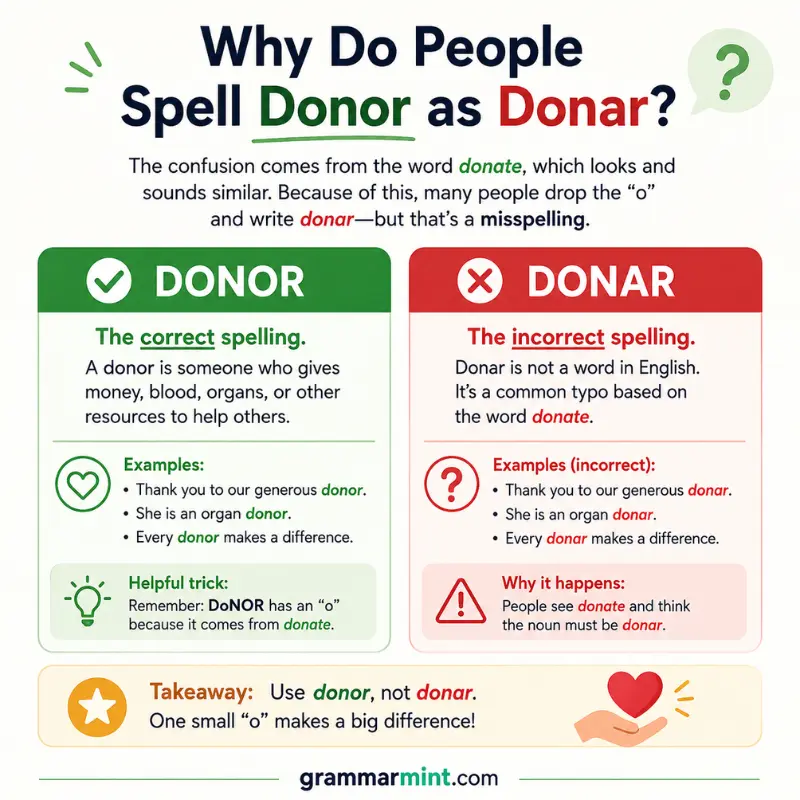
The most common reason people write donar is that they are spelling the word based on how it sounds.
English pronunciation does not always make spelling obvious. When people hear donor, they may remember the final sound incorrectly and write donar.
Other reasons include:
- Typing too quickly
- Relying on pronunciation instead of spelling
- Confusing similar-looking words
- Learning English through speech
- Seeing the misspelling online
- Forgetting the correct vowel
- Skipping a final proofread
Even though donar may look reasonable at first glance, it is not the standard spelling for someone who gives something.
Can Donar Ever Be Correct?
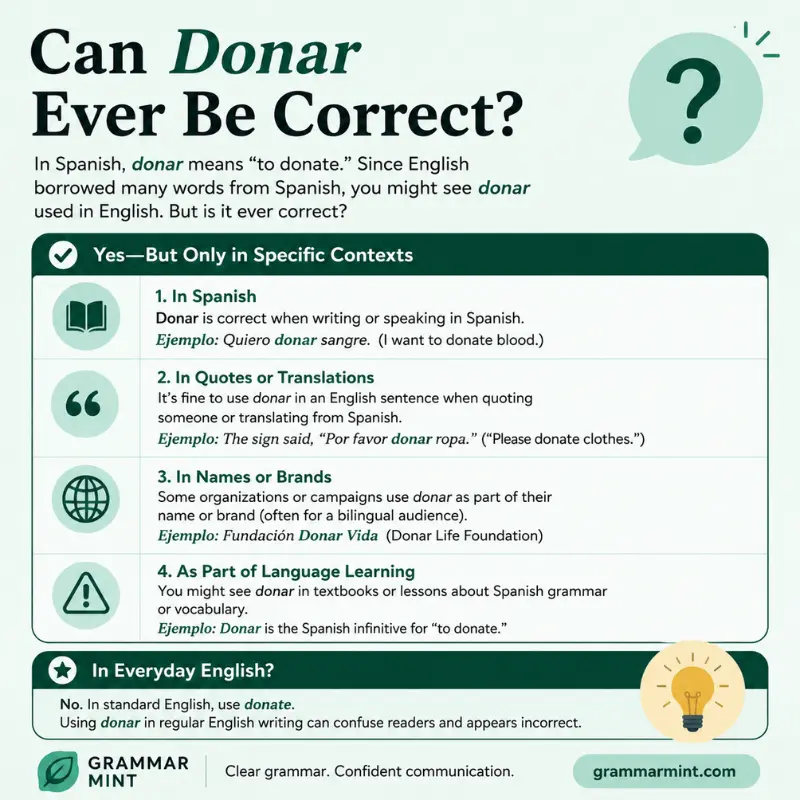
Yes, but only in a special context.
Donar can be used as a proper name associated with Germanic mythology and the figure identified with Thor. In this context, it is a name rather than the ordinary English word for a person who gives something.
For example:
Donar is a name associated with Thor in Germanic tradition.
This does not mean that donar is an alternative spelling of donor.
If you are writing about charity, blood donation, fundraising, or medical donation, use donor.
Compare the two:
- Donor → a person who gives something
- Donar → a proper name in a specialized mythology context
For ordinary English writing, donor is the word you need.
Donor Pronunciation
Donor is generally pronounced like DOH-ner in American English.
Because the pronunciation can sound slightly different from the spelling, it is easy for some writers to choose donar by mistake.
A useful memory trick is to connect donor with donate and donation:
donate → donation → donor
If someone makes a donation, that person can be called a donor.
Remembering this word family makes the spelling much easier.
Donor in Charity and Fundraising
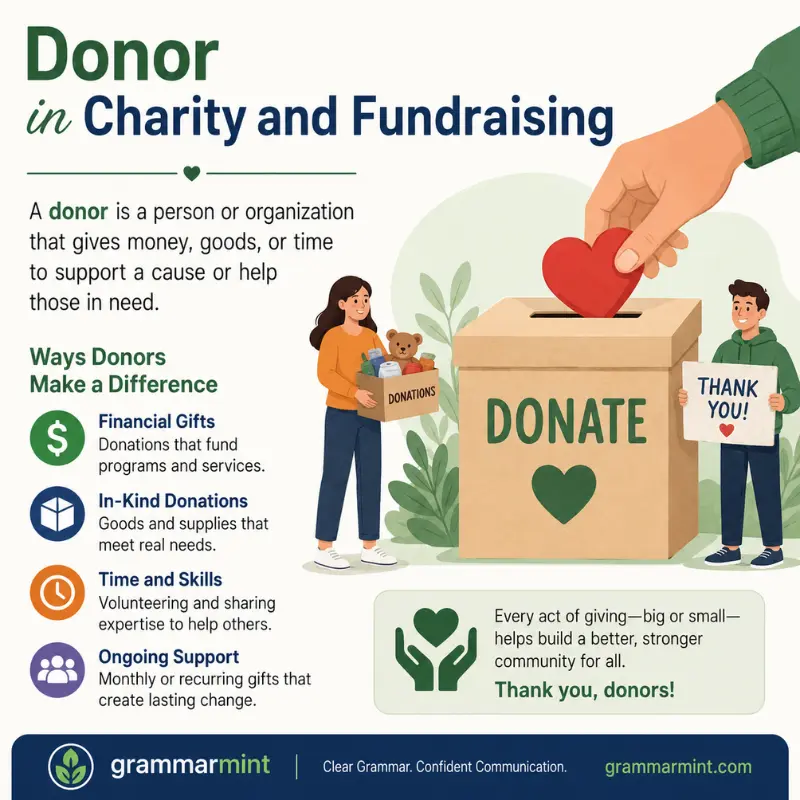
Donor is extremely common in charity and fundraising contexts.
A donor may give money to a nonprofit organization, support a community project, fund a scholarship, or contribute to a specific cause.
Common expressions include:
- charity donor
- major donor
- anonymous donor
- individual donor
- longtime donor
- donor support
- donor list
- donor database
- donor program
- donor campaign
For example:
The charity thanked its donors for their continued support.
In all these cases, donor is the correct spelling.
Blood Donor Meaning
A blood donor is a person who gives blood for medical use.
The phrase is common in hospitals, blood banks, public health campaigns, and everyday conversation.
Examples include:
Every blood donor completed a health screening.
The blood bank is asking for more donors.
She became a regular blood donor.
The spelling is always blood donor, not blood donar.
Organ Donor Meaning
An organ donor is a person who gives or agrees to provide an organ for transplantation.
You may see the phrase in hospital information, registration forms, public health campaigns, and discussions about transplantation.
Common expressions include:
- organ donor
- donor registration
- donor card
- donor consent
- organ donation
- transplant donor
For example:
He registered as an organ donor.
Again, donor is the correct spelling.
Egg Donor and Sperm Donor
The word donor is also commonly used in fertility and reproductive medicine.
Two familiar phrases are:
- egg donor
- sperm donor
For example:
The clinic provided information for potential egg donors.
The couple learned more about the sperm donor program.
These are established terms, and donar should not be used in their place.
Donor in Science and Medicine
The meaning of donor extends beyond charity and healthcare.
In scientific and medical writing, the word can describe something that provides or transfers another substance.
For example, chemistry may use terms such as electron donor, while medicine may use tissue donor or cell donor.
The exact meaning depends on the subject, but the spelling remains the same:
donor
This makes the word useful in both everyday and technical English.
Donor vs. Donator
You may also come across the word donator and wonder whether it is better than donor.
Both words can refer to someone who gives something, but donor is generally the more natural and common choice in modern English.
Compare:
She is a generous donor.
She is a generous donator.
The first sentence sounds more natural to most English speakers.
You will commonly hear and see:
- blood donor
- organ donor
- charity donor
- anonymous donor
- major donor
For normal writing, donor is usually the best choice.
Donor, Donate, Donation, and Donee
These words are related, but each has a different role.
| Word | Meaning |
|---|---|
| Donate | To give something |
| Donation | Something that is given |
| Donor | The person or organization that gives |
| Donee | The person or organization that receives |
For example:
Maria decided to donate money.
Her donation helped the shelter.
Maria became a regular donor.
The charity was the donee receiving the funds.
Understanding these related words can help you remember that the correct spelling is donor.
Donor in Sentences
Here are some natural examples of donor in everyday and formal English:
- The hospital thanked every blood donor.
- She registered as an organ donor.
- A generous donor funded the new library.
- The charity welcomed several new donors.
- An anonymous donor paid for the scholarship.
- The museum recognized a longtime donor.
- The clinic needs more volunteer donors.
- He became a regular blood donor.
- The organization sent a thank-you letter to each donor.
- The form asked whether I wanted to become an organ donor.
Notice that donor works naturally in charity, medical, educational, and general contexts.
Common Phrases With Donor
Learning common word combinations can make the correct spelling easier to remember.
Here are some of the most common phrases:
- blood donor
- organ donor
- tissue donor
- charity donor
- major donor
- anonymous donor
- individual donor
- donor list
- donor card
- donor program
- donor support
- donor database
If you see any of these phrases, the spelling is donor.
Donar vs. Donor: Quick Comparison
| Word | Correct? | Meaning |
|---|---|---|
| Donor | Yes | A person or organization that gives something |
| Donar | Usually no | Common misspelling of donor |
| Donar | Yes in a special context | A proper name associated with Germanic mythology |
| Donator | Yes, but less common | Someone who gives something |
For ordinary English writing, donor is the safest and most natural choice.
Easy Ways to Remember Donor
If you often confuse donar and donor, try these simple memory tricks.
1. Connect It to Donation
Think:
donation → donor
Both contain the same important don-o pattern.
2. Remember “DOH-ner”
Think of the pronunciation as DOH-ner, which can help you visualize the spelling.
3. Learn Common Phrases
Memorize phrases such as:
- blood donor
- organ donor
- charity donor
- major donor
Seeing the correct spelling repeatedly helps make it automatic.
4. Check for “Donar”
If you are proofreading an article, form, or document, search for donar. If you mean someone who gives something, change it to donor.
FAQs
Is donor or donar correct?
Donor is the correct standard English spelling when you mean a person who gives something. Donar is usually a misspelling.
What does donor mean?
A donor is a person, organization, or source that gives something. The word is commonly used for money, blood, organs, tissue, and other valuable resources.
Can donar ever be correct?
Yes. Donar can appear as a proper name associated with Germanic mythology. However, it is not the standard spelling of the ordinary English word donor.
Is donor the same as donator?
They have similar meanings, but donor is much more natural and common in most modern English contexts. Phrases such as blood donor and organ donor are standard.
Why is donor sometimes spelled donar?
The mistake usually comes from pronunciation. People may spell the word based on how it sounds, especially when typing quickly or writing from memory.
How do you remember the spelling of donor?
Connect it with donate and donation:
donate → donation → donor
This word family is an easy way to remember the correct spelling.
Is donor used only for people?
No. Donor can also refer to an organization or, in technical contexts, a source that provides or transfers something.
What is the plural of donor?
The plural is donors.
Example:
The charity thanked all its donors.
Conclusion
When choosing between donar or donor, the correct standard English spelling is donor.
Use donor when referring to someone who gives money, blood, an organ, tissue, or another valuable resource. The word is common in charity, fundraising, healthcare, science, and everyday English.
Donar is usually a misspelling in these contexts, although it can appear as a proper name in Germanic mythology.
The easiest way to remember the correct spelling is to connect it with donate and donation:
donate → donation → donor
So, whenever you mean a person who gives, choose donor.