If you write reviews, captions, school work, product copy, or social posts, Censored or Sensored can trip you up fast. The confusion happens because censor, censored, and sensor sound alike, yet they point to very different ideas: censorship, edited media, blocked words, blurred images, smart devices, and detection systems. You might see the issue in movie talk, online comments, app filters, or smart-home product descriptions. In everyday American English, the safe choice usually depends on one simple question: was something removed, or was something detected? This guide makes that choice easy and gives you examples you can actually reuse.
Quick Answer
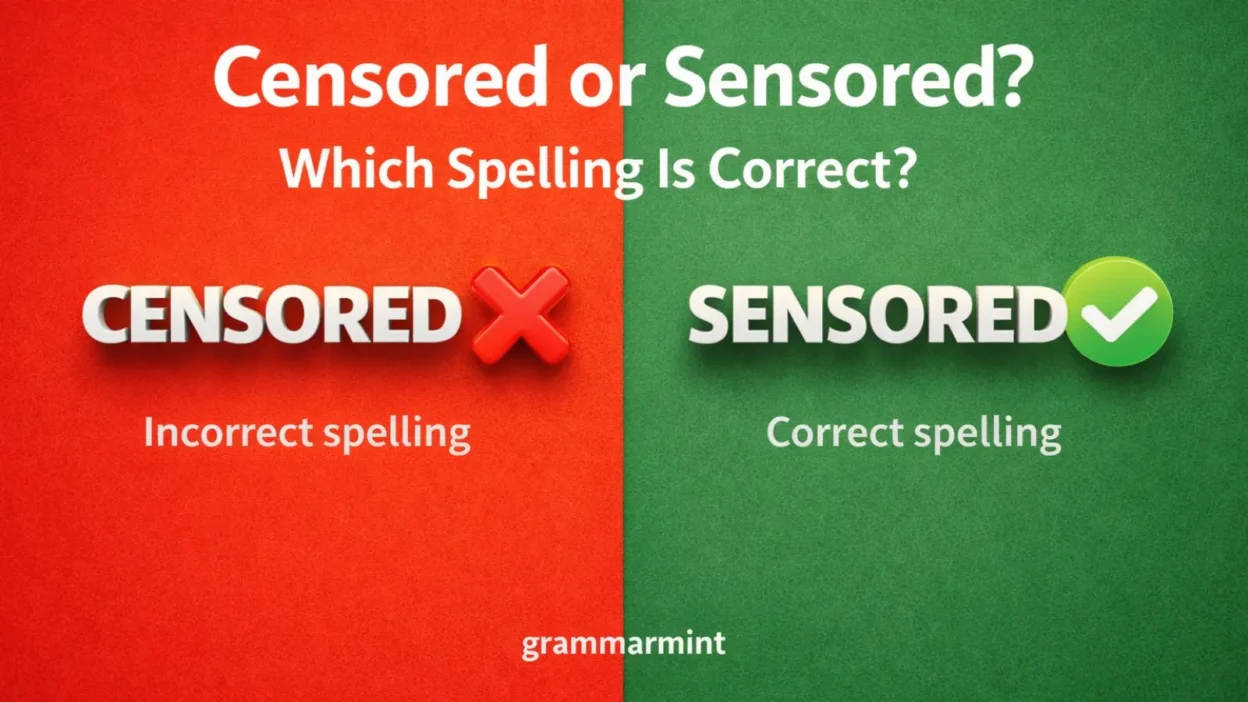
Censored or Sensored? For content that was cut, blurred, blocked, or edited, the correct word is censored. Sensored is only a narrow technical word for something fitted with sensors, so it is usually the wrong choice in everyday writing.
TL;DR
• Use censored for blocked or edited content.
• Use sensored only in technical device contexts.
• Sensor names the detector itself.
• Censure means official criticism, not editing.
• Sound alone won’t choose the right spelling.
What Censored Means
Censored means content was suppressed, altered, or deleted because someone found it objectionable or sensitive. In plain use, it belongs to media, speech, writing, and public communication, not hardware.
• Means blocked content for public viewing
• Often describes books, films, and broadcasts
• Suggests something was cut or hidden
• Can involve blurred visuals or muted audio
• Often appears with policy or rules
• Fits both official and informal settings
• Works well after was or were
• Pairs naturally with scene or version
• Also fits content, clip, or passage
• Implies removal, not detection
• Usually contrasts with uncensored material
• Common in news, reviews, and captions
What Sensored Means
Sensored points to something connected to sensors, usually in technical or product language. Cambridge’s example of “motion-sensored lights” shows that the form exists, but it is narrow and much less common than censored in everyday writing.
• Means sensor-equipped in technical wording
• Often appears in automation copy
• Fits devices, systems, and fixtures
• Works in smart-home product language
• Common with motion or heat detection
• Rare in casual school writing
• Rare in film or media talk
• Best read as hardware-related
• Often sounds niche to general readers
• Sometimes replaced by sensor-based
• Sometimes replaced by sensor-enabled
• Context must clearly signal technology
Censored Or Sensored At A Glance
The split is simple once you check the sentence. If something gets removed, softened, or hidden, use censored; if something detects movement, heat, or light, you are in sensor territory.
• Choose homophone carefully by context
• Use censored for removed material
• Use sensored for sensor-fitted gear
• Use sensor for the device
• Use censor for the action
• Ask what the sentence describes
• Removal points toward censored
• Detection points toward sensor language
• Media talk favors censored strongly
• Product talk may allow sensored
• Most general prose wants censored
• Sound alone will mislead you
Is Sensored A Real Word?
Yes, sensored can be real in a narrow technical sense. Still, it is not the standard everyday word for edited or blocked content, so in most general writing it reads like a misspelling.
• Real in technical context only
• Not standard for media restriction
• Often mistaken for a typo
• Acceptable in narrow device talk
• Awkward in essays and reviews
• Awkward in headline-style writing
• Better avoided in casual prose
• Better replaced in broad audiences
• Usually loses to censored quickly
• Readers may pause at it
• Clear hardware context can save it
• Otherwise choose the safer spelling
Why Censor And Sensor Get Mixed Up
These words are easy to mix up because they sound alike in English. Vocabulary.com also treats them as part of a common homophone set, which explains why writers swap them when typing fast or working from sound alone.
• Same pronunciation misleads many writers
• A sound-alike pair invites guessing
• Fast typing hides spelling clues
• Spoken English blurs the contrast
• Both can follow was or were
• Both appear in modern contexts
• Both feel familiar at first
• Similar endings create a trap
• Nearby censure adds extra noise
• Autocorrect may miss intent
• Context matters more than sound
• Reading back catches the error
Censored In Movies, TV, And Books
Entertainment language strongly favors censored. Dictionaries and usage pages tie censor to examining and cutting objectionable parts from publications, films, and communications.
• bleeped lines count as censored
• cut scenes are often censored
• An edited version may be censored
• TV airings may soften profanity
• School editions may trim passages
• Posters may blur graphic details
• Subtitles may replace harsh wording
• Broadcasts may mute risky phrases
• Clips may hide spoiler footage
• Comics may omit violent panels
• Trailers may mask sensitive images
• Reviews often compare censored cuts
Censored Online, In Apps, And On Social Media
Online use still follows the same core meaning: something is hidden, blurred, muted, or removed. The medium changes, but the logic does not.
• filtered posts may look censored
• A blurred image can be censored
• muted audio may signal censorship
• Comments may replace letters with stars
• Videos may mask identifying details
• Reels may swap risky sound clips
• Posts may hide slurs or names
• Thumbnails may blur shocking visuals
• Memes may use black bars
• Usernames may get partially hidden
• Screenshots may cover private data
• Livestreams may mute flagged language
Sensored In Tech, Engineering, And Product Copy
Technical writing is where sensored has its best chance of sounding natural. It works when the sentence clearly points to detection, automation, or smart-device behavior.
• A sensor-based system may be sensored
• Built-in detection supports the term
• A smart device may be sensored
• Sensored doors trigger entry alerts
• Sensored lights react to motion
• Sensored pumps watch pressure shifts
• Sensored motors report operating status
• Sensored shelves track item movement
• Sensored gates open automatically
• Sensored rooms monitor heat changes
• Sensored valves react to flow
• Sensored wearables log body data
Censor, Censure, And Sensor Compared
This trio causes a lot of unnecessary mistakes. Censor is about suppressing material, censure is about formal disapproval, and sensor is a detector.
• reprimand belongs with censure
• suppression belongs with censor
• detector belongs with sensor
• Censor removes objectionable material
• Censure criticizes harshly or formally
• Sensor detects motion or light
• Censored footage was edited
• Censured officials were publicly rebuked
• Sensor data feeds machines
• One term is media-focused
• One term is criticism-focused
• One term is hardware-focused
Censor As A Noun And A Verb
Merriam-Webster lists censor as both a noun and a verb. That means a censor can be a person or body, while to censor is the act of suppressing or deleting objectionable material.
• A censor can be a person
• A censor can be an authority
• To censor means remove material
• Censored is the finished action
• Censoring shows the action continuing
• Censors can review films
• Editors may censor specific lines
• Governments may censor broadcasts
• Parents may censor viewing choices
• Writers may self-censor sometimes
• Headlines often use the verb
• The noun feels more formal
Censored In A Sentence
Writers usually learn this pair fastest through patterns. Once you see where censored sits in a sentence, the right choice comes quicker.
• The film was censored for television
• Their comments were heavily censored overnight
• The publisher censored several paragraphs
• That clip looked partly censored online
• The station censored the harsh lyric
• Her post was censored after review
• The board censored the scene
• The magazine published a censored version
• His remarks sounded oddly censored
• The stream showed a censored frame
• The network aired the censored cut
• Their edition felt strangely censored
Copyable Censor Or Sensor Examples
These examples are built for daily writing, not dictionary study. You can reuse them in texts, captions, school notes, or work messages.
• This classroom copy is censored for minors
• They censored the bad words
• My clip got censored again
• Please send the uncensored version
• The app censors phone numbers
• We installed a motion-sensored lamp
• Buy the sensored faucet model
• That trailer used a censored still
• The museum added sensored lighting
• Their hallway uses heat sensors
• This review mentions a censored scene
• The alarm has a door sensor
Formal Alternatives When Censored Feels Too Broad
Sometimes censored is correct, but not precise enough. In formal writing, a more exact substitute can sound cleaner and more professional.
• Use redacted for hidden document details
• Use edited for softened wording
• Use filtered for automated screening
• Use blurred for hidden visuals
• Use muted for removed audio
• Use blocked for denied access
• Use screened for review processes
• Use moderated for comment control
• Use masked for hidden names
• Use trimmed for shortened cuts
• Use restricted for access limits
• Use detected for sensor responses
Common Censor And Sensor Mistakes
Most mistakes happen when the writer hears the sentence before seeing it. A quick fix is to ask whether the line is about removal or detection.
• Wrong: sensored film. Fix: censored film.
• Wrong: sensor the book. Fix: censor the book.
• Wrong: sensored lyrics. Fix: censored lyrics.
• Wrong: censored detector. Fix: sensor detector.
• Wrong: censure the scene. Fix: censor the scene.
• Wrong: sensor the comments. Fix: censor the comments.
• Wrong: sensored post. Fix: censored post.
• Wrong: censor switch. Fix: sensor switch.
• Wrong: sensoring users. Fix: censoring users.
• Wrong: censored lights. Fix: sensored lights.
• Wrong: censure device. Fix: sensor device.
• Wrong: sensor version. Fix: censored version.
How To Remember Censor Vs Sensor
A simple memory trick helps more than memorizing a rule. Tie censor to censorship and sensor to sense or sensing.
• Think memory trick before you spell
• Think sense for sensor
• Think censorship for censor
• Ask who or what acts
• Ask what gets removed
• Ask what gets detected
• Link sensor to smart devices
• Link censor to blocked content
• Link censure to criticism
• Read the full sentence once
• Replace the word mentally
• Slow down on homophones
Censored Or Sensored: Which Should You Use?
For almost all everyday English, censored is the better choice when you mean blocked or edited content. Save sensored for narrow tech writing where the sentence clearly means sensor-fitted or sensor-driven.
• Use best choice logic, not sound
• Use clearer word for your audience
• Use final answer rules fast
• Use censored for blurred images
• Use censored for bleeped audio
• Use censored for restricted posts
• Use sensored for smart fixtures
• Use sensor for the detector
• Use censure for formal rebuke
• Use edited for softer tone
• Use redacted for document blackouts
• Use the clearest option available
FAQs
Is sensored a word?
Yes, but only in a narrow technical sense tied to sensors or sensor-equipped objects. In normal writing about blocked or edited content, censored is the standard choice.
What does censored mean?
It means content was suppressed, altered, deleted, blurred, or otherwise limited because it was considered objectionable or sensitive. That meaning applies to media, speech, writing, and public communication.
What is the difference between censor and sensor?
Censor is a person or action that removes or suppresses material. Sensor is a device that detects movement, heat, light, or another change in the environment.
Is censored the past form of censor?
Yes. Censored works as the past tense and past participle form of censor, and it also appears as an adjective describing restricted material.
How do you use censored in a sentence?
Use it when something has been cut, hidden, softened, or blocked. For example: “The TV version was censored for prime time.”
Can sensored mean equipped with sensors?
Yes. That is the clearest reason the word exists at all, as shown by technical-style examples such as motion-sensored lights. Still, many general readers prefer plainer alternatives like sensor-equipped or sensor-based.
Conclusion
For everyday writing, Censored or Sensored usually has one easy answer: choose censored for edited or blocked content.
Use sensored only when the sentence clearly belongs to sensors, devices, and detection.
When in doubt, ask yourself one question: was something removed, or was something detected?