If you write emails, school assignments, reviews, or customer messages, this guide is for you. Complaint or complain confuses many English learners and even fluent writers because the words look close, sound close, and appear in customer service, legal writing, workplace notes, and everyday speech. Still, Merriam-Webster, Cambridge Dictionary, Britannica, and Oxford-style usage all point to the same simple rule. Once you see the pattern, you’ll know when to use the noun form, when to use the verb form, how sentence examples should sound, and which common mistakes to avoid. By the end, you’ll be able to pick the right word fast and with confidence.
Quick Answer
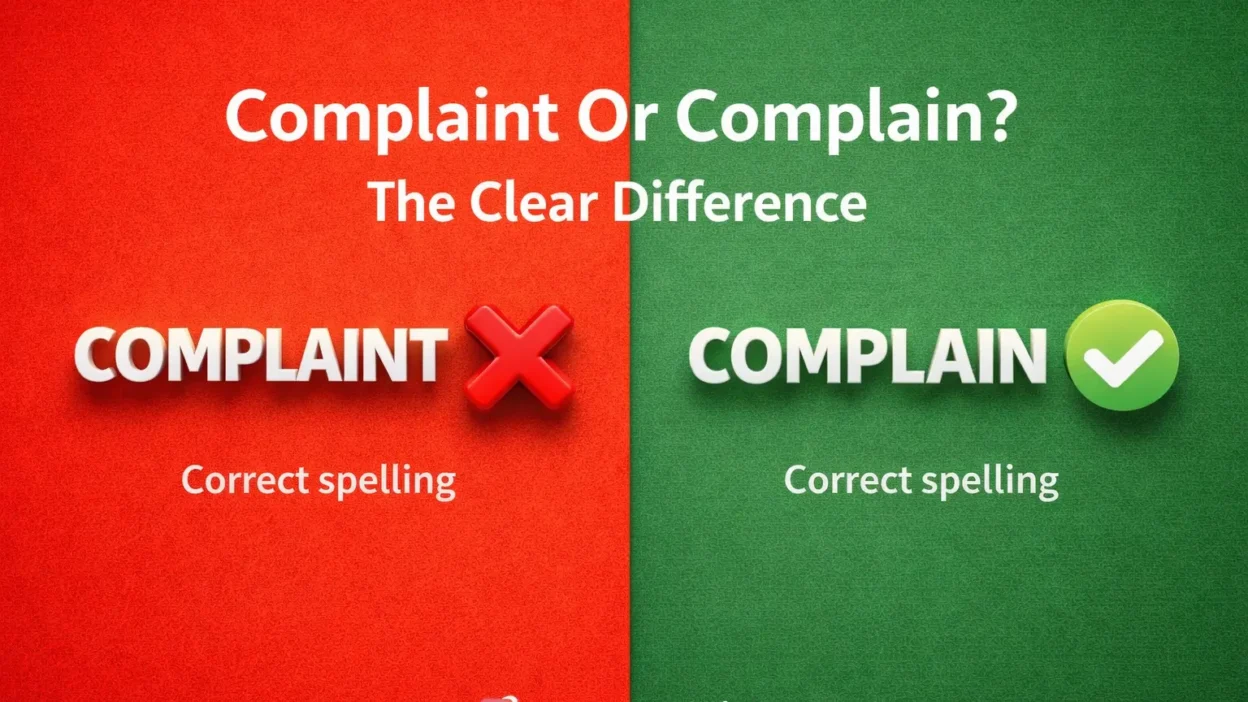
Complaint or complain depends on the job the word is doing in the sentence. Use complaint when you are naming the problem, and use complain when you are describing the action of speaking up about that problem.
TL;DR
• Complaint is the noun
• Complain is the verb
• Say “make a complaint”
• Say “complain about the service”
• “I have a complaint” is correct
• “I have a complain” is wrong
Complaint Vs Complain
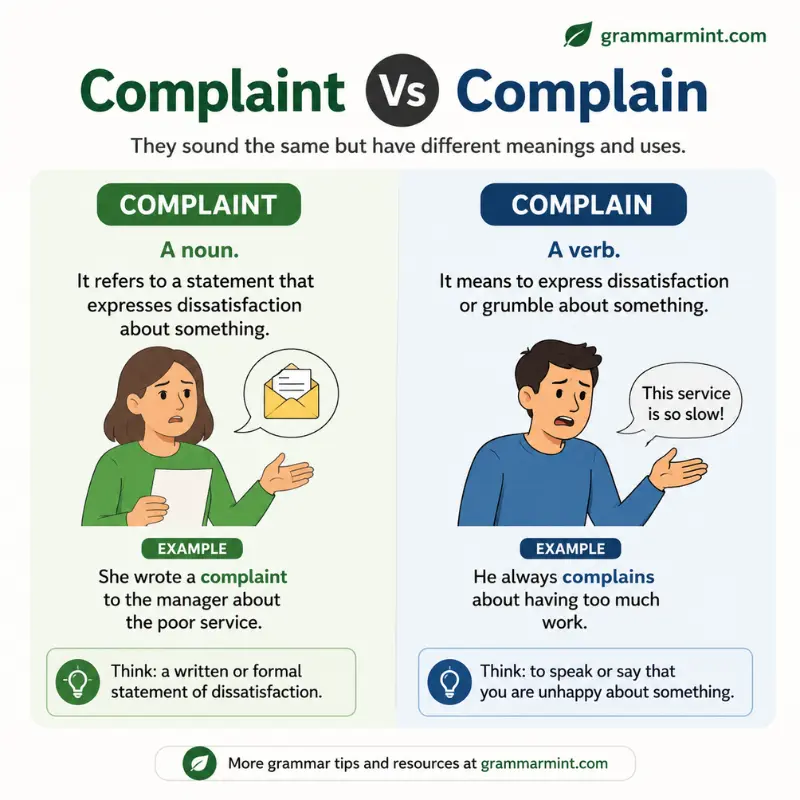
Start here, because this is the rule that solves most mistakes. The key is part of speech. In everyday US English, complaint is a noun, while complain is a verb.
• Complaint names a problem or grievance
• Complain shows someone voicing dissatisfaction
• One is a thing; one acts
• Use complaint after a, an, or the
• Use complain after subjects like I or they
• “Make a complaint” is correct
• “Want to complain” is correct
• “I have a complain” is wrong
• “She complaint yesterday” is wrong
• Swap noun for issue to test
• Swap verb for protest to test
• The sentence job decides the choice
Complain vs. Complaint
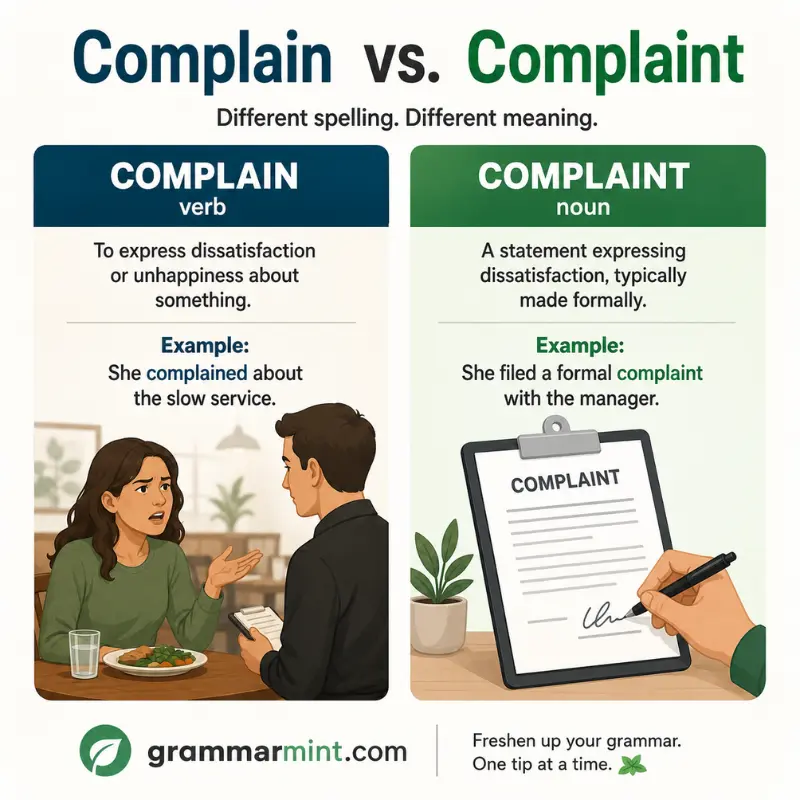
Complain is a verb. It means to express dissatisfaction or say that something is wrong.
- Customers often complain about slow service.
- She complained to the manager.
- Don’t complain without suggesting a solution.
Complaint is a noun. It means the statement or issue expressing dissatisfaction.
- The manager received a complaint.
- I filed a formal complaint about the service.
- The company responded to every customer complaint.
Easy Rule
- You complain about a problem.
- You make or file a complaint.
Correct: I want to complain about my order.
Correct: I have a complaint about my order.
Incorrect: I want to complaint about my order.
Complaint Meaning
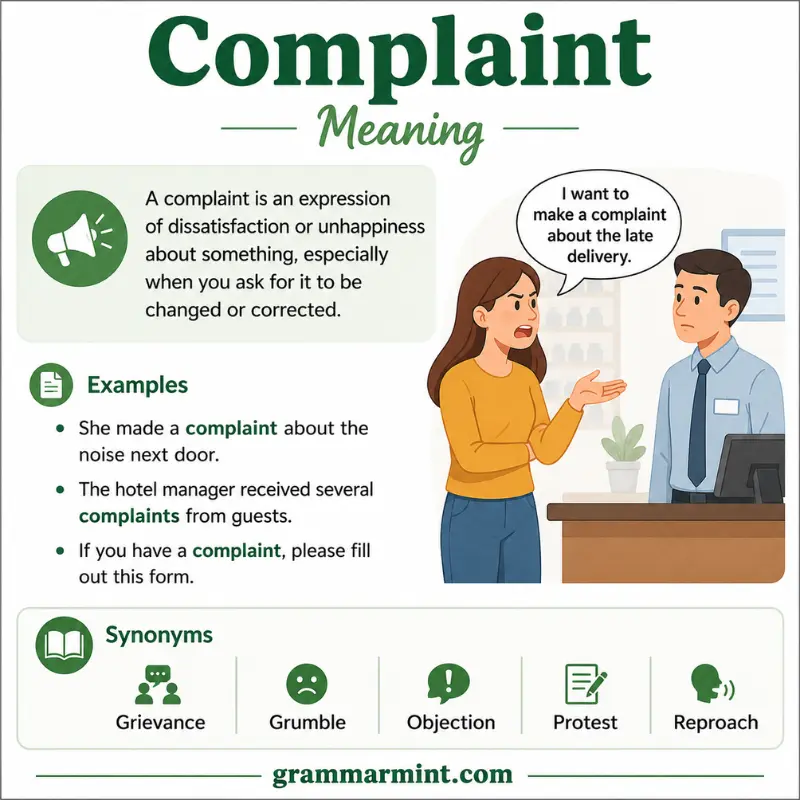
Now let’s focus on the noun side. In most cases, complaint means a reported problem or grievance. In more formal settings, it can also mean a formal statement.
• It often means a reported problem
• It can describe a customer grievance
• It may mean an official written report
• In conversation, it is often less formal
• In business, teams log complaints
• In law, meaning becomes narrower
• In medicine, it can mean ailment
• Singular complaint means one issue
• Plural complaints means several problems
• A complaint can be spoken
• A complaint can be written
• Grievance is a close formal synonym
Complain Meaning
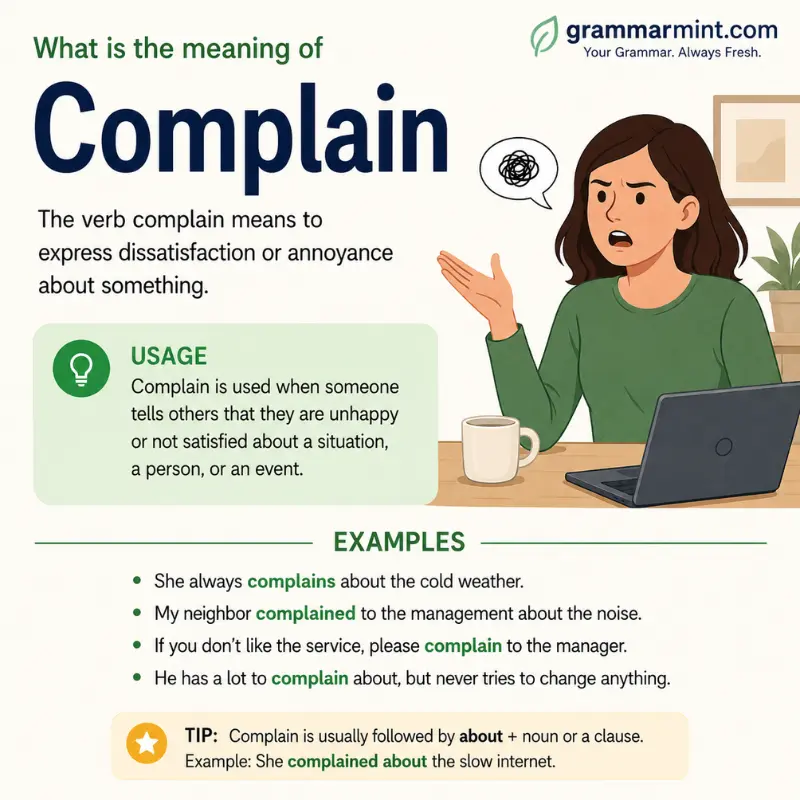
Next comes the verb side. Complain is an action word that means express dissatisfaction or speak up when something feels wrong, unfair, or uncomfortable.
• It means to say something is wrong
• It can describe speaking or writing
• People complain about delays and noise
• Customers complain when service disappoints them
• Students complain when directions feel unclear
• Neighbors complain when music gets loud
• Workers complain to managers or HR
• Patients may complain of pain
• The verb changes with tense
• Complain does not name the issue
• It tells what someone does
• Tone can be calm or upset
Complaint Examples
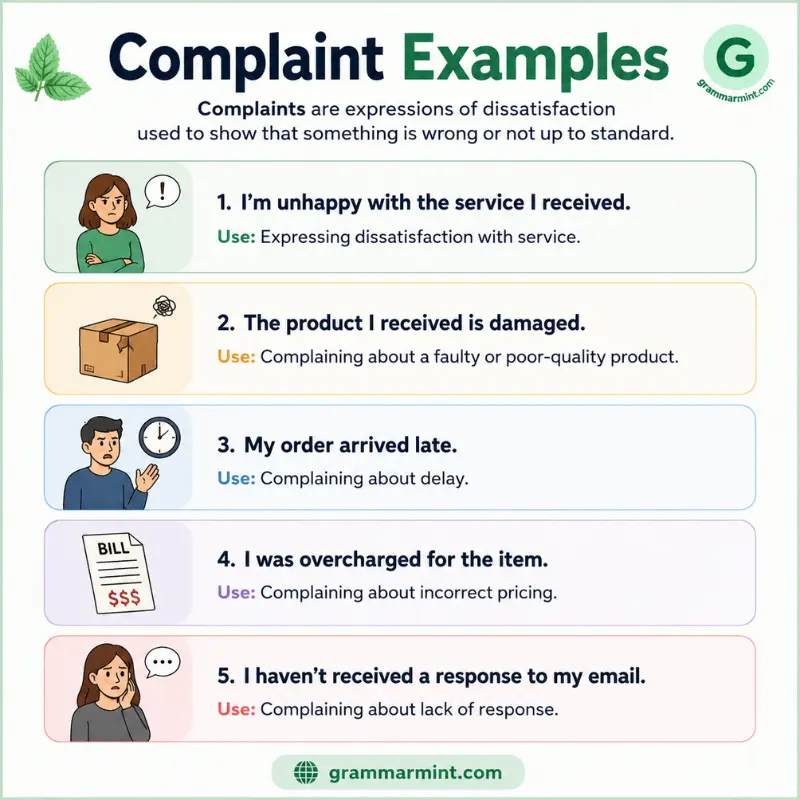
Examples make the noun easier to remember. So here are short, natural uses of customer complaint, written complaint, and noise complaint in real-life style.
• I filed a complaint about billing
• Her complaint concerned the broken heater
• Our main complaint was the long wait
• The hotel received one written complaint
• His complaint reached the district office
• That noise complaint came from upstairs
• The board reviewed every complaint carefully
• Mom’s only complaint was the price
• The complaint sounded fair and specific
• One complaint triggered a refund review
• Their complaint included photos and dates
• The complaint stayed polite and clear
Complain Or Complaint Examples
Side-by-side practice helps fast. In each pair below, the word choice depends on the sentence frame and usage pattern.
• I have a complaint about lunch
• I want to complain about lunch
• She made a complaint in writing
• She complained in writing yesterday
• They sent a complaint to support
• They complained to support directly
• He has no complaint today
• He will not complain today
• We heard the complaint first
• We listened as they complained
• Use the noun for the issue
• Use the verb for the action
Complaint In A Sentence
This section gives you model sentence practice with natural phrasing and clear context. If the word names the problem, complaint usually fits.
• The complaint reached the front desk
• Your complaint deserves a quick response
• This complaint involves two separate charges
• Her complaint sounds reasonable to me
• A written complaint creates a clear record
• Their complaint mentioned rude service
• The complaint outlined times and names
• No complaint was filed that day
• His complaint focused on safety
• The complaint went to corporate
• One complaint changed the whole policy
• Every complaint needs a fair review
Complain In A Sentence
Now switch to the verb. These everyday English lines show the verb form in a real example style.
• I need to complain about the charge
• They complain whenever deadlines suddenly change
• She complained to the landlord twice
• We complained that the room smelled
• He rarely complains about hard work
• Parents complained about the late bus
• Guests complained because towels never arrived
• The team complained of wrist pain
• Do not complain before checking the facts
• Please complain politely and stay specific
• People complain more when updates disappear
• She has complained since Monday
I Have A Complaint Or I Have A Complain
This is one of the most common mistakes. The correct phrase is clear because the sentence needs a noun slot, not a verb, and that makes it a common mistake worth fixing early.
• “I have a complaint” is correct
• “I have a complain” is incorrect
• Have usually takes a noun here
• Complaint names the issue you have
• Complain cannot follow have this way
• Think “I have a problem”
• Not “I have a complain”
• Use it in stores and offices
• Use it in emails and chats
• It fits formal and casual settings
• Add details after about or regarding
• Keep the sentence direct and polite
I Have No Complaints Or I Have No Complains
Here the confusion is plural form. Complaints is the plural noun, while complains is a verb ending, so the natural expression is “I have no complaints.”
• “I have no complaints” is right
• “I have no complains” is wrong
• Complaints is the plural noun
• Complains is a verb form
• Use complaints after no, many, or several
• Use complains after he, she, or it
• “No complaints” sounds natural and positive
• It often means you are satisfied
• It can also mean “good enough”
• The phrase works in speech
• The phrase works in reviews
• The final s changes the word job
Complaint Vs Compliant
These words cause a spelling mix-up because they look close. But compliant is an adjective, while complaint keeps its noun meaning.
• These words look similar, not identical
• Complaint is a noun about dissatisfaction
• Compliant is an adjective about following rules
• A compliant worker follows instructions
• A complaint raises an issue
• The extra letters change the meaning
• Spell-check may not catch confusion
• Read the full sentence aloud
• Ask whether you need a description
• Ask whether you need a reported issue
• Customer complaint differs from compliant customer
• Never swap them in formal writing
Complain Box Or Complaint Box
When the phrase appears on a public sign, use the standard phrase that fits normal label wording. In English, that phrase is complaint box.
• “Complaint box” is the standard phrase
• A complaint box collects written concerns
• “Complain box” sounds unnatural in English
• The box holds complaints, not actions
• Schools may place one near offices
• Hotels may keep one at reception
• Digital forms work like complaint boxes
• Suggestion box is a different idea
• One gathers problems; one invites ideas
• Labels should stay short and clear
• Public signs need the noun form
• Use complaint box on forms and notices
Complain Past Tense
Verb forms matter, especially in school and workplace writing. The right base here is complained, and both the present participle and past participle follow the normal pattern.
• The past tense is complained
• Add ed to the base verb
• Present tense base is complain
• Present third-person is complains
• Present participle is complaining
• Past participle is also complained
• “She complained yesterday” is correct
• “They complained about delays” is correct
• “He complaint yesterday” is wrong
• Watch spelling before adding endings
• The pattern stays predictable
• Keep tense consistent across sentences
Complain About, Complain To, And Complain Of
This is where many strong writers still slip. The preposition changes the target. Use complain about for the problem and complain to for the person you tell.
• Complain about names the problem
• Complain to names the listener
• Complain of often signals pain
• Complain that introduces a full clause
• People complain about noise and prices
• Customers complain to supervisors or support
• Patients complain of headaches or nausea
• Writers often mix these patterns up
• “Complain for” is usually wrong
• Use both about and to together
• Example: complain to staff about billing
• Prepositions change the sentence meaning
Make A Complaint Or Complain
Both choices can work, so the real question is tone. Formal tone often prefers the noun, while everyday speech leans on the verb, and context fit decides the better choice.
• Both choices can be correct
• Make a complaint sounds more formal
• Complain sounds more direct and active
• Offices often ask you to file one
• Friends usually say complain, not complaint
• Use complaint in forms and policies
• Use complain in everyday conversation
• Written notices prefer the noun pattern
• Quick speech prefers the verb pattern
• Tone matters as much as grammar
• Choose the form that fits context
• Formality often decides the better option
Complaint In Law
This meaning is narrower than the everyday one. In legal use, a legal filing or court document may be called an official complaint, and that can start formal action.
• In law, complaint has a special meaning
• It can start a civil case
• It states claims against a defendant
• Courts treat it as a formal filing
• Everyday complaint is broader than legal complaint
• Legal wording must stay precise
• Many agencies also accept formal complaints
• “Complaint against” appears in official language
• A court complaint is not casual feedback
• Filing rules vary by jurisdiction
• Legal complaint and customer complaint can overlap
• Context prevents expensive misunderstandings
How To Pronounce Complaint
Pronunciation matters less than meaning, yet it still helps memory. In American pronunciation, the stress pattern falls late, and the main syllable stress lands on “plaint.”
• Americans say kuhm-PLAYNT
• The stress falls on plaint
• The first syllable sounds reduced
• The vowel matches complain closely
• The final t is usually light
• Say it slower: com-plaint
• Pair it with complain for contrast
• Complaint ends with a clear nt
• Complain ends with the long a sound
• Listening helps more than guessing
• Repeat both words in one breath
• Pronunciation gets easier with sentence practice
FAQs
What is the difference between complain and complaint?
Complain is the verb, so it describes the action of speaking up about something. Complaint is the noun, so it names the issue, concern, or formal report itself.
How do you explain a complaint?
A complaint is a statement that something is wrong, unfair, unsatisfactory, or uncomfortable. In everyday use, it can be casual, but in business or legal settings, it may also be formal.
How do you use complaint?
Use complaint when the sentence needs a noun. For example, say “I have a complaint,” “She filed a complaint,” or “Their complaint was resolved.”
What is the meaning of complaint in business?
In business, complaint usually means a spoken or written statement from a customer, client, or user about a problem. It often appears in support, billing, shipping, service, and workplace processes.
Is it a complaint or complain?
Use complaint when naming the problem and complain when describing the action. A quick memory trick is this: you make a complaint, but you complain about something.
How do you use complain in a sentence?
Use complain as the action word. Good examples include “I want to complain about the charge” and “She complained to the manager yesterday.”
Conclusion
Now you know the real difference between complaint or complain. Use complaint for the thing, use complain for the action, and test the sentence job when you feel stuck.