If you’ve ever paused over in effect or in affect, you’re asking the same question many writers, students, and professionals ask. These two words sound close, but they don’t work the same way in English. Once you learn the basic difference between affect, effect, in effect, take effect, affected, and effected, the confusion gets much easier to handle.
Quick Answer
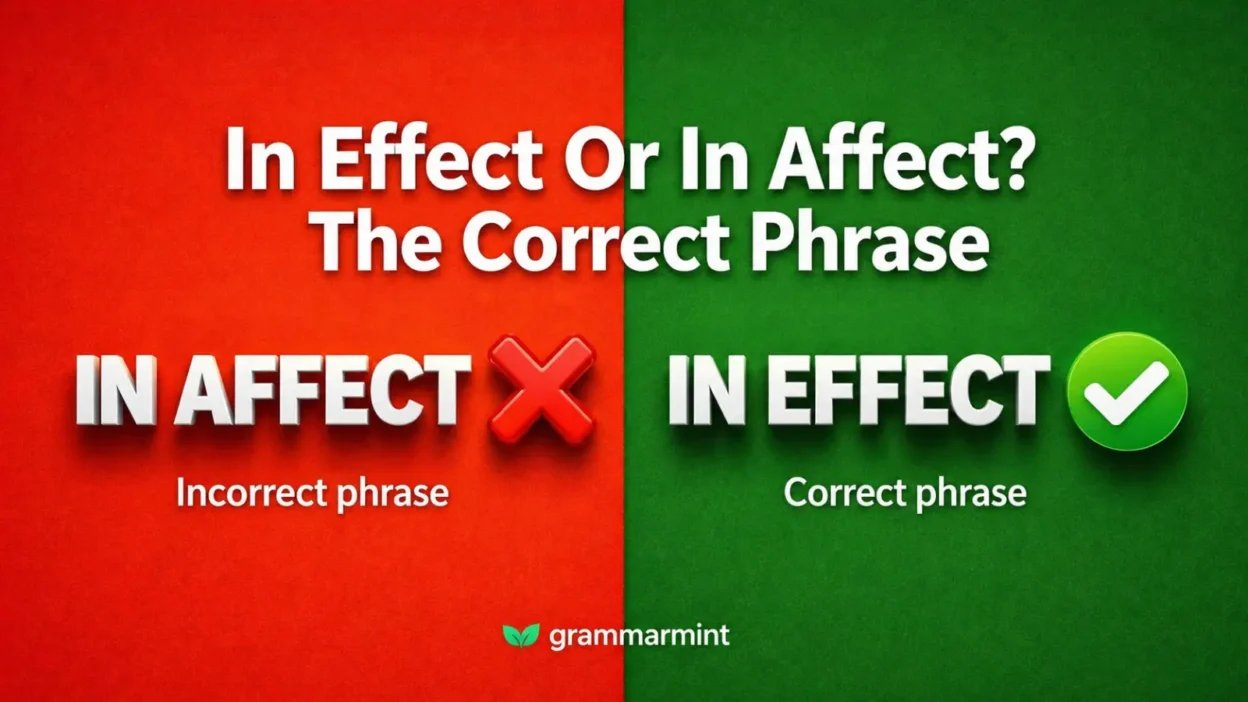
In effect is the correct phrase in standard English. Use it when you mean “in force,” “working,” “essentially,” or “in practice.” In affect is usually a mistake in everyday writing.
TL;DR
• In effect is the correct phrase.
• Affect is usually a verb.
• Effect is usually a noun.
• In effect has two common meanings.
• In affect is rarely right.
• Rare exceptions don’t change the rule.
In Effect Or In Affect
Most of the time, the answer is simple. In effect is the correct phrase in standard English, and in affect is a common mistake.
Use in effect when something is active, operating, or true in practice. That’s the form readers expect.
• The new policy is still in effect.
• In effect, they made the same choice.
• The discount remains in effect today.
• Her advice is, in effect, a warning.
• The rule stayed in effect all summer.
• In effect, the two plans are identical.
• The order went in effect at noon.
• The safety notice remains in effect.
• In effect, he admitted the problem.
• That temporary ban is still in effect.
• In effect, we already agreed.
• The guideline will be in effect tomorrow.
Affect Vs Effect
Here’s the rule that solves most confusion. Affect is usually a verb, while effect is usually a noun that names a result.
That one pattern will get you right most of the time. Start there before worrying about exceptions.
• Stress can affect your sleep.
• The speech had a strong effect.
• Weather may affect travel plans.
• The change had little effect.
• Cost can affect buyer behavior.
• Noise often affects concentration.
• The medicine had no effect yet.
• One delay can affect the schedule.
• The decision produced a lasting effect.
• Lighting affects how colors look.
• The update had a positive effect.
• Poor timing can affect results.
What In Effect Means
The phrase in effect has two everyday uses. It can mean in force, and it can also mean in practice or essentially.
Context tells you which meaning fits. In legal, school, or workplace writing, both are common.
• The curfew is in effect tonight.
• The rule stays in effect through June.
• In effect, she became the team lead.
• The waiver remains in effect this year.
• In effect, the offer cuts the price.
• The restriction was in effect at dawn.
• In effect, they merged both roles.
• The alert is in force and in effect.
• In effect, the plan delays payment.
• The tax break remains in effect.
• In effect, he said no politely.
• The temporary limit is still in effect.
How To Use In Effect In A Sentence
You can place in effect at the start, middle, or near the end of a sentence. As an intro phrase, it often summarizes meaning. In the middle, it can add a careful explanation that suits formal writing.
Keep it natural. Don’t force it where a simpler word would sound better.
• In effect, the meeting was canceled.
• The law is, in effect, a ban.
• Their promise remained in effect overnight.
• In effect, we lost a full day.
• The exception is still in effect now.
• Her note was, in effect, an apology.
• In effect, the app became a diary.
• The notice stayed in effect for weeks.
• In effect, both sides compromised.
• The agreement remained in effect afterward.
• In effect, he volunteered without saying so.
• That pricing rule is still in effect.
When In Affect Seems Tempting
People often write in affect because the words sound similar. This is a classic case of sound-alike words creating spelling confusion in everyday usage.
Still, sound alone does not decide spelling. Standard written English almost always wants in effect here.
• “In affect” looks right to many writers.
• Fast speech can blur both words.
• Spellcheck may miss phrase errors.
• The mistake appears in drafts often.
• Writers hear the phrase before learning it.
• Sound can mislead careful people too.
• Everyday typing makes slipups more likely.
• Similar endings cause quick confusion.
• The wrong form often survives proofreading.
• Reading the whole sentence helps.
• Checking meaning fixes the error.
• “In effect” matches normal usage.
When Affect Is A Noun
There is one real exception worth knowing. In psychology, affect can be a noun that means outward emotional expression, such as a patient showing “flat affect.”
That matters in medical or psychology contexts. Even so, it does not make in affect a normal everyday phrase.
• The clinician noted a flat affect.
• Her affect seemed calm and steady.
• The report described restricted affect.
• His affect changed after the call.
• The nurse observed cheerful affect.
• The chart mentioned blunted affect.
• Doctors discuss affect in evaluations.
• The term belongs to specialized writing.
• Most students never need this sense.
• It rarely appears in casual messages.
• It does not rescue “in affect.”
• Everyday writing still favors “in effect.”
When Effect Is A Verb
Less often, effect works as a verb. In that use, it means bring about or make happen, often in a formal tone.
You’ll see it in policy, legal, academic, and business writing. It sounds more formal than everyday speech.
• The board hopes to effect change.
• Reform can effect long-term savings.
• The treaty effected a new arrangement.
• Leaders tried to effect reform quickly.
• The merger effected major shifts.
• New steps may effect improvement.
• The campaign helped effect policy change.
• Good planning can effect real progress.
• The law effected broad revisions.
• Their pressure effected a reversal.
• The committee aimed to effect order.
• One decision effected several changes.
Take Effect And Come Into Effect
These phrases belong to the same family as in effect. Take effect means become active or start working. Come into effect often means officially apply or begin operating.
This is why take affect is almost always wrong in normal usage.
• The new rule takes effect Monday.
• The medicine should take effect soon.
• The ban will come into effect next week.
• The changes take effect immediately.
• The update came into effect today.
• The pain relief took effect slowly.
• The policy takes effect after approval.
• The rule came into effect at midnight.
• The warning remains in effect now.
• The cream took effect within minutes.
• The price cap comes into effect tomorrow.
• The order took effect without delay.
In Effect Vs In Fact
These phrases can feel close, but they are not identical. In fact points to something directly true. In effect often gives a practical summary, not always the exact original wording.
That difference matters in careful writing. One reports truth plainly; the other explains what something amounts to.
• In fact, the store had closed.
• In effect, the store was unavailable.
• In fact, he refused the job.
• In effect, he ended negotiations.
• In fact, taxes rose last year.
• In effect, families paid more overall.
• In fact, the room was empty.
• In effect, the event was canceled.
• In fact, she said yes.
• In effect, she accepted the terms.
• In fact, the plan failed.
• In effect, the team had no backup.
To That Effect And Similar Phrases
You’ll also see to that effect, into effect, and put into effect. These are fixed expressions, so it helps to learn them as whole phrases.
Once you know the pattern, they become much easier to spot and use.
• He made a comment to that effect.
• The memo said something to that effect.
• The change goes into effect Friday.
• They put the plan into effect.
• Her email was to that effect.
• The update came into effect yesterday.
• We put safety steps into effect.
• The statement was to that effect.
• The rule goes into effect soon.
• They finally put reforms into effect.
• His reply was brief but to that effect.
• The order came into effect overnight.
Affected Vs Effected
These past-tense forms confuse many writers. Affected usually means influenced, changed, or touched. Effected usually means brought about or made to happen.
Because the verb effect is less common, effected appears less often too. Still, it matters in formal writing.
• The storm affected local traffic.
• The court ruling effected major change.
• Rising costs affected small stores.
• The vote effected a leadership shift.
• The delay affected customer trust.
• The agreement effected a compromise.
• Heat affected battery life.
• The policy effected new procedures.
• The error affected the totals.
• The settlement effected peace briefly.
• Budget cuts affected hiring plans.
• The reform effected lasting changes.
Affecting Vs Effecting
The same difference continues in the -ing forms. Affecting usually means influencing or changing. Effecting means causing something to happen.
In everyday writing, affecting is far more common. Effecting appears more in formal or institutional language.
• The news is affecting morale.
• The team is effecting change gradually.
• Heat is affecting the system.
• New rules are effecting broader reform.
• Stress is affecting his focus.
• Their work is effecting progress.
• Price shifts are affecting buyers.
• The grant is effecting improvement.
• Delays are affecting service levels.
• Training is effecting cultural change.
• Drought is affecting crop growth.
• The program is effecting real savings.
Effect Change Vs Affect Change
This pair causes trouble because both can appear before change. Effect change means make change happen. Affect change means influence a change or influence something called change.
Most of the time, writers who mean “make happen” want effect change. Writers who mean “influence” want affect.
• Leaders hope to effect change soon.
• Budget cuts may affect change efforts.
• One vote can effect real change.
• Fear can affect change adoption.
• Good policy may effect change.
• Poor messaging can affect change plans.
• The campaign tried to effect change.
• Delay could affect change outcomes.
• Pressure helped effect change fast.
• Cost may affect change decisions.
• Organized action can effect change.
• Confusion can affect change management.
Personal Effects And Other Common Uses
The word effect appears in many familiar noun phrases. Personal effects means belongings. Side effects means extra results, often unwanted. Special effects means visual or sound tricks in film.
Learning these chunks helps the right spelling feel more natural.
• She packed her personal effects.
• The drug caused mild side effects.
• The film used impressive special effects.
• His effects were returned later.
• Side effects faded by morning.
• The studio improved the visual effects.
• Personal effects filled one small box.
• Some side effects were temporary.
• The sound effects felt realistic.
• Her personal effects stayed in storage.
• The treatment had few side effects.
• The movie relied on practical effects.
A Simple Memory Trick
A quick memory aid can save time. Think A = action and E = end result. Or use RAVEN: Remember, Affect Verb, Effect Noun.
No memory trick is perfect, but this one works well for most everyday sentences.
• Affect starts with A for action.
• Effect starts with E for end.
• First comes influence, then result.
• Affect usually does the acting.
• Effect usually names the outcome.
• RAVEN helps in quick edits.
• Use the trick during proofreading.
• Check whether the word acts.
• Check whether the word names.
• Meaning matters more than sound.
• A simple pause prevents errors.
• Practice makes the pattern stick.
Quick Practice With Correct And Incorrect Examples
The fastest way to learn this pair is to compare right and wrong forms. Read the sentence, ask what you mean, and then choose the word that matches the job.
That habit builds confidence fast. After a while, the correct version starts to feel natural.
• Correct: The order is in effect.
• Incorrect: The order is in affect.
• Correct: Stress can affect memory.
• Incorrect: Stress can effect memory.
• Correct: The change had little effect.
• Incorrect: The change had little affect.
• Correct: The law takes effect today.
• Incorrect: The law takes affect today.
• Correct: They hope to effect change.
• Incorrect: They hope to affect change.
• Correct: The patient showed flat affect.
• Incorrect: The patient showed flat effect.
FAQs
Is “in effect” or “in affect” correct?
In effect is correct in standard everyday English. In affect is usually an error unless you are using the rare psychology noun affect, which most writers are not.
What does “in effect” mean?
It usually means either “in force” or “in practice.” The exact meaning depends on the sentence around it.
Can “affect” ever be a noun?
Yes, but it is rare outside psychology and medical writing. In that field, affect means outward emotional expression, as in “flat affect.”
Can “effect” be a verb?
Yes. As a verb, effect means bring about, accomplish, or make happen. That use is less common and often sounds more formal.
Is “take affect” ever correct?
In normal English, no. The standard phrase is take effect, which means begin working or become active.
What is the difference between “affected” and “effected”?
Affected usually means influenced or changed. Effected usually means brought about or caused to happen.
Conclusion
If you’re choosing between in effect or in affect, the right everyday choice is in effect. Learn the basic pattern, remember the rare exceptions, and you’ll catch this mistake much faster in your own writing.