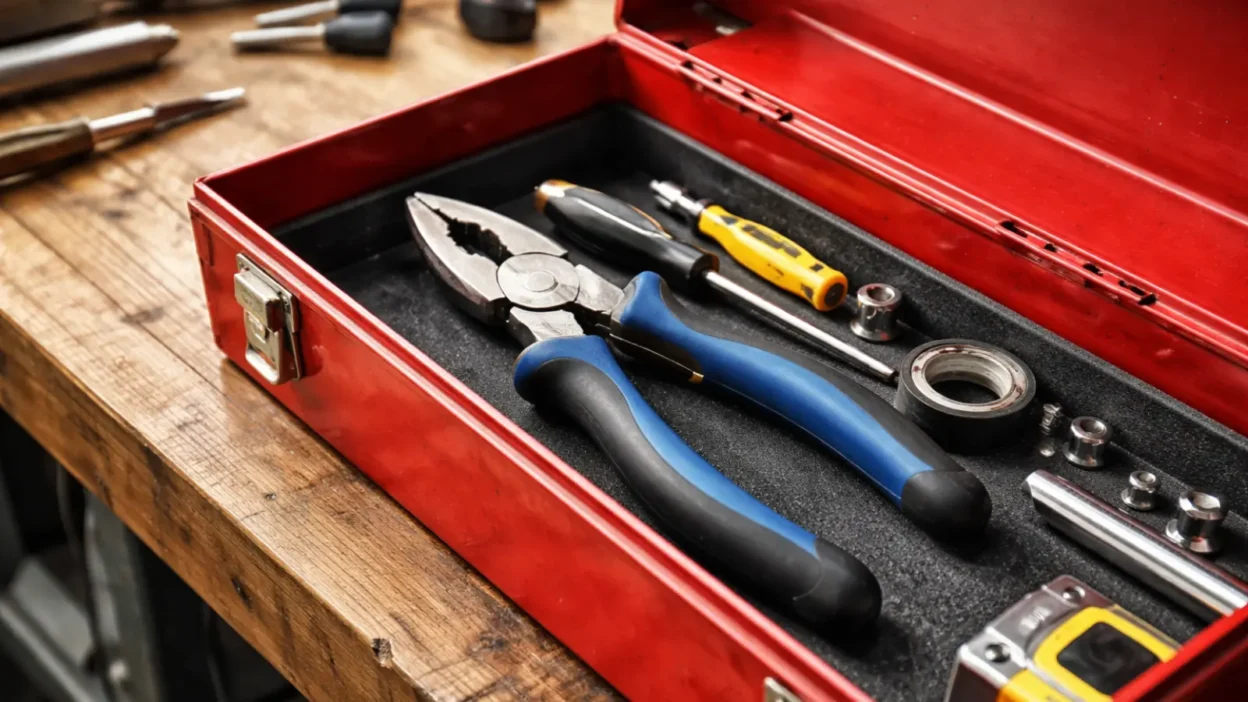
Many writers, students, DIY enthusiasts, and home repairers wonder whether the hand tool used to grip, bend, cut, or twist materials should be spelled pliers or plyers.
Because the spoken word sounds roughly like ply-ers, the spelling plyers may seem reasonable at first. However, the standard spelling of the tool is pliers.
In both American and British English, pliers refers to the familiar handheld tool with two handles and gripping jaws. Plyers, on the other hand, should not be used as the standard spelling when you mean this tool.
Therefore, if you are writing a school assignment, DIY guide, product description, technical manual, or casual message, pliers is the correct choice.
This guide explains plyers vs pliers, including their spelling, pronunciation, grammar, meaning, examples, and common mistakes.
Quick Answer
Pliers is the correct English spelling for the hand tool used to grip, hold, bend, twist, pull, or cut materials.
By contrast, plyers is generally an incorrect spelling when referring to the tool.
A simple rule to remember is:
Tool = pliers
For example:
Correct: I need a pair of pliers to remove this wire.
Incorrect: I need a pair of plyers to remove this wire.
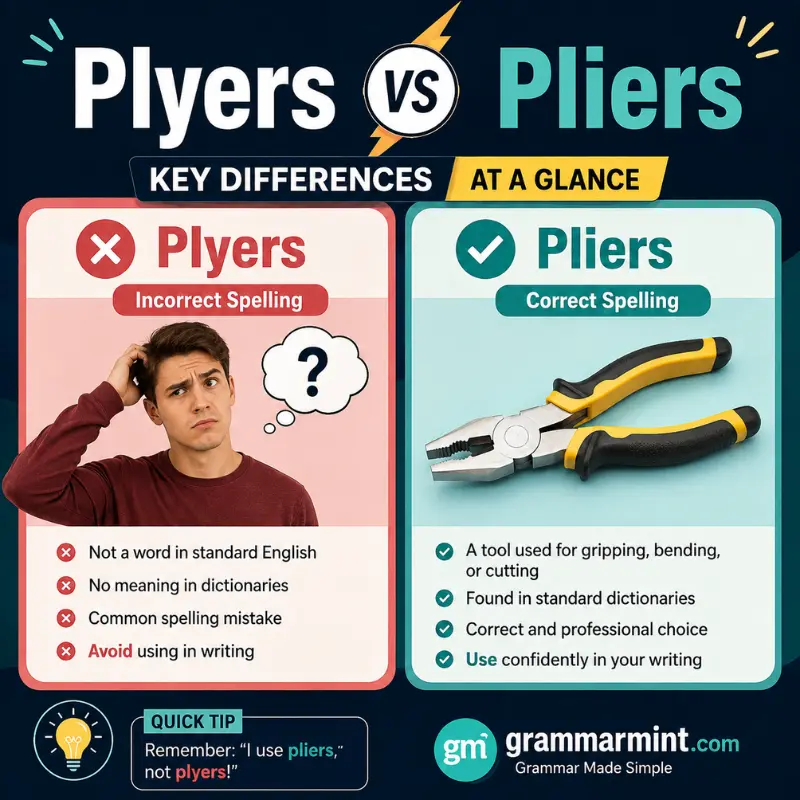
Plyers vs Pliers: Key Differences at a Glance
| Feature | Pliers | Plyers |
|---|---|---|
| Correct spelling for the tool | Yes | No |
| Standard dictionary form | Yes | Not normally for the tool |
| Used in American English | Yes | Nonstandard for the tool |
| Used in British English | Yes | Nonstandard for the tool |
| Suitable for formal writing | Yes | No |
| Suitable for DIY instructions | Yes | No |
| Main reason for confusion | Standard word | Sounds like the pronunciation |
| Example | a pair of pliers | usually a spelling mistake |
As you can see, pliers is the correct choice in standard writing. Therefore, if you are discussing the common hand tool, use pliers every time.
What Does “Pliers” Mean?
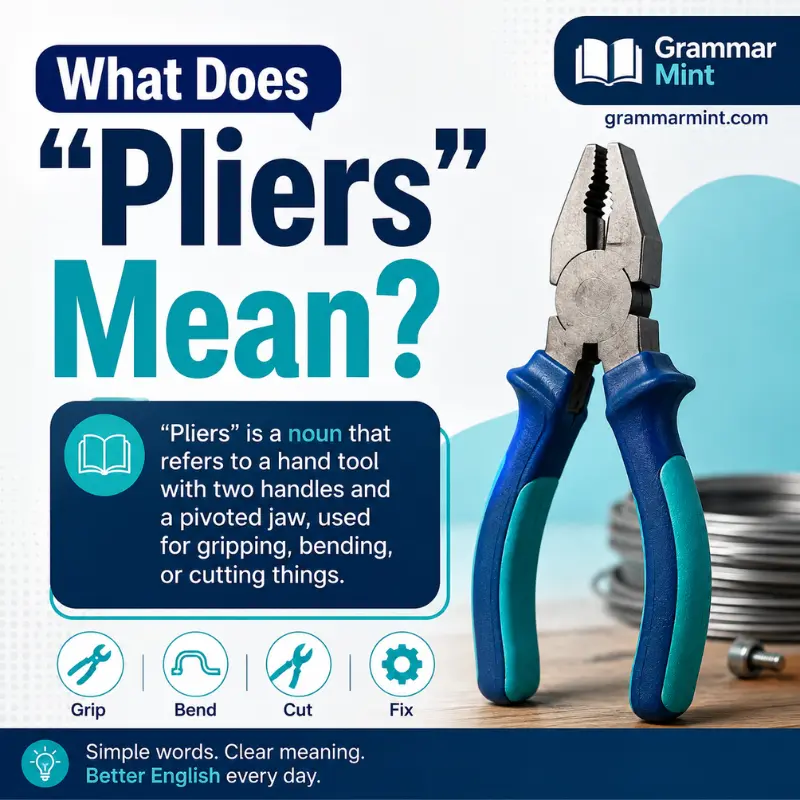
Pliers are a handheld tool made with two joined arms, handles on one end, and gripping jaws on the other.
When the handles are squeezed, the jaws move together. As a result, the tool can firmly hold or manipulate different materials.
Depending on the type, pliers can be used to:
- Grip small objects
- Hold wires
- Bend metal
- Twist wire
- Pull nails or pins
- Cut electrical wire
- Tighten or loosen certain objects
- Reach into narrow spaces
For example, you may find pliers in a toolbox, workshop, garage, electrical kit, jewelry-making kit, or mechanic’s workspace.
Consider this sentence:
Use the pliers to hold the nut while you turn the bolt.
Here, pliers clearly refers to the hand tool.
Why Is “Pliers” the Correct Spelling?
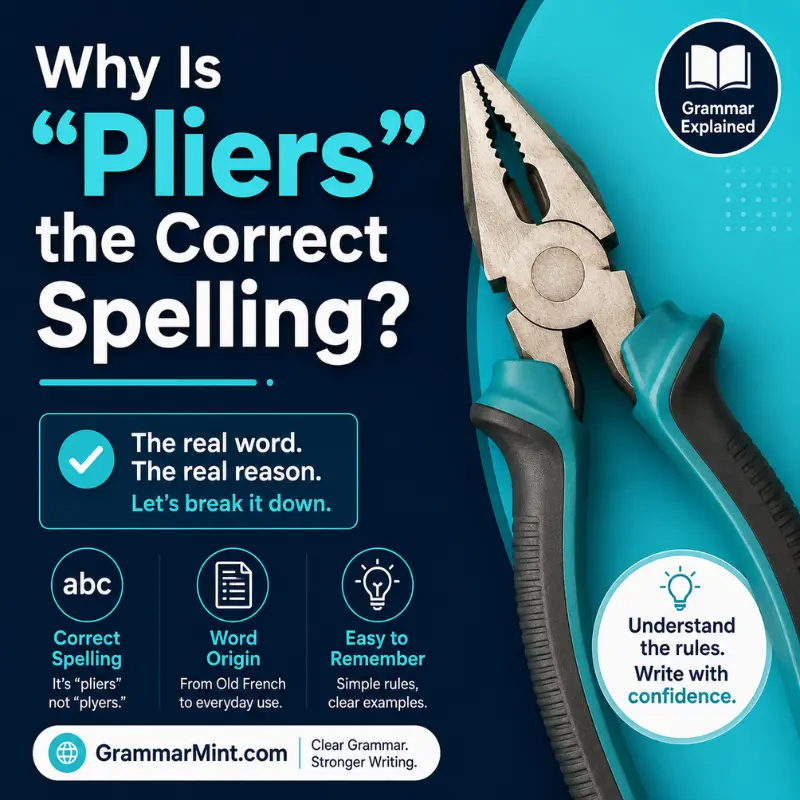
The standard spelling is pliers, although its pronunciation can make plyers seem logical.
English spelling does not always match pronunciation exactly. For this reason, relying only on how a word sounds can sometimes lead to spelling mistakes.
Because pliers sounds similar to ply-ers, someone who hears the word before seeing it in writing may assume that it contains a y. Nevertheless, conventional English spelling uses pliers.
Therefore:
Correct: pliers
Incorrect for the tool: plyers
Once you associate pliers with the physical tool, the correct spelling becomes much easier to remember.
Why Do People Spell Pliers as “Plyers”?
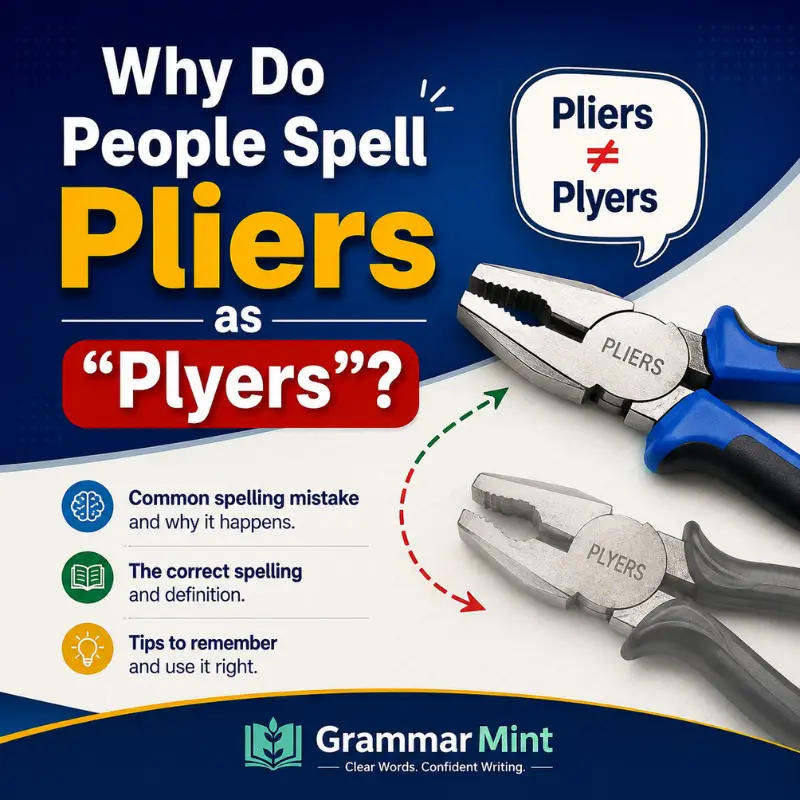
The main source of confusion is pronunciation.
When spoken aloud, pliers sounds approximately like:
ply-ers
Consequently, some writers spell the word according to its sound and type plyers.
This mistake is especially common among people who have heard the word in conversation more often than they have seen it written.
For instance, an informal message might say:
Where are my plyers?
Although the intended meaning is easy to understand, the standard version is:
Where are my pliers?
So, even if plyers appears online, that does not make it the correct spelling of the tool.
How Do You Pronounce “Pliers”?
Pliers is commonly pronounced like:
PLY-erz
The word has two syllables.
Because the first syllable sounds like the word ply, the spelling may seem confusing. However, the correct written form begins with “pli,” not “ply.”
A simple pronunciation guide is:
pliers = PLY-erz
Therefore, remember the pronunciation, but do not copy it directly into the spelling.
Is “Plyers” Ever a Word?
This question requires a small distinction.
When someone asks “plyers or pliers?”, they usually want the correct spelling of the hand tool. In that context, the answer is straightforward:
Use pliers.
However, Plyers may occasionally appear in proper names, usernames, business names, surnames, or unusual branding.
For example, a company may intentionally choose a creative spelling for its brand. Even so, that does not make plyers the standard spelling of the common tool.
Therefore, the practical rule remains simple:
If you mean the hand tool, write pliers.
Is “Pliers” Singular or Plural?
Although pliers can describe one physical tool, the word is normally treated grammatically as a plural noun.
For example:
The pliers are on the workbench.
Not:
The pliers is on the workbench.
This pattern is similar to several other English words, including:
- Scissors
- Tongs
- Tweezers
- Binoculars
These objects contain paired or connected parts. Therefore, English commonly treats their names as plural.
Should You Say “A Plier” or “A Pair of Pliers”?
In everyday English, the most natural expression is:
a pair of pliers
For instance:
I bought a new pair of pliers yesterday.
Although plier can sometimes appear in specialized terminology or compounds, most speakers do not normally call the complete tool “a plier.”
Instead, these forms sound more natural:
Correct: Pass me the pliers.
Correct: I need a pair of pliers.
Less natural in everyday English: I need a plier.
Therefore, when writing for a general audience, a pair of pliers is usually the safest and clearest form.
Is It “Pliers Is” or “Pliers Are”?
Use are when pliers is the subject of the sentence.
Correct: The pliers are in the drawer.
Incorrect: The pliers is in the drawer.
However, the grammar changes when pair becomes the subject.
For example:
The pair of pliers is in the drawer.
In this sentence, pair is singular, so is is correct.
Compare the two examples:
The pliers are rusty.
This pair of pliers is rusty.
As a result, the verb depends on the grammatical subject, not simply on the object being discussed.
US vs UK English
There is no important spelling difference between American and British English in this case.
Both varieties use:
pliers
You will also see the same spelling in Canadian and Australian English.
In addition, pliers is the standard form used in:
- Technical manuals
- Hardware catalogs
- DIY instructions
- Product descriptions
- Trade publications
- Educational materials
Therefore, you do not need to change the spelling according to your audience.
Whether you are writing for readers in the United States or the United Kingdom, pliers remains the correct choice.
Different Types of Pliers
There are many types of pliers, and each style serves a slightly different purpose. Nevertheless, the basic spelling remains the same.
Slip-Joint Pliers
Slip-joint pliers have an adjustable pivot point. As a result, the jaws can open to different widths.
They are commonly used for general household repairs and gripping objects of various sizes.
Needle-Nose Pliers
Needle-nose pliers have long, narrow jaws.
Because of their shape, they are especially useful for:
- Electrical work
- Jewelry making
- Small components
- Tight spaces
- Bending thin wire
For example:
She used needle-nose pliers to bend the small wire loop.
Cutting Pliers
Some pliers are designed mainly for cutting wire and similar materials.
For instance:
Use cutting pliers instead of scissors for the thick electrical wire.
Locking Pliers
Locking pliers can clamp onto an object and remain locked in place.
Therefore, they are useful when a task requires a strong, steady grip.
Regardless of the type, the standard word is always pliers.
Which Should You Use?
The answer remains consistent across almost every normal writing situation.
Everyday Writing
Use pliers.
For example:
Can you bring me the pliers?
School Assignments
Again, choose pliers.
Incorrect spelling may make otherwise good writing look poorly proofread.
DIY Guides
Always use pliers when referring to the tool.
Because instructions need to be clear, correct terminology is particularly important in repair guides.
Product Descriptions
Use pliers when describing or selling the tool.
Common examples include:
needle-nose pliers
cutting pliers
locking pliers
Professional Manuals
Professional and technical documents should also use pliers.
After all, standardized terminology improves clarity and consistency.
Search Queries and Online Content
Use pliers as the main spelling in website content and page titles.
Although some users may search for plyers by mistake, professionally written content should clearly explain that pliers is the correct form.
Common Mistakes With “Pliers”
Several mistakes appear frequently. Fortunately, they are easy to correct once you understand the basic rules.
Mistake 1: Writing “Plyers”
Incorrect: Hand me the plyers.
Correct: Hand me the pliers.
This mistake usually happens because writers follow the pronunciation instead of the standard spelling.
Mistake 2: Using “Pliers Is”
Incorrect: The pliers is missing.
Correct: The pliers are missing.
Since pliers normally functions as a plural noun, use are.
Mistake 3: Saying “A Pliers”
Awkward: I bought a pliers.
Better: I bought a pair of pliers.
Therefore, use a pair of pliers when referring to one complete tool.
Mistake 4: Assuming “Plyers” Is British English
Some spelling differences exist between American and British English. However, this is not one of them.
Both varieties use pliers.
Mistake 5: Trusting Pronunciation Instead of Spelling
English pronunciation can sometimes be misleading.
For that reason, remembering the written form pliers is more reliable than trying to spell it by sound.
How to Remember the Correct Spelling
One simple memory trick is to focus on the first three letters:
PLI-ers
You can also associate the correct spelling with this sentence:
Please leave it in the toolbox: PLIers.
In addition, visual repetition can help. Write or read the correct form a few times:
Eventually, plyers will begin to look incorrect because your brain becomes familiar with the standard spelling.
Pliers in a Sentence
Here are several natural examples:
- I used the pliers to bend the wire.
- Can you pass me a pair of pliers?
- The pliers are inside the red toolbox.
- She grabbed the pliers and pulled out the nail.
- For smaller wires, use needle-nose pliers.
- These pliers are too large for the job.
- He bought a new pair of locking pliers.
- After finishing the repair, return the pliers to the tool cabinet.
- During the wiring job, the electrician used pliers to grip the wire.
- We need cutting pliers for this repair.
As these examples show, the correct form remains pliers in different sentence structures.
Everyday Examples
Text Message
“Can you bring the pliers to the garage?”
Email to a Coworker
“I need a pair of pliers for the wiring job.”
Social Media
“Lost my pliers again. Has anyone seen them?”
Workshop Note
“Store pliers in the second drawer.”
DIY Instructions
“First, grip the wire firmly with pliers. Then bend it carefully.”
Hardware Shopping List
- Hammer
- Screwdriver
- Tape measure
- Pliers
- Utility knife
In every example, pliers is the correct spelling.
Pliers vs Plyers Example Sentences
Seeing both forms side by side makes the difference easier to remember.
Incorrect: I left my plyers outside.
Correct: I left my pliers outside.
Incorrect: These plyers are rusty.
Correct: These pliers are rusty.
Incorrect: Use plyers to twist the wire.
Correct: Use pliers to twist the wire.
Incorrect: He bought a new pair of plyers.
Correct: He bought a new pair of pliers.
Incorrect: Where did you put the plyers?
Correct: Where did you put the pliers?
Therefore, whenever plyers appears as the name of the tool, replace it with pliers.
Pliers vs Other Similar Tools
People sometimes use pliers as a general term for gripping tools. However, different tools have different functions.
| Tool | Main Use |
| Pliers | Gripping, bending, twisting, or cutting |
| Tweezers | Handling very small or delicate objects |
| Tongs | Gripping or lifting larger objects |
| Wrench | Turning nuts, bolts, or fittings |
| Scissors | Cutting paper, fabric, and similar materials |
For example, tweezers are better for handling a tiny object, while a wrench is better for turning many nuts and bolts.
Therefore, choosing the correct tool name improves both accuracy and clarity.
Why Correct Tool Terminology Matters
Correct spelling is not only about grammar.
In DIY guides, safety instructions, product descriptions, technical manuals, and repair tutorials, readers need to identify tools quickly.
For example, consider this instruction:
Use plyers to disconnect the wire.
Most readers will understand the intended meaning. However, the misspelling can make the instructions appear less professional.
A better version is:
Use pliers to disconnect the wire.
As a result, the instruction looks clearer, more reliable, and properly edited.
Accurate terminology is particularly important when instructions involve electricity, machinery, vehicles, or other technical tasks.
FAQs
Is It Pliers or Plyers?
Pliers is the correct spelling for the handheld tool used to grip, bend, twist, pull, or cut materials. Plyers, by contrast, is usually a spelling mistake caused by the way pliers sounds when spoken.
How Do You Spell Pliers the Tool?
Spell it:
P-L-I-E-R-S
Therefore, the correct word is pliers.
Is “Plyers” an Alternative Spelling of Pliers?
No. In standard English, plyers is not the regular alternative spelling of the tool. Instead, use pliers in schoolwork, DIY guides, professional writing, and everyday communication.
Is It a Plier or a Pair of Pliers?
In normal everyday English, a pair of pliers is the more natural expression.
For example:
I bought a pair of pliers.
Is Pliers Singular or Plural?
Pliers is normally treated as a plural noun.
Therefore, say:
The pliers are on the table.
However, when using pair, say:
This pair of pliers is new.
Is Pliers Spelled Differently in the UK?
No. Both American and British English use pliers.
Why Does “Pliers” Sound Like “Plyers”?
The pronunciation sounds approximately like PLY-erz. As a result, some people assume the word should contain a y. Nevertheless, the correct spelling is pliers.
What Is the Correct Plural of Pliers?
The ordinary word is already pliers.
For example, you can say:
one pair of pliers
or:
two pairs of pliers
If several sets are involved, pairs of pliers is the clearest wording.
Conclusion
When choosing between plyers and pliers, the answer is simple: pliers is the correct standard spelling for the hand tool.
Although plyers may look reasonable because the word sounds like ply-ers, English spelling does not always follow pronunciation exactly. Therefore, use pliers in school assignments, DIY guides, product descriptions, professional documents, technical writing, and everyday communication.
In addition, remember that pliers normally functions as a plural noun. Write “the pliers are” rather than “the pliers is.” When you mean one complete tool, “a pair of pliers” is usually the most natural expression.
Finally, keep this simple rule in mind:
If you mean the tool used to grip, bend, twist, or cut something, spell it P-L-I-E-R-S: pliers.