If you’ve paused while writing grateful or greatful, you’re not alone. This is one of the most common spelling mix-ups in American English, especially in thank-you notes, school writing, emails, captions, and everyday messages. The tricky part is that greatful looks logical at first glance, but the correct form is grateful. In this guide, you’ll learn the right spelling, the meaning, the most useful sentence patterns, and a few easy memory tricks. You’ll also see how thankful, appreciative, gratitude, gratefully, and common phrases fit into real writing.
Quick Answer
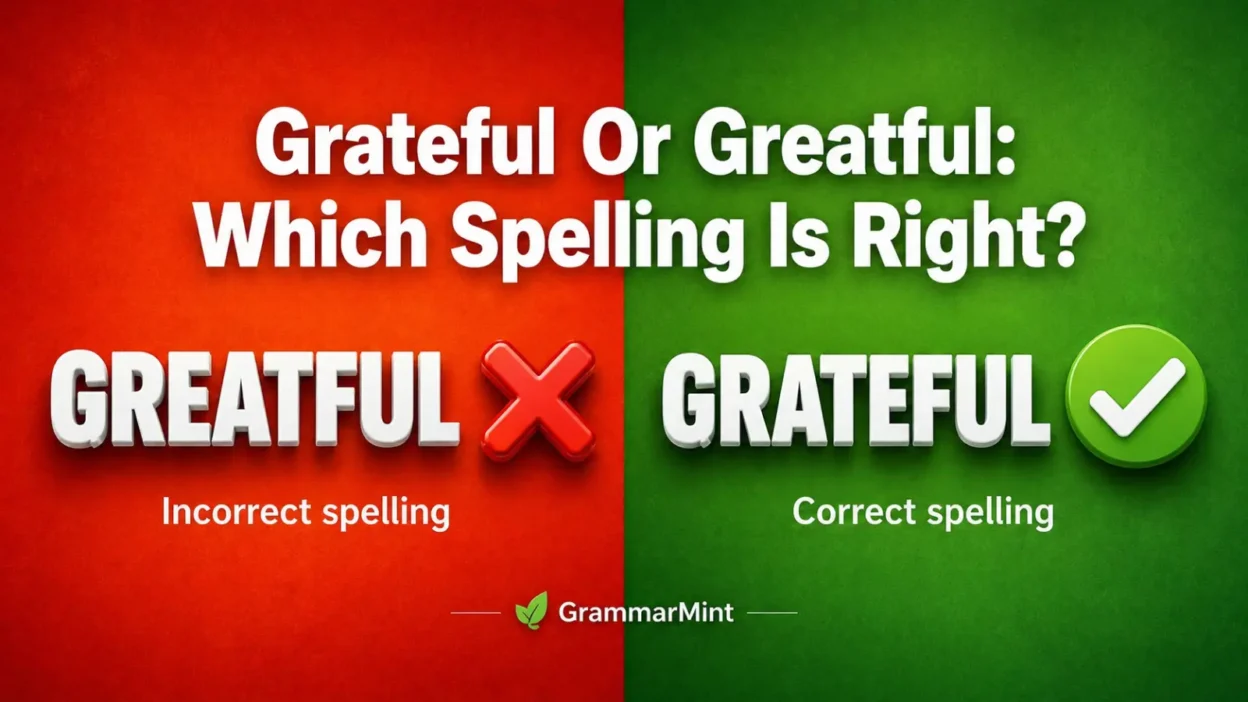
Grateful or greatful: the correct spelling is grateful. Greatful is a misspelling. Use grateful when you mean thankful, appreciative, or full of gratitude.
TL;DR
• Grateful is correct
• Greatful is a spelling error
• Use grateful for thanks
• Common patterns: for, to, that
• Link it to gratitude
• Check phrases before sending
Grateful Or Greatful: The Correct Spelling
If you only need the fast answer, here it is: grateful is right. Greatful is wrong in standard English.
This matters because the wrong spelling can stand out in emails, essays, and thank-you messages.
• Grateful is the correct spelling
• Greatful is a common misspelling
• Use it in school and work writing
• Choose it in cards and emails
• Keep it for captions and posts
• It means thankful or appreciative
• It connects to gratitude
• It does not come from “great”
• Spell-check may miss casual errors
• Proofread short messages carefully
• Writers confuse sound with spelling
• Standard dictionaries support grateful
Which Spelling Is Correct
The easiest rule is simple: if you mean thankful, write grateful. That quick check works almost every time.
Also, this is the form you should use in polished writing.
• Ask yourself, “Do I mean thankful?”
• If yes, write grateful
• Don’t choose greatful by sound
• Follow the proper form every time
• Watch for this common error
• Use the same spelling in titles
• Keep it consistent in body text
• Fix it before sending applications
• Fix it before posting publicly
• Double-check handwritten notes too
• Save the right form in memory
• Good writing starts with accuracy
Why Grateful Is Not Spelled Greatful
This word confuses people because greatful looks like it should work. Still, English built this word from a different family.
That’s why the best spelling clue is not great. It’s gratitude.
• Link grateful to gratitude
• Think about the word origin
• Remember the Latin root idea
• Don’t build it from “great”
• Sound can mislead careful writers
• Spelling history beats spelling guesswork
• The middle letters matter here
• This is a strong memory trick
• Think “gratitude makes me grateful”
• The noun helps confirm the adjective
• Related words protect your spelling
• Etymology explains the strange look
What Grateful Means
Grateful means feeling or showing thanks. It often points to kindness, help, support, or a good result.
In everyday English, it’s close to thankful and appreciative.
• Thankful is a close meaning
• Appreciative also fits many contexts
• It shows real gratitude
• It can describe feelings
• It can describe actions
• It fits sincere thank-you notes
• It works in formal writing
• It sounds natural in speech
• It often follows help received
• It can follow good news
• It can follow relief too
• It shows warm appreciation
Is Greatful A Real Word
In standard edited English, greatful is not accepted as the correct form. Treat it as an error and change it.
So, even if you see it online, don’t copy it.
• Nonstandard forms should be avoided
• It’s usually just a typo
• It isn’t accepted in formal use
• Teachers mark it as wrong
• Editors change it quickly
• Readers may notice the mistake
• It weakens polished writing
• It can distract from your message
• Search results may still show it
• Online posts often contain errors
• Stick with accepted usage
• Replace it with grateful immediately
Grateful Vs Thankful
These words are very close, and people often use them the same way. Still, grateful can sound a bit deeper or more personal in some contexts.
Meanwhile, thankful can feel slightly more direct and everyday.
• Both show similar meaning
• Both work in everyday English
• Tone can shift slightly
• Grateful may feel more heartfelt
• Thankful may feel more direct
• Both fit spoken English well
• Both fit thank-you messages
• Grateful often sounds a bit warmer
• Thankful can sound more immediate
• Many sentences allow either word
• Choose by voice and context
• Don’t overthink small differences
Grateful To, Grateful For, And Grateful That
This is where many learners need the most help. Thankfully, the patterns are easy once you see them clearly.
Use grateful to with a person, grateful for with a thing, and grateful that with a full idea.
• Use a preposition carefully here
• Be grateful to your teacher
• Be grateful for the support
• Be grateful that you’re safe
• Use person after “to”
• Use thing after “for”
• Use clause after “that”
• This sentence pattern is common
• The clause form sounds natural
• Don’t swap all three randomly
• Match the pattern to meaning
• Practice each structure aloud
Grateful In A Sentence
Examples make spelling easier to remember. They also show how the word sounds in natural American English.
Here are short patterns you can copy and adapt.
• I’m grateful for your help
• She felt grateful to be there
• We’re grateful that you stayed
• He was grateful for the chance
• They seemed grateful after dinner
• I’ll always be grateful to you
• She sounded grateful in class
• We felt grateful after the storm
• He wrote a grateful note
• I’m deeply grateful for today
• They were grateful for support
• She looked grateful and relieved
Everyday Examples Of Grateful
This word shows up in real life more than people think. You can use it in messages, school work, work emails, and casual conversation.
So, it helps to see it in familiar situations.
• Use it in an email
• Use it in school writing
• Say it in conversation
• Write, “I’m grateful for your time”
• Write, “We’re grateful for your support”
• Say, “I’m grateful you came”
• Add it to thank-you cards
• Use it in graduation notes
• Use it after job interviews
• Use it in family messages
• Use it in social captions
• Keep the tone sincere
So Grateful Or So Greatful
This phrase appears everywhere in texts and posts. Even so, only one version is correct.
Write so grateful, never so greatful.
• The common phrase is “so grateful”
• “So greatful” is incorrect
• Use the correct form in captions
• It adds strong emphasis naturally
• “So grateful for your help” works
• “So grateful to be here” works
• “So grateful that you stayed” works
• It fits both speech and writing
• It sounds warm and natural
• It works in short posts
• It works in thank-you replies
• Check it before hitting send
Beyond Grateful Meaning
Beyond grateful means extremely thankful. It adds extra emotional force without changing the core meaning.
Because of that, it works best in heartfelt moments.
• It’s an intensifier phrase
• It shows strong emotional tone
• It’s a popular modern phrase
• It means extremely thankful
• It fits life updates well
• It works after big support
• It suits personal milestones
• It sounds warm in captions
• It fits sincere thank-you notes
• Use it when emotion feels bigger
• Don’t overuse it casually
• Save it for meaningful moments
Eternally Grateful Meaning
Eternally grateful means deeply thankful in a lasting way. It often sounds more formal, serious, or emotional.
So, it fits major help, life-changing support, or long-term appreciation.
• It suggests lasting thanks
• It carries a formal tone
• It shows deep appreciation
• It works in serious messages
• It fits memorial language
• It fits major life support
• It can sound poetic
• It may sound too strong daily
• Use it with real feeling
• It suits heartfelt letters
• It works in tribute posts
• Keep the context appropriate
Grateful, Gratefully, Gratitude, And Gratefulness
These words belong to the same family, but they do different jobs in a sentence. Learning them together makes spelling much easier.
That’s why this section is worth remembering.
• Grateful is an adjective
• Gratefully is an adverb
• Gratitude is a noun form
• Gratefulness is also a noun
• Use grateful for a feeling
• Use gratefully for an action
• Use gratitude for the concept
• Use gratefulness less often
• Related words build memory
• Word families improve accuracy
• One root helps you remember
• These are strong related words
Common Mistakes To Avoid
Most people do not struggle with the meaning. Instead, they struggle with speed, habit, and typing.
Because of that, small checks can prevent the error.
• Trust proofreading before posting
• Don’t trust autocorrect completely
• Fix the typo right away
• Don’t copy random online spelling
• Don’t write by sound alone
• Don’t mix it with “great”
• Don’t rush thank-you messages
• Recheck titles and headings
• Recheck social media captions
• Recheck school assignments
• Recheck work communication
• Save a correct sample sentence
Memory Tricks For Spelling Grateful
A quick memory trick can save you every time. The best one is to connect grateful with gratitude.
Once you do that, the wrong spelling usually looks strange.
• Use a simple mnemonic
• Link it to remembering gratitude
• Build a strong word link
• Think: gratitude → grateful
• Ignore the false “great” clue
• Picture the letters “grat”
• Say the pair out loud
• Write both words together once
• Save it in your notes
• Practice with one sentence daily
• Spot the wrong form faster
• Let the noun guide spelling
When To Use Grateful In Writing
Use grateful when you want to show thanks clearly and naturally. It works in both personal and professional writing.
Still, the tone changes slightly based on context.
• Use it in formal writing
• Use it in a thank-you note
• Use it in a short message
• It fits interview follow-ups
• It fits teacher emails
• It fits recommendation replies
• It fits appreciation posts
• It fits speeches and remarks
• It sounds respectful and warm
• It works with simple wording
• It rarely sounds too casual
• It stays useful across settings
FAQs
Which is correct, grateful or greatful?
Grateful is correct. Greatful is a common misspelling and should be avoided in standard English.
Why is grateful not spelled greatful?
Because the word is connected to gratitude, not to great. That link helps explain why the spelling looks less obvious than people expect.
Is greatful a real word?
Not in standard edited English. If you write greatful, it should be corrected to grateful.
How do you use grateful in a sentence?
Use it with common patterns like grateful for, grateful to, and grateful that. For example: “I’m grateful for your help” or “We’re grateful that you stayed.”
What is the difference between grateful and thankful?
They are very close in meaning, and many sentences allow either one. Still, grateful can sound slightly warmer or deeper, while thankful can sound more direct.
Is it so grateful or so greatful?
The correct phrase is so grateful. The version with greatful is incorrect.
Conclusion
If you’re choosing between grateful or greatful, the right answer is simple: use grateful. Keep the link to gratitude in mind, and the correct spelling becomes much easier to remember.