If you’re writing emails, texts, school papers, captions, or work notes, the choice between Lots or Lot’s can trip you up fast. One small apostrophe changes a simple quantity phrase into a possessive form, so this is really a question about plural spelling, ownership, a lot, lots of, quantity phrases, tone, and proofreading. People also mix it up with alot, which makes the mistake even easier to repeat. This guide clears up the rule, shows when lot’s is actually correct, and gives you plain examples you can use in casual writing, formal writing, greetings, and quick final edits.
Quick Answer
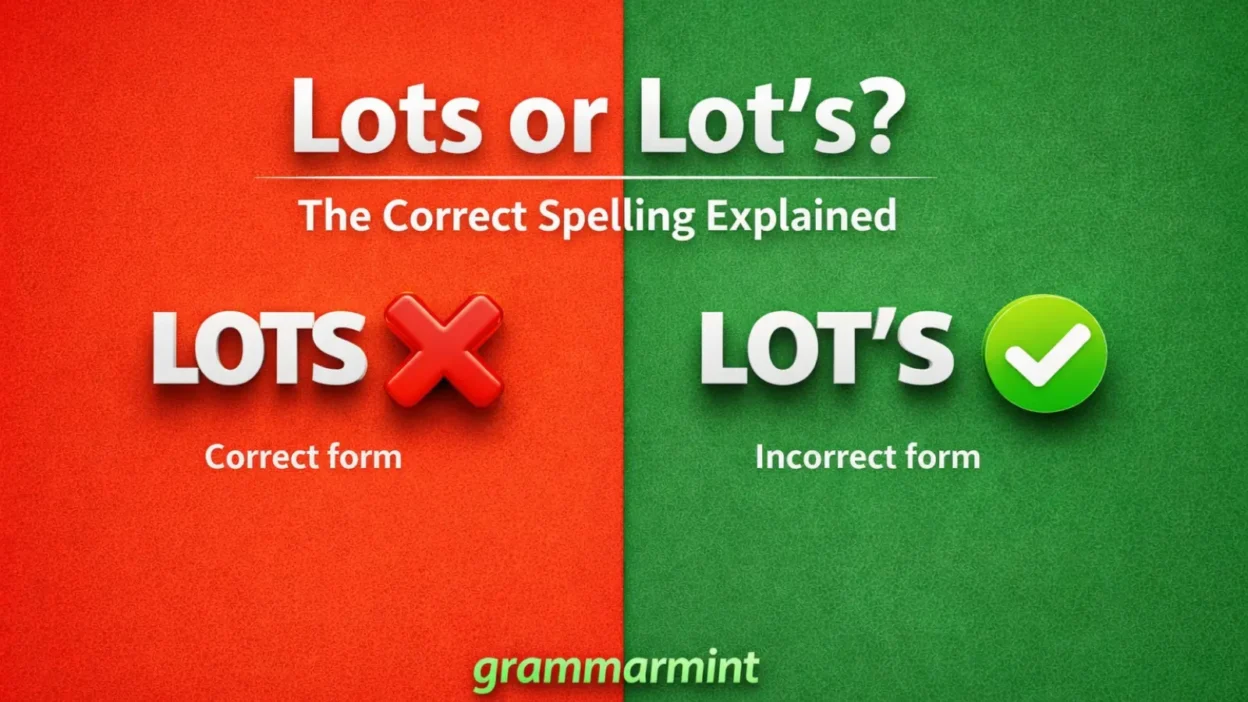
Use lots when you mean many or a large amount. Use lot’s only when something belongs to a single lot, like the lot’s fence or the lot’s owner. For quantity, never write lot’s.
TL;DR
• Lots means many or a large amount.
• Lot’s shows ownership, not quantity.
• A lot is also correct.
• Lots of works with many nouns.
• Formal writing may prefer many or much.
Lots Or Lot’s
Start here, because this is the main choice. In most everyday writing, lots is correct, while lot’s works only for possession.
• Use lots for large amounts.
• Use lot’s only for ownership.
• The apostrophe changes the meaning.
• Most daily writing needs lots.
• Emails almost always want lots.
• Captions usually want lots too.
• Essays should avoid lot’s here.
• Texts often use lots naturally.
• Read the noun after the phrase.
• If it means many, drop apostrophe.
• If it owns something, keep apostrophe.
• This one check fixes most errors.
Lots Of Or Lot’s Of
This is the mistake people type most often. So, if you mean quantity, lots of is the form you want.
• Write lots of before nouns.
• Never write lot’s of for quantity.
• Use it with books and friends.
• Use it with time and money.
• The word after of carries meaning.
• The apostrophe adds false possession.
• That false possession sounds wrong fast.
• Readers notice this typo quickly.
• Teachers mark it as an error.
• Editors remove it on sight.
• Spell it clean in greetings.
• Keep this pair together mentally.
A Lot Or Lots
These two forms are both correct. However, a lot sounds a bit more neutral, while lots sounds more relaxed.
• A lot feels slightly more neutral.
• Lots feels looser and friendlier.
• Both work in casual speech.
• Both express large quantity.
• A lot also works as adverb.
• Lots can stand alone sometimes.
• Choose a lot for balanced tone.
• Choose lots for easy conversation.
• Neither needs an apostrophe.
• Both are common in American English.
• Context decides the better rhythm.
• Read the sentence aloud to choose.
A Lot Of Or Lots Of
These phrases are close in meaning. Still, they differ a little in tone.
• A lot of fits many situations.
• Lots of feels a touch lighter.
• Both pair with plural nouns.
• Both pair with uncountable nouns.
• Both work in questions.
• Both work in negatives.
• A lot of time sounds natural.
• Lots of ideas sounds natural.
• Style matters more than grammar.
• Formal prose may prefer alternatives.
• Don’t force much or many.
• Natural phrasing usually reads better.
What Lot’s Actually Means
Now here is the part many short guides skip. Lot’s can be correct, but only when lot is a singular noun showing ownership.
• Lot’s means something belongs to lot.
• Think of a parking lot’s exit.
• Think of a building lot’s fence.
• Think of the lot’s owner.
• Here apostrophe signals possession.
• The word lot stays singular.
• The owned noun comes after.
• Real estate examples make this clear.
• Auction examples can work too.
• Quantity meaning disappears here.
• This use is correct but rare.
• Most learners need it occasionally.
Plural Vs Possessive
This rule makes the whole topic simpler. A plural shows more than one, while a possessive shows ownership or connection.
• Plural names more than one.
• Possessive shows ownership or connection.
• Lots is the plain plural form.
• Lot’s is the singular possessive form.
• Lots’ would be plural possessive.
• That form is far less common.
• Apostrophes never make regular plurals.
• They only show possession here.
• This rule solves many typos.
• Compare dogs, dog’s, and dogs’.
• Then apply the same pattern here.
• Grammar gets simpler with contrasts.
Apostrophe Rules You Need
Apostrophes look small, but they do big work. Because of that, one mark can change your sentence fast.
• Use apostrophes for ownership, not counting.
• Add ’s to singular nouns.
• Add apostrophe alone to plural s-nouns.
• Avoid random marks in common phrases.
• Don’t trust autocorrect blindly.
• Apostrophe mistakes look careless fast.
• Signs often get this wrong.
• Social posts spread the error.
• Clean punctuation builds trust.
• One tiny mark changes meaning.
• Proofread every final line.
• Especially check short sign-offs.
Countable And Uncountable Nouns
This is where quantifiers matter. Luckily, lots of and a lot of are flexible.
• Countable nouns include books, chairs, emails.
• Uncountable nouns include time, water, advice.
• Lots of works with both types.
• A lot of does too.
• Many fits countable nouns better.
• Much fits uncountable nouns better.
• In casual writing, lots feels easier.
• In formal writing, choose carefully.
• Don’t say much books.
• Don’t say many advice.
• Quantity words must match noun type.
• This prevents awkward sentences.
Is Lots Informal
Yes, lots is informal. But that does not make it wrong.
• Informal English welcomes lots.
• Neutral writing may prefer a lot.
• Speech uses lots very naturally.
• Friendly emails often use lots.
• Personal notes sound warm with lots.
• Academic papers usually choose alternatives.
• Business reports lean more formal.
• Marketing copy may still use lots.
• Tone matters more than strictness.
• Audience should guide your pick.
• Casual brands can sound human.
• Formal documents need tighter wording.
Better Choices For Formal Writing
Sometimes lots of feels too casual. In that case, choose a more formal option that still sounds clear.
• Use many with plural count nouns.
• Use much with singular uncount nouns.
• Try numerous for a polished tone.
• Try significant for measured emphasis.
• Try substantial for weightier phrasing.
• Use a large number of carefully.
• Use a great deal of sparingly.
• Replace vague quantity when precision matters.
• Formal writing likes cleaner structure.
• But natural tone still matters.
• Don’t overcorrect every sentence.
• Pick the simplest accurate option.
Common Phrases With Lots
Fixed phrases matter, because people remember them as chunks. So, natural wording helps your writing sound right right away.
• Lots of love is common and warm.
• Lots of thanks sounds uncommon today.
• Lots to do drops of.
• Lots more works in speech.
• Lots better appears as adverb.
• A lot better is safer.
• Thanks a lot is standard.
• Thanks lots sounds niche.
• Lots of fun feels natural.
• Lots of people is everyday English.
• Lots of money stays informal.
• Common phrases shape reader expectations.
Everyday Examples
Examples make this easier to remember. Notice how quantity and ownership change the spelling.
• We had lots of snacks ready.
• She got a lot of texts.
• I have lots to finish.
• He worries a lot lately.
• The lot’s gate was locked.
• Our team got lots better.
• There were a lot of choices.
• My aunt sent lots of love.
• The parking lot’s lights flickered.
• We spent a lot on travel.
• Lots of rain ruined plans.
• I learned a lot today.
Common Mistakes And Fixes
Now let’s clean up the errors people make most. These are short, but they save a lot of editing later.
• Mistake: lot’s of books. Fix: lots of books.
• Mistake: alot. Fix: a lot.
• Mistake: lots car. Fix: lots of cars.
• Mistake: much friends. Fix: many friends.
• Mistake: many water. Fix: much water.
• Mistake: thanks lots in formal email. Fix: thanks very much.
• Mistake: random apostrophe. Fix: remove it.
• Mistake: stiff report wording. Fix: revise quantity.
• Mistake: unclear owner. Fix: rewrite possessive.
• Mistake: overusing lots. Fix: vary wording.
• Mistake: no final proofread. Fix: scan endings.
• Mistake: trusting spellcheck. Fix: read meaning.
When Lot’s Is Correct
This is the rare but real case. If a single lot owns or relates to something, lot’s is correct.
• Use lot’s before owned nouns.
• The lot’s entrance stayed blocked all day.
• The lot’s survey looked outdated.
• The lot’s corner marker shifted.
• The lot’s dimensions seemed narrow.
• The lot’s drainage needed work.
• The lot’s listing went live.
• The lot’s access road flooded.
• The lot’s value increased slowly.
• The lot’s zoning changed recently.
• The lot’s boundary line mattered.
• The lot’s permit expired yesterday.
Quick Proofreading Tests
When you are unsure, use a fast check. In fact, one question usually solves it.
• Ask, “Does anything belong to lot?”
• If no, delete apostrophe.
• Ask, “Do I mean many?”
• If yes, write lots.
• Ask, “Do I need of?”
• Add it before following nouns.
• Check greetings and sign-offs carefully.
• Scan captions before posting.
• Review email closings twice.
• Compare with the a lot test.
• Read each phrase backward slowly.
• Tiny checks catch easy errors.
Final Usage Patterns To Remember
At this point, the rule is simple. Meaning comes first, and spelling follows meaning.
• Use lots for relaxed quantity.
• Use a lot for relaxed degree.
• Use a lot of before nouns.
• Use lots of before nouns too.
• Use lot’s only for possession.
• Use many in tighter prose.
• Use much with uncounted amounts.
• Skip apostrophes in regular plurals.
• Match the noun and tone.
• Prefer clarity over habit.
• Choose the version readers expect.
• Keep your sentence meaning first.
FAQs
What is the difference between lots and a lot?
Both can express a large amount. However, lots usually sounds more casual, while a lot often sounds a little more neutral.
Is lot’s ever correct?
Yes, but only as a possessive form. It works when something belongs to a single lot, such as the lot’s fence.
Is lots of grammatically correct?
Yes, lots of is a normal English phrase. It works well in everyday writing and speech.
Can I use lots of with uncountable nouns?
Yes, you can say lots of time, lots of water, or lots of money. It also works with plural count nouns like lots of books.
Is lots more informal than a lot?
Usually, yes. Lots often sounds more conversational, while a lot can feel slightly more neutral.
Should I write lot’s of love or lots of love?
Write lots of love. The apostrophe version is wrong when you mean affection in a sign-off.
Conclusion
When you’re choosing between Lots or Lot’s, think about meaning before spelling.
If you mean quantity, use lots. If you mean ownership, use lot’s.
That one habit will keep your writing clean, natural, and easy to trust.