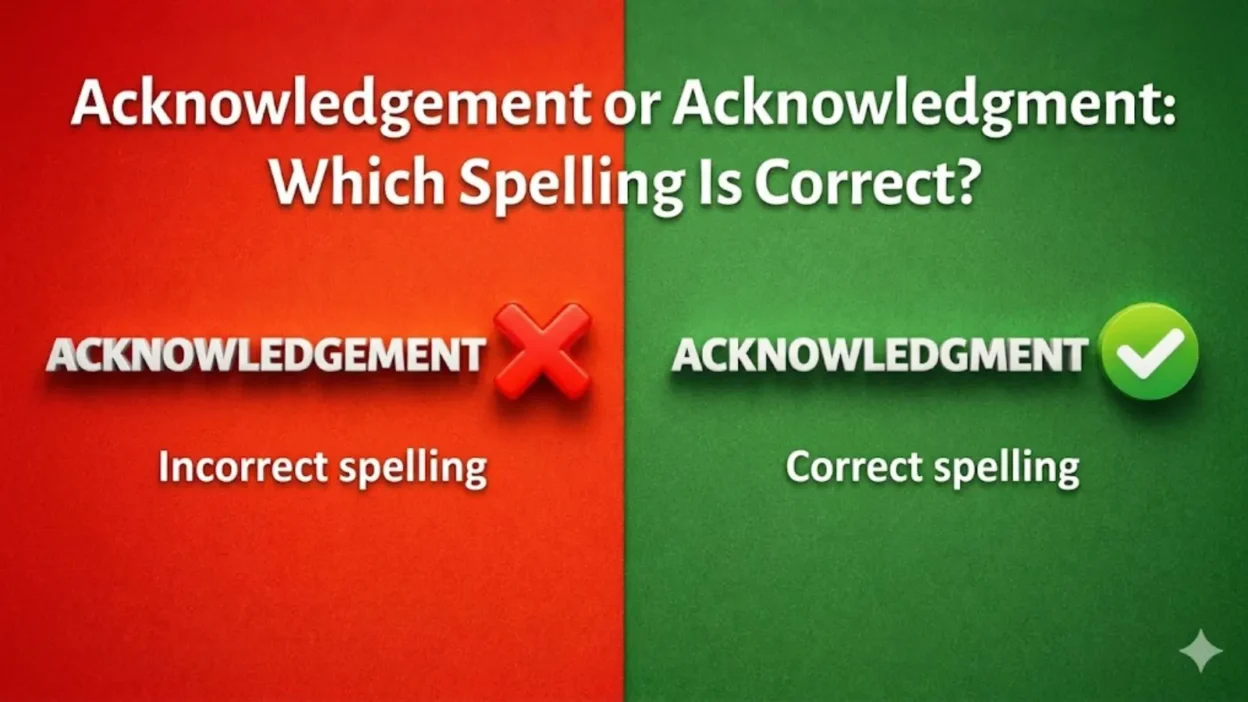
The words acknowledgement and acknowledgment often create hesitation for writers because they look almost identical, yet both appear in real writing. This leads to a common question: which one is correct?
The simple answer is that both spellings are correct. They represent the same word and carry the same meaning. The difference lies mainly in regional usage and writing preference, not in grammar or definition.
In American English, acknowledgment (without the “e”) is more widely used in modern writing. In British English, acknowledgement (with the “e”) is more common, although both forms are still accepted in many contexts.
This guide explains everything you need to confidently choose between the two spellings, including usage rules, real examples, writing contexts, common mistakes, and detailed word breakdowns.
Quick Answer
Both spellings are correct:
- Acknowledgment → More common in American English
- Acknowledgement → More common in British English
They mean the same thing, are pronounced the same way, and function as the same noun.
Why People Confuse Them
The confusion comes from how English handles silent letters when adding suffixes.
In many English words, an “e” is dropped before adding endings like -ment, but not always. This creates pairs like:
- acknowledgment / acknowledgement
- judgment / judgement
- enrollment / enrolment
Because both forms have existed for a long time, writers encounter both in books, emails, legal documents, and online writing.
Another reason for confusion is consistency. Some writers see both versions used in different sources and assume one must be incorrect. In reality, both are accepted depending on style tradition.
Key Differences At A Glance
| Context | Acknowledgement | Acknowledgment | Why |
|---|---|---|---|
| US general writing | Less common | Preferred | Modern American style removes extra “e” |
| UK general writing | Common | Also accepted | British usage keeps traditional spelling |
| Business writing | Acceptable | Very common | US business style favors shorter form |
| Legal documents | Acceptable | Often preferred in US | Formal consistency in US drafting |
| Academic writing | Depends on guide | Depends on guide | Style rules vary by institution |
| Global writing | Acceptable | Acceptable | Consistency matters most |
Are They the Same Word?
Yes, they are the same word with identical meaning.
Both refer to:
- Recognition of something
- Acceptance of truth or existence
- Expression of thanks or credit
- Confirmation of receipt (documents, emails, payments)
They also share the same pronunciation:
- “uh-NAK-nowl-edge-ment” (both spellings sound identical in speech)
There is no difference in grammar or usage meaning. The only difference is spelling tradition.
US vs UK Preference
The main distinction between these two spellings is regional convention.
American English
In American English writing, acknowledgment is the preferred modern form. It is widely used in:
- Business communication
- Legal writing
- Academic papers
- Digital content
- Formal documentation
The shorter spelling aligns with a general pattern in American English where simpler forms are often preferred.
British English
In British English, acknowledgement remains more common in everyday writing. It appears frequently in:
- Newspapers
- Books
- Formal letters
- Institutional writing
However, British English does not reject the shorter form. Both spellings can appear depending on publisher style.
Important takeaway
Neither spelling is incorrect in either region. It is a matter of preference, not grammar rules.
Which Spelling Should You Use?
The best choice depends on your audience.
Use acknowledgment if:
- Your readers are mainly in the United States
- You are writing business or legal documents in American style
- You want modern American consistency
- Your organization follows US English standards
Use acknowledgement if:
- Your audience is primarily in the UK or Commonwealth regions
- You are matching British publishing style
- You are following a UK-based academic guide
- The document already uses British spelling patterns
The golden rule
Do not mix both spellings in the same document. Choose one style and stay consistent throughout.
When One Spelling Looks Wrong
Even though both forms are correct, context can influence perception.
For example:
- In a US corporate report, “acknowledgement” may look outdated or inconsistent.
- In a UK publication, “acknowledgment” may look slightly unusual but not incorrect.
This “feeling of wrongness” is stylistic, not grammatical.
Readers often judge spelling based on familiarity rather than correctness.
Common Mistakes (and Quick Fixes)
Mistake 1: Mixing both spellings
❌ The acknowledgement section includes all acknowledgments
✔ Use one form only: acknowledgment OR acknowledgement
Mistake 2: Thinking one is incorrect
❌ Acknowledgement is wrong in US English
✔ Both are accepted, but acknowledgment is preferred
Mistake 3: Overthinking meaning differences
❌ They have different meanings
✔ They mean exactly the same thing
Mistake 4: Changing spelling mid-document
❌ Using acknowledgement in one paragraph and acknowledgment in another
✔ Choose one and stay consistent
Everyday Examples
Here are real-world examples showing both spellings in natural use.
Acknowledgement (British-style examples)
- The company sent an acknowledgement of receipt within 24 hours.
- Her acknowledgement of the problem helped resolve the issue quickly.
- The book includes a short acknowledgement section.
Acknowledgment (American-style examples)
- We received an acknowledgment of payment from the bank.
- His acknowledgment of responsibility was important in the case.
- The report includes an acknowledgment of contributors.
Both sets are correct and interchangeable in meaning.
Dictionary-Style Word Details
Verb
- Acknowledgement: Not used as a verb.
- Acknowledgment: Not used as a verb.
The related verb is acknowledge, which both forms come from.
Noun
- Acknowledgement: A noun meaning recognition, acceptance, or confirmation.
- Acknowledgment: Same noun with identical meaning.
Both function identically in sentences.
Synonyms
Shared synonyms include:
- recognition
- acceptance
- appreciation
- confirmation
- credit
- notice
Closest plain alternatives:
- response
- thanks
- confirmation note
Antonyms (context-dependent):
- denial
- rejection
- refusal
- disregard
Example Sentences
Acknowledgement
- The acknowledgement arrived shortly after submission.
- Her acknowledgement of the issue was appreciated.
- The report includes an acknowledgement of support staff.
Acknowledgment
- We received an acknowledgment of the application.
- His acknowledgment of the mistake helped the discussion.
- The certificate served as acknowledgment of participation.
Word History
Both spellings come from the verb acknowledge, which combines older English forms meaning “to recognize” or “to admit.”
Over time, two spelling traditions developed:
- British English preserved the extra “e” in many cases
- American English often simplified spelling patterns by removing certain silent letters
As a result, both acknowledgement and acknowledgment became accepted variants of the same word.
Neither form is newer in meaning—they simply reflect different spelling traditions.
Phrases Containing
Common phrases include:
- acknowledgment of receipt
- acknowledgment of responsibility
- acknowledgment section
- written acknowledgment
- formal acknowledgment
- acknowledgment letter
- in acknowledgment of
- public acknowledgment
These phrases are used in legal, academic, and business writing.
Feature Comparison (Extra Table)
| Feature | Acknowledgement | Acknowledgment |
|---|---|---|
| Spelling style | Traditional British form | Modern American form |
| Usage frequency (US) | Lower | Higher |
| Usage frequency (UK) | Higher | Moderate |
| Formal acceptance | Yes | Yes |
| Meaning difference | None | None |
| Pronunciation | Same | Same |
FAQs
1. Is “acknowledgement” or “acknowledgment” correct?
Both are correct spellings of the same word. Neither is wrong. The difference is mainly regional preference.
2. Which spelling is used in American English?
In American English, “acknowledgment” (without the “e”) is more commonly used in most formal writing.
3. Is “acknowledgement” wrong in the US?
No, it is not wrong. It is still understood and sometimes used, but it is less common in modern American writing.
4. What is the difference between acknowledgement and acknowledgment?
There is no difference in meaning or pronunciation. The only difference is spelling preference between regions and style guides.
5. Which spelling is more formal?
Both are equally formal. However, American publications tend to prefer acknowledgment, while British publications often use acknowledgement.
6. Can I use both spellings in the same document?
No. You should choose one spelling style and stay consistent throughout your writing.
7. Why are there two spellings?
Both forms developed historically and continued in different English regions. Over time, American English dropped the “e” in many similar words.
8. Which spelling should I use in academic writing?
It depends on your institution or style guide. Many US-based academic styles prefer acknowledgment, while UK-based guides may prefer acknowledgement.
9. Do both spellings have the same pronunciation?
Yes. Both are pronounced the same way, so the difference only appears in writing.
10. Is one spelling becoming more common worldwide?
In global digital and American-influenced writing, “acknowledgment” appears slightly more often, but both remain widely accepted.
Conclusion
The difference between acknowledgement and acknowledgment is simple: there is no difference in meaning, only in spelling preference.
Both are correct, widely accepted, and used in formal writing. The key is to match your audience and maintain consistency throughout your work.
If you are writing for American readers, acknowledgment is usually the safer choice. If you are writing for British readers, acknowledgement may feel more natural.
Once you understand this, you can use either spelling confidently without second-guessing your writing.