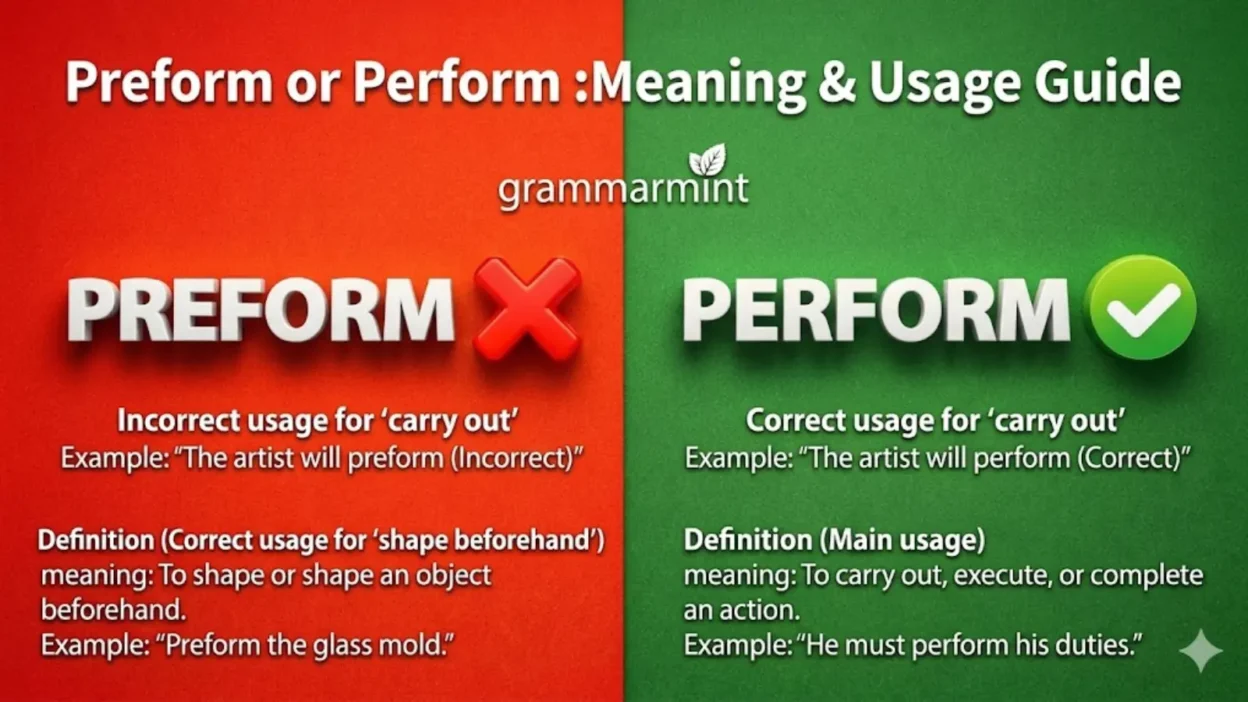
“Preform” and “perform” are two English words that often confuse writers because they look almost identical. The only difference is a single letter, but that small change creates a completely different meaning. One word is widely used in everyday English, while the other is limited to technical and industrial contexts.
The word “perform” is part of daily communication. We use it when talking about actions, responsibilities, entertainment, sports, work tasks, and many other situations where someone does something. It is one of the most flexible and commonly used verbs in modern English.
On the other hand, “preform” is much more specialized. It is not used in normal conversation or general writing. Instead, it appears mainly in manufacturing, engineering, and production-related fields. It refers to shaping or forming something before it reaches its final stage.
The confusion between these two words usually happens because of spelling similarity rather than meaning overlap. Many people accidentally replace one with the other, especially when typing quickly or relying on memory instead of context.
Understanding the difference helps avoid writing mistakes and improves clarity. Once you clearly see when each word belongs, choosing the correct one becomes simple and automatic.
Quick Answer
Use perform for actions, tasks, duties, or activities in everyday English.
Use preform only when talking about shaping or forming materials in advance in technical or manufacturing settings.
Why People Confuse Them
The confusion between “preform” and “perform” happens for a few simple reasons.
First, they look almost identical. Only one letter separates them, which makes them easy to mix up while typing or reading quickly.
Second, they sound very similar when spoken. In fast speech, the difference between “preform” and “perform” is not always clear, especially for learners or non-native speakers.
Third, people often rely on memory instead of meaning. If someone has only seen one of the words before, they may accidentally assume both are the same or interchangeable.
Finally, modern writing tools sometimes auto-correct without explaining meaning, which can reinforce confusion instead of fixing it.
Even though they look and sound close, their usage is completely different. One belongs to general English, while the other belongs to technical language.
Key Differences At A Glance
| Context | Best Choice | Why |
|---|---|---|
| Daily actions, tasks, duties | perform | Standard verb for doing something |
| Work, school, sports, music | perform | Used for executing activities or roles |
| Manufacturing or production shaping | preform | Means shaping material before final use |
| General communication | perform | Natural and widely accepted word |
Meaning and Usage Difference
“Perform” is a general action verb. It describes doing something, carrying out a task, or completing an activity. It is extremely flexible and works in many contexts such as school, work, entertainment, and sports.
For example, a singer performs on stage, a student performs well in exams, and an employee performs job duties. In all these cases, the idea is the same: someone is actively doing something.
“Preform,” however, is much more limited. It is not used for general actions. Instead, it is used in technical industries where materials are shaped before their final stage. For example, in plastic manufacturing, a material may be preformed before it is molded into its final shape.
This makes “preform” a specialized word, while “perform” is a general-purpose word.
Tone, Context, and Formality
Perform
- Works in casual and formal English
- Common in writing, speech, business, education
- Neutral tone suitable for almost all situations
- Example contexts: presentations, exams, instructions, conversations
Preform
- Used in technical or industrial tone
- Found in engineering, manufacturing, and production writing
- Not used in everyday conversation
- Example contexts: factory processes, material shaping, industrial reports
The key difference is audience. “Perform” fits general audiences, while “preform” is for specialists.
Which One Should You Use?
In most cases, the correct choice is perform. It is the standard English verb and works in almost all writing situations.
You should use preform only if you are clearly describing a manufacturing or technical process involving shaping materials before final use.
If you are unsure, “perform” is usually the safe and correct choice.
When One Choice Sounds Wrong
Using the wrong word can make a sentence sound unnatural or incorrect.
For example:
- “She will preform on stage tonight” sounds incorrect because stage activity requires “perform.”
- “The engineer will perform plastic molds” may sound too general if the meaning is about shaping before production.
The key test is simple: if it involves actions, duties, or activities, “perform” is correct. If it involves shaping materials before final processing, “preform” may be correct.
Common Mistakes (and Quick Fixes)
Many errors happen because people focus on spelling instead of meaning.
- Wrong: He will preform in the concert
Correct: He will perform in the concert - Wrong: She preformed her duties at work
Correct: She performed her duties at work - Wrong: The company performs plastic into shape
Correct: The company preforms plastic before molding
Quick fix rule:
If the sentence is about doing something → use perform
If it is about shaping materials → use preform
Everyday Examples
Here are practical examples to make the difference clearer:
- The actor will perform in a new movie.
- She always performs well under pressure.
- The team performed better this season.
- The musician will perform live tonight.
- Students must perform their assignments on time.
- The factory preforms plastic parts before final molding.
- Engineers preform materials before production.
- The company preforms components for industrial use.
- Workers perform safety checks daily.
- The athlete performed exceptionally in the match.
- The material is preformed before heating.
Dictionary-Style Word Details
Verb
- Preform: Rare technical verb meaning to shape something before final use.
- Perform: Common verb meaning to carry out, complete, or execute an action or task.
Noun
- Preform: A partially shaped material used in manufacturing processes.
- Perform: Not commonly used as a noun in standard English usage.
Synonyms
- Preform: shape in advance, pre-shape, prepare (closest plain alternatives)
- Perform: do, carry out, execute, accomplish, fulfill
Antonyms (context-based):
- Perform: neglect, fail, ignore (depending on context)
- Preform: no strong direct antonym in general usage
Example Sentences
- Preform: The factory preforms the plastic before final shaping.
- Preform: Materials are preformed before heating and molding.
- Perform: She performs at concerts across the country.
- Perform: Employees perform tasks according to schedule.
- Perform: The system performs daily checks automatically.
Word History
- Preform: Built from “pre” meaning before and “form” meaning shape. It developed mainly in technical and industrial language.
- Perform: Comes from older roots meaning to carry out fully. It evolved into a general English action verb used in many contexts today.
Phrases Containing
- Preform: preform mold, preform stage, preform material, preform process
- Perform: perform duties, perform well, perform live, perform surgery, perform tasks
FAQs
1. What is the main difference between preform and perform?
“Perform” means to carry out an action or task. “Preform” means to shape something in advance, usually in a technical or manufacturing process.
2. Is preform a correct English word?
Yes, “preform” is a correct word, but it is mostly used in technical fields like engineering or manufacturing.
3. Can I use perform and preform interchangeably?
No. They are not interchangeable because they have different meanings and are used in different contexts.
4. When should I use perform?
Use “perform” when talking about doing tasks, actions, jobs, or activities, such as performing on stage or performing duties at work.
5. When is preform used in real life?
“Preform” is used in industries where materials are shaped before final processing, such as plastic molding or manufacturing production steps.
6. Which word is more common in everyday English?
“Perform” is much more common and used in everyday English writing and speech.
7. What is a simple way to remember the difference?
Think of “perform” as doing something, and “preform” as shaping something before it is finished.
Conclusion
The difference between “preform” and “perform” is clear once you understand their purpose. “Perform” is a general action word used in everyday English for tasks, roles, and activities. “Preform” is a specialized technical term used mainly in manufacturing to describe shaping materials before final processing.
In most writing situations, “perform” is the correct choice. “Preform” only applies in specific industrial contexts. Recognizing this distinction helps avoid common mistakes and improves writing clarity.