The confusion between “puting” and “putting” is very common for English learners and even native speakers in casual writing. At first glance, the two words look almost identical. The only difference is one extra “t.”
But that small difference completely changes whether the word is correct or incorrect in standard English.
In simple terms, “putting” is the correct form used in everyday English, while “puting” is a spelling mistake. This guide explains why that happens, how the correct form works, and how to avoid the error in real writing.
We will break everything down in a clear, practical way so you can confidently choose the right spelling every time.
Quick Answer
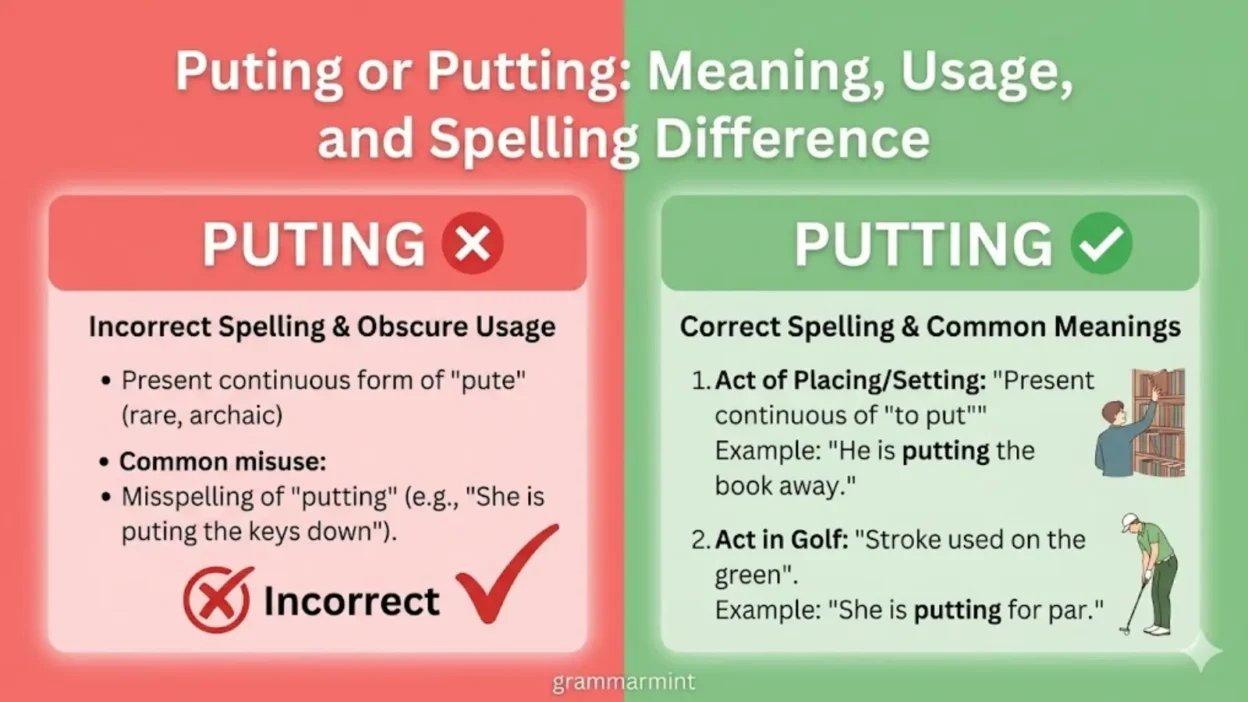
“Putting” is the correct English word.
“Puting” is incorrect and should not be used in standard writing.
Why People Confuse Them
The confusion usually comes from how English verbs change when we add “-ing.”
Most verbs simply add “-ing”:
• go → going
• play → playing
• read → reading
So many learners assume:
• put → puting
But English has spelling rules that change certain verbs before adding “-ing.” “Put” is one of those special cases.
Instead of becoming “puting,” it becomes “putting” with a doubled “t.”
This doubling rule is what creates most of the confusion.
Another reason is fast typing and autocorrect mistakes. People often miss the second “t” because their brain expects a simple pattern.
Key Differences At A Glance
| Feature | Puting | Putting |
|---|---|---|
| Spelling | Incorrect | Correct |
| Grammar status | Not recognized | Standard verb form |
| Usage | Never used in formal English | Used in all contexts |
| Meaning | No accepted meaning | Action of placing or arranging |
Meaning and Usage Difference
The most important thing to understand is this:
The difference is not about meaning—it is about correctness.
“Putting” is the present participle (and gerund form) of the verb “put.” It describes an action happening right now or continuously.
Example idea:
• She is putting the books on the shelf.
“Puting,” on the other hand, is not a valid English word. It does not follow spelling rules and is not accepted in grammar.
So when you see “puting,” it is simply a spelling mistake for “putting.”
Tone, Context, and Formality
“Putting” is used in every type of communication:
• casual speech
• school writing
• professional emails
• instructions and directions
It is neutral in tone and widely accepted.
“Puting” has no accepted tone because it is not a valid form. In formal writing, it is always considered incorrect.
Even in informal texting, it may still be marked as an error by readers or apps.
Which One Should You Use?
Always use: putting
You should use it when describing actions like:
• placing something somewhere
• positioning objects
• applying effort or action
Examples:
• I am putting my phone on silent.
• She is putting the dishes away.
• They are putting effort into the project.
Never use “puting” in any context.
When One Choice Sounds Wrong
“Puting” immediately stands out as incorrect to native English readers.
It looks unfinished because English spelling patterns usually require a doubled consonant in this case.
“Putting” feels natural and smooth in both writing and speech.
If you see “puting,” it will almost always be flagged as a spelling mistake in any formal or informal setting.
Common Mistakes (and Quick Fixes)
Here are the most common errors learners make:
Mistake 1
❌ I am puting my shoes on.
✔ I am putting my shoes on.
Mistake 2
❌ She is puting her bag away.
✔ She is putting her bag away.
Mistake 3
❌ They are puting the chairs in place.
✔ They are putting the chairs in place.
Quick Fix Rule
If the verb is “put,” remember this:
👉 Double the “t” before adding “-ing”
put → putting
Everyday Examples
Here are natural, real-life uses of the correct form:
• I am putting groceries in the fridge.
• He is putting his phone in his pocket.
• We are putting decorations up for the party.
• She is putting her name on the list.
• They are putting extra effort into practice.
• I was putting the books back on the shelf.
• You are putting too much pressure on yourself.
These examples show how common the word “putting” is in everyday English.
Feature Comparison (Extra Table)
| Feature | Puting | Putting |
|---|---|---|
| Grammar validity | Not valid | Fully valid |
| Reader perception | Mistake | Correct usage |
| Writing safety | Avoid completely | Safe in all writing |
Dictionary-Style Word Details
Verb
• Puting: Not recognized as a verb form in standard English.
• Putting: Present participle and gerund of “put,” meaning to place, set, or position something.
Noun
• Puting: Not used as a noun.
• Putting: Can function as a noun in specific contexts, especially sports (like golf), meaning the act of making short, controlled strokes toward a target.
Synonyms
• Puting: No valid synonyms (not a standard word).
• Putting: placing, setting, positioning, arranging, inserting, installing (closest plain alternatives depending on context)
Example Sentences
• Puting: Not correct in standard English usage.
• Putting: She is putting the final touches on her presentation.
Additional examples:
• He is putting the keys on the table.
• They are putting the plan into action.
Word History
• Puting: No recognized historical development because it is a spelling error.
• Putting: Comes from Old English “putian,” which evolved into the modern verb “put.” The “-ing” form follows standard English grammar rules that often double consonants for short vowel verbs.
Phrases Containing
• Puting: No standard phrases exist.
• Putting: putting up with, putting on, putting together, putting away, putting in, putting off, putting forward, putting out
These phrases are widely used in everyday English and professional communication.
FAQs
1. Is “puting” ever correct in English, or is it always wrong?
“Puting” is always considered incorrect in standard English. It does not follow English spelling rules for verb forms. The correct form is “putting,” which is used as the -ing form of the verb “put.” If you write “puting” in school, work, or formal writing, it will be marked as a spelling mistake. There is no accepted situation where “puting” is the right choice.
2. Why does “put” become “putting” instead of “puting”?
“Put” is a short verb that follows a spelling rule in English where the final consonant is doubled before adding “-ing.” This helps keep the pronunciation clear and consistent. So instead of “puting,” English doubles the “t” to form “putting.” This is the standard pattern used in many similar verbs like “run → running” or “sit → sitting.”
3. What is the meaning of “putting” in everyday English?
“Putting” means placing, positioning, or moving something into a specific place. It can describe physical actions like putting a book on a table or abstract actions like putting effort into work. It is also used in continuous actions, such as “She is putting her ideas together.” In short, it refers to the act of placing or arranging something.
4. Why do so many people misspell “putting” as “puting”?
Most people misspell “putting” as “puting” because they assume all English verbs simply add “-ing” without changes. Since “put” is a short word, learners often forget the doubling rule. Fast typing, autocorrect issues, and lack of awareness about consonant doubling also contribute to this common mistake.
5. Is there any difference in meaning between “puting” and “putting”?
No, there is no difference in meaning because “puting” does not have a recognized meaning in English. It is simply a spelling error. The only valid and meaningful form is “putting,” which carries all standard meanings related to placing or arranging something.
6. How can I easily remember the correct spelling of “putting”?
A simple way to remember is this rule: short verbs ending in a single consonant usually double the last letter before adding “-ing.” So “put” becomes “putting.” You can also think of it as “put + t + ing = putting.” Repeating correct examples in sentences can also help fix the spelling in memory.
7. Is “putting” used in formal writing and professional English?
Yes, “putting” is widely used in all types of English, including formal writing, academic work, business communication, and everyday speech. It is a standard verb form and is completely acceptable in professional contexts. It is one of the most common verb forms in English.
8. Can “putting” be used as a noun, or is it only a verb form?
“Putting” is mainly used as a verb form, but it can also work as a noun in certain contexts. For example, in golf, “putting” refers to the act of making short strokes on the green to sink the ball. Outside of sports, it is mostly used as a verb form in continuous sentences.
9. What are some common phrases that use “putting”?
There are many everyday phrases that use “putting,” such as “putting up with,” “putting together,” “putting on,” “putting away,” and “putting in effort.” These phrases are very common in spoken and written English and often express actions, effort, or arrangement of things.
10. What happens if I use “puting” in writing or exams?
If you use “puting” in writing, exams, or professional communication, it will be marked as a spelling error. Most teachers, editors, and writing tools will correct it to “putting.” While the meaning may still be understood, it is considered incorrect English and can affect writing accuracy scores or grades.
Conclusion
The difference between “puting” and “putting” is simple but important.
“Putting” is the correct and standard English form used in all contexts. “Puting” is a spelling mistake that happens when the second “t” is accidentally dropped.
Once you remember the rule—double the “t” before adding “-ing”—you will avoid this error completely.
Clear writing always depends on small details, and this is one of the easiest fixes in English spelling.