“Therefore” and “therefor” are two words that look almost identical but behave very differently in English.
Most people assume the extra “e” is just a spelling variation. That’s not true.
These two words have separate meanings and are used in different contexts. One is common in everyday writing. The other appears mostly in formal, legal, or technical language.
Understanding the difference helps you avoid confusion in writing, especially in academic, business, or professional settings.
Quick Answer
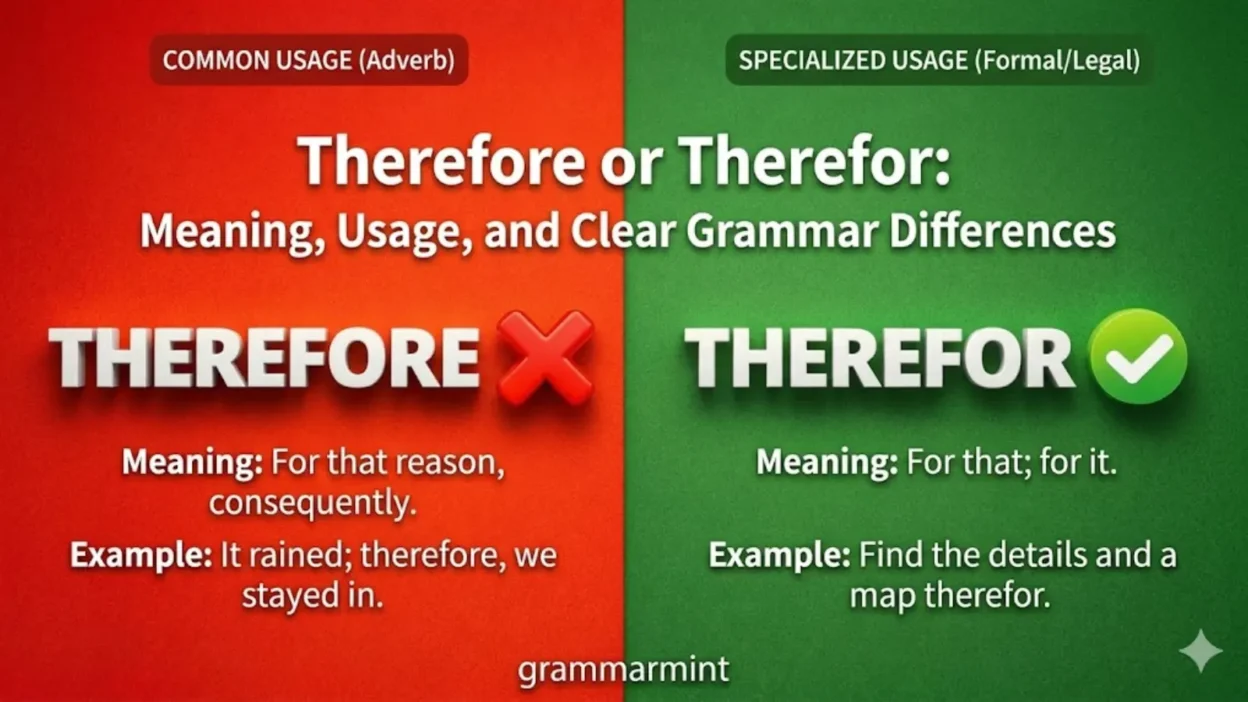
Use therefore when you mean a result or conclusion, like “for that reason.”
Use therefor when you mean “for that thing” or “for that purpose,” usually in formal or legal writing.
In modern English, therefore is far more common and widely accepted.
Why People Confuse Them
The confusion happens for three main reasons:
First, the words look almost identical. Only one letter separates them.
Second, both come from older English structures where “there-” words were used differently to connect ideas or refer to things.
Third, most modern speakers rarely see “therefor,” so they assume it is either a typo or an outdated spelling of “therefore.”
But they are not interchangeable.
They developed different grammatical roles over time, and that difference still exists today.
Key Differences At A Glance
| Context | Best Choice | Why |
|---|---|---|
| Showing cause and result | Therefore | Means “for that reason” |
| Referring to something provided | Therefor | Means “for that purpose” |
| Everyday communication | Therefore | Standard modern usage |
| Legal/contract writing | Therefor | Traditional formal term |
| Academic writing | Therefore | Clear logical connector |
Meaning and Usage Difference
Therefore
“Therefore” is a logical connector.
- It was late, therefore we left early.
- He didn’t study, therefore he failed the test.
- The store was closed, therefore we went home.
It works like a bridge between two ideas.
Therefor
“Therefor” refers to something given, done, or intended “for that thing.”
It is not used to show reasoning or results.
- He was paid and gave services therefor.
- The contract specifies compensation therefor.
It is mostly seen in legal writing, contracts, or formal documents where precise wording matters.
Core distinction
- therefore = logical result
- therefor = reference to something specific or exchanged
Tone, Context, and Formality
Therefore
- Common in modern English
- Used in essays, emails, reports
- Clear and natural in speech and writing
- Works in both formal and informal contexts
Therefor
- Rare in everyday English
- Appears in legal, contractual, or historical writing
- Feels outdated in modern conversation
- Used for precision in legal meaning
Which One Should You Use?
In almost all writing situations, choose therefore.
It is the standard word for showing results or conclusions.
Use therefor only when:
- You are reading or writing legal documents
- The meaning specifically refers to “for that thing” or exchange
- The style requires formal legal phrasing
If you are unsure, “therefore” is the safe and correct choice.
When One Choice Sounds Wrong
Using these words incorrectly can change meaning or sound unnatural.
Wrong use of “therefor” in modern writing
- ❌ I was tired, therefor I went home.
- ✔ I was tired, therefore I went home.
Wrong use of “therefore” in legal meaning
- ❌ He received goods therefore payment.
- ✔ He received goods therefor payment.
In most everyday writing, “therefor” will feel incorrect.
Common Mistakes (and Quick Fixes)
Mistake 1: Thinking they are spelling variants
They are not. They are different words with different meanings.
Mistake 2: Using “therefor” in casual writing
Fix: Replace it with “therefore” unless legal context requires it.
Mistake 3: Overusing “therefore” in informal speech
Fix: You can often replace it with “so” in casual conversation.
- It was late, therefore we left.
- It was late, so we left.
Everyday Examples
Therefore in real use
- The weather was bad, therefore the event was canceled.
- She missed the bus, therefore she was late to school.
- The system failed, therefore the data was lost.
- He didn’t respond, therefore we moved on.
Therefor in formal use
- Payment was made and services rendered therefor.
- The agreement includes compensation therefor.
- Goods were delivered and receipt issued therefor.
You can see the difference clearly:
one connects ideas, the other refers to something specific.
Dictionary-Style Word Details
Verb
- Therefore: Not used as a verb in standard English.
- Therefor: Not used as a verb.
Both words function outside verb usage in modern English.
Noun
- Therefore: Not used as a noun. It functions as an adverb or conjunctive adverb.
- Therefor: Not used as a noun. It functions in legal-style adverbial reference.
Synonyms
Therefore:
- consequently
- thus
- so
- hence
- as a result
Therefor (closest plain alternatives):
- for that
- for it
- in exchange for that
- for that purpose (contextual explanation, not direct synonym)
Example Sentences
Therefore:
- The road was blocked; therefore, we took another route.
- He forgot his wallet; therefore, he couldn’t pay.
- The system crashed; therefore, the file was lost.
Therefor:
- The contractor was paid and completed work therefor.
- The goods were shipped and payment issued therefor.
Word History
Both words come from older English structures using “there-” forms.
Therefore developed to mean “for that reason,” combining “there” and “fore” in older English usage patterns.
Therefor developed in legal and formal writing to mean “for that thing,” often used in exchange or reference contexts.
Over time, “therefore” remained common in everyday English, while “therefor” stayed mostly in legal language.
Phrases Containing
Therefore:
- and therefore
- therefore clause
- therefore statement
- therefore reasoned argument
Therefor:
- payment therefor
- compensation therefor
- services therefor
- consideration therefor
These phrases highlight how differently each word behaves in context.
FAQs
1. What is the main difference between therefore and therefor?
Therefore means “for that reason” and is used to show a result.
Therefor means “for that thing” and is mostly used in formal or legal writing.
2. Is “therefor” still used in modern English?
Yes, but very rarely. You’ll mostly see therefor in legal contracts or formal documents. In everyday English, it is almost always replaced by therefore.
3. Can I use therefore and therefor interchangeably?
No. They are not interchangeable.
Using one in place of the other can change the meaning of the sentence.
4. Which one is more common in writing today?
Therefore is far more common and is the standard choice in modern English writing, including essays, emails, and articles.
5. Why does “therefor” exist if “therefore” is more common?
“Therefor” comes from older legal and formal English usage. It survived in legal language because it has a specific meaning related to “for that thing.”
6. Is “therefore” formal or informal?
“Therefore” is neutral. It works in both formal writing (academic, professional) and informal writing (messages, everyday speech).
7. What’s an easy way to remember the difference?
Think of it this way:
- Therefore = result (for that reason)
- Therefor = purpose or thing (for that thing)
8. Can I replace “therefore” with “so”?
Yes, in casual English.
Example:
- It was late, therefore we left.
- It was late, so we left.
But “therefore” sounds more formal and structured.
9. Where will I usually see “therefor”?
You’ll mostly see it in:
- legal contracts
- official agreements
- old formal documents
10. Is it wrong to use “therefor” in everyday writing?
It’s not grammatically “wrong,” but it will look unusual or incorrect in modern casual writing. Most readers expect therefore instead.
Conclusion
“Therefore” and “therefor” are closely related in appearance but very different in meaning and usage.
One is part of everyday English and shows cause and effect. The other is a formal legal-style term used to refer to something given or exchanged.
If you remember only one rule, make it this:
Use “therefore” for results. Use “therefor” only for formal or legal references.
For modern writing, “therefore” is almost always the correct and natural choice.