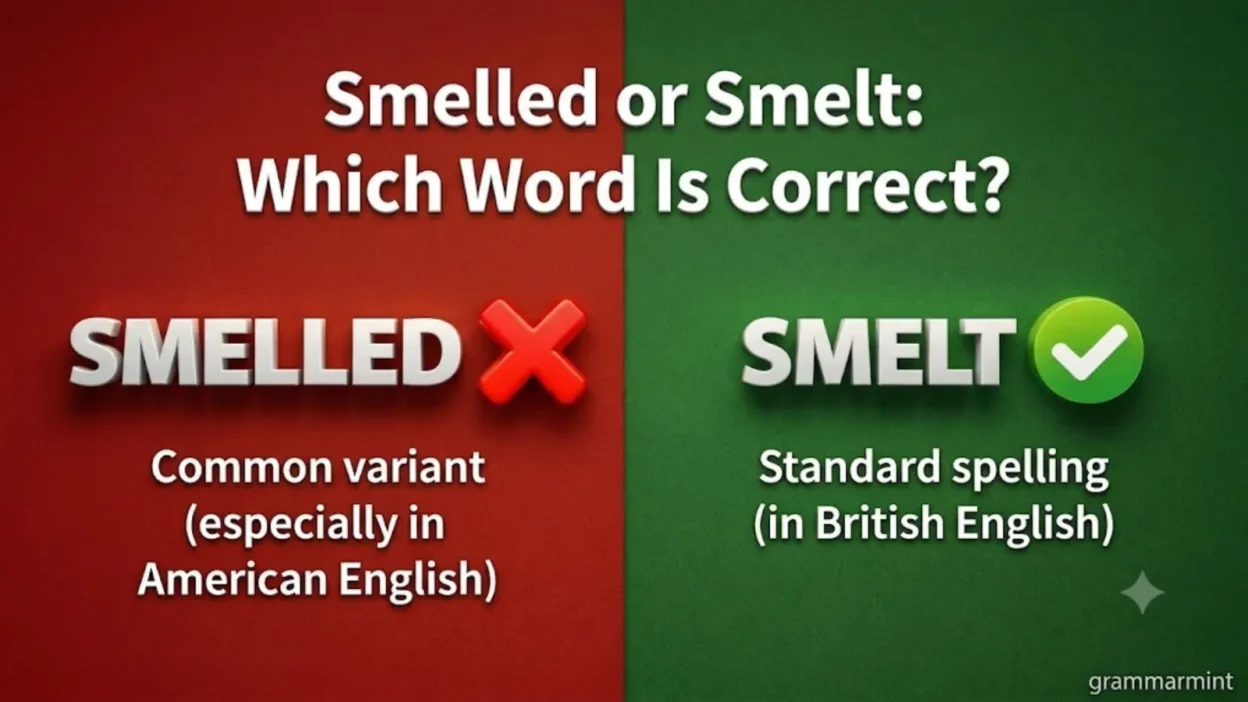
Smelled and smelt are easy to mix up because both can be connected to the verb smell.
For a US audience, the safest choice is usually smelled. It is the standard past tense and past participle of smell in American English.
Smelt is not just a “wrong spelling,” though. It can be used as a past form of smell in British English. It also has other meanings in standard English: a smelt can be a small fish, and to smelt means to heat ore to get metal from it.
So the right choice depends on what you mean and who your audience is.
Quick Answer
Use smelled when you mean “noticed an odor” or “gave off an odor” in American English.
Correct: I smelled smoke in the hallway.
Correct: The kitchen smelled like garlic.
Correct: The towels smelled clean after washing.
Use smelt mainly if you are writing British English, talking about a small fish, or using the metalworking verb.
Correct in British English: The room smelt damp.
Correct as a noun: We ordered fried smelt.
Correct as a metal verb: The workers smelt iron ore.
For most US writing, choose smelled.
Why People Confuse Them
People confuse smelled and smelt because English has several verbs with both -ed and -t past forms.
You may see pairs like learned and learnt, burned and burnt, or dreamed and dreamt. In some English varieties, both forms still appear. Smelled and smelt follow a similar pattern.
The confusion grows because smelt has more than one job. It can be a British past form of smell, but it can also be a noun for a fish or a verb about metal.
That means this sentence may sound odd to US readers:
The candle smelt sweet.
A British reader may find it normal. A US reader may pause because smelt often suggests fish or metal before it suggests smelling.
Key Differences At A Glance
| Context | Best Choice | Why |
|---|---|---|
| US English past tense of smell | smelled | Standard and natural in American writing |
| British English past tense of smell | smelled or smelt | Both are used |
| Formal US writing | smelled | Clearest and safest choice |
| Talking about a small fish | smelt | Smelt is the noun |
| Talking about extracting metal | smelt | Smelt is the base verb |
| Past tense of the metal verb smelt | smelted | Not smelled or smelt |
| Global audience | smelled | More widely understood |
Meaning and Usage Difference
Smelled means “noticed an odor,” “tested something by scent,” or “gave off an odor.”
Examples:
I smelled coffee before I reached the kitchen.
The basement smelled musty after the storm.
She smelled the milk before pouring it.
Smelt can mean the same thing in British English:
The basement smelt musty after the storm.
In US English, that sentence is understandable, but it may sound foreign, old-fashioned, or unusual.
Smelt also has meanings that smelled does not have.
A smelt is a small fish:
The restaurant served fried smelt.
To smelt means to heat and melt ore to separate metal:
The factory smelts copper ore.
The past tense of that metal verb is smelted:
The ore was smelted at a high temperature.
That is an important difference. Smelt can be related to smelling, fish, or metal. Smelled is only connected to smell.
Tone, Context, and Formality
Smelled is neutral in American English. It works in casual speech, school writing, business writing, journalism, fiction, and formal documents.
Smelt as the past tense of smell has a British feel. It is not usually the best choice for a US audience unless you are quoting British speech, writing a British character, or following a British style.
Compare:
US: The room smelled like fresh paint.
British: The room smelt like fresh paint.
Neither sentence is hard to understand. The difference is audience expectation.
Smelt as a fish or metal word is not British-only. Those meanings are standard in American English too.
Pronunciation can also help. Smelled sounds like “smeld.” Smelt rhymes with “felt.” The sound difference is small but clear.
Which One Should You Use?
For US readers, use smelled when you are talking about scent.
Choose smelled in sentences like these:
I smelled rain before the storm started.
The dog smelled another dog near the fence.
Her sweater smelled like lavender.
Use smelt only when you mean the fish or the metal process:
We caught smelt near the lake.
The company smelts aluminum.
The ore was smelted before shipping.
Use smelt as the past tense of smell only when British English fits your sentence.
Compact comparison:
- Smelled: best for US past tense and past participle of smell.
- Smelt: British past form of smell; also a fish; also a metalworking verb.
- Smelted: past tense and past participle of the metalworking verb smelt.
When One Choice Sounds Wrong
Smelt can sound wrong to American readers when the sentence is clearly about scent.
Awkward for US readers: I smelt cookies baking.
Natural in US English: I smelled cookies baking.
Smelled sounds wrong when you mean the fish.
Wrong: We ordered smelled for dinner.
Correct: We ordered smelt for dinner.
Smelled also sounds wrong when you mean metal extraction.
Wrong: The workers smelled iron ore.
Correct: The workers smelt iron ore.
Correct past tense: The workers smelted iron ore.
The sentence “The workers smelled iron ore” could be grammatical, but it means they noticed the odor of iron ore. It does not mean they processed it.
Common Mistakes (and Quick Fixes)
Mistake: Using smelt for US past tense of smell in ordinary writing.
Fix: Use smelled.
Less natural in US English: The hallway smelt like smoke.
Better: The hallway smelled like smoke.
Mistake: Using smelled for the fish.
Fix: Use smelt.
Wrong: The lake is known for smelled.
Correct: The lake is known for smelt.
Mistake: Using smelt as the past tense of the metal verb.
Fix: Use smelted.
Wrong: The ore was smelt last week.
Correct: The ore was smelted last week.
Mistake: Thinking smelt is always wrong.
Fix: Remember that smelt is valid in the right context.
Correct: The restaurant served smelt.
Correct: The plant smelts ore.
British English: The room smelt damp.
Everyday Examples
Smelled in US English:
I smelled popcorn as soon as I walked into the theater.
The laundry smelled fresh after drying outside.
He smelled gas and called the building manager.
The car smelled like wet dog after the trip.
She smelled the candle before buying it.
Smelt as British past tense:
The kitchen smelt of onions.
His jacket smelt like campfire smoke.
The old books smelt musty.
Smelt as a noun:
My uncle fried smelt for dinner.
The bait shop had frozen smelt.
Smelt are small, silvery fish.
Smelt as a metal verb:
The company smelts ore near the port.
You need intense heat to smelt metal from rock.
The copper was smelted before it was shaped.
Dictionary-Style Word Details
Verb
Smelled: A past tense and past participle form of smell. It means noticed an odor, tested something by scent, or gave off an odor.
Example: The room smelled clean.
Smelt: A chiefly British past tense and past participle form of smell. It can also be a separate present-tense verb meaning to heat ore to get metal from it.
Example as British past form: The room smelt clean.
Example as metal verb: They smelt ore in the furnace.
Important: The past tense of the metal verb smelt is smelted.
Noun
Smelled: Not commonly used as a noun in standard English. Use smell for the noun.
Correct: The smell of coffee filled the room.
Smelt: A noun meaning a small fish, often used for certain small silvery fish.
Correct: We had fried smelt with lemon.
Synonyms
Smelled: Closest plain alternatives include sniffed, detected, noticed, sensed, or gave off an odor. The best choice depends on the sentence.
Example: I smelled smoke.
Alternative: I detected smoke.
Smelt: When used as a British past form of smell, its closest plain alternatives are the same as smelled. When used as a metal verb, closest alternatives include melt, refine, or extract, but those are not exact in every sentence. When used as a noun, it names a fish and does not need a synonym in most writing.
Clear antonyms are limited. For smelled as “detected an odor,” a practical opposite may be missed or failed to notice, but that is a phrase, not a single exact antonym.
Example Sentences
Smelled:
The baby smelled like lotion after her bath.
I smelled something burning in the kitchen.
The gym bag smelled awful after practice.
She had smelled that perfume before.
Smelt:
British English: The cottage smelt of pine and rain.
Noun: We saw smelt swimming near the shore.
Metal verb: The plant smelts iron ore.
Metal verb past tense: The ore was smelted yesterday.
Word History
Smelled comes from the verb smell with the regular -ed ending. In modern American English, it is the normal past tense and past participle form.
Smelt as a past form of smell reflects an older -t past-tense pattern that still appears in some English verbs. That form remains more familiar in British English than in American English.
Smelt as a fish name and smelt as a metalworking verb are separate meanings. Their histories are not the same as the everyday past-tense choice between smelled and smelt, so it is safest not to treat all uses of smelt as one single meaning.
Phrases Containing
Smelled:
smelled like
smelled of
smelled bad
smelled good
smelled smoke
smelled trouble
have smelled
had smelled
Smelt:
smelt like
smelt of
smelt a rat
fried smelt
rainbow smelt
to smelt ore
smelt iron
smelted metal
For US readers, phrases with smelled will usually sound more natural when scent is the meaning.
Conclusion
Smelled or smelt is mostly a question of audience and meaning.
Use smelled for the past tense and past participle of smell in American English. It is the clearest and most natural choice for US readers.
Use smelt if you are writing British English, naming the fish, or using the metalworking verb. Just remember that the metal verb uses smelted in the past tense.